
Tracking an Errant Space Rocket to a Mysterious Crater on the Moon
A new study shows how a team at the University of Arizona's Space4 Center tracked down a contested piece of space junk that crashed onto the moon and provides an explanation for why it left not one but two craters.Tracking an Errant Space Rocket to a Mysterious Crater on the Moon

By Daniel Stolte, University Communications - November 16, 2023
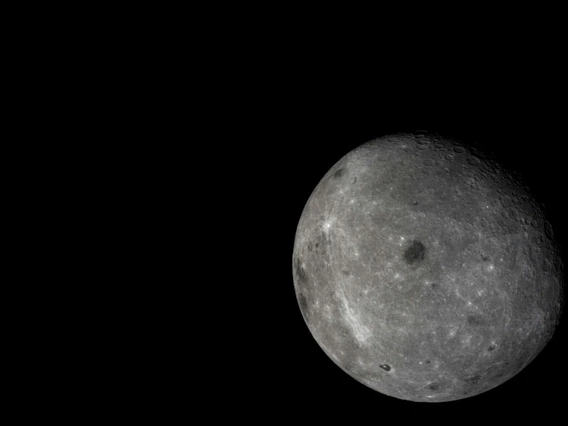
In March 2022, a defunct part of a space rocket hurled toward the moon's surface and impacted near the Hertzsprung Crater, an enormous impact feature on the far side of the moon that is never directly visible from Earth. Curiously, and unlike any other space hardware that ended up on the moon's surface, this one left behind not one but two craters, causing speculation about what exactly it was that found its final resting place on the moon's surface, according to Tanner Campbell, a doctoral student at the University of Arizona Department of Aerospace and Mechanical Engineering in the College of Engineering and the study's first author.
In a paper published in the Planetary Science Journal, a team of researchers at UArizona provides the definitive proof that the object was a booster from a Chinese space rocket that had spent several years tumbling through space. The study also found that the abandoned rocket stage likely carried an undisclosed, additional payload.
The moon is no stranger to what one could call high-tech littering – the remains of spacecraft slamming into the moon after they have ended their journeys through space. Several rocket boosters from NASA's Apollo missions are just a few examples of space hardware that future astronauts might stumble on while exploring the cold, quiet and airless lunar landscape.
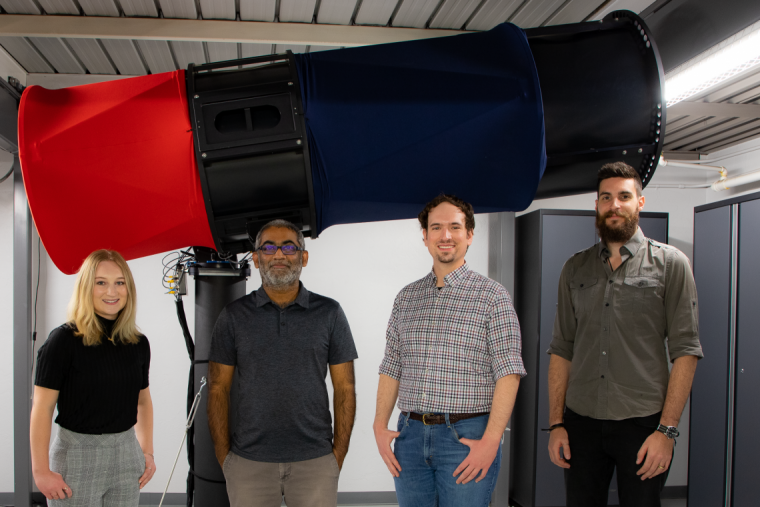
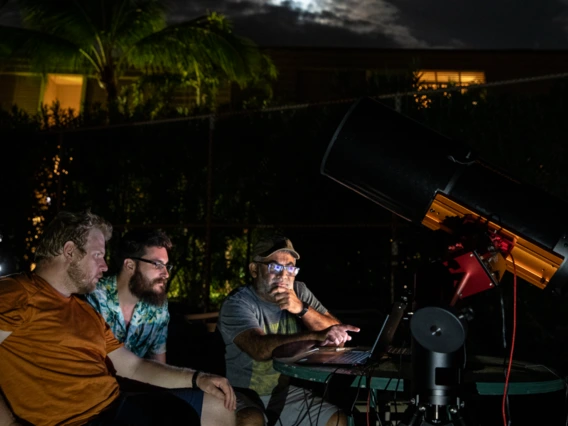
The UArizona Space Domain Awareness team - including Grace Halferty, Vishnu Reddy, Adam Battle and Tanner Campbell, all co-authors on the study - stand in front of the RAPTORS-1 telescope they used for the spectral observations of the errant rocket booster. Vishnu Reddy
Seven years prior, researchers at the UArizona-led Catalina Sky Survey, one of the world's leading programs tasked with detecting and studying asteroids that could pose a hazard to Earth, discovered an object as it moved at a brisk pace between Earth and the moon. They assigned it the designation WE0913A, but its identity was unknown.
Based on its path through the sky, WE0913A was initially thought to be an errant SpaceX Falcon 9 rocket booster from a 2015 launch, with a trajectory that put it on a path to hit the moon. Initial observations with the Raptor Telescope, which was built by the student team, and spectral analysis soon tracked the precise light signals bouncing off the object's surface.
They concluded that WE0913A's light reflection signature and the way it moved through space made it more likely to be a booster from a Chang'e 5-T1, a rocket launched in 2014 as part of the Chinese space agency's lunar exploration program. While the Chinese space agency claimed the rocket booster burned up in Earth's atmosphere upon re-entry, the U.S. Space Command confirmed the rocket's third stage never re-entered the Earth's atmosphere.
Designed as a dry run for a mission to bring a sample of lunar soil back to Earth, the Chang'e 5-T1 was an experimental, robotic spacecraft riding atop of a Long March 3C rocket. The third and uppermost stage of that rocket is the object that was later identified as object WE0913A by the Catalina Sky Survey. The booster provided the thrust that propelled the payloads toward an orbit around the moon. Once spent, it jettisoned the orbiting module and sample return capsule and was then left to its own devices, a typical procedure for rocket boosters after they have fulfilled their duty.
While the rocket booster is too small to be resolved even by a high-powered telescope, the observations yielded a characteristic light curve of brightening and dimming, caused by its rotation.
"As the object is spinning, we see variations in the right light it reflects as the visible surface area is changing," said Vishnu Reddy, a professor of planetary science at the UArizona Lunar and Planetary Laboratory and the director of Space4 Center. Reddy is one of the paper's co-authors and Campbell’s co-adviser. "When the broad side of the rocket is pointed at you, you get more light, and as it turns, you get less light from that side."
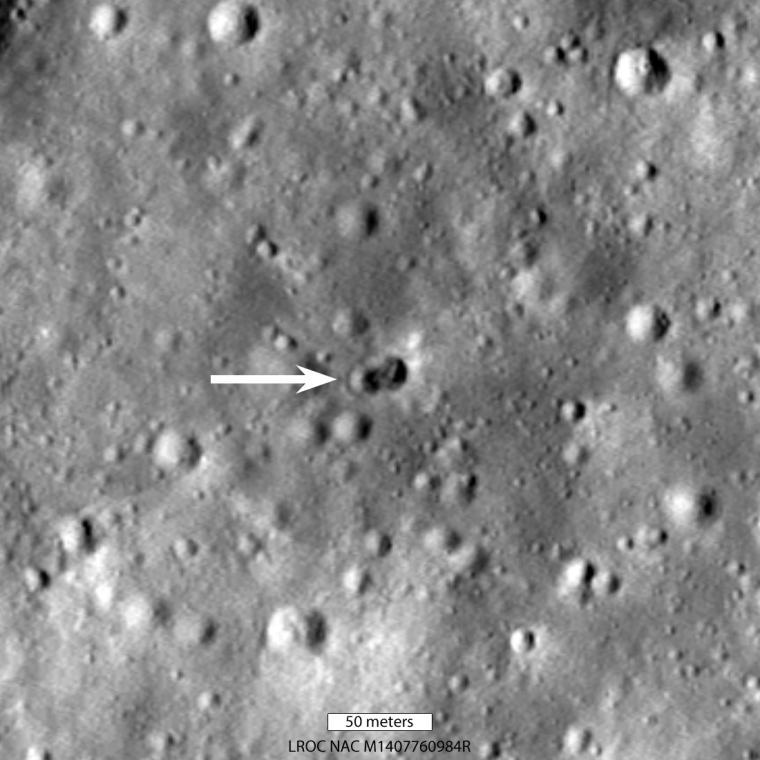
NASA's Lunar Reconnaissance Orbiter took this image of the double crater left by the errant rocket stage when it slammed into the moon's surface near the Hertzsprung crater. The impact site spans roughly 92 feet in the longest dimension. The scale bar equals 164 feet. NASA/GSFC/Arizona State University
By comparing the light curve data with computer simulations of thousands of hypothetical objects floating through space, the team was able to determine that WE0913A was not what would be expected from a rocket booster.
"Something that's been in space as long as this is subjected to forces from the Earth's and the moon's gravity and the light from the sun," Campbell said. "So you would expect it to wobble a little bit, particularly when you consider that the rocket body is a big empty shell with a heavy engine on one side. But this was just tumbling end-over-end, in a very stable way."
In other words, the rocket booster must have had some kind of counterweight to the two engines, each of which weighs 1,200 pounds without fuel.
"We know the booster had an instrument deck mounted to its top end, but those weigh only about 60 pounds or so," Campbell said. "We performed a torque balance analysis, which showed that this amount of weight would have moved the rocket's center of gravity by a few inches – it wasn't nearly enough to account for its stable rotation. That's what leads us to think that there must have been something more mounted to the front."
Further clues came from the impact itself: When the rocket booster slammed into the moon, it made two craters, about 100 feet apart, instead of one. Again, very unusual, according to Campbell, who pointed out that the craters left behind by Apollo rockets are either round, if the impactor came straight down, or oblong, if it came in at a shallow angle.
"This is the first time we see a double crater," he said. "We know that in the case of Chang'e 5 T1, its impact was almost straight down, and to get those two craters of about the same size, you need two roughly equal masses that are apart from each other."
The study illustrates a growing need: Being able to keep track of defunct space hardware after it has served its purpose is vital for the continuation of space exploration. To that end, research programs into what is known as space situational awareness play a critical role, and UArizona's Space4 Center is part of that effort, according to Roberto Furfaro, Space4's deputy director and Campbell's co-adviser.
Furfaro is a co-author of the paper and a professor in the Department of Systems and Industrial Engineering. Other co-authors on the paper from UArizona include Adam Battle, a graduate student at the Lunar and Planetary Lab, and Neil Pearson, Reddy's lab manager.
"There's a big push on both the governmental and commercial level to go to the moon," Furfaro said, "and once you're putting more and more objects on the moon, it becomes extremely important that we not only track the object, but also understand what they are going to do once they get there."
As for the Chang'e 5 T1 rocket's extra payload, there is a good chance that its identity will remain mysterious, Campbell said.
"Obviously, we have no idea what it might have been – perhaps some extra support structure, or additional instrumentation, or something else," he said. "We probably won't ever know."
Tracking an Errant Space Rocket to a Mysterious Crater on the Moon
OSIRIS-REx Flies on as OSIRIS-APEX to Explore a Second Asteroid
NASA’s OSIRIS-REx mission learned much about the potentially hazardous asteroid Bennu and its risk to Earth. Now, the mission will change hands and target a different kind of potentially hazardous asteroid, Apophis.OSIRIS-REx Flies on as OSIRIS-APEX to Explore a Second Asteroid

By Mikayla Mace Kelley, University Communications - October 31, 2023
After seven years in space and over 4 billion miles traveled, NASA's OSIRIS-REx mission successfully collected and delivered the first U.S. sample from a near-Earth asteroid. Yet, after all this time and travel, the spacecraft will not retire.
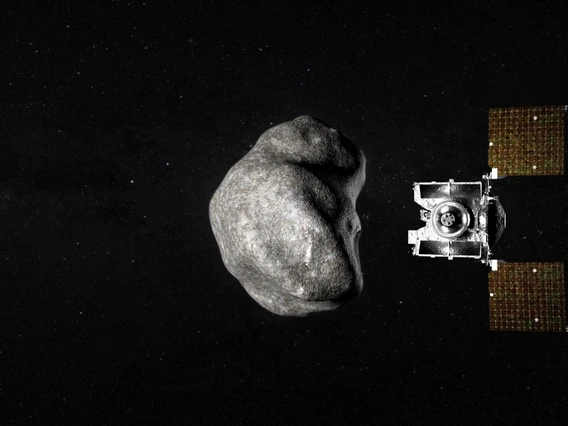
Instead, NASA extended the University of Arizona-led mission so that the spacecraft can be used to study another near-Earth asteroid named Apophis. The mission was renamed OSIRIS-APEX, short for OSIRIS-APophis EXplorer. An overview of the mission was published in the Planetary Science Journal.
 Dani DellaGiustinaChristopher Richards/University Communications
OSIRIS-REx deputy principal investigator Dani DellaGiustina is now the principal investigator for the OSIRIS-APEX mission.
Twenty minutes after dropping the sample high above Earth's atmosphere on Sept. 24, the spacecraft fired its thrusters to put it on course to rendezvous with Apophis in 5½ years – just after Apophis makes its own close approach to Earth. This path includes three Earth gravity assists and several nail-bitingly close laps around the sun.
By April 2, 2029, the spacecraft cameras will begin collecting data as it approaches the asteroid. Apophis will also be closely observed by Earth-based telescopes. But in the hours after the close encounter, Apophis will appear too near the sun in the sky to be observed by Earth-based optical telescopes. This means any changes triggered by the close encounter will be best detected by spacecraft.
The spacecraft will catch up to the asteroid on April 13, 2029, as the asteroid wizzes 20,000 miles above Earth's surface. Scientists will then spend the next 18 months studying the asteroid in detail. They'll also disturb the material on the surface with the spacecraft to reveal what lies just beneath.
"Apophis is an infamous asteroid," said DellaGiustina, who is an assistant professor of planetary sciences at the UArizona Lunar and Planetary Laboratory. "When it was discovered in 2004, there was a scare that it was going to impact the Earth in 2029, but that risk was retired. Then there was another scare that it was going to impact the Earth exactly seven years later, in 2036, but observations combined with modeling now show that Apophis doesn't pose a risk for at least the next one hundred years. Despite this, Apophis still has this role in the psyche of all of us who study these things. While it's not going to impact the Earth in 2029, however, it does get very close."
The 340-meter-wide Apophis is a stony, or S-type, asteroid made of silicate materials and nickel-iron, which are different than C-type asteroids like OSIRIS-REx's first target, Bennu, which are rich in carbonaceous material. Apophis likely formed from a collision of a parent body in the asteroid belt that knocked it toward Earth's neighborhood. The asteroid will pass closer than some of Earth's orbiting satellites and one-tenth the distance to the moon. This is the closest approach by an asteroid of this size in modern history, and it will be visible to the naked eye in the Eastern Hemisphere. An asteroid of this size coming so close to Earth is rare, occurring roughly once every 7,500 years.
The mission considered visiting other targets – even Venus – but Apophis was chosen, because it was the only object that the spacecraft could closely rendezvous with, DellaGiustina said. The close approach allows scientists to study interactions with Earth's gravitational forces, specifically tidal forces that could disturb its surface to reveal what lies beneath.
"Apophis gets close enough that there is some amount of activity that we are anticipating on its surface," DellaGiustina said. "There might be landslides or particle ejections that create a comet-like tail. The close approach is a great natural experiment.
"We know that tidal forces and the accumulation of rubble pile material are foundational processes that could play a role in planet formation. They could inform how we got from debris in the early solar system to full-blown planets. Our best guess right now is that Apophis is, indeed, a rubble pile"
Mission science goals are based on what is known about Apophis from ground-based observations, the team's experiences at Bennu and current data for other S-type asteroids. Ultimately, the team hopes to understand the asteroid's evolution and characteristics, including Apophis' material strength, porosity and density. All they learn can inform planetary defense research, especially because most of the potentially hazardous asteroids are also S-type asteroids like Apophis.
"We learned a lot at Bennu, but now we're armed with even more questions," said Amy Simon, OSIRIS-APEX mission project scientist and senior scientist for Planetary Atmospheres Research in the Solar System Exploration Division at the NASA Goddard Space Flight Center.
For example, as deputy instrument scientist for the OSIRIS-REx Visible and near-IR Spectrometer, Simon and colleagues detected clay minerals and organics on Bennu, suggesting that the asteroid interacted with water in the past. Scientists predicted finding these on C-type asteroids like Bennu but were unable to detect it from ground-based observations.
Simon said she's excited to see how Apophis looks different from expectations and from carbonaceous asteroids Bennu and Ryugu, which Japan visited with the Hayabusa 2 probe in 2018.
Getting up close and personal with these asteroids presents a unique opportunity for planetary scientists. Currently, scientific understanding of solar system formation is heavily informed by meteorites, which are pieces of other celestial bodies that fall to Earth. Asteroids are the primary parent bodies of meteorites but are usually observed from so far away that they appear only as points of light in the sky that reveal little about their global properties or surface variability.
The OSIRIS spacecraft science instruments were specifically designed to connect our understanding of meteorites to their parent asteroids by placing meteorite-scale rocks into geologic context on asteroids and investigating asteroids' geologic processes at Bennu and very soon at Apophis.
OSIRIS-REx Flies on as OSIRIS-APEX to Explore a Second Asteroid
Tracking the Bennu Sample Capsule's Separation from OSIRIS-REx
Data collected ahead of the OSIRIS-REx sample return capsule's plunge into Earth's atmosphere will help test algorithms used to pinpoint asteroids that could impact Earth.Tracking the Bennu Sample Capsule's Separation from OSIRIS-REx

By Niranjana Rajalakshmi, University Communications - October 25, 2023
Hours before the OSIRIS-REx sample return capsule blasted into Earth’s atmosphere and landed safely in the Utah desert on Sept. 24, a small University of Arizona team was tracking another key part of the mission: the capsule's separation from the spacecraft.
With three optical telescopes at different locations, the team of faculty, students and staff from the Lunar and Planetary Laboratory and the Space4 Center joined industry partners in front of computer screens, watching as one dot – the spacecraft – became two when it released the capsule at around 3:42 a.m. Tucson time.
 A team from the UArizona Lunar and Planetary Laboratory and the Space4 Center used telescopes to capture the moment, at around 3:42 a.m. Tucson time, when the OSIRIS-REx spacecraft released the capsule with the sample of the asteroid Bennu, sending it toward Earth. Two dots in the center-right of the frame show the capsule and the spacecraft as they separate.Vishnu Reddy/University of Arizona
While tracking the capsule with optical telescopes wasn't officially part of NASA's historic UArizona-led OSIRIS-REx asteroid sample return mission, the event can be used as an analog for tracking an asteroid on a collision course with Earth if one were ever discovered, said Vishnu Reddy, who led the project.
"The techniques used to track an incoming asteroid on its terminal trajectory before it enters the Earth’s atmosphere are the same as us tracking the sample return capsule before it reaches the atmosphere," said Reddy, a planetary sciences professor in the Lunar and Planetary Laboratory and the director of the Space4 Center.
The capsule separation from the spacecraft was visible only between central Australia and the eastern Pacific Ocean. Within that sliver, the team observed the return using three telescopes: two at Siding Spring Observatory in Australia that were operated remotely at the UArizona campus, and one in Kihei, Maui, Hawaii, where researchers observed in person.
After the separation, two telescopes tracked the capsule while one remained on the spacecraft. About 20 minutes after the separation, the spacecraft fired its engines and began its multiyear journey to another asteroid, Apophis. By collecting data on the spacecraft, the team also hopes to better understand how spacecraft maneuver through orbits between the Earth-moon system – information useful for space situational awareness, which is the practice of tracking celestial bodies, understanding their environment and predicting their future positions.
Along with Reddy, the team included graduate students David Cantillo and Adam Battle from the Lunar and Planetary Laboratory and Tanner Campbell from the Department of Aerospace and Mechanical Engineering. Scott Tucker from Starizona, a Tucson-based small business, and Neil Pearson, the lab manager of Reddy's research group, were also part of the group. The team collaborated on the project with scientists supported by the NASA Planetary Defense Coordination Office and the Air Force Research Lab for work relevant to their respective missions.
Tracking at Maui started at 2 a.m. Tucson time, with the spacecraft appearing on the team's computer screens as a blurry dot about 90,000 miles away from the observing location. Successive images of the dot showed it hurtling through space, while the stars in the image remained static.
"We were one of the few research teams that optically tracked the sample return capsule using telescopes just before it entered the atmosphere," Reddy said. "We picked out the object right away and tracked it all the way to the capsule separation, when one object became two."
While the capsule separated from the spacecraft at 3:42 a.m. Tucson time, the UArizona team estimated it would take an additional 20 minutes to see both objects as two individual dots, given the resolution of their telescopes. They were surprised to observe the separation on their computer screens after only eight minutes, at 3:50 a.m. As they collected images, the group processed the data in real time to verify its path.
 Lunar and Planetary Laboratory graduate students Adam Battle (left) and David Cantillo (right) track the OSIRIS-REx spacecraft and sample return capsule remotely using telescopes in Siding Spring, Australia.Space4 Center
"There was a certain feeling of relief, knowing that the sample return capsule had successfully separated from that main spacecraft, and it was on its final journey home," Cantillo said. Cantillo and Battle observed remotely using the telescopes in Australia.
The Maui team continued to track the capsule until 7:38 a.m. Tucson time, a few minutes before it entered the Earth's atmosphere off the coast of California. The capsule traveled at more than 27,000 mph as it descended through Earth's atmosphere.
"This was one of the fastest objects we have ever tracked," Reddy said.
Prior to the Sept. 24 return, Cantillo and Battle developed and tested computer scripts that remotely controlled the telescopes in Australia. To enable tracking, the scripts included precise predicted positions of the spacecraft and capsule the team wanted to track at different times during their five-hour observation block and matched the exact rate at which the spacecraft would be traveling.
What made these observations unique was that the work was mostly front-loaded in terms of planning, and setting up the scripts that were run on telescopes, Cantillo said.
"Fortunately, everything worked flawlessly, and we got all the data we planned for," Battle said.
Tracking the Bennu sample capsule's separation from OSIRIS-REx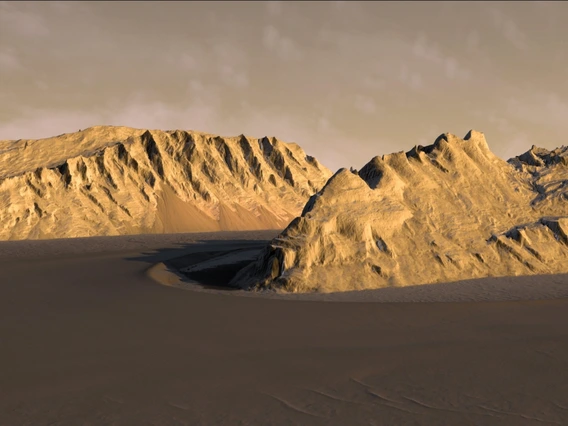
Digital Terrain Models Zero in on Martian Surface
Realistic, to-scale renditions of otherworldly landscapes, created by a team at the university's Lunar and Planetary Laboratory, help lay the groundwork for ongoing and future Mars exploration campaigns.Digital Terrain Models Zero in on Martian Surface

By Penny Duran, NASA Space Grant Science Writing Intern, University Communications - October 25, 2023
Picture soaring over a rugged canyon on another world, strapped into an imaginary hang glider. Or getting a bird's eye view of craters that stretch on for miles and following along the same paths as the robotic rovers that have explored the surface of Mars. All of this is possible – virtually – thanks to specialists at the University of Arizona's Lunar and Planetary Laboratory.
A team at the Lunar and Planetary Laboratory has created realistic terrain models of Mars' surface using specialized software and high-resolution images taken from space. Known as digital terrain models, or DTMs, these renderings allow mission planners to examine landing sites for landers and rovers and scout routes across the alien terrain, laying the groundwork for ongoing and future Mars exploration campaigns.
Creating a DTM begins with high-resolution images taken with the High Resolution Imaging Science Experiment, or HiRISE, a UArizona-led camera instrument aboard NASA's Mars Reconnaissance Orbiter, or MRO, which has captured detailed views of the red planet's surface since 2006. Unlike a consumer-grade digital camera, HiRISE does not take "snapshots" of a scene – rather, it relies on a method called push-broom photography. As the orbiter passes over Mars, the camera takes a long scan, producing pictures used to create DTMs, which are topography maps and capture the shape of planetary surfaces.
 Rocky outcroppings are visible in this digital terrain model of Martin Crater on Mars created by Kris Akers at the Lunar and Planetary Laboratory. DTMs offer faithful renditions of the topography and surface features of planetary bodies and help mission planners pick safe routes for rovers and landers, for example.Kris Akers, HiRISE, Lunar and Planetary Laboratory
"DTMs take a long time to make," says HiRISE outreach coordinator Ari Espinoza, "so the fact we've been able to crank them out in such high numbers underscores the value that HIRISE still has – especially because no one else is making such high-resolution images of Mars' terrain."
HiRISE can resolve objects as small as three feet, about the size of a coffee table. Thus, HiRISE can reveal potential snags and obstacles in landscapes that may look deceptively easy to navigate when viewed from a distance. The sheer amount of DTMs from UArizona has made them a sought-after resource used to examine changes in Mars' geology, find safe landing sites and navigate rover routes.
For each DTM, two images of the same area are necessary. HiRISE captures each image on a separate orbit and at a different angle, and combining the images results in a so-called stereo pair.
Essentially, the set of images making up a stereo pair mimics the left eye and right eye, creating a sense of depth, explains HiRISE scientist and DTM lead Sarah Sutton.
"When you look at the images together with special glasses – like the red-blue glasses often handed out at science fairs – it allows your brain to make a 3D image," she says.
The stereo pairs are then used to produce the DTMs – an intensive process that involves a coding component, examining the actual images taken by HiRISE and editing the DTMs.
The program launched in 2008 with Sutton being the sole producer of DTMs. Thanks to a growing team that includes student workers, the effort is on track to complete more than 150 for this year alone, a record. September saw the completion of a major milestone when the number of total DTMs passed the 1,000 mark.
"Production has gotten a lot faster because we have better targeting of stereo pairs, more automation in our process, and we are continually refining our methods," Sutton says.
Editing especially requires a lot of hands-on work. For example, stark differences in lighting, such as a dark shadow covering one side of a crater, can cause errors that need to be evaluated by a human pair of eyes.
 The UArizona-led HiRISE camera instrument aboard NASA's Mars Reconnaissance Orbiter has taken high-resolution images of Mars since 2006.JPL-Caltech/NASA
"In such cases, the computer doesn’t register what is actually on the surface, and so it makes things up that we have to correct manually," says Branden Gosse, a recent UA graduate who now works as a research technician for HiRISE.
During HiRISE's repeated passes over the same area, it sometimes witnesses changes on the Martian surface that provide valuable scientific clues about dynamic processes, Sutton explains.
"We can observe seasonal changes in frost cover or dunes moving across the land," she says. "That's only possible with DTMs, since they correct for differences due to the individual images being taken from slightly different optical perspectives."
On top of depicting surface changes, DTMs help Mars rovers navigate terrain that could be dangerous. While small, sharp rocks are too small for DTMs to resolve, they can effectively display hazardous sand dunes that rover wheels can get stuck in. In collaboration with cameras aboard rovers, DTMs can even enable almost real-time navigation of rovers' routes.
Making space science tangible
The feats accomplished through DTMs have been made possible through the scores of UArizona students who have produced them over the years, culminating in 1,000 DTMs made from a pool of almost 8,000 stereo pair images. Although DTM production has a steep learning curve, the benefits are immense and planetary science gets more tangible, according to Sutton.
"DTM production gives students the opportunity to see how space science really works outside a classroom," she says.
Simultaneously, the HiRISE team learns from students’ new perspectives, and students learn how to work with the software, according to Max Cabrera, a student worker majoring in physics and astronomy.
"Last semester, there would be this overlap where I’d use the techniques from DTM production in class and vice versa," he says. "There was this nice back and forth that helped me hone my edge for coding."
Even with a long history under their belt, DTMs cover a very small percent of Mars' surface – less than 1 or 2 percent – which highlights the extent of contributions HiRISE can continue to make for as long as the hardware lasts. With students and scientists hard at work in the DTM lab, the topography maps are bound to secure the success of Mars missions – and possibly even human space exploration in the not-too-distant future.
According to Alfred McEwen, the mission’s principal investigator, "DTMs are critical for finding future landing sites for humans or robots as well as monitoring safety and what is happening on the surface."
"Researchers for other moons and planets wish they had something like HiRISE and the MRO orbiting their field of study," McEwen says. "High-resolution images are highly desired pretty much anywhere that you have a solid surface."
Aside from HiRISE, McEwen serves as deputy principal investigator for the Europa Imaging System, or EIS, on NASA's Europa Clipper spacecraft, scheduled for launch next year. Similar to the flyovers over Mars' surface, the Clipper mission will involve studying Jupiter's moon Europa, the sixth-largest moon in the solar system, during a series of flybys.
"As the spacecraft orbits Jupiter and makes close passes to Europa, we hope to get the same kind of stunningly beautiful pictures of this icy world as we do of Mars with HiRISE," McEwen says.
UArizona Researchers Probe How a Piece of the Moon Became a Near-Earth Asteroid
An interesting pathway could have led the moon fragment to reach Earth's orbital space.UArizona Researchers Probe How a Piece of the Moon Became a Near-Earth Asteroid

By Niranjana Rajalakshmi, University Communications - October 23, 2023
In 2021, a team of University of Arizona astronomers suggested that a recently discovered near-Earth asteroid, Kamo`oalewa, could be a chunk of the moon. Two years after the striking discovery, another UArizona research group has found that a rare pathway could have enabled this to happen.
So far, only distant asteroids from beyond the orbit of Mars have been considered a source of near-Earth asteroids, said Renu Malhotra, Regents Professor of planetary sciences and a senior author on the paper.
"We are now establishing that the moon is a more likely source of Kamo`oalewa," Malhotra said.
The implication is that many more lunar fragments remain to be discovered among the near-Earth asteroid population. The study was published in the journal Communications Earth & Environment.
UArizona researchers decided to study Kamo`oalewa for two reasons. Kamo`oalewa is uncommon in that it is Earth's quasi-satellite, a term used for asteroids whose orbits are so Earth-like that they appear to orbit Earth even though they actually orbit the sun.
The other peculiar aspect of Kamo`oalewa is its longevity, said Jose Daniel Castro-Cisneros, the study's lead author and a graduate student in the Department of Physics. Kamo`oalewa is expected to remain as a companion of the Earth for millions of years, which is its remarkable feature, Castro-Cisneros said, unlike other known objects that stay in these very Earth-like orbits only for a few decades.
Aaron Rosengren, a former assistant professor in the Department of Aerospace and Mechanical Engineering, in the College of Engineering, was part of the study. Rosengren is now at the University of California, San Diego.
The 2021 study found that Kamo`oalewa's spectrum was unlike that of other near-Earth asteroids but matched most closely that of the moon. Based on this, the team hypothesized that the asteroid could have been ejected from the lunar surface as a result of a meteoroidal impact.
In the new study, Malhotra and her team wanted to determine the feasibility for a knocked-off piece of the moon to get into this quasi-satellite orbit – a phenomenon that is quite unlikely, Malhotra said. Moon fragments that have enough kinetic energy to escape the Earth-moon system also have too much energy to land in the Earth-like orbits of quasi-satellites, she said.
With numerical simulations that accurately account for the gravitational forces of all the solar system's planets, Malhotra's group found that some lucky lunar fragments could actually find their way to such orbits. Kamo`oalewa could be one of those fragments created during an impact on the moon in the past few million years, according to the study.
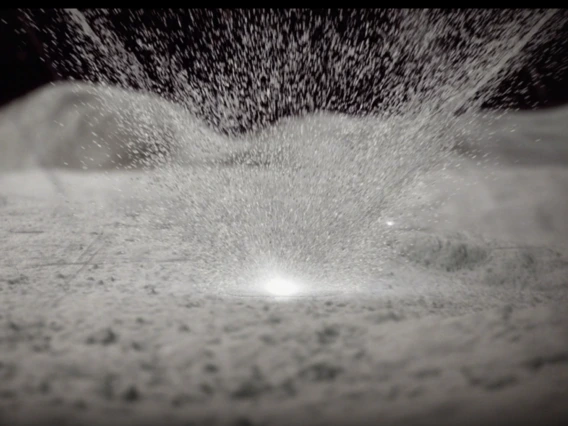
Throughout its history, the moon has been bombarded by asteroids, which is evident in the numerous impact craters preserved on its surface, explained Malhotra. Impact craters are created when asteroids or meteorites crash into the surface of a planet or the moon. Impacts cause lunar material to be ejected from the moon's surface, but most of that material usually falls back on the moon, she said.
Some of the ejected materials fall on Earth, and that's how we get meteorites from the moon, Malhotra said. But a small fraction could escape the gravity of both the moon and the Earth and end up orbiting around the sun like other near-Earth asteroids. Numerical simulation suggests that Kamo`oalewa could be one of even tinier fractions that gained entry into the hard-to-reach Earth's co-orbital space.
The study's findings could help understand more about near-Earth asteroids, which are considered a hazard to Earth, Malhotra said. More detailed studies of Kamo`oalewa and determining this asteroid's origin in a specific impact crater on the moon will provide useful insights on impact mechanics, she said.
In the future, Castro-Cisneros said the team is planning to identify the specific conditions that allowed the orbital pathway of Kamo`oalewa. The group is also aiming to work on determining Kamo`oalewa's exact age, he said.
"We looked at Kamo`oalewa's spectrum only because it was in an unusual orbit," Malhotra said. "If it had been a typical near-Earth asteroid, no one would have thought to find its spectrum and we wouldn't have known Kamo`oalewa could be a lunar fragment."
UArizona Researchers Probe How a Piece of the Moon Became a Near-Earth Asteroid
UArizona Launches Arizona Astrobiology Center to Unlock the Mysteries of Life in the Universe
The center will bring together students and faculty from across campus and disciplines to unravel the enigma of life's beginnings and our place in the cosmos.UArizona Launches Arizona Astrobiology Center to Unlock the Mysteries of Life in the Universe

By Mikayla Mace Kelley, University Communications - October 17, 2023
The University of Arizona on Tuesday announced the opening of the Arizona Astrobiology Center, which brings together more than 40 faculty members from four colleges and 13 disciplines to conduct cutting-edge astrobiological research, train diverse future leaders and encourage collaborative dialogue with communities about the existence, origin and evolution of life in the universe.
This announcement comes on the heels of the success of the UArizona-led OSIRIS-REx mission, which delivered a treasure trove of pristine rocks and dust – the very building blocks of our solar system's origin – from the asteroid Bennu. Scientists from around the world, including some from UArizona, have begun digging into the material to discover new insights about the origins of life on Earth and much more.
The sample's arrival on Earth marks not only the beginning of new scientific research but has also sparked the creation of the Arizona Astrobiology Center, which will serve as a hub of scientific collaboration and public engagement.
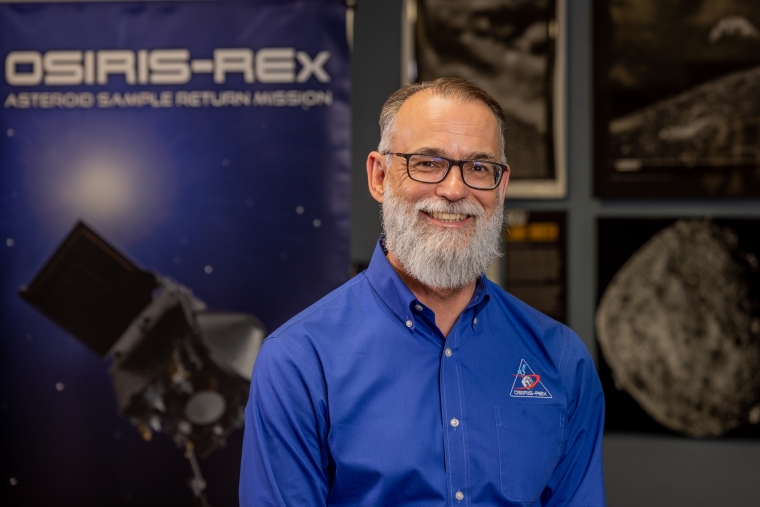 Dante Lauretta is the director of the Arizona Astrobiology Center director and principal investigator for NASA's OSIRIS-REx mission.Chris Richards/University Communications
Dante Lauretta, Regents Professor of planetary sciences at the UArizona Lunar and Planetary Laboratory and principal investigator for NASA's OSIRIS-REx mission, is the center director.
"The formation of the center signifies our passion for unraveling the profound mysteries of our universe and our unwavering commitment to understanding the origin of life, the incredible story of our solar system's birth and the quest to find life elsewhere in the galaxy," Lauretta said. "Together, we embark on this exciting journey to explore the cosmos while also engaging with communities to illuminate the wonders of life."
UArizona's highly regarded astrobiology education program offers students the opportunity to explore the universe's grand questions, Lauretta said. The program spans six departments, including astronomy, chemistry and biochemistry, ecology and evolutionary biology, geosciences, molecular and cellular biology and planetary sciences.
 Corey Knox is the Arizona Astrobiology Center deputy director
But the Arizona Astrobiology Center's reach extends beyond these departments. Part of what the center will explore – in addition to life's origins and existence on other worlds – is what such discoveries might mean to different cultures and traditions around the world. The center also seeks to share these grand ideas through public engagement efforts, said the center's deputy director, Corey Knox.
"The University of Arizona is renowned for pioneering research, especially in planetary sciences. With the establishment of the Arizona Astrobiology Center, our faculty and students will be looking at the universe, life and humanity through a new lens that combines scientific expertise with scholarship in humanities, fine arts and other disciplines," said University of Arizona President Robert C. Robbins. "The knowledge and discoveries that result from this collaboration are sure to be transformational, and Dante Laurette is the right person to lead the way. I am proud that the University of Arizona is a place where this kind of exploration is possible."
A broad approach to big questions
Sawsan Wehbi, a graduate student studying genetics and astrobiology, is collaborating with Lauretta to understand how asteroids like Bennu could have seeded early life on Earth.
Wehbi said she's eager to connect not only with faculty through the center, but also with other students involved in astrobiology research.
"As a biologist approaching the question of life's origins, I've found that I have so much in common with the geology majors who investigate rock formations and compositions of hydrothermal vent systems and the astronomy majors working on protoplanetary systems and near-Earth asteroids," she said. "We get to discuss these fundamental questions from different angles, which is at the heart of this interdisciplinary science."
Center members are also exploring topics and methods of inquiry that extend beyond traditional astrobiology.
Solange Duhamel, an associate professor of molecular and cellular biology, studies how aquatic microbes adapt to extreme environments on Earth. Her work explores how life might arise on other worlds.
For Ken McAllister, Sumayya Granger and Judd Ruggill – College of Humanities faculty members who study the speculative field of xenolinguistics, or extraterrestrial languages – the center will serve as a hub where they can discuss their ideas and be involved in the "center's collaborative, transdisciplinary and forward-looking efforts," said McAllister, who is the college's associate dean for research and program innovation.
"The college specializes in research related to intercultural knowledge and fluency, multilingualism, translation and interpretation, and applied linguistics, including xenolinguistics," he said. "The prospect of exploring ways to transform the terrestrial humanities into disciplines encompassing universal scales would be exceptionally difficult to pursue in isolation. The center will significantly reduce the difficulty of pursuing such work and open new doors to grant funding, community engagement and curriculum development."
Ellen McMahon's research focuses on how the arts work to help us make sense of ourselves, our situations and our surroundings. As associate dean for research in the College of Fine Arts and member of the center, she will facilitate projects at the intersection of art and astrobiology that make scientific findings about humanity's place in the universe relatable for a broad and inclusive audience, which is one of the center's primary goals.
"Art provides unique opportunities for embodied experiences, enabling individuals to make sense of the vast expanse of cosmic knowledge we encounter daily," McMahon said. "This function of art – to help us feel what we know and know how we feel – is critical for the individual and social change needed to rise to the challenges facing our species here on Earth."
Deputy director Knox, an educational researcher and cultural studies scholar, focuses on the inclusion, expansion and transformation of science education and engagement. She thinks that astrobiology is perfectly suited to engage diverse audiences both in and beyond academia.
"The center's mission is to make astrobiology relevant to everyone," Knox said. "In a way, it's all about origins stories: Where did we come from? How did we get here? It will be exciting to engage in discussions and discoveries with people across disciplines, cultures and backgrounds."
Student-powered from day one
While the Arizona Astrobiology Center will be a hub for diverse scientific endeavors and dialogue, its faculty will also nurture the next generation of astrobiologists, scientists, thinkers and creators, Lauretta said.
"For students fortunate enough to be a part of this visionary institution, the opportunities are nothing short of extraordinary," Lauretta said. "From day one, they'll find themselves immersed in the heart of groundbreaking scientific endeavors, collaborating alongside world-renowned faculty and fellow students from diverse disciplines. They will have the chance to work on projects at the forefront of astrobiology, from decoding the secrets of asteroids like Bennu to exploring the possibilities of life beyond Earth's boundaries."
The Arizona Astrobiology Center is also committed to fostering a culture of community engagement, enabling students to share their passion for science with the public. In fact, the astrobiology ambassadors club has already begun outreach efforts. More than a dozen undergraduate and graduate students helped design and staff an event at the Children's Museum Tucson on Sept. 24, when the OSIRIS-REx sample landed on Earth.
"Answering some of the kids' questions about space, life and the mission was truly exhilarating," said Wehbi, a member of the astrobiology club. "Community outreach is another big reason why I'm excited to be part of the center."
UArizona faculty, staff, students and community members can participate in the center in many ways, including through seminars and research partnerships, and also by designing, supporting and attending programs and events.
UArizona Launches Arizona Astrobiology Center to Unlock the Mysteries of Life in the Universe
First Look at Bennu Sample Reveals Carbon and Water
NASA's University of Arizona-led OSIRIS-REx mission has returned a sample that scientists will study for decades to learn more about the formation of the solar system.First Look at Bennu Sample Reveals Carbon and Water

By NASA and University Communications - October 11, 2023
Initial studies of the 4.5-billion-year-old asteroid Bennu sample collected in space and brought to Earth by NASA's University of Arizona-led OSIRIS-REx mission show evidence of water and high-carbon content, which together could indicate the building blocks of life on Earth may be found in the rock.
NASA announced the finding Wednesday from its Johnson Space Center in Houston, where leadership and scientists showed off the asteroid material for the first time since it landed in the Utah desert on Sept. 24. The finding was part of a preliminary assessment of the OSIRIS-REx science team.
"As we peer into the ancient secrets preserved within the dust and rocks of asteroid Bennu, we are unlocking a time capsule that offers us profound insights into the origins of our solar system," said Dante Lauretta, OSIRIS-REx principal investigator and UArizona Regents Professor of Planetary Sciences. "The bounty of carbon-rich material and the abundant presence of water-bearing clay minerals are just the tip of the cosmic iceberg. These discoveries, made possible through years of dedicated collaboration and cutting-edge science, propel us on a journey to understand not only our celestial neighborhood but also the potential for life's beginnings. With each revelation from Bennu, we draw closer to unraveling the mysteries of our cosmic heritage."
 Dante Lauretta (center), OSIRIS-REx principal investigator and UArizona Regents Professor of Planetary Sciences, speaks during a press conference announcing the first discoveries from the Bennu asteroid sample at NASA's Johnson Space Center on Wednesday. Other panelists, from left, are Lori Glaze, NASA's Science Mission Directorate's Planetary Science Division director; OSIRIS-REx sample analysis lead Daniel Glavin; OSIRIS-REx deputy curation lead Francis McCubbin; and NASA Administrator Bill Nelson.Chris Richards/University of Arizona
Although more work is needed to understand the nature of the carbon compounds found, the initial discovery bodes well for future analyses of the asteroid sample. The secrets held within the rocks and dust from the asteroid will be studied for decades to come, offering insights into how our solar system was formed, how the precursor materials to life may have been seeded on Earth, and what precautions need to be taken to avoid asteroid collisions with our home planet.
"The OSIRIS-REx sample is the biggest carbon-rich asteroid sample ever delivered to Earth and will help scientists investigate the origins of life on our own planet for generations to come," said NASA Administrator Bill Nelson. "Almost everything we do at NASA seeks to answer questions about who we are and where we come from. NASA missions like OSIRIS-REx will improve our understanding of asteroids that could threaten Earth while giving us a glimpse into what lies beyond. The sample has made it back to Earth, but there is still so much science to come – science like we've never seen before."
Bonus sample material
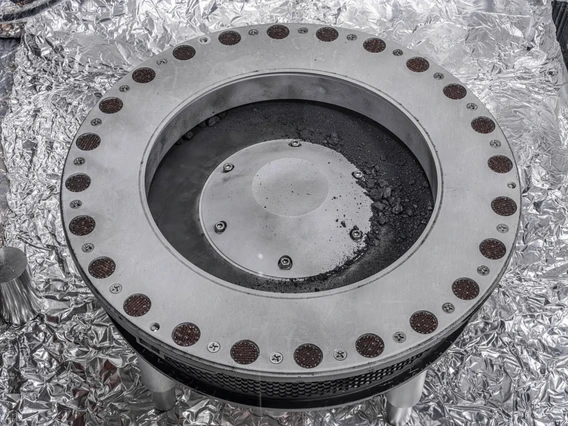
The goal of the OSIRIS-REx sample collection was 60 grams of asteroid material. Curation experts at NASA Johnson, working in new clean rooms built especially for the mission, have spent 10 days so far carefully disassembling the sample return hardware to obtain a glimpse at the bulk sample within. When the science canister lid was first opened, scientists discovered bonus asteroid material covering the outside of the collector head, canister lid and base. There was so much extra material it slowed down the careful process of collecting and containing the primary sample.
"Our labs were ready for whatever Bennu had in store for us," said Vanessa Wyche, NASA Johnson director. "We've had scientists and engineers working side-by-side for years to develop specialized gloveboxes and tools to keep the asteroid material pristine and to curate the samples so researchers now and decades from now can study this precious gift from the cosmos."
Within the first two weeks, scientists performed "quick-look" analyses of that initial material, collecting images from a scanning electron microscope, infrared measurements, X-ray diffraction and chemical element analysis. X-ray computed tomography was also used to produce a 3D computer model of one of the particles, highlighting its diverse interior. This early glimpse provided the evidence of abundant carbon and water in the sample.
For the next two years, the mission's science team will continue characterizing the samples and conducting the analysis needed to meet the mission's science goals. NASA will preserve at least 70% of the sample at Johnson for further research by scientists worldwide, including future generations of scientists.
As part of OSIRIS-REx's science program, a cohort of more than 200 scientists around the world will explore the regolith's properties, including researchers from many U.S. institutions, NASA partners at the Japan Aerospace Exploration Agency, the Canadian Space Agency, and other scientists from around the world. Additional samples will also be loaned later this fall to the Smithsonian Institution, Space Center Houston, and UArizona's Alfie Norville Gem & Mineral Museum.
First Look at Bennu Sample Reveals Carbon and Water
Tucson-born Asteroid Mission Keeps Flying
The moment the OSIRIS-REx spacecraft released the capsule filled with rocks and dust from asteroid Bennu, Daniella DellaGiustina, assistant professor at Lunar and Planetary Laboratory, assumed command of the robotic probe.Tucson-born Asteroid Mission Keeps Flying


A Gift from Space: UArizona-led OSIRIS-REx Mission Delivers Largest-ever Asteroid Sample to Earth
The delivery from the asteroid Bennu, seven years after the spacecraft launched, marks the end of the space-voyaging phase of the mission. Scientists will now study the rocks and dust to better understand the origins of life on Earth.A Gift from Space: UArizona-led OSIRIS-REx Mission Delivers Largest-ever Asteroid Sample to Earth

By Lonnie Shekhtman, NASA, and Daniel Stolte, University Communications - September 24, 2023
After years of anticipation and hard work by the mission team, the University of Arizona-led NASA OSIRIS-REx mission has successfully landed a capsule with rocks and dust from the asteroid Bennu in the Utah desert.
 The OSIRIS-REx sample return capsule lying near its parachute shortly after touching down in the Utah desert. NASA/Keegan Barber
The capsule landed at 8:52 a.m. Mountain Daylight Time – 7:52 a.m. in Tucson – on Sunday, in a targeted area of the Department of Defense's Utah Test and Training Range, or UTTR, 80 miles southwest of Salt Lake City.
Dante Lauretta, principal investigator for OSIRIS-REx at UArizona, was among the first people to approach the sample return capsule after it landed.
"It was like seeing an old friend that you hadn't seen for a long time," Lauretta said during a post-landing press conference hosted by NASA at UTTR. "I did want to give it a hug."
Remembering the late Michael Drake, Lauretta said his former mentor and head of the UArizona Lunar and Planetary Laboratory who first came up with the mission concept "would have been proud today."
"I was there when the capsule was nothing but a PowerPoint on a slide in a proposal that we were submitting to NASA," Lauretta said. "It was amazing and emotional."
According to Lauretta, the capsule didn’t bounce, didn't skid, made only a tiny divot and came to rest gently, tipped on its side.
"Boy, did we stick that landing," he said, "and that is pretty much what OSIRIS-REx has done consistently."
Within an hour and a half, the capsule was transported by helicopter to a temporary clean room set up in a hangar on the training range, where it now is under supervision and connected to a continuous flow of nitrogen.
Getting the sample under a "nitrogen purge," as scientists call it, was one of the OSIRIS-REx team's most critical tasks today. Nitrogen is a gas that doesn't interact with most other chemicals, and a continuous flow of it into the sample container inside the capsule will keep out earthly contaminants to leave the sample pure for scientific analyses.
The Bennu sample – an estimated 8.8 ounces, or 250 grams – will be transported in its unopened canister by aircraft to NASA's Johnson Space Center in Houston on Monday, Sept. 25. Curation scientists there will disassemble the canister, extract and weigh the sample, create an inventory of the rocks and dust, and, over time, distribute pieces of Bennu to scientists worldwide.
The sample collected from Bennu will help scientists make discoveries to better understand planet formation and the origin of organics and water that led to life on Earth, as well as benefit all of humanity by learning more about potentially hazardous asteroids.
 A crowd, including University of Arizona President Robert C. Robbins, cheers as the OSIRIS-REx sample return capsule touches down. Chris Richards/University Communications
Today's delivery of an asteroid sample – a first for the U.S. – went according to plan thanks to the massive effort of hundreds of people who remotely directed the spacecraft's journey since it launched on Sept. 8, 2016. The team then guided it to arrival at Bennu on Dec. 3, 2018, followed by the search for a safe sample-collection site in 2019 and 2020, sample collection on Oct. 20, 2020, and the return trip home starting on May 10, 2021.
"Congratulations to the OSIRIS-REx team on a picture-perfect mission – the first American asteroid sample return in history – which will deepen our understanding of the origin of our solar system and its formation,” said NASA Administrator Bill Nelson. “Not to mention, Bennu is a potentially hazardous asteroid, and what we learn from the sample will help us better understand the types of asteroids that could come our way. With OSIRIS-REx, Psyche launch in a couple of weeks, DART's one-year anniversary, and Lucy's first asteroid approach in November, Asteroid Autumn is in full swing.
“These missions prove once again that NASA does big things. Things that inspire us and unite us. Things that show nothing is beyond our reach when we work together."
UArizona leads the OSIRIS-REx mission's science team and science observation planning and data processing. NASA Goddard provides overall mission management, systems engineering, and the safety and mission assurance.
After traveling billions of miles to Bennu and back, the OSIRIS-REx spacecraft released its sample capsule toward Earth's atmosphere at 3:42 a.m. Tucson time. The spacecraft was 63,000 miles, or 102,000 kilometers, from Earth's surface at the time – about one-third the distance from Earth to the moon.
Once the spacecraft jettisoned the capsule, it officially began its extended mission, OSIRIS-APEX, to study and map another potentially hazardous near-Earth asteroid, called Apophis. Planetary sciences assistant professor and OSIRIS-REx deputy principal investigator Dani DellaGiustina will serve as principal investigator for OSIRIS-APEX.
Traveling at 27,650 mph (44,500 kph), the capsule pierced the atmosphere at 7:42 a.m. Tucson time, off the coast of California at an altitude of about 83 miles (133 kilometers). Within 10 minutes, it landed on the military range. Along the way, two parachutes successfully deployed to stabilize and slow the capsule down to a gentle 11 mph (18 kph) at touchdown.
"The whole team had butterflies today, but that's the focused anticipation of a critical event by a well-prepared team," said Rich Burns, project manager for OSIRIS-REx at NASA's Goddard Space Flight Center in Greenbelt, Maryland. "For us, this was the World Series, ninth inning, bases-loaded moment, and this team knocked it out of the park."
Radar, infrared and optical instruments in the air and on the ground tracked the capsule to its landing coordinates inside a 36-mile by 8.5-mile (58-kilometer by 14-kilometer) area on the range. Within several minutes, the recovery team was dispatched to the capsule's location to inspect and retrieve it. The team found the capsule in good shape at 8:07 a.m. Tucson time and then determined it was safe to approach. Within 70 minutes, they wrapped it up for safe transport to the clean room on the range.
 Lauretta victoriously returns from the field where he and other scientists sampled the immediate environment around the sample return capsule before towing it away by helicopter. Chris Richards/University Communications
Even with a series of rehearsals preceding today's capsule recovery operations, Lauretta said there were heart-pounding moments during the helicopter ride out to the landing area, and he admits he was mentally preparing himself for the worst-case scenario – a hard landing in the event the main parachute had not opened as planned. It was hard to hear the status updates, he said, and he did not have access to NASA's live video feed.
"I told myself, 'You've got to keep it together when you get out of this helicopter, deal with whatever is there and then mourn if that's what you are going to have to do,'" Lauretta said.
"As soon as I heard 'main chute,' that's when I just emotionally let it go," he added. "Tears were streaming down my eyes, and I thought, 'That's the only thing I needed to hear.' From this point on, we know what to do, we're home, we're safe, we did it."
According to Lauretta, today marks an extraordinary milestone not just for the OSIRIS-REx team but for science as a whole.
"Successfully delivering samples from Bennu to Earth is a triumph of collaborative ingenuity and a testament to what we can accomplish when we unite with a common purpose," he said. "But let's not forget – while this may feel like the end of an incredible chapter, it's truly just the beginning of another. We now have the unprecedented opportunity to analyze these samples and delve deeper into the secrets of our solar system."

OSIRIS-REx's Successful Sample Delivery Marks the Start of Extended OSIRIS-APEX Mission
After dropping off its historic sample from asteroid Bennu, the OSIRIS-REx spacecraft is headed to its next target: another potentially hazardous near-Earth asteroid, called Apophis.OSIRIS-REx's Successful Sample Delivery Marks the Start of Extended OSIRIS-APEX Mission

By Mikayla Mace Kelley, University Communications - September 24, 2023
NASA's OSIRIS-REx mission just made history as the first U.S. mission deliver a piece of an asteroid to Earth. The mission, led by the University of Arizona, launched in 2016 and has traveled over 4 billion miles before returning home. Now its next journey begins.
After jettisoning its sample return capsule in the Utah desert, OSIRIS-REx fired its thrusters to put the spacecraft on course to rendezvous with another potentially hazardous near-Earth asteroid, called Apophis. NASA renamed the extended mission OSIRIS-APEX, short for OSIRIS-APophis EXplorer.
While the spacecraft's mechanisms are no longer in place to collect another sample, the UArizona-led science team will study and map the asteroid in great detail. What the team learns will further enrich our understanding of the early solar system and potentially hazardous asteroids.
 OSIRIS-APEX mission principal investigator Dani DellaGiustina.Chris Richards/University Communications
Planetary sciences assistant professor and OSIRIS-REx deputy principal investigator Dani DellaGiustina will serve as principal investigator for OSIRIS-APEX.
DellaGiustina started working on the OSIRIS-REx mission in 2006 as an undergraduate student. She left to pursue a master's degree before returning and being hired on as the lead imaging scientist on the mission while simultaneously obtaining a doctorate from the UArizona Department of Geosciences. In 2021, she became OSIRIS-REx's deputy principal investigator.
"All we learned during our time at Bennu will inform the questions we ask of Apophis," DellaGiustina said. "I'm looking forward to this next chapter and am excited to carry on the legacy of this history-making mission."
Regents Professor of Planetary Sciences at the Lunar and Planetary Laboratory Dante Lauretta will remain principal investigator of OSIRIS-REx through the remaining two-year sample analysis phase of the mission.
"I am so proud to see the long-awaited and much-anticipated sample delivery, which so many University of Arizona community members have tirelessly worked on these past many years. The OSIRIS-REx mission has already surprised us in so many ways. I know that it will continue to do so as our scientists dig into the sample and work to reveal more about the origins of the solar system and potentially life itself," said University of Arizona President Robert C. Robbins. "The OSIRIS-APEX mission will only compound the success of the OSIRIS-REx mission and continue to demonstrate to the world – especially students who want to study what lies beyond our planet – that the University of Arizona is a leader in space sciences."
After nearly six more years of travel and several laps around the sun, OSIRIS-APEX will begin snapping pictures of Apophis in early April 2029 – just a few days before the asteroid's rare close encounter with Earth, coming to within less than 20,000 miles, or one-tenth the distance between the Earth and moon. Scientists will then spend the next 18 months studying the asteroid up close.
Apophis is an "infamous" asteroid, DellaGiustina said, and while many other targets were considered, it's the perfect target for this mission.
When Apophis was first discovered in 2004, scientists studying its orbit thought it would impact Earth in 2029, but later observation ruled out that possibility. Then, scientists again thought it would strike in 2036. That also was ruled out. Further observation and tracking have now shown that Earth is safe from Apophis for at least 100 years.
While Apophis won't hit Earth any time soon, it will come very close, DellaGiustina said, and this is exactly what makes it such a rich target of study.
The mission science team plans to study how Earth's gravitational influence during this close approach changes the asteroid by disturbing the rotation rate and surface, potentially revealing what lies just beneath the surface and more about its material properties. Instruments onboard the spacecraft will snap pictures and collect data as it travels to the asteroid and will continue to monitor any changes after the close approach.
Scientists are also interested in learning more about the composition of this asteroid. OSIRIS-REx's target asteroid, Bennu, is a carbonaceous asteroid, meaning it is relatively rich in carbon-bearing materials such as organic molecules. Apophis, on the other hand, is expected to be poor in carbon-bearing materials and water and is slightly smaller than Bennu. Both are about 1,500 feet at their widest points.
The knowledge gleaned from the Apophis rendezvous will inform scientific understanding of potentially hazardous asteroids and how to protect against future collisions with these solar system wanderers.