

Take a Stroll Through the Solar System – on the UArizona Campus
Designed objects true to scale, 11 plaques have been installed across campus as part of of an outreach project to make space science accessible to people of all ages.Take a Stroll Through the Solar System – on the UArizona Campus

By Daniel Stolte, University Communications - September 12, 2023
Thanks to a University of Arizona student and her childhood dream, visitors to the UArizona campus now can take a walk through the solar system at the same time.
Zarah Brown, a doctoral student at the UArizona Lunar and Planetary Laboratory, led the installation of 11 plaques depicting various objects of the solar system true to scale. Designed to show the relative sizes and distances of solar system objects at a 1:5 billion scale, the outreach project aims to make space science accessible to people of all ages and backgrounds and to highlight UArizona's accomplishments exploring the solar system.
Dedicated with a ribbon-cutting ceremony on Sept. 8, the stations comprising the Arizona Scale Model Solar System are spaced out across two-thirds of a mile of campus between the Kuiper Space Sciences Building and the intersection of East University Boulevard and North Euclid Avenue.
A project website, accessible by QR codes at each stop, will provide information via screen readers for the visually impaired, as well as additional details as new scientific discoveries are made.
The project is the result of collaborative efforts made possible by the support of the NASA Space Grant program and an anonymous benefactor.
Brown talked to University of Arizona News about her childhood dream, what drove her to make it a reality and what sets the Arizona Scale Model Solar System apart from similar installations.
Q: How did you get the idea for this project?
A: I wanted to do this for a really long time. In second grade, I had a poster of the solar system that I loved, and it had all of the numbers on there, all of the planets, their sizes and their distances. And that was great, except they all were represented at the same size and distance from each other, and I thought, "I want this to be right. I want it to look right." So I decided to draw my own solar system model on a sheet of paper. I had my little calculator out, and I was figuring it out. And soon I was like, "Oh, my goodness, I'm going to need another sheet of paper” the farther out I got into the solar system. At some point I said, "Dad! I need more paper." I needed a ream of paper to get to the end of the solar system, and that was just mind-blowing at that young age. Since then, I've always found that experience to be just so compelling and fascinating and wonderful. It had me totally rethink who I am, how big our planet is, and how vast space is.
 A young visitor spots Bennu, the target asteroid of the UArizona-led OSIRIS-REx mission, on the plaque featuring the asteroid belt, which is located at the entrance of the Flandrau Science Center and Planetarium.Daniel Stolte/University Communications
Q: What can you tell us about the design of the plaques?
A: They are 30 inches wide and 20 inches tall, and each of them has a depiction of the solar system object silhouetted against the sun, at the same scale, so you can see how big the planet is compared to the sun. The plaques provide details on the mass, diameter, surface gravity and temperature of various solar system objects, as well as stories about related University of Arizona scientific contributions. The interpretive information on each plaque is complemented by NASA images and illustrations by James Keane, an alumnus of the University of Arizona Lunar and Planetary Laboratory.
Q: Can you give us a sneak preview of the objects featured in your installation?
A: The sun is located outside of the Kuiper Space Sciences building. At the scale of 1:5 billion, it measures 10.9 inches across. Next, a few steps away is Mercury, the innermost planet of the solar system. It's just a tiny dot against the sun, and because it is so close to it, it's a hot, dry planet with no atmosphere. Any atmosphere it might have had when it formed would have long been stripped away by the sun.
Across from Mercury, on the other side of the walkway leading up to the front of the building is Venus. Next, a few steps to the west, is a plaque for the Earth and the moon. From here, you can see the "moon tree" in the background, which is kind of neat, because that's the tree that went to the moon as a seed during the Apollo missions and then came back and was planted here. If you continue walking westward, you'll encounter Mars at the walkway up to Flandrau Science Center, followed by a big gap before we reach Jupiter in front of the Sonett Space Science Building. In that gap, a plaque for the asteroid belt was placed at the corner of University Boulevard and Cherry Avenue. The asteroid belt isn't typically featured in solar system scale models, but given all of our wonderful work around asteroids, most notably the OSIRIS-REx sample return mission, we thought it would be very important to include the asteroid belt.
Passing Jupiter, we continue to walk westward until we reach the Modern Languages Building, where we encounter Saturn, which happens to be my favorite planet. As we keep walking past the Student Union, we arrive at the plaque for Uranus, just north of Old Main. By the time we reach Neptune, the outermost of the planets, we are at the edge of campus on the opposite end of where we started. That planet's plaque is located just east of the stone wall at Main Gate.
Q: What about Pluto, the dwarf planet that is no longer recognized as a "proper" planet?
A: We have slated a home for Pluto along the pedestrian walkway amid the shops near University Boulevard and Euclid Avenue. This property is owned by the Marshall Foundation, which aims to support education for children and young adults in the Tucson community.
Q: Who provided the content? Did you write all of the narratives?
A: I know that I'm not an expert in every single object in our solar system, so I had a team of about 10 graduate students in LPL (the Lunar and Planetary Laboratory) who helped me write an initial draft focusing on which aspects of each object are the most interesting and outlining some of the facts.
Q: What do you hope to accomplish with this project?
A: My main goal is to have the wonder of the universe that we live in be more accessible to anyone who comes to campus. I'm really passionate about science being accessible to the public. I think that sometimes scientists get very focused on their aspect of research, and we don't always do the best at translating what we're learning to everyone. I also hope that seeing how small the Earth is compared to the vastness of space might give people the type of perspective that would have them see how precious our planet is and how precious one another are.

Preparing to Welcome an Asteroid Sample
On the morning of Aug. 29, outside a hangar on the U.S. Army's Dugway Proving Ground in the high mountain desert of central Utah, members of NASA's OSIRIS-REx sample recovery team began a two-day "dress rehearsal" – their last opportunity to perfect procedures before the first extraterrestrial samples collected beyond the orbit of the moon are expected to land on Earth on Sept. 24.Preparing to Welcome an Asteroid Sample

By University Communications - August 31, 2023
On the morning of Aug. 29, outside a hangar on the U.S. Army's Dugway Proving Ground in the high mountain desert of central Utah, members of NASA's OSIRIS-REx sample recovery team began a two-day "dress rehearsal" – their last opportunity to perfect procedures before the first extraterrestrial samples collected beyond the orbit of the moon are expected to land on Earth on Sept. 24.
Currently on its way to Earth, NASA's OSIRIS-REx spacecraft is carrying a capsule containing an estimated 8.8 ounces of rocky material collected from the surface of asteroid Bennu in 2020. Researchers will study the sample in the coming years to learn about how our planet and solar system formed and about the origin of organics that may have led to life on Earth.
Mission principal investigator Dante Lauretta, University of Arizona Regents Professor of Planetary Sciences and a member of the sample recovery team, was brimming with anticipation during the critical practice run.
"I wanted to personally be out there to greet these pieces of Bennu to our home planet," he said during a news conference hosted by NASA's Goddard Space Flight Center following the completion of the two-day rehearsal. "I want to welcome them to the curation facility at Johnson Space Center and get them ready for the adventure we're about to put them on."
Part of that adventure, Lauretta said, will take place at the University of Arizona, where scientists and experts have been busy building world-class laboratory instruments, including state-of-the-art electron microscopes, ion microprobes and a whole suite of ancillary equipment that can extract a wealth of information from even the smallest pieces of asteroid material.
One of the mission's biggest surprises came when the spacecraft's sampling arm extended into the asteroid surface during sample collection and encountered almost no resistance, said Lauretta, who likes to call Bennu the "trickster asteroid."
"It has challenged us every step of the way," he said. "We thought we were going to touch down on a solid surface, but it responded actually more like a fluid, like if you dropped yourself in a ball pit at a children's playground."
The good news, he said, is that because of that soft surface, the OSIRIS-REx spacecraft was able to collect an "enormous amount of material."
"We believe that we have at least four times as much material in that sample return capsule as we promised NASA when we designed the mission," Lauretta said. "More than 8 ounces, or about 250 grams, and boy, is the science team excited to get that."

OSIRIS-REx Team Completes Final Test Before Asteroid Sample Delivery
The OSIRIS-REx spacecraft will deliver a sample from asteroid Bennu to scientists waiting in the Utah desert on Sept. 24.OSIRIS-REx Team Completes Final Test Before Asteroid Sample Delivery

Members of the sample curation team wheel the capsule into the cleanroom after it was delivered from its landing spot in the desert. Chris Richards/University Communications
By University Communications and NASA Goddard Space Flight Center - September 1, 2023
Members of NASA's OSIRIS-REx asteroid sample recovery team gathered in Utah's West Desert this week to participate in final preparations for the arrival of the first U.S.-collected asteroid sample, slated to land on Earth later this month.
The team includes mission principal investigator Dante Lauretta, a University of Arizona Regents Professor of Planetary Sciences, and Anjani Polit, a senior systems engineer with the university's Lunar and Planetary Laboratory who serves as mission implementation systems engineer for the OSIRIS-REx mission.
A mockup of the OSIRIS-REx sample capsule was dropped from an aircraft Wednesday and landed at the drop zone at the Department of Defense's Utah Test and Training Range in the desert outside Salt Lake City. This was part of the mission's final major test prior to the Sept. 24 arrival of the actual capsule containing a sample of asteroid Bennu collected in space almost three years ago.
"We are now mere weeks away from receiving a piece of solar system history on Earth, and this successful drop test ensures we're ready," said Nicola Fox, associate administrator of NASA's Science Mission Directorate in Washington, D.C.
The drop test followed a series of earlier rehearsals – focused on capsule recovery, spacecraft engineering operations and sample curation procedures – conducted in the spring and earlier this summer.
NASA's OSIRIS-REx spacecraft collected a sample from asteroid Bennu in October 2020. Stowed safely inside the spacecraft's sample return capsule, it will land in Utah via parachute.
Researchers will study the sample in the coming years to learn about how our planet and solar system formed and about the origin of organics that may have led to life on Earth.
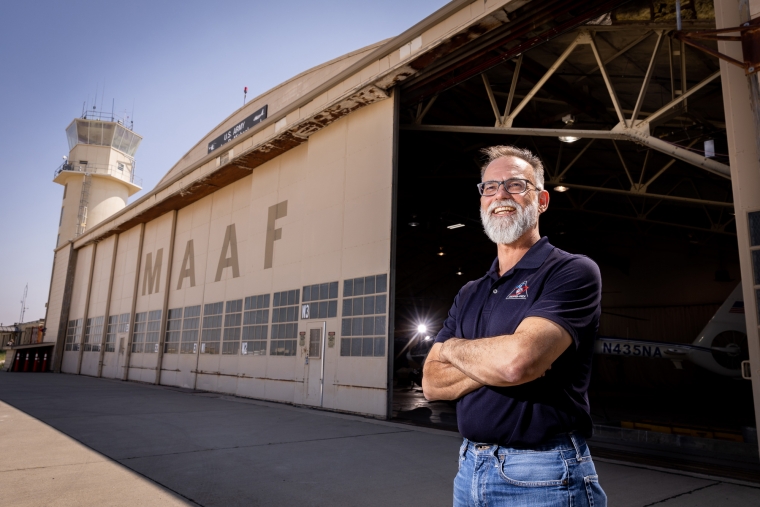 OSIRIS-REx principal investigator Dante Lauretta in front of a hangar on Michael Army Airfield on the Dugway Proving Ground after two successful days of practicing sample capsule recovery. Chris Richards/University Communications
"We're going back to the dawn of the solar system; we're looking for clues why Earth is a habitable world," Lauretta said during a news conference following the successful drop test. "What is life, how did it originate, and why was Earth the place where it occurred? Bennu is so rich in carbonaceous compounds. We believe that we bring material that may literally be representative of the seeds of life that these asteroids delivered at the beginning of our planet."
Lauretta said the OSIRIS-REx team was convinced the spacecraft was going to touch down on a solid surface, but Bennu's surface responded more like a fluid. He likened the process to punching a ball pit at a children's playground.
"I call Bennu the 'trickster asteroid.' It has challenged us every step of the way,'" Lauretta said. "The good news is that due to that soft surface, we collected an enormous amount of material. We believe that we have at least four times as much material in that sample return capsule as we promised NASA when we designed the mission – over 8 ounces, or about 250 grams – and boy, is the science team excited to get that."
Lauretta said he is immensely proud of the efforts the team has poured into the endeavor.
OSIRIS-REx principal investigator Dante Lauretta examines a replica of the sample capsule, consisting of the heatshield (white) and the back shell (tan), following a successful drop test.Chris Richards/University Communications
"Just as our meticulous planning and rehearsal prepared us to collect a sample from Bennu, we have honed our skills for sample recovery," he said.
The capsule will enter Earth's atmosphere on Sept. 24 at 10:42 a.m. EDT (7:42 a.m. MST), traveling at about 27,650 mph. NASA's live coverage of the capsule landing starts at 10 a.m. EDT (7 a.m. MST) and will air on NASA TV, the NASA app and the agency website.
Once located and packaged for travel, the capsule will be flown to a temporary clean room on the military range, where it will undergo initial processing and disassembly in preparation for its journey by aircraft to NASA's Johnson Space Center in Houston, where the sample will be documented, cared for and distributed for analysis to scientists worldwide.
"One of the best parts about being at a university and being able to lead a program like this is training the next generation," Lauretta said, noting that more than 200 undergraduate and graduate students that have contributed to the mission, working on science, engineering, marketing, graphic arts, video production and business management – "all of the skills that it takes to bring a mission like this to a close."
Now, an "army of graduate students is waiting to get involved in the sample science program," Lauretta said.
"It's really a great entry point for young people to get involved in science," he said. "They're super excited just to think that we've got these pieces of an asteroid."

Asteroid Sample Delivery to Launch Decades of Science
A University of Arizona-led NASA mission nearly 20 years in the making is finally reaching its end, but the scientific investigation is only beginning.Asteroid Sample Delivery to Launch Decades of Science

By Mikayla Mace Kelley, University Communications - August 22, 2023
The University of Arizona-led OSIRIS-REx mission – NASA's first mission to collect an asteroid sample and deliver it to Earth – was dreamed up in 2004 by the late Michael Drake, who at the time was head of the UArizona Lunar and Planetary Laboratory.
His most burning questions were about the origins of life, and a sample from an asteroid was key to answering those questions. Drake, who would become the principal investigator of OSIRIS-REx, spent years designing the asteroid-sampling mission with his team. But shortly after NASA made OSIRIS-REx an official mission in 2011, Drake died.
His legacy has lived on through his mentee, Dante Lauretta, a UArizona planetary scientist who worked with Drake from the mission's inception. Now, two decades later, Lauretta will see OSIRIS-REx through its final stage on behalf of them both.
"The origin of life investigation is where my mind is a lot these days," Lauretta said. "It's a really challenging scientific puzzle, and I'm excited to really dig into it after more than 20 years of mission planning and execution."
On Sept. 24, the OSIRIS-REx spacecraft, which launched in 2016, will deliver a capsule containing rocks and dust it picked up from asteroid Bennu in 2020. The spacecraft will release the capsule over the Department of Defense's Utah Test and Training Range, 80 miles southwest of Salt Lake City.
The next day, on Sept. 25, the Bennu sample – an estimated 8 ounces, give or take 4 ounces – will be delivered to NASA's Johnson Space Center in Houston, where it will be cared for and stored. This will mark the end of the OSIRIS-REx mission in space. But the occasion also will mark the beginning of research that will keep scientists busy for generations and supply intellectual fodder for conversations about the origins of life, the nature of asteroids, planetary defense and much more.
Lauretta's biggest question
Lauretta and other scientists have been waiting for years to study pieces of Bennu in their labs to help tease out the details of how life emerged on Earth. To do this, they need samples collected in space; these are the best records of the solar system's chemical history because they are so well preserved compared to anything found on Earth, where activity such as erosion and shifting continents have erased most evidence of the planet's ancient history.
When it comes to unraveling the origins of life, many scientists are keen to trace organic molecules – chains of atoms associated with living things – back in time to find out how they evolved into living creatures.
Lauretta and his colleagues will study organic compounds called amino acids, which are components of proteins that are critical to the structure, function and regulation of all living things on Earth.
Scientists know amino acids can be formed in space, because they have detected them in meteorites, which are space rocks that fall to Earth's surface. But scientists wonder if the first amino acids used by life were delivered by meteorites or if they were a product of "primordial soup," the chemical mixture on Earth during its earliest days, from which life first took hold.
To try to find out, Lauretta's team members at NASA's Goddard Space Flight Center in Greenbelt, Maryland, will steep a powdered sample of Bennu in cool water to extract the amino acids in a process similar to making cold-brew coffee. Then, they will use chemical methods to separate, identify and quantify the amino acids present.
"Some of the amino acids used in biology are relatively fragile – too fragile to survive the harsh methods, such as boiling water, typically used to extract them from rocks," said Jason Dworkin, an OSIRIS-REx project scientist at NASA's Goddard Space Flight Center. "So, Dante challenged the Goddard team to develop a method that is tough enough to liberate amino acids from a stone, yet sufficiently gentle to preserve the delicate molecules that emerge, and that's what we've done."
 Graduate student Sawsan Wehbi
The OSIRIS-REx research team will provide their amino acids data to Sawsan Wehbi, a UArizona graduate student studying astrobiology and genetics. She will compare Bennu's amino acid inventory with that of the theoretical microbe known as the Last Universal Common Ancestor, from which all Earth life is thought to have emerged about 4 billion years ago.
A strong correlation could mean that some early lifeforms used the organic material delivered from outer space, Wehbi hypothesizes.
"Right now, we just don't know," Wehbi said. "It might be that life was surrounded by meteorites containing precious amino acids but couldn't access them. Or, maybe early life only relied on terrestrial amino acids or was dependent on what was delivered by meteorites. If we find that early life was dependent on meteorite amino acids, that would change the whole story."
Launching the next generation
Between 1988 and 1993, Lauretta studied math, physics and Japanese at UArizona. He returned as a faculty member in 2001. Drake quickly took Lauretta under his wing, appointing him deputy principal investigator of OSIRIS-REx. They worked for seven years to develop the mission. Drake died four months after OSIRIS-REx was selected by NASA, and Lauretta stepped into the lead role.
"His death was terrible and unexpected, and it put me in the leadership role really quickly," Lauretta said. "But Mike taught me a lot in those years we worked together, so I was ready."
As principal investigator, Lauretta, too, has taken on many mentees. One of them is Dani DellaGiustina, who began working with Lauretta and Drake as a student in 2004. She was appointed OSIRIS-REx imaging team lead in 2015, then deputy principal investigator in 2021.
Next, DellaGiustina will lead a new mission, OSIRIS-APEX, to study asteroid Apophis. The new mission will use the existing OSIRIS-REx spacecraft after it drops the Bennu sample to Earth in September.
"I'm looking forward to handing the flight system off to a new generation and getting back into the laboratory," Lauretta said.

This Is How the First-Ever U.S. Asteroid Sample Return Will Unfold
Scientists are gearing up for a high-stakes finale to OSIRIS-REx, the first U.S. mission to snare a sample from an asteroidThis Is How the First-Ever U.S. Asteroid Sample Return Will Unfold

By Leonard David, Scientific American - July 27, 2023
In the historic quest to bring samples from across the solar system back to Earth, the best mantra for success may be a simple, familiar phrase: “practice makes perfect.”
At least, that’s the feeling from recent dry runs of the grand finale of NASA’s OSIRIS-REx, an acronym for the megamouthful Origins, Spectral Interpretation, Resource Identification, Security-Regolith Explorer. Launched in September 2016, OSIRIS-REx is the first U.S. mission to snare a sample from an asteroid. In October 2020 the spacecraft dutifully gathered bits and pieces of the space rock Bennu, an ancient rubble pile of diverse leftovers from the early days of the solar system’s creation about 4.5 billion years ago. Now, it’s en route back to Earth, seeking to return that precious payload safely to terra firma in a thrilling act of interplanetary derring-do set to unfold in the early-morning hours of September 24.
At the heart of this effort is perhaps 250 grams (no one knows exactly how much yet) of extraterrestrial freight that was grabbed from Bennu using the novel Touch-and-Go Sample Acquisition Mechanism (TAGSAM), which also stores the sample. That hardware is cocooned within a sample-return capsule that OSIRIS-REx will cast off with split-second precision as it zooms by Earth. After enduring a fiery reentry targeted for the Department of Defense Dugway Proving Ground in the Utah Test and Training Range, roughly 70 miles west of Salt Lake City, the capsule should slow its descent via parachute and touch down somewhere within that remote swath of high desert—presuming, of course, that everything proceeds according to plan.
To prepare for all plausible scenarios, nominal and otherwise, in late June and again early this month a cadre of scientists, engineers and other support personnel gathered for high-fidelity, step-by-step simulations of the OSIRIS-REx capsule retrieval and transport to a mock clean room.
June’s dry run was organized by Lockheed Martin—which built TAGSAM, the return capsule and OSIRIS-REx—and occurred at the company’s campus in Littleton, Colo., under the watchful eyes of planners scribbling notes for other missions. Foremost among these is the multiagency Mars Sample Return program—an even more ambitious and fraught multibillion-dollar effort that seeks to deliver Red Planet materials back to the Earth in the 2030s.
EDGE OF THE ELLIPSEThere are good reasons for the OSIRIS-REx team to be on edge. The same stretch of Utah landscape that will shape its mission’s fate in a few months’ time has already been witness to both calamity and victory.
In September 2004 NASA’s Genesis spacecraft, toting samples of solar wind, failed to deploy its parachutes after atmospheric reentry. Because of improperly installed parachute-deployment switches, the high-speed impact led to a severely banged-up capsule and the contamination of its prized shipment. Fortunes turned less than two years later, in January 2006, when NASA’s Stardust mission successfully parachuted to Earth a capsule sprinkled with particles spewed by Comet P/Wild 2, providing a rich bonanza of material for subsequent laboratory scrutiny.
Significant work has gone into avoiding a “Genesis-level” event, says Richard Witherspoon, lead of Lockheed Martin’s OSIRIS-REx ground-recovery operations. “We’re confident that won’t happen again. We understand the technical issue that occurred on Genesis. We have done extensive testing on OSIRIS-REx to make sure that wouldn’t happen.” The design of the OSIRIS-REx capsule and recovery procedures are based on Stardust heritage, he adds.
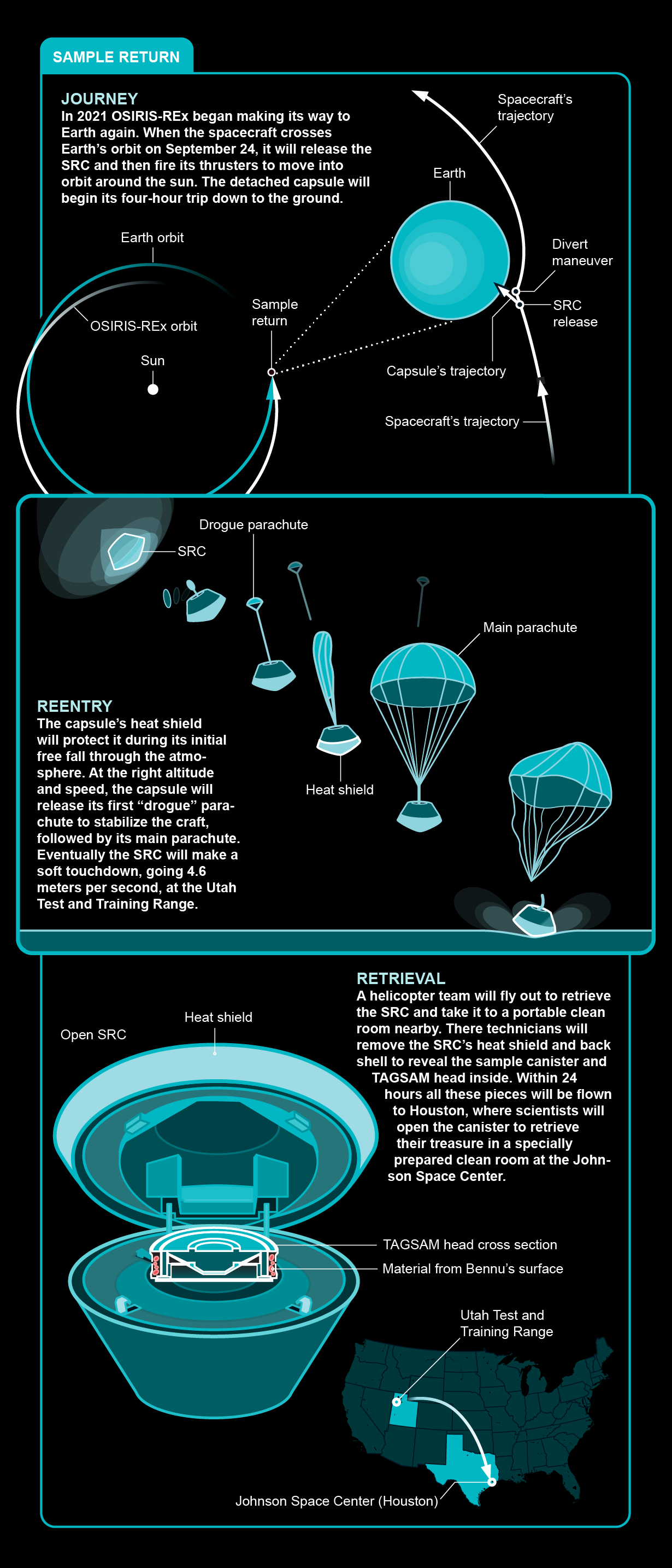
Nevertheless, Witherspoon notes that the landing carries unavoidable risks—even at a slow 10 miles per hour under parachute. An unlucky landfall on a rock could breach the outer part of the capsule’s heat protective shield—although that situation is not expected to compromise the sample-carrying canister itself. Other less-than-ideal circumstances would involve finding the capsule upside down or retrieving it from a mushy mud puddle formed from rare desert rainfall.
The capsule’s drop area in Utah is an ellipse that measures 36 by 8.5 miles. On the nail-biting day, it will be ringed by four helicopters ready to transport a dozen or more recovery team members once the capsule’s touchdown site is pinpointed within. A systems safety officer will be among the first on the scene. They will check for any breaches or outgassing from the capsule to assure both the area and the payload are safe and sound for a soon-to-follow entourage of personnel.
“We have created conditions that were significantly worse just to make sure that we knew how to handle any scenario,” Witherspoon says. “We expect to have the capsule back to the clean-room processing area within two hours of it being on the ground and to have it on nitrogen purge within another two hours.”
That nitrogen flush will be done to assure outside air doesn’t pollute the samples prior to relocating the capsule and its high-value contents to NASA’s Johnson Space Center in Houston, Tex. Once there, the capsule will be fully disassembled, with removal of TAGSAM and the load of asteroid goodies occurring in freshly updated clean-room facilities.
While the June dry run had recovery team members practicing the handling of a mock return capsule and delivery to a simulated clean room, the second session (which took place from July 18 to 20) was on location in the area of the Utah desert where the asteroid samples will arrive. The latter session included helicopter training for recovery team members tasked with airlifting the sample capsule.
“THE MOMENT OF ENORMOUS EMOTIONAL RELIEF”Dante Lauretta, OSIRIS-REx’s principal investigator at the University of Arizona, reels off a long list of possible pain points while observing June’s recovery rehearsal. The most concerning ones are those that any dry run’s meticulous planning and improvisational actions can’t properly address. First and foremost, the capsule must be autonomously released above Earth—a complex procedure requiring the cutting of cables and detonation of explosive “hold down” bolts. Internal batteries need to wake up and supply power. Parachutes packed way back in 2016 need to unfurl. A problem anywhere in that lengthy chain will easily result in TAGSAM being crushed like a beer can after a free-falling, high-speed nose-dive into the desert floor.
Lauretta isn’t really worried, however. “Quite honestly, I put us at 99 percent chance of mission success,” he says, underscoring all the painstaking prelaunch testing of hardware and spacecraft performance to date. Even so, “it will be the moment of enormous emotional relief to see our parachute open and that sample drifting safely down to Earth. Then I know we did it. At that point it’s all gravy.”
Even if OSIRIS-REx’s capsule suffers a Genesis-like hard landing, Lauretta and others on his team are confident they could still pull off some great science. “What we’re worried about is protecting the asteroid sample from Earth contamination,” says Anjani Polit, OSIRIS-REx’s mission implementation systems engineer at the University of Arizona. “All the effort, the many rehearsals and operational readiness tests that are higher and higher fidelity, that’s worked extremely well.”
PRIME THE PUMPSAll the tender loving care and lessons learned from OSIRIS-REx are feeding into NASA’s major planetary-science undertaking for the 2030s: the Mars Sample Return (MSR) enterprise.
Specimens of the Red Planet are also destined for delivery to the Utah Test and Training Range. But there are differences, mostly driven by the hot-button issue of whether life-forms might exist on Mars—and thus potentially in the retrieved samples. Anything other than a nonzero prospect of hauling viable extraterrestrial organisms to Earth and introducing them to our biosphere raises the specter of what “planetary protection” specialists call “backward contamination.”
As now planned, the cone-shaped MSR Earth entry vehicle will fall through Utah’s skies without a parachute, ruggedized to endure the wallop of impact with the high-desert hardpan, as well as any subsequent rolling and bouncing. From there, a recovery team will treat it as potentially hazardous material, enclosing it in a protective container and then transporting it to a yet-to-be-built isolation facility, likely positioned outside of Utah.
For MSR, “we are very much leveraging a lot of the work that’s being done on OSIRIS-REx,” says Nick Benardini, NASA’s planetary protection officer. “We’re building up the necessary skill sets for what’s needed,” with public safety and high sample integrity for scientific analysis as the driving goals.
The process is complicated by MSR’s inherently international nature—both NASA and the European Space Agency are fleshing out the endeavor. And even on the U.S. side, Benardini explains, the mission is so complex that NASA must rigorously engage with a slew of interagency partners, from the Centers for Disease Control and Prevention and the Federal Emergency Management Agency to the Department of Transportation and the Department of Homeland Security.
“OSIRIS-REx allows us to prime the pumps,” Benardini continues, to get procedures, training and sample integrity methods worked out as early as possible. “It’s allowing everybody to have a Mars Sample Return mindset.”

OSIRIS-REx Team Members Practice Recovering Asteroid Sample Capsule Bound for Earth
Everything must go smoothly when the OSIRIS-Rex spacecraft releases its capsule with pristine asteroid material to land in the Utah desert in September.OSIRIS-REx Team Members Practice Recovering Asteroid Sample Capsule Bound for Earth

By Daniel Stolte, University Communications - July 6, 2023
The capsule looks a little bit like a miniature UFO from a 1960s sci-fi flick. Resting on the ground, slightly tilted, its white heat shield flaked off in places, it looks how one would expect it to after speeding in from outer space and streaking across the sky like a shooting star. But looks can be deceiving, and the mini-fridge-sized object has, in fact, never left the surface of Earth.
Instead, it is a replica of the sample capsule mounted on NASA's OSIRIS-REx spacecraft, which has been cruising through space since it departed asteroid Bennu in May 2021 with an estimated half-pound of pristine asteroid material onboard. For training purposes, engineers placed the replica capsule on a field on June 27 at the Lockheed Martin campus near Littleton, Colorado, where the spacecraft was built.
The sun burns hot on this June day, and gusty winds stroke meadows chirping with unseen crickets as a dozen or so scientists and engineers read measurements off screens, hammer sampling cores into the ground and scribble notes into field journals. Somewhere up in a tree, a bird makes a noise that sounds startlingly similar to the iconic beeps and trills of R2D2, the famous little droid from "Star Wars."
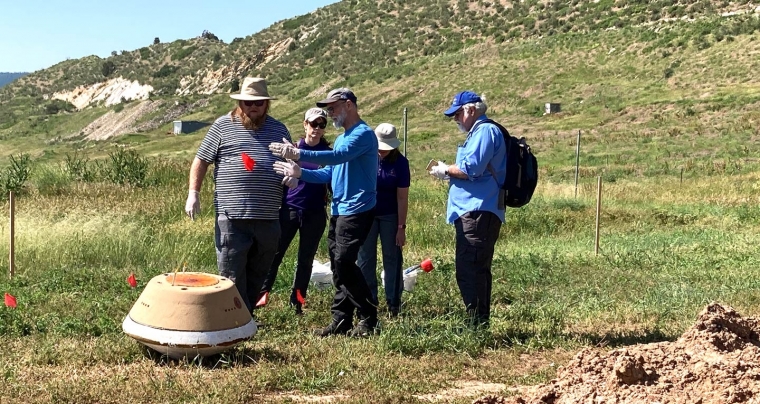 OSIRIS-REx mission members including UArizona scientists Dante Lauretta (center) and Anjani Polit (in back) practice procedures during an exercise with a replica of the spacecraft's sample capsule. The dirt pile on the right was used to simulate a muddy landing site in case of rain. Daniel Stolte/University Communications
OSIRIS-REx team members from NASA, Lockheed Martin and the University of Arizona have gathered for two days to rehearse procedures for the next critical milestone of the mission: recovering the real capsule after it lands and extracting the sample canister in a clean room that will be set up at the Utah Test and Training Range for the actual landing on Sept. 24.
"We're literally on a playground here," says OSIRIS-REx principal investigator Dante Lauretta, a professor of planetary sciences at the UArizona Lunar and Planetary Laboratory, who took part in the rehearsal June 27-28. "We have room to mess up and practice for the real thing."
Lauretta has swapped his usual jeans for trail pants, a ball cap and hiking boots. Today is very special, he says, because it is the first time all members of the sample recovery team are working together. For the exercise, the recovery team members have taken their positions, divided into four groups – each group next to a wooden stake that acts as a stand-in for one of four helicopters that will take the team to the landing site once the capsule is on the ground.
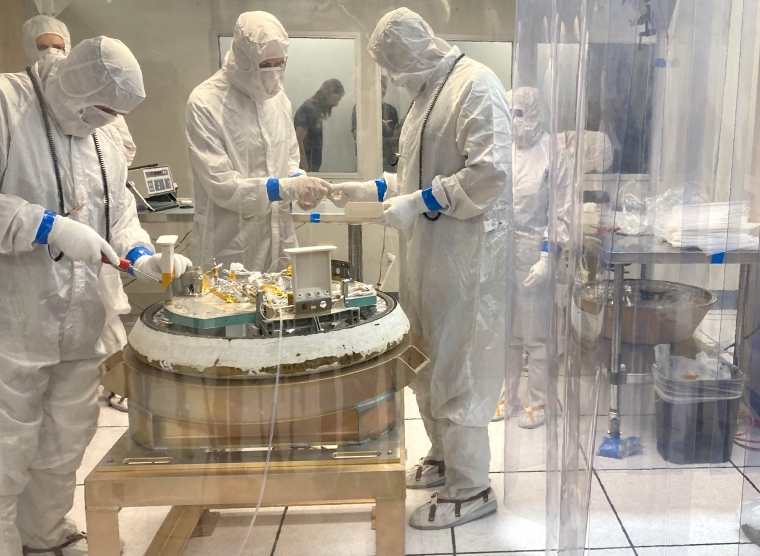 The clean room crew practiced disassembling the sample capsule in a clean room tent after it has been recovered from its landing site. Daniel Stolte/University Communications
Picking up a container on the ground may not seem like a big deal. But when that container has just dropped from the sky via parachute, bearing 4.5-billion-year-old material collected from an asteroid, it is. A major goal of the OSIRIS-REx mission is understanding the organic molecular evolution of the early solar system, Lauretta explains. Bennu was chosen as the target asteroid because it contains what planetary scientists call primitive carbonaceous material, left over from when the first planets were born in the swirling cloud of gas and dust that would eventually become the solar system.
Unlike meteorites that have fallen to Earth unprotected, the Bennu sample has been shielded in its capsule from terrestrial elements – air, water, weather, soil and microbes. Researchers covet such pristine asteroid material because of its promise to help them find answers about how the solar system and, ultimately, life itself came to be.
"Even though we'll be landing in a desert, and even if it is a nominal landing and the capsule looks great, there are still organisms around," Lauretta says. "The risk of any of that material contacting the sample is really low, but it is not zero."
To address this concern, the team practices taking samples from the environment around the capsule to create a library of all the things that it could potentially have been exposed to – soil, air, organic matter and so on. At this point in the rehearsal, Lauretta's science team isn't allowed to go anywhere near the capsule, which is sitting in the grass next to a knee-high pile of dirt and rocks.
Before anyone can approach the capsule, Vicki Thiem, a safety engineer with Lockheed Martin, rehearses taking its temperature – which will be an important step during the actual sample return to ensure it has cooled down sufficiently from its violent atmospheric entry. Next, the safety team practices inspecting the area around the capsule for potential hazards and taking measurements to rule out any hazards from gases that might be emanating from it, plugging its pressure vents and capping off electric wires exposed during the descent. Once the capsule has been secured, Lauretta and his team walk around, inspect the terrain, point out observations and plant little red flags in the ground to demarcate a "keep-out zone" where they don't want other team members to step.
"In the real event, we'll be particularly interested in documenting the tracks the capsule left as it landed, because most likely it's going to bounce or roll for a bit before it comes to rest," Lauretta says. "We need to document the environmental conditions that the sample capsule sees when it comes in, in as much detail as possible."
Since its inception by the late Michael J. Drake, Lauretta's mentor and former director of the UArizona Lunar and Planetary Laboratory, the OSIRIS-REx mission has been designed around the idea of keeping a record of the capsule's history while keeping the mission's procedures as robust and simple as possible, according to mission experts.
"Even before we began building the spacecraft, as the clean rooms were set up, we documented every environment that this capsule has seen, even in space," he says.
So-called witness coupons inside the capsule record exposure to gases or particles shaved from moving parts, such as motors, and document the entire history of the capsule.
"That way, if you find something that looks really fundamental to the origin of life, you have no doubt, and you should be able to rule it out as a contaminant because of that documented history," Lauretta says.
Because the capsule will reach atmospheric pressure during its descent from space, it is outfitted with several layers of filters to remove particles and certain gases, preventing them from coming into contact with the sample. One of the first actions the recovery team will perform is to attach a hose that will bathe the sample in a continuous supply of ultra-pure nitrogen gas, says Richard Witherspoon, who leads ground recovery operations at Lockheed Martin.
"We have a significant amount of time to do our recovery operations, so we don't need to hurry," Witherspoon says. "We allotted about two hours for the recovery, which gives us a good balance of having enough time in the field to assess, take soil and air samples and get the capsule back without rushing the team. In the unlikely event anything doesn't go quite as planned, the team is prepared to move faster than that."
Once it has been secured, two people lift the capsule replica, which weighs about 100 pounds, into a metal crate and wrap it in multiple sheets of Teflon and a tarp. Next, they attach a harness to the crate so it can be attached to a cable, which would be attached to a helicopter. This is where the exercise ends.
The next round of sample recovery rehearsals will take place in Utah, where activities will get more realistic – or "flight-like" as Lauretta puts it – involving helicopters and training at the actual landing site. During the actual return event, after recovering the capsule and getting it ready for transport, the capsule will be taken to a clean room set up at a hangar, where crews will open it and extract the sample canister. The next day, it will be flown to NASA's Johnson Space Center in Houston, Texas, for disassembly and extraction of the sample for immediate analysis and preservation for the future.
Lauretta says the June rehearsal is just a "faint shadow" of what he expects to be experiencing on landing day.
"Just like today, I'll be working next to the capsule, but for the real thing, I will know there's an asteroid sample sitting inside," he says. "I'll know I'm supposed to be digging soil and collecting water samples, but all I'll really want to do is open that thing and see what's inside."

Hamilton, Ranjan, Robinson Named 2023 Scialog Fellows
Scialog is short for “science + dialog.” Created in 2010 by RCSA, the Scialog format supports research by stimulating intensive interdisciplinary conversation and community building around a globally important scientific theme. Teams of two or three Fellows who have not previously collaborated compete for seed funding for novel research projects based on the ideas that emerge at the conference.Hamilton, Ranjan, Robinson Named 2023 Scialog Fellows

Research Corporation for Science Advancement, the Heising-Simons Foundation, the Kavli Foundation and NASA announce awards totaling more than $1 million to eight interdisciplinary teams in the final year of Scialog: Signatures of Life in the Universe, an initiative launched in 2021 to catalyze fundamental science in the search for life beyond Earth.
Scialog is short for “science + dialog.” Created in 2010 by RCSA, the Scialog format supports research by stimulating intensive interdisciplinary conversation and community building around a globally important scientific theme. Teams of two or three Fellows who have not previously collaborated compete for seed funding for novel research projects based on the ideas that emerge at the conference.
The 21 individual awards of $50,000 in direct costs will go to 19 researchers from a variety of institutions in the United States and Canada.

Pass the Salt: This Space Rock Holds Clues as to How Earth Got Its Water
The discovery of tiny salt grains in an asteroid sample brought to Earth by the Japanese Hayabusa spacecraft provides strong evidence that liquid water may be more common in the solar system's largest asteroid population than previously thought.Pass the Salt: This Space Rock Holds Clues as to How Earth Got Its Water

By Daniel Stolte, University Communications - June 13, 2023
Sodium chloride, better known as table salt, isn't exactly the type of mineral that captures the imagination of scientists. However, a smattering of tiny salt crystals discovered in a sample from an asteroid has researchers at the University of Arizona Lunar and Planetary Laboratory excited, because these crystals can only have formed in the presence of liquid water.
Even more intriguing, according to the research team, is the fact that the sample comes from an S-type asteroid, a category known to mostly lack hydrated, or water-bearing, minerals. The discovery strongly suggests that a large population of asteroids hurtling through the solar system may not be as dry as previously thought. The finding, published in Nature Astronomy, gives renewed push to the hypothesis that most, if not all, water on Earth may have arrived by way of asteroids during the planet's tumultuous infancy.
Tom Zega, the study's senior author and a professor of planetary sciences at the UArizona Lunar and Planetary Laboratory, and Shaofan Che, lead study author and a postdoctoral fellow at the Lunar and Planetary Laboratory, performed a detailed analysis of samples collected from asteroid Itokawa in 2005 by the Japanese Hayabusa mission and brought to Earth in 2010.
The study is the first to prove that the salt crystals originated on the asteroid's parent body, ruling out any possibility they might have formed as a consequence of contamination after the sample reached Earth, a question that had plagued previous studies that found sodium chloride in meteorites of a similar origin.
"The grains look exactly like what you would see if you took table salt at home and placed it under an electron microscope," Zega said. "They're these nice, square crystals. It was funny, too, because we had many spirited group meeting conversations about them, because it was just so unreal."
Zega said the samples represent a type of extraterrestrial rock known as an ordinary chondrite. Derived from so-called S-type asteroids such as Itokawa, this type makes up about 87% of meteorites collected on Earth. Very few of them have been found to contain water-bearing minerals.
"It has long been thought that ordinary chondrites are an unlikely source of water on Earth," said Zega who is the director of the Lunar and Planetary Laboratory's Kuiper Materials Imaging & Characterization Facility. "Our discovery of sodium chloride tells us this asteroid population could harbor much more water than we thought."
Today, scientists largely agree that Earth, along with other rocky planets such as Venus and Mars, formed in the inner region of the roiling, swirling cloud of gas and dust around the young sun, known as the solar nebula, where temperatures were very high – too high for water vapor to condense from the gas, according to Che.
"In other words, the water here on Earth had to be delivered from the outer reaches of the solar nebula, where temperatures were much colder and allowed water to exist, most likely in the form of ice," Che said. "The most likely scenario is that comets or another type of asteroid known as C-type asteroids, which resided farther out in the solar nebula, migrated inward and delivered their watery cargo by impacting the young Earth."
The discovery that water could have been present in ordinary chondrites, and therefore been sourced from much closer to the sun than their "wetter" kin, has implications for any scenario attempting to explain the delivery of water to the early Earth.
The sample used in the study is a tiny dust particle spanning about 150 micrometers, or roughly twice the diameter of a human hair, from which the team cut a small section about 5 microns wide – just large enough to cover a single yeast cell – for the analysis.
Using a variety of techniques, Che was able to rule out that the sodium chloride was the result of contamination from sources such as human sweat, the sample preparation process or exposure to laboratory moisture.
Because the sample had been stored for five years, the team took before and after photos and compared them. The photos showed that the distribution of sodium chloride grains inside the sample had not changed, ruling out the possibility that any of the grains were deposited into the sample during that time. In addition, Che performed a control experiment by treating a set of terrestrial rock samples the same as the Itokawa sample and examining them with an electron microscope.
"The terrestrial samples did not contain any sodium chloride, so that convinced us the salt in our sample is native to the asteroid Itokawa," he said. "We ruled out every possible source of contamination."
Zega said tons of extraterrestrial matter is raining down on Earth every day, but most of it burns up in the atmosphere and never makes it to the surface.
"You need a large enough rock to survive entry and deliver that water," he said.
Previous work led by the late Michael Drake, a former director of the Lunar and Planetary Lab, in the 1990s proposed a mechanism by which water molecules in the early solar system could become trapped in asteroid minerals and even survive an impact on Earth.
"Those studies suggest several oceans worth of water could be delivered just by this mechanism," Zega said. "If it now turns out that the most common asteroids may be much 'wetter' than we thought, that will make the water delivery hypothesis by asteroids even more plausible."
Itokawa is a peanut-shaped near-Earth asteroid about 2,000 feet long and 750 feet in diameter and is believed to have broken off from a much larger parent body. According to Che and Zega, it is conceivable that frozen water and frozen hydrogen chloride could have accumulated there, and that naturally occurring decay of radioactive elements and frequent bombardment by meteorites during the solar system's early days could have provided enough heat to sustain hydrothermal processes involving liquid water. Ultimately, the parent body would have succumbed to the pummeling and broken up into smaller fragments, leading to the formation of Itokawa.
"Once these ingredients come together to form asteroids, there is a potential for liquid water to form," Zega said. "And once you have liquids form, you can think of them as occupying cavities in the asteroid, and potentially do water chemistry."
The evidence pointing at the salt crystals in the Itokawa sample as being there since the beginning of the solar system does not end here, however. The researchers found a vein of plagioclase, a sodium-rich silicate mineral, running through the sample, enriched with sodium chloride.
"When we see such alteration veins in terrestrial samples, we know they formed by aqueous alteration, which means it must involve water," Che said. "The fact that we see that texture associated with sodium and chlorine is another strong piece of evidence that this happened on the asteroid as water was coursing through this sodium-bearing silicate."
 In the lab, Che and Zega embedded the dust particle from asteroid Itokawa in epoxy resin to prepare it for thin sectioning. The scale indicates 200 micrometers, about the width of two or three human hairs placed side by side.
Shaofan Che and Tom Zega
 Artist's impression of the Japanese spacecraft Hayabusa approaching asteroid Itokawa in 2005. UArizona researchers Shaofan Che and Tom Zega analyzed a particle that the Hayabusa mission brought to Earth in 2010.
JAXA/Akihiro Ikeshita
 Researchers used a diamond knife to slice through the epoxy and expose a section through the inside of the dust particle, seen here under an electron microscope.
Shaofan Che and Tom Zega
Catalina Sky Survey Wants Your Help Hunting for Asteroids
Anyone with an internet connection can now join University of Arizona researchers as they work to discover asteroids hurtling through our solar system.Catalina Sky Survey Wants Your Help Hunting for Asteroids
By Kylianne Chadwick, NASA Space Grant Science Writing Intern, University Communications - May 16, 2023
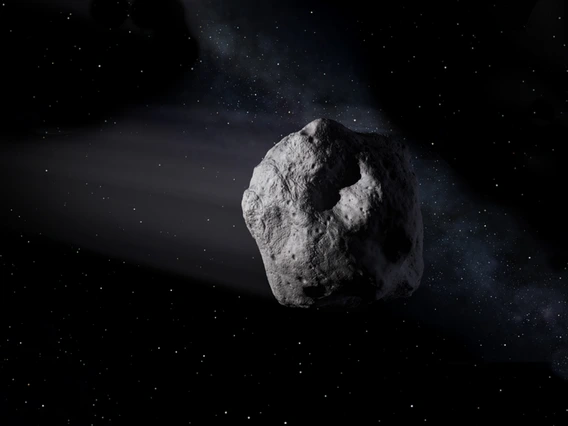
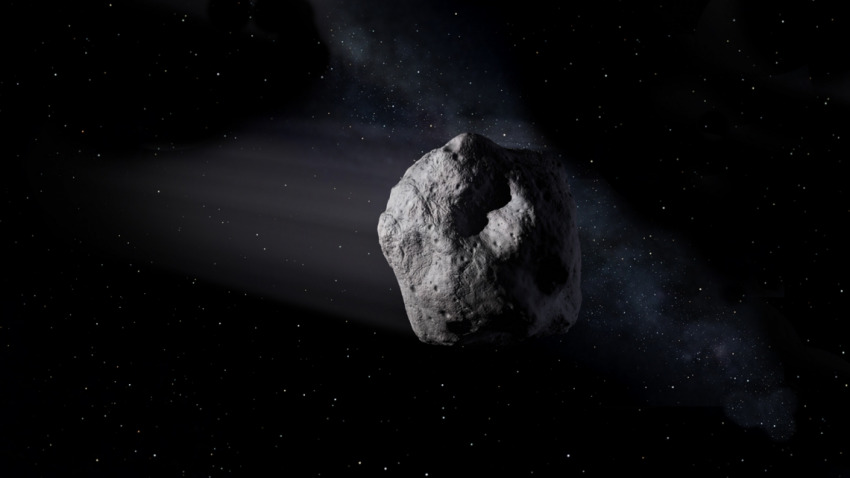
Anyone can become an asteroid hunter thanks to a new program launched by astronomers at the University of Arizona Lunar and Planetary Laboratory. As part of the NASA-funded Catalina Sky Survey, the scientists created an online portal that opens their mission – the discovery and identification of space rocks that regularly visit Earth's neighborhood – to the general public.
While gazing up at the night sky with the naked eye, one might see stars, planets and the occasional airplane. What one usually won't see, however, are asteroids and comets – lumps of rock tumbling through space – left over from the formation of our solar system about 4.6 billion years ago. Because of their origin, these space objects might hold clues about the formation of the sun and planets, scientists believe.
Graph showing the amount of near-Earth asteroids discovered over time. Most notably, the current total of almost 32,000 asteroids is at least triple the amount that had been detected ten years ago. Catalina Sky Survey alone has discovered over 14,400 near-Earth asteroids, including 1,200 in the past year.Alan Chamberlin/JPL-Caltech
Through the new portal, scientists from the Catalina Sky Survey will share potential asteroid and comet detections from their ground-based telescopes with anyone with an internet connection. Even amateurs can help scientists find unknown objects in the solar system as they click through and pore over high-resolution, telescope snapshots of the sky that scientists haven't been able to look at.
"I thought it would be great if people could do what we do every night," said Carson Fuls, a science engineering specialist for the Catalina Sky Survey who heads the project. "We see this website as throwing open the doors: Do you want to look for asteroids, too? If so, come on in."
To begin asteroid hunting, participants must create an account on Zooniverse, an online platform for people-powered research. Through the website, volunteers without any specialized training or expertise assist professional researchers from various fields. In the case of the public asteroid detection portal, a basic tutorial will have participants picking out moving asteroids from pictures in no time.
Participants look at sets of images of the night sky taken by one of the Catalina Sky Survey telescopes. Each image set contains four exposures taken six or seven minutes apart. The pictures are noteworthy because software spotted a moving speck of light from one image to the next, which may or may not represent the light reflected from a faraway comet or asteroid.
The task for the amateur asteroid hunter: Decide if the identified speck of light in the images looks like a genuine celestial body or, rather, is a false detection resulting from inconveniently timed "twinkles" of the star-studded background, dust on the telescope mirror or other causes. After answering by clicking a "yes" or "no" button, the participant can either write a comment or move on to the next detection.
It is not necessary that people know the correct answer every time, said Catalina Sky Survey director Eric Christensen. Rather, the system relies on strength in numbers.
"With enough people participating, you can establish a general consensus, so there's less margin of error." Christensen said.
The Catalina Sky Survey operates up to five large, powerful telescopes each night in their quest to keep track of over 1 million lumps of flying rock with diameters ranging from the length of a school bus to the width of Arizona. Initially, the images in the portal will come from their G96 telescope atop Mount Lemmon, just north of Tucson. The diameter of the telescope's primary mirror is approximately 5 feet, and it can usually survey the whole Northern Hemisphere night sky in about a month.
"The number of asteroids we detect per night with our telescope really depends on the weather or where we are in the lunar calendar," Christensen said. "On clear nights, the database matches tens of thousands of candidates to known asteroids based on their motion, speed and position in the sky."
While the lab's software detects and records all asteroid sightings, Catalina Sky Survey is a NASA-funded project with the mission of specifically tracking and discovering near-Earth objects, or NEOs. NEOs are asteroids that have strayed from the flock of space rocks plodding around the sun in the asteroid belt between Mars and Jupiter. Their new orbits take them much closer to Earth, and some pose a potential threat if their orbit crosses that of Earth.
More than 14,400 NEOs in the past 30 years – almost half of the entire known population of nearly 32,000 – have been discovered by the Catalina Sky Survey. Of those, 1,200 were found just in the past year.
"We are most interested in candidates that are moving fast with an unknown identity because they are most likely to be NEOs," Fuls said. "Because NEOs are closer to us, they appear to move faster and in somewhat random directions from our viewpoint compared to main belt asteroids."
The process of spotting a new NEO and reporting it is time sensitive, and astronomers can lose track of them if there is no immediate follow-up on their discovery. That's because NEOs have highly elliptical orbits that only bring them close to Earth every three or four years. Plus, some smaller NEOs can only be detected if they are passing near Earth.
"NEOs move so erratically that it's easy to miss them," Christensen said. "We try not to filter out false detections too aggressively because this could also filter out some NEOs."
Currently, the asteroid-tracking telescope on Mount Lemmon is set up to take about 1,000 images per night. Afterwards, sensitive software ranks detected moving objects from most to least likely to be an asteroid. The final step is for a human observer to analyze the detections that the software identified.
"A human can only process so many images a night," said Fuls, explaining that while the software flags many possible objects, the researchers don't have the time and resources to look through everything that was picked up. "We are missing a certain number of objects because they simply didn't rank high enough in the algorithm."
That is where a Zooniverse account comes in handy, as "citizen scientists" peek through sky photos that the software flagged but weren't obvious enough to make the cut. For each set of images, a participant must decide: Did the software pick up on a never-before seen space object or did it just get confused by the flickering stars?
Already, three citizen scientists have discovered 64 possible candidates for unknown asteroids during the testing phase of the web portal.
"We've sent these detections off to the Minor Planet Center as potential new discoveries, and most of these objects have not yet been linked to any object that has been detected before," Fuls said. "We anticipate that there will be many more discoveries like that going forward."
The Catalina Sky Survey astronomers plan to release new data into the interface every day after their scheduled nighttime viewing session.
"The observations made by these citizen scientists may not always be of a never-before-detected object," Christensen said. "But they may still be key observations that allow the Minor Planet Center to nail down the identity of something that, until now, was just a candidate."
To keep prospective asteroid hunters on their toes, Fuls said, he and his colleagues will throw pictures of already known objects into the mix to test people's ability to identify real objects and keep them engaged.
"Even when you're at the telescope, you perk up when you see one of those," Fuls said. "You don't want it to be mindless and boring."
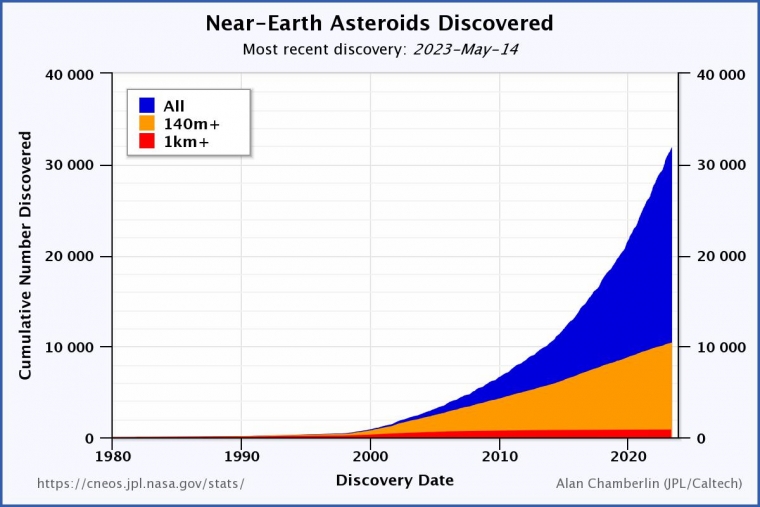 Graph showing the amount of near-Earth asteroids discovered over time. Most notably, the current total of almost 32,000 asteroids is at least triple the amount that had been detected ten years ago. Catalina Sky Survey alone has discovered over 14,400 near-Earth asteroids, including 1,200 in the past year.
Alan Chamberlin/JPL-Caltech
Webb Finds Water Vapor, But From a Rocky Planet or Its Star?
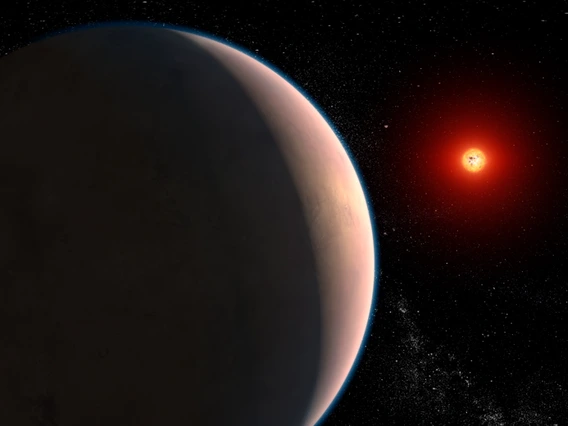
GJ 486 b is about 30% larger than the Earth and three times as massive, which means it is a rocky world with stronger gravity than Earth. It orbits a red dwarf star in just under 1.5 Earth days. It is too close to its star to be within the habitable zone, with a surface temperature of about 800 degrees Fahrenheit. And yet, Webb observations show hints of water vapor.
Webb Finds Water Vapor, But From a Rocky Planet or Its Star?

By Christine Pulliam, Space Telescope Science Institute - May 1, 2023
The most common stars in the universe are red dwarf stars, which means that rocky exoplanets are most likely to be found orbiting such a star. Red dwarf stars are cool, so a planet has to hug it in a tight orbit to stay warm enough to potentially host liquid water (meaning it lies in the habitable zone). Such stars are also active, particularly when they are young, releasing ultraviolet and X-ray radiation that could destroy planetary atmospheres. As a result, one important open question in astronomy is whether a rocky planet could maintain, or reestablish, an atmosphere in such a harsh environment.
To help answer that question, astronomers used NASA’s James Webb Space Telescope to study a rocky exoplanet known as GJ 486 b. It is too close to its star to be within the habitable zone, with a surface temperature of about 800 degrees Fahrenheit (430 degrees Celsius). And yet, their observations using Webb’s Near-Infrared Spectrograph (NIRSpec) show hints of water vapor. If the water vapor is associated with the planet, that would indicate that it has an atmosphere despite its scorching temperature and close proximity to its star. Water vapor has been seen on gaseous exoplanets before, but to date no atmosphere has been definitively detected around a rocky exoplanet. However, the team cautions that the water vapor could be on the star itself – specifically, in cool starspots – and not from the planet at all.
“We see a signal and it’s almost certainly due to water. But we can’t tell yet if that water is part of the planet’s atmosphere, meaning the planet has an atmosphere, or if we’re just seeing a water signature coming from the star,” said Sarah Moran of the University of Arizona in Tucson, lead author of the study.
“Water vapor in an atmosphere on a hot rocky planet would represent a major breakthrough for exoplanet science. But we must be careful and make sure that the star is not the culprit,” added Kevin Stevenson of the Johns Hopkins University Applied Physics Laboratory in Laurel, Maryland, principal investigator on the program.
GJ 486 b is about 30% larger than the Earth and three times as massive, which means it is a rocky world with stronger gravity than Earth. It orbits a red dwarf star in just under 1.5 Earth days. It is expected to be tidally locked, with a permanent day side and a permanent night side.
GJ 486 b transits its star, crossing in front of the star from our point of view. If it has an atmosphere, then when it transits starlight would filter through those gasses, imprinting fingerprints in the light that allow astronomers to decode its composition through a technique called transmission spectroscopy.
The team observed two transits, each lasting about an hour. They then used three different methods to analyze the resulting data. The results from all three are consistent in that they show a mostly flat spectrum with an intriguing rise at the shortest infrared wavelengths. The team ran computer models considering a number of different molecules, and concluded that the most likely source of the signal was water vapor.
While the water vapor could potentially indicate the presence of an atmosphere on GJ 486 b, an equally plausible explanation is water vapor from the star. Surprisingly, even in our own Sun, water vapor can sometimes exist in sunspots because these spots are very cool compared to the surrounding surface of the star. GJ 486 b’s host star is much cooler than the Sun, so even more water vapor would concentrate within its starspots. As a result, it could create a signal that mimics a planetary atmosphere.
“We didn’t observe evidence of the planet crossing any starspots during the transits. But that doesn’t mean that there aren’t spots elsewhere on the star. And that’s exactly the physical scenario that would imprint this water signal into the data and could wind up looking like a planetary atmosphere,” explained Ryan MacDonald of the University of Michigan in Ann Arbor, one of the study’s co-authors.
A water vapor atmosphere would be expected to gradually erode due to stellar heating and irradiation. As a result, if an atmosphere is present, it would likely have to be constantly replenished by volcanoes ejecting steam from the planet’s interior. If the water is indeed in the planet’s atmosphere, additional observations are needed to narrow down how much water is present.
Future Webb observations may shed more light on this system. An upcoming Webb program will use the Mid-Infrared Instrument (MIRI) to observe the planet’s day side. If the planet has no atmosphere, or only a thin atmosphere, then the hottest part of the day side is expected to be directly under the star. However, if the hottest point is shifted, that would indicate an atmosphere that can circulate heat.
Ultimately, observations at shorter infrared wavelengths by another Webb instrument, the Near-Infrared Imager and Slitless Spectrograph (NIRISS), will be needed to differentiate between the planetary atmosphere and starspot scenarios.
“It’s joining multiple instruments together that will really pin down whether or not this planet has an atmosphere,” said Stevenson.
The study is accepted for publication in The Astrophysical Journal Letters.
The James Webb Space Telescope is the world’s premier space science observatory. Webb will solve mysteries in our solar system, look beyond to distant worlds around other stars, and probe the mysterious structures and origins of our universe and our place in it. Webb is an international program led by NASA with its partners, ESA (European Space Agency) and the Canadian Space Agency.