
UArizona Moon Researchers Helped NASA Nail Apollo 12 Pinpoint Landing
Lunar and planetary scientist Ewen Whitaker used his incomparable knowledge of lunar geography to help NASA demonstrate a pinpoint landing on the moon with Apollo 12.
UArizona Moon Researchers Helped NASA Nail Apollo 12 Pinpoint Landing

By Mikayla Mace, University Communications - November 13, 2019
The Eagle swooped over the craggy, monochromatic terrain, keenly searching for a smooth landing place. Nothing but an unwelcoming host of craters and boulders streamed below. Pushing its limits, it flew on.
The Apollo 11 Lunar Module touched down in the Sea of Tranquility, in what could be considered one of the greatest human accomplishments. But with its fuel nearly drained, the Eagle landed nearly four miles from the intended landing site. During the next mission, NASA sought to demonstrate a pinpoint landing with “Intrepid,” the Lunar Module of the Apollo 12 mission, which launched 50 years ago on Nov. 14, 1969.
Five days later, two Apollo 12 astronauts – Pete Conrad and Alan Bean – climbed out of Intrepid. They were only 600 feet (about two football fields) from their target location – the landing site of lunar lander Surveyor 3.
The feat was accomplished thanks to the work of University of Arizona planetary scientist Ewen Whitaker and a team led by Gerard Kuiper, the father of modern-day planetary science and founder of the Lunar and Planetary Laboratory.
Finding Surveyor 3
When President John F. Kennedy announced in 1961 that Americans would walk on the surface of the moon by the decade’s end, Whitaker, Kuiper and their team were already imaging and mapping the lunar surface. Their efforts to produce the first photographic lunar atlases of the moon and their partnerships with the university’s geology department and the astrogeology branch of the United States Geological Survey gave them a deep understanding of the moon’s geology and geography.
As a result, the team played a key role in the series of robotic spacecraft that visited the moon ahead of the Apollo missions.
Surveyor 1, the first of seven unmanned lunar landers in a program that ran from June 1966 through January 1968, reached the surface of the moon on June 2, 1966 and sent back panoramic photos from its travels. Surveyor 1’s success reassured the astronauts they would not be swallowed by dust.
When NASA published what they thought was Surveyor 1's correct landing site in the journal Science, Whitaker disagreed. He demonstrated his peerless prowess of lunar geography when he correctly identified Surveyor 1’s landing site after poring over images taken by the Lunar Orbiter and matching lunar features in photos with moon maps. Whitaker published the alternate location in the September issue of Science. His skills earned him the task of locating four more Surveyor landing sites, including Surveyor 3, which landed on the moon in the western Oceanus Procellarum (Ocean of Storms) on April 20, 1967.
To demonstrate a pinpoint landing with Apollo 12, NASA used Whitaker’s location of Surveyor 3 as the target. The location also gave the crew a chance to return parts of the robotic explorer Surveyor 3, which had been on the moon since 1967, for assessment after more than two years in space.
Finding Surveyor 3 was more difficult than Surveyor 1 because Surveyor 3 had landed in a crater, meaning there were limited landmarks to rely upon.
“I’m sure Ewen Whitaker was holding his breath as the astronauts climbed out of the lunar module,” said Jim Scotti, an astronomer with SPACEWATCH®, the UArizona group dedicated to detecting near-earth objects. “Surveyor 3 had been in darkness as the Lunar Module came in for a landing.”
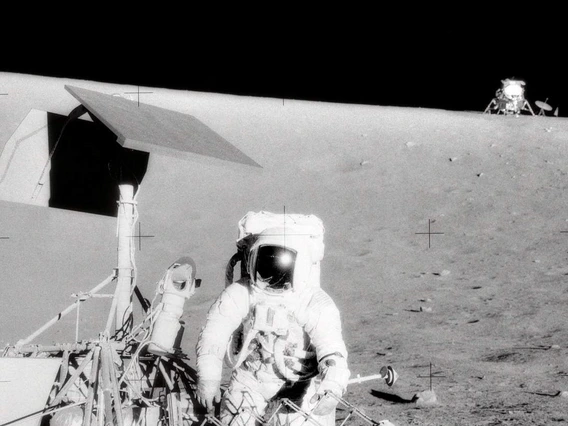
Whitaker’s location was so spot on that the astronauts were able to walk to Surveyor 3.
“The iconic image, for me, of Apollo 12 is the astronaut Pete Conrad standing by Surveyor 3 with the lunar lander in the background,” said Tim Swindle, director of the UArizona Lunar and Planetary Laboratory.
Meeting Alan Bean
Scotti has often joked that by becoming a space artist, astronaut Alan Bean, who snapped that iconic image, made up for damaging the sensors of the first color television camera on the moon’s surface when he accidentally pointed it toward the sun.
Luckily, becoming an artist also brought Bean to Tucson – a hub for space art – where he met Whitaker about 30 years after leaving the moon.
Scotti, a space artist himself, was there to witness the first meeting of the two people responsible for the success of Apollo 12.
“Ewen Whitaker and I were in line together to meet Alan Bean,” Scotti said. “He had brought photographs that he used to find Surveyor and was going to ask Bean to sign them. When he eventually did, it was like watching two best friends chatting back and forth like they’d known each other for years.”

Mysteries Behind Interstellar Buckyballs Finally Answered
Mimicking conditions thought to exist around dying stars, researchers discovered a mechanism that could explain why planetary nebulae are teeming with complex carbon molecules.
Mysteries Behind Interstellar Buckyballs Finally Answered

By Rachel Abraham, NASA Space Grant Science Writing Intern, University Communications - November 13, 2019
Scientists have long been puzzled by the existence of so-called "buckyballs" – complex carbon molecules with a soccer-ball-like structure – throughout interstellar space. Now, a team of researchers from the University of Arizona has proposed a mechanism for their formation in a study published in the Astrophysical Journal Letters.
Carbon 60, or C60 for short, whose official name is Buckminsterfullerene, comes in spherical molecules consisting of 60 carbon atoms organized in five-membered and six-membered rings. The name “buckyball” derives from their resemblance to the architectural work of Richard Buckminster Fuller, who designed many dome structures that look similar to C60. Their formation was thought to only be possible in lab settings until their detection in space challenged this assumption.
For decades, people thought interstellar space was sprinkled with lightweight molecules only: mostly single atoms, two-atom molecules and the occasional nine or 10-atom molecules. This was until massive C60 and C70 molecules were detected a few years ago.
Researchers were also surprised to find that that they were composed of pure carbon. In the lab, C60 is made by blasting together pure carbon sources, such as graphite. In space, C60 was detected in planetary nebulae, which are the debris of dying stars. This environment has about 10,000 hydrogen molecules for every carbon molecule.
"Any hydrogen should destroy fullerene synthesis," said astrobiology and chemistry doctoral student Jacob Bernal, lead author of the paper. "If you have a box of balls, and for every 10,000 hydrogen balls you have one carbon, and you keep shaking them, how likely is it that you get 60 carbons to stick together? It’s very unlikely."
Bernal and his co-authors began investigating the C60 mechanism after realizing that the transmission electron microscope, or TEM, housed at the Kuiper Materials Imaging and Characterization Facility at UArizona, was able to simulate the planetary nebula environment fairly well.
The TEM, which is funded by the National Science Foundation and NASA, has a serial number of "1" because it is the first of its kind in the world with its exact configuration. Its 200,000-volt electron beam can probe matter down to 78 picometers – scales too small for the human brain to comprehend – in order to see individual atoms. It operates under a vacuum with extremely low pressures. This pressure, or lack thereof, in the TEM is very close to the pressure in circumstellar environments.
"It’s not that we necessarily tailored the instrument to have these specific kinds of pressures," said Tom Zega, associate professor in the UArizona Lunar and Planetary Lab and study co-author. "These instruments operate at those kinds of very low pressures not because we want them to be like stars, but because molecules of the atmosphere get in the way when you’re trying to do high-resolution imaging with electron microscopes."
The team partnered with the U.S. Department of Energy’s Argonne National Lab, near Chicago, which has a TEM capable of studying radiation responses of materials. They placed silicon carbide, a common form of dust made in stars, in the low-pressure environment of the TEM, subjected it to temperatures up to 1,830 degrees Fahrenheit and irradiated it with high-energy xenon ions.
Then, it was brought back to Tucson for researchers to utilize the higher resolution and better analytical capabilities of the UArizona TEM. They knew their hypothesis would be validated if they observed the silicon shedding and exposing pure carbon.
"Sure enough, the silicon came off, and you were left with layers of carbon in six-membered ring sets called graphite," said co-author Lucy Ziurys, Regents Professor of astronomy, chemistry and biochemistry. "And then when the grains had an uneven surface, five-membered and six-membered rings formed and made spherical structures matching the diameter of C60. So, we think we’re seeing C60."
This work suggests that C60 is derived from the silicon carbide dust made by dying stars, which is then hit by high temperatures, shockwaves and high energy particles , leeching silicon from the surface and leaving carbon behind. These big molecules are dispersed because dying stars eject their material into the interstellar medium – the spaces in between stars – thus accounting for their presence outside of planetary nebulae. Buckyballs are very stable to radiation, allowing them to survive for billions of years if shielded from the harsh environment of space.
"The conditions in the universe where we would expect complex things to be destroyed are actually the conditions that create them," Bernal said, adding that the implications of the findings are endless.
"If this mechanism is forming C60, it’s probably forming all kinds of carbon nanostructures," Ziurys said. "And if you read the chemical literature, these are all thought to be synthetic materials only made in the lab, and yet, interstellar space seems to be making them naturally."
If the findings are any sign, it appears that there is more the universe has to tell us about how chemistry truly works.
This work was supported by the National Science Foundation (AST-1515568, 1531243 and AST-1907910), NASA (NNX15AD94G, NNX15AJ22G, NNX16A31G, NNX12AL47G and 80NSSC19K0509), the National Institutes of Health (R25GM062584), the U.S. Department of Energy (DE-AC07-051D14517) and the Sloan Foundation Baseline Scholars Program.
The Origins of Buckyballs in Space
The spectroscopic fingerprints of buckyballs have been observed in space, but questions remain about how these large molecules form. Laboratory experiments have revealed a possible mechanism.
The Origins of Buckyballs in Space

By Alessandra Candian, Nature - October 24, 2019
Formation of Interstellar C60 from Silicon Carbide Circumstellar Grains
J. J. Bernal1, P. Haenecour2, J. Howe3, T. J. Zega2,4, S. Amari5, and L. M. Ziurys1,6,7
The Astrophysical Journal Letters, Volume 883, Number 2
A long-standing mystery in astronomical spectroscopy concerns diffuse interstellar bands, a family of absorption features seen in the spectra of the interstellar medium of the Milky Way and of other galaxies. First observed almost 100 years ago, the origin of any of the bands was unknown until 2015, when four of them were assigned1 to the cation of buckministerfullerene (C60+; the uncharged molecule is often referred to simply as fullerene, or colloquially as a buckyball). Fullerene and its analogue, C70, are by far the biggest molecules detected in space, raising the question of how such large species can form in those rarified conditions. Researchers have suggested that fullerene forms in the outflows of old, carbon-rich stars known as asymptotic giant branch stars2 — the temperatures and densities of these outflows promote chemistry similar to that of combustion. This could lead to the formation of soot, which can contain fullerene-like structures. Writing in Astrophysical Journal Letters, Bernal et al.3 propose a very different formation route for fullerene.
The carbon atoms in fullerene are arranged in the shape of a football, a molecular structure that is remarkably stable but also difficult to construct. Fullerene has been made in the laboratory in experiments designed to probe the chemistry that occurs in carbon-rich stars: carbon in the form of graphite was vaporized into a high-density helium flow, producing carbon clusters4. The discovery that fullerene was among the reaction products led to the award of the Nobel Prize in Chemistry to Harry Kroto, Richard Smalley and Robert Curl in 1996.
However, the range of temperatures required to create fullerene in this way is quite specific2; outside that range, molecules known as polycyclic aromatic hydrocarbons (PAHs) are produced instead. These molecules are 2D sections of a single layer of graphite (a graphene sheet), decorated with hydrogen atoms. Subsequent experiments5,6 have shown that PAHs that contain more than 60 carbon atoms are converted into fullerenes when exposed to sufficient ultraviolet irradiation.
The first astronomical source in which fullerene was detected was the star Tc 1 (ref. 7). Puzzlingly, however, the emission associated with fullerene came from a location far away from the star and its ultraviolet photons, whereas the PAH emissions were closer to the star. On the basis of the previously reported laboratory experiments, this is the opposite of what should happen if fullerene forms from PAHs in this source8. So how can the locations of the emissions be explained?
Bernal and co-workers now report that fullerene also forms readily from silicon carbide (SiC), which has been proposed to be the first carbonaceous material to condense out of old, carbon-rich stars9. The authors rapidly heated grains of the crystalline form of SiC that is found in highest abundance in meteorites10, and irradiated them with xenon ions, mimicking the heating caused by shock waves around old stars.
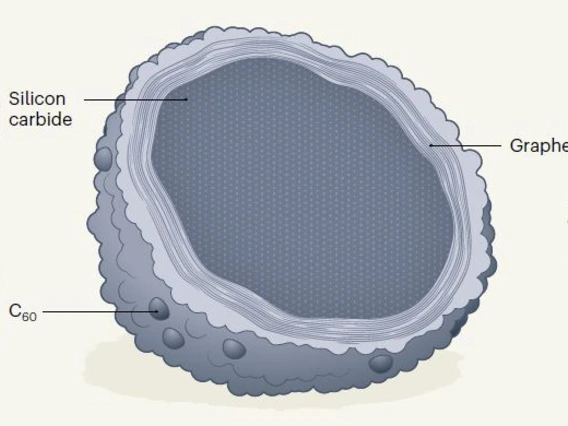
Using a transmission electron microscope to image the surfaces of the samples down to the subnanometre scale, the scientists observed that the grain material had altered notably as a result of its treatment (Fig. 1). Silicon atoms had percolated to the outer layers of the grains, leaving behind what looked like sheets of carbon atoms in a hexagonal ‘chicken-wire’ arrangement — that is, graphene sheets.
The transformation of the outer layers of SiC into graphene sheets at high temperatures had been reported11 previously for a different form of SiC from that studied by Bernal and colleagues. However, Bernal et al. also observed the formation of hemispherical structures with diameters similar to that of fullerene. Their work thus provides a convincing new mechanism for the formation of fullerene in evolved stars.
Bernal et al. report another piece of evidence supporting the idea that SiC grains are rapidly heated and bombarded with ions in evolved stars. They have identified a fragment of the Murchison meteorite — a highly studied meteorite that is rich in organic compounds — in which the ratio of carbon-12 to carbon-13 isotopes is typical of material from an old, carbon- rich star. This indicates that the fragment was not produced during or after the formation of the meteorite, but instead is stardust that originated in an old star. The fragment has a core of SiC surrounded by graphene sheets. However, previous analyses12 of graphite-containing stardust found evidence only of titanium carbide cores, rather than SiC cores. This raises the question of how common SiC cores are in graphite-containing stardust.
The rapid heating of SiC grains in the presence of hydrogen can lead to the formation of PAHs13. Bernal and colleagues’ findings therefore suggest that the thermal conversion of SiC to graphene sheets in evolved stars could be the first step in the formation of large carbon-containing molecules in general: subsequent (or simultaneous) exposure of the graphene to atomic hydrogen produces PAHs, whereas ion bombardment produces fullerene. Alternatively, PAH molecules might be molecular intermediates in the formation of carbon soot, which can then be broken down by ultraviolet irradiation to make PAHs again14.
The efficiency of Bernal and colleagues’ fullerene-forming mechanism is unknown, raising the question of how many SiC grains are needed to account for the observed abundance of fullerene molecules in space. If there aren’t enough grains, then a further mechanism will be required to explain the abundance of fullerene. By contrast, if there are too many SiC grains, what happens to the ‘excess’ fullerene molecules produced, given that they are notoriously difficult to degrade? More experiments and detailed modelling of the formation of fullerene and of other carbon-containing large molecules from SiC grains are needed to understand this process, and to quantify its importance in old stars.
The launch of the James Webb Space Telescope in 2021 will provide powerful new tools for studying old stars, among other astronomical objects. Observations of fullerene- containing sources7,8 such as Tc 1 will be able to constrain the regions in which SiC grains, fullerene and PAHs are present, providing more clues about how large molecules are actually formed. Further analysis and modelling of the routes involved will eventually allow astronomers to suggest the identities of the other mysterious molecules responsible for the diffuse interstellar bands.
Alessandra Candian is at the van’t Hoff Institute for Molecular Sciences, University of Amsterdam, 1090 GD Amsterdam, the Netherlands, and at the Leiden Observatory, University of Leiden, Leiden, the Netherlands. e-mail: a.candian@uva.nl
1. Campbell, E. K., Holz, M., Gerlich, D. & Maier, J. P. Nature 523, 322–323 (2015).
2. Jäger, C., Huisken, F., Mutschke, H., Llamas Jansa, I. & Henning, T. Astrophys. J. 696, 706–712 (2009).
3. Bernal, J. J. et al. Astrophys. J. 883, L43 (2019).
4. Kroto, H. W., Heath, J. R., O’Brien, S. C., Curl, R. F. & Smalley, R. E. Nature 318, 162–163 (1985).
5. Berné, O. & Tielens, A. G. G. M. Proc. Natl Acad. Sci. USA 109, 401–406 (2012).
6. Zhen, J., Castellanos, P., Paardekooper, D. M., Linnartz, H. & Tielens, A. G. G. M. Astrophys. J. 797, L30 (2014).
7. Cami, J., Bernard-Salas, J., Peeters, E. & Male, S. E. Science 329, 1180–1182 (2010).
8. Cami, J., Peeters, E., Bernard-Salas, J., Doppmann, G. & De Buizer, J. Galaxies 6, 101 (2018).
9. Frenklach, M., Carmer, C. S. & Feigelson, E. D. Nature 339, 196–198 (1989).
10. Daulton, T. L. et al. Science 296, 1852–1855 (2002).
11. Mishra, N., Boeckl, J., Motta, N. & Iacopi, F. Phys. Status Solidi A 213, 2277–2289 (2016).
12. Croat, K. T., Bernatowicz, T. J. & Daulton, T. L. Elements 10, 441–446 (2014).
13. Merino, P. et al. Nature Commun. 5, 3054 (2014).
14. Cherchneff, I., Barker, J. R. & Tielens, A. G. G. M. Astrophys. J. 401, 269–287 (1992).

Space Science, Research Reputation Shine in Best Global Ranking
The University of Arizona ranked No. 21 among U.S. public universities and No. 85 overall in the sixth annual "Best Global Universities" ranking, published by U.S. News & World Report.
Space Science, Research Reputation Shine in Best Global Ranking

By Nick Prevenas, University Communications - October 23, 2019
The University of Arizona has once again been recognized as one of the world's elite research institutions by U.S. News & World Report.
The University of Arizona ranked No. 85 out of 1,500 higher education institutions across 81 countries in the 2020 Best Global Universities ranking, released Tuesday. The UA was No. 44 among universities in the U.S. and No. 21 among public universities.
The university's overall score of 70.6 represents an increase over last year's score of 69.7.
"The University of Arizona is recognized throughout the world as a premier academic research institution," said UA President Robert C. Robbins. "That reputation is due entirely to the consistently excellent work of our faculty and research staff and the university's long-standing commitment toward supporting world-class scholarship and research across all fields of study."
U.S. News & World Report's Best Global Universities also ranks colleges and universities in 28 separate subjects. The University of Arizona earned a spot on 26 of the subject rankings.
The university's highest subject ranking once again came in space science, where the UA is tied for No. 11 overall (No. 8 in the U.S and No. 3 among public universities), taking into account the university's strong research reputation and publication frequency. University of Arizona researchers currently hold leadership positions in the groundbreaking OSIRIS-REx mission to retrieve and analyze particles from asteroid Bennu, as well as the effort to capture the first direct image of a black hole.
"This research reputation comes from a long history of astronomers and space scientists who came to this place in Arizona where they could see farther and more clearly," said Elizabeth "Betsy" Cantwell, senior vice president for research and innovation. "That vision has helped propel the University of Arizona and our people to stellar achievements."
The university also received top 100 placements for its programs in plant and animal sciences (20), geosciences (29), arts and humanities (30), environment and ecology (35), surgery (83), civil engineering (91), social sciences and public health (94) and economics and business (94).
As part of its overall ranking, the University of Arizona secured strong placements in books published (77), global research reputation (83), total citations (107) and publications (123).
The sixth annual Best Global Universities ranking is produced in order to provide insight into how research institutions compare throughout the world. The rankings focus specifically on schools' academic research and reputation overall.
U.S. News & World Report weighs factors that measure a university's global and regional research reputation and academic research performance using indicators such as publications, citations and international collaboration. The schools were evaluated based on 13 indicators that measure their academic research performance and their global and regional reputations.
In September, the university tied for No. 53 among U.S. public universities in the U.S. News & World Report Best Colleges 2020 ranking.

Beyond Jupiter, Researchers Discovered a 'Cradle of Comets'
Researchers have discovered a region just beyond Jupiter that acts as a "comet gateway," funneling icy bodies from deep space into the inner solar system, where they can become regular visitors of Earth's neighborhood.
Beyond Jupiter, Researchers Discovered a 'Cradle of Comets'

By Daniel Stolte, University Communications - October 22, 2019
Comets are known to have a temper. As they swoop in from the outer edges of our solar system, these icy bodies begin spewing gas and dust as they venture closer to the sun. Their luminous outbursts can result in spectacular sights that grace the night sky for days, weeks or even months.
But comets aren't born that way, and their pathway from their original formation location toward the inner solar system has been debated for a long time. Comets are of great interest to planetary scientists because they are likely to be the most pristine remnants of material left over from the birth of our solar system.
In a study published in The Astrophysical Journal Letters, a team of researchers including Kathryn Volk and Walter Harris at the University of Arizona Lunar and Planetary Laboratory report the discovery of an orbital region just beyond Jupiter that acts as a "comet gateway." This pathway funnels icy bodies called centaurs from the region of the giant planets – Jupiter, Saturn, Uranus and Neptune – into the inner solar system, where they can become regular visitors of Earth's neighborhood, cosmically speaking.
Roughly shaped like an imaginary donut encircling the area, the gateway was uncovered as part of a simulation of centaurs, small icy bodies traveling on chaotic orbits between Jupiter and Neptune.
Centaurs: Icy Rogues on Haphazard Trails
Centaurs are believed to originate in the Kuiper belt, a region populated by icy objects beyond Neptune and extending out to about 50 Astronomical Units, or 50 times the average distance between the sun and the Earth. Close encounters with Neptune nudge some of them onto inward trajectories, and they become centaurs, which act as the source population of the roughly 1,000 short-period comets that zip around the inner solar system. These comets, also known as Jupiter-family comets, or JFCs, include comets visited by spacecraft missions such as Tempel 1 (Deep Impact), Wild 2 (Stardust) and 67P/Churyumov-Gerasimenko (Rosetta).
"The chaotic nature of their orbits obscures the exact pathways these centaurs follow on their way to becoming JFCs," said Volk, a co-author on the paper and an associate staff scientist who studies Kuiper belt objects, planetary dynamics and planets outside our solar system. "This makes it difficult to figure out where exactly they came from and where they might go in the future."
Jostled by the gravitational fields of several nearby giant planets – Jupiter, Saturn and Neptune – centaurs don’t tend to stick around, making for a high-turnover neighborhood, Harris said.
"They rattle around for a few million years, perhaps a few tens of millions of years, but none of them were there even close to the time when the solar system formed," he said.
"We know of 300 centaurs that we can see through telescopes, but that's only the tip of an iceberg of an estimated 10 million such objects," Harris added.
"Most centaurs we know of weren't discovered until CCD's became available, plus you need the help of a computer to search for these objects," Volk said. "But there is a large bias in observations because the small objects simply aren't bright enough to be detected."
Where Comets Go to Die
Every pass around the sun inflicts more wear and tear on a comet until it eventually breaks apart, has a close encounter with a planet that ejects it from the inner solar system, or its volatiles – mostly gas and water – are depleted.
"Often, much of the dust remains and coats the surface, so the comet doesn't heat up much anymore and it goes dormant," Harris said.
By some mechanism, a steady supply of "baby comets" must replace those that have run their course, "but until now, we didn't know where they were coming from," he added.
To better understand how centaurs become JFCs, the research team focused on creating computer simulations that could reproduce the orbit of 29P/Schwassmann-Wachmann 1, or SW1, a centaur discovered in 1927 and thought to be about 40 miles across.
SW1 has long puzzled astronomers with its high activity and frequent explosive outbursts despite the fact that is too far from the sun for water ice to melt. Both its orbit and activity put SW1 in an evolutionary middle ground between the other centaurs and the JFCs, and the original goal of the investigation was to explore whether SW1’s current circumstances were consistent with the orbital progression of the other centaurs.
To accomplish this, the team modeled the evolution of bodies from beyond Neptune’s orbit, through the giant planet’s region and inside Jupiter’s orbit.
"The results of our simulation included several findings that fundamentally alter our understanding of comet evolution," Harris said. "Of the new centaurs tracked by the simulation, more than one in five were found to enter an orbit similar to that of SW1 at some point in their evolution."
In other words, even though SW1 appears to be the only large centaur of the handful of objects currently known to occupy the "cradle of comets," it is not the outlier it was thought to be, but rather ordinary for a centaur, according to Harris.
In addition to the commonplace nature of SW1’s orbit, the simulations led to an even more surprising discovery.
"Centaurs passing through this region are the source of more than two-thirds of all Jupiter-family comets," Harris said, "making this the primary gateway through which these comets are produced."
"Historically, our assumption has been that the region around Jupiter is fairly empty, cleaned out by the giant planet's gravity, but our results teach us that there is a region that is constantly being fed," Volk says.
This constant source of new objects may help explain the surprising rate of icy body impacts with Jupiter, such as the famous Shoemaker-Levy 9 event in 1994.
A Comet Worthy of Worship
Based on estimates and calculations of the number and size of objects entering, inhabiting and leaving the gateway region, the study predicted it should sustain an average population of about 1,000 Jupiter-family objects, not too far off the 500 that astronomers have found so far.
The results also showed that the gateway region triggers a rapid transition: once a centaur has entered it, it is very likely to become a JFC within a few thousand years, a blink of an eye in solar system timeframes.
The calculations suggest that an object of SW1's size should enter the region every 50,000 years, making it likely that SW1 is the largest centaur to begin this transition in all of recorded human history, Harris and Volk suggest. In fact, SW1 could be on its way to becoming a "super comet" within a few thousand years.
Comparable in size and activity to comet Hale-Bopp, one of the brightest comets of the 20th century, SW1 has a 70% chance of becoming what could potentially amount to the most spectacular comet humankind has ever seen, the authors suggest.
"Our descendants could be seeing a comet 10 to 100 times more active than the famous Halley comet," Harris said, "except SW1 would be returning every six to 10 years instead of every 75."
"If there had been a comet this bright in the last 10,000 years we would know about it," Volk said.
"We take this as strong evidence that a similar event has not happened at least since then," Harris said, "because ancient civilizations would not only have recorded the comet, they may have worshiped it!"
The study was co-authored by Gal Sarid and Maria Womack, both of the Florida Space Institute and the University of Central Florida; Jordan Steckloff of the Planetary Science Institute and the University of Texas at Austin; and Laura Woodney of California State University.
Iron Magma Could Explain Psyche’s Density Puzzle
Volcanism has always intrigued humanity. Less than 50 years ago, scientists discovered cryovolcanism – ice volcanoes on other worlds. Now, researchers may have identified volcanoes of molten metal.
Iron Magma Could Explain Psyche’s Density Puzzle

By Mikayla Mace, University Communications, & Emil Venere, Purdue University - September 23, 2019
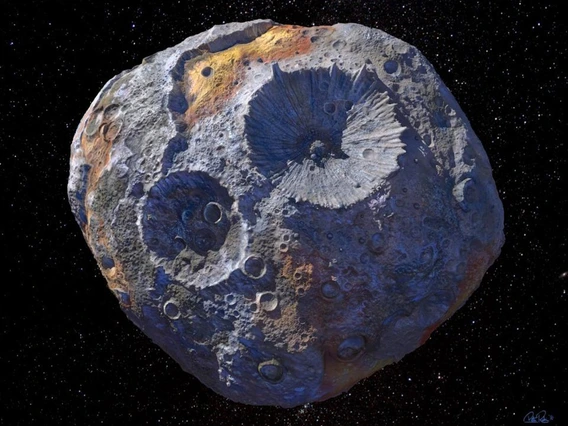
The metallic asteroid Psyche has mystified scientists because it is less dense than it should be. Now, a new theory by researchers including scientists at the University of Arizona, could explain Psyche’s low density and metallic surface.
Psyche, the largest known metallic asteroid in the solar system, is located in the asteroid belt between Mars and Jupiter. Psyche appears to be composed largely of iron and nickel, rather than rocky rubble, like most asteroids, yet its density is estimated to be only about half that of an iron meteorite.
Metal-rich asteroids are thought to have formed when primordial planetesimals collided, stripping away much of the outer material and leaving behind the inner metallic cores, which then cooled and solidified from the outside in. During this cooling process, an alloy of residual melted pockets of iron, nickel and lighter elements like sulfur, might have flowed to the surface through fluid-filled cracks called dikes, coating a topmost, rocky layer.
“We refer to these processes collectively as ‘ferrovolcanism,’” said Brandon Johnson, an associate professor of earth and atmospheric sciences at Purdue University.
“This is a very new idea as of 2019. It’s a kind of volcanism where the magma is liquid metal instead of liquid rock,” said Michael Sori, an associate staff scientist at the UA Lunar and Planetary Laboratory.
The theory is detailed in a paper that was recently published in Nature Astronomy. The paper was co-authored by Johnson, Sori and Alexander Evans, an assistant professor of earth, environmental and planetary sciences at Brown University.
“The first half of the paper is really theoretical. We show that the process is viable,” Sori said. “Then the second half, we give two examples of things we think it can explain. One is meteorites and the other is Psyche.”
Meteorites called pallasites are thought to be a mixture of core and mantle material, possibly blended together by ferrovolcanism. The pockets of liquid metal mixed with sulfur are less dense than surrounding solid material, producing an “excess pressure” and possibly causing the propagation of dikes and allowing ferrovolcanism to occur.
The researchers determined how far these dikes would have to propagate to make volcanism possible.
“Our calculations suggest that ferrovolcanic eruptions may be possible for small, metal-rich bodies, especially for sulfur-rich melts and bodies with mantles thinner than about 35 kilometers or bodies where the mantle has been locally thinned by large impact craters,” Johnson said.
An upcoming NASA space mission to Psyche, planned for 2022, will help scientists test this theory. The ferrovolcanic eruptions might explain Psyche’s low density, which exists despite radar and other scientific evidence of a metallic surface composition. The researchers theorize that the asteroid might consist of two layers, where a metal core is surrounded by a lower density mantle of rocky material.
“Ferrovolcanism may have transported core material to the surface, causing the radar detections of metal,” Johnson said.
The research is ongoing, with future work harnessing more sophisticated modeling to study how ferrovolcanism might occur and possibly probing Psyche’s evolution.
No spacecraft has yet to visit a metallic asteroid, and the concept of ferrovolcanism is based on mathematical models. Sori’s role was applying these models to the asteroid Psyche.

Today’s Students are Tomorrow’s Space Explorers
Ten students from Japan and Arizona gathered for the first official Space Camp at Biosphere 2, where they designed Biosphere 3 to sustain life on Mars.
Today’s Students are Tomorrow’s Space Explorers

By Mikayla Mace, University Communications - August 14, 2019
From the depths of the ocean’s trenches to the most tenuous heights of the atmosphere and everything in between, Biosphere 1 encompasses all life on Earth. The University of Arizona’s Biosphere 2 is the world’s largest earth science laboratory, housing seven model ecosystems dedicated to the research of global scientific issues. Today’s students, and the next generation of interplanetary explorers, have imagined what Biosphere 3 will become on the surface of the Red Planet.
Ten undergraduate students – five from Kyoto University in Japan and five from colleges across Arizona, including one from the UA, gathered for the first official Space Camp at Biosphere 2, held Aug. 5-10. The summer camp was jointly organized and run by researchers from Kyoto and the UA.
At Biosphere 2, the students participated in hands-on research in the facility’s diverse ecosystems including the rainforest, ocean and desert biomes. They also attended lectures by faculty from both universities and three NASA and JAXA astronauts – Richard Linnehan, Kimiya Yui and Takao Doi – about their training and experiences in space.
The activities generated discussion about how to translate lessons learned from the Biosphere 2 closed system for human life support on Mars.
“We worked together to plan Biosphere 3,” said Daniel McConville, a UA sophomore majoring in materials science and engineering.
McConville plans to someday become an astronaut and use the education and experiences he gained at the UA and Space Camp to pursue a career in space development. He hopes to be part of teams that construct bases on the moon and Mars.
“This is a unique opportunity for us to partner with researchers from Japan who have experience on the International Space Station, leverage the expertise the UA has with planetary exploration and conduct research in Biosphere 2,” said John Adams, deputy director of Biosphere 2. “Many researchers have the strong belief that an extended stay in space needs to be balanced between bioregegenerative life support systems and traditional mechanical devices, not just one or the other. The Biosphere is a great place to have those conversations and discuss lessons learned here with the students.”
Biosphere 3
Students were broken up into five groups of two students from both countries. The first team analyzed the geology of Mars to understand resource availability and select a construction site; The second team focused on developing food production techniques to last 50 years for 10 astronauts; The third, which included McConville, designed the human habitat.
The fourth group developed ways to monitor and mitigate harmful radiation. The fifth analyzed student mental and physical health while inhabiting a closed environment for a long period of time. They measured stress levels and recorded vital signs using Fitbits, among other observations.
After a long week of exploring Biosphere 2, the students presented their plans for Biosphere 3. Many were based on lessons learned from the first group of Biospherians that emerged from their sealed excursion more than 25 years ago.
“Biosphere 2 has been running ecosystems for nearly 30 years, which has never been done, Doi said. “Biosphere 2 is not perfect, but we can learn a lot.”
Radiation will be one of the biggest hurdles to space exploration.
“We don’t know if we can even achieve migration to Mars. Even traveling is dangerous and nearly fatal. It’s an expensive problem to overcome,” said Yosuke Yamashiki, a professor at Kyoto University.
As an exercise, the students calculated the radiation dosage in different parts of the biosphere under different conditions. Yamashiki suggested building Biosphere 3 with the ocean on top; A meter of water can be protective against harmful rays.
Another major issue facing the original Biospherians was figuring out how to sustain nutritionally sufficient diets. To avoid some of the same pitfalls, the students decided to incorporate aquaponics, a system of growing crops in water containing fish to cycle nutrients.
“It’s 90% more efficient in terms of water usage and you get three times better crop yield,” McConville said.
Diana Ramirez, an Arizona State University senior majoring in microbiology, drew inspiration from the desert: “Mesquite bean pods have protein and cactus can be eaten,” she said. Desert plants could be used as water-efficient crops.
Future explorers will also have to balance carbon dioxide and oxygen levels in a closed ecosystem, which was a struggle for the original crew sealed within the glass and steel.
“We can’t replicate life-sustaining systems if we don’t first fully understand earth systems,” said Katie Morgan, manager of marine systems at Biosphere 2. “I also believe that the tech we develop for Mars should also help us on Earth.”
Another problem will be energy consumption: “Biosphere 2 also uses a lot of energy,” McConville said. “Solar might be the best way to power Biosphere 3, but there are limitations like weaker sunlight. We also considered nuclear power.”
Dust will also be a major issue for those living on Mars. Martian soil can potentially be carcinogenic and damage electronics in Biosphere 3. The students researched a suit-docking station concept, so the suits (and dust) never have to enter the facility.
McConville said another consideration is the cost of launching building materials to the Red Planet. The students decided they’d send robots ahead of humans to 3D print as many structural components as possible. Explorers from Earth would then follow with additional materials to make the structure airtight. The facility should be lit with lightweight, energy efficient LED bulbs as well as fiber optics to direct in sunlight when windows might be scarce, McConville said. Additionally, air and water recycling systems were inspired by the International Space Station’s closed system.
“A balance between biological and mechanical systems to create a truly self-sustaining environment has not been done yet,” Adams said. “Space Camp has provided an overview of these topics. It’s the initial insight as they further their studies.”
Give Them Space
For many of the students, the best part was interacting with real NASA and JAXA astronauts. While McConville and many others wanted to be astronauts since childhood, Ramirez didn’t dream of venturing into space. She has since changed her mind.
“The astronauts said I should go up there and that my skills will be needed. Now, all I want is to go to space,” Ramirez said.
Yusaku Miyashita, a Kyoto student, has wanted to be an astronaut since he was a kid. He is studying to be a medical doctor and believes space medicine is a necessary field of the future.
“The people who will explore Mars by the 2030s are now students,” said Takao Doi, a Kyoto University professor and former astronaut. He traveled to space in 1997 and again in 2008, spending a total of 32 days in space.
In recent years, he’s decided to promote human space exploration, he said. He came up with the idea for the space camp in 2017.
“As a university, we were already thinking about future Mars missions. We have the land but not the facility. It’s too expensive. We decided: Don’t build, collaborate instead,” said Yamashiki.
Future space camps
Ramirez enjoyed working with international students with a diversity of majors. She believes one of the most important aspects of the camp is the interdisciplinary work.
“We need a mix of sciences in space,” she said. “We all referred to each other with questions during discussions and had the dynamics of a cohesive crew.”
Nearly 50 students from Arizona and over 40 students from Japan applied to the program, according to Michelle Coe, Arizona/NASA Space Grant Consortium manager who coordinated the student selection process. The selected Arizona students come from a diverse pool of majors, demographics and colleges, she said.
Space missions will have to be an international effort, Doi said. In the future, he hopes to incorporate more students from more countries.
Kyoto University ran Space Camp for the past two years in Japan, and this year, they partnered with Biosphere 2 to facilitate and expand the program. Doi and his team will receive additional funding from the Ministry of Education, Culture, Sports, Science and Technology of Japan and continue Space Camp at Biosphere 2 in 2020 and 2021, he said.
“A lot of applicants had outstanding letters of recommendation and high grade point averages, but what made the selected students stand out,” Coe said, “was that each of them talked about getting to work with a different community of STEM (science, technology, engineering and math) scholars, which I thought was important, and also talked about their visions for the future.”
The UA Department of Hydrology and Atmospheric Sciences, UA Lunar and Planetary Laboratory, Biosphere 2 and the Kyoto University Unit for Synergetic Studies for Space, as well as the Graduate School of Advanced Integrated Studies in Human Survivability of Kyoto University, were responsible for the camp.

Best of Both Worlds: Asteroids and Massive Mergers
LPL researchers are using the Catalina Sky Survey’s near-Earth object telescopes to locate the optical counterparts to gravitational waves triggered by massive mergers.
Best of Both Worlds: Asteroids and Massive Mergers

By Mikayla Mace, University Communications - August 14, 2019
The race is on. Since the construction of technology able to detect the ripples in space and time triggered by collisions from massive objects in the universe, astronomers around the world have been searching for the bursts of light that could accompany such collisions, which are thought to be the sources of rare heavy elements.
The University of Arizona’s Steward Observatory has partnered with the Catalina Sky Survey, which searches for near-Earth asteroids from atop Mount Lemmon, in an effort dubbed Searches after Gravitational Waves Using ARizona Observatories, or SAGUARO, to find optical counterparts to massive mergers.
“Catalina Sky Survey has all of this infrastructure for their asteroid survey. So we have deployed additional software to take gravitational wave alerts from LIGO (the Laser Interferometer Gravitational-Wave Observatory) and the Virgo interferometer then notify the survey to search an area of sky most likely to contain the optical counterpart,” said Michael Lundquist, postdoctoral research associate and lead author on the study published today in the Astrophysical Journal Letters.
“Essentially, instead of searching the next section of sky that we would normally, we go off and observe some other area that has a higher probability of containing an optical counterpart of a gravitational wave event,” said Eric Christensen, Catalina Sky Survey director and Lunar and Planetary Laboratory senior staff scientist. “The main idea is we can run this system while still maintaining the asteroid search.”
The ongoing campaign began in April, and in that month alone, the team was notified of three massive collisions. Because it is difficult to tell the precise location from which the gravitational wave originated, locating optical counterparts can be difficult.
According to Lundquist, two strategies are being employed. In the first, teams with small telescopes target galaxies that are at the right approximate distance, according to the gravitational wave signal. Catalina Sky Survey, on the other hand, utilizes a 60-inch telescope with a wide field of view to scan large swaths of sky in 30 minutes.
Three alerts, on April 9, 25 and 26, triggered the team’s software to search nearly 20,000 objects. Machine learning software then trimmed down the total number of potential optical counterparts to five.
The first gravitational wave event was a merger of two black holes, Lundquist said.
“There are some people who think you can get an optical counterpart to those, but it’s definitely inconclusive,” he said.
The second event was a merger of two neutron stars, the incredibly dense core of a collapsed giant star. The third is thought to be a merger between a neutron star and a black hole, Lundquist said.
While no teams confirmed optical counterparts, the UA team did find several supernovae. They also used the Large Binocular Telescope Observatory to spectroscopically classify one promising target from another group. It was determined to be a supernova and not associated with the gravitational wave event.
“We also found a near-Earth object in the search field on April 25,” Christensen said. “That proves right there we can do both things at the same time.”
They were able to do this because Catalina Sky Survey has observations of the same swaths of sky going back many years. Many other groups don’t have easy access to past photos for comparison, offering the UA team a leg up.
“We have really nice references,” Lundquist said. “We subtract the new image from the old image and use that difference to look for anything new in the sky.”
“The process Michael described,” Christensen said, “starting with a large number of candidate detections and filtering down to whatever the true detections are, is very familiar. We do that with near-Earth objects, as well.”
The team is planning on deploying a second telescope in the hunt for optical counterparts: Catalina Sky Survey’s 0.7-meter Schmidt telescope. While the telescope is smaller than the 60-inch telescope, it has an even wider field of view, which allows astronomers to quickly search an even larger chunk of sky. They’ve also improved their machine learning software to filter out stars that regularly change in brightness.
"Catalina Sky Survey takes hundreds of thousands of images of the sky every year, from multiple telescopes. Our survey telescopes image the entire visible nighttime sky several times per month, then we are looking for one kind of narrow slice of the pie," Christensen said. “So, we’ve been willing to share the data with whoever wants to use it.”

NASA Mission Selects Final Four Site Candidates for Asteroid Sample Return
Four locations on the asteroid Bennu have been selected as potential sample sites for the OSIRIS-REx spacecraft.
NASA Mission Selects Final Four Site Candidates for Asteroid Sample Return

By Brittany Enos & Erin Morton, OSIRIS-REx - August 13, 2019
After months grappling with the rugged reality of asteroid Bennu’s surface, the team leading NASA’s first asteroid sample return mission has selected four potential sites for the Origins, Spectral Interpretation, Resource Identification, Security-Regolith Explorer, or OSIRIS-REx, spacecraft to “tag” its cosmic dance partner.
Since its arrival in December 2018, the OSIRIS-REx spacecraft has mapped the entire asteroid in order to identify the safest and most accessible spots for the spacecraft to collect a sample. These four sites now will be studied in further detail in order to select the final two sites – a primary and backup – in December.
The team originally had planned to choose the final two sites by this point in the mission. Initial analysis of Earth-based observations suggested the asteroid’s surface likely contains large “ponds” of fine-grain material. The spacecraft’s earliest images, however, revealed Bennu has an especially rocky terrain. Since then, the asteroid’s boulder-filled topography has created a challenge for the team to identify safe areas containing sampleable material, which must be fine enough – less than 1 inch (2.5 cm) in diameter – for the spacecraft’s sampling mechanism to ingest it.
“We knew that Bennu would surprise us, so we came prepared for whatever we might find,” said Dante Lauretta, OSIRIS-REx principal investigator at the University of Arizona. “As with any mission of exploration, dealing with the unknown requires flexibility, resources and ingenuity. The OSIRIS-REx team has demonstrated these essential traits for overcoming the unexpected throughout the Bennu encounter.”
The original mission schedule intentionally included more than 300 days of extra time during asteroid operations to address such unexpected challenges. In a demonstration of its flexibility and ingenuity in response to Bennu’s surprises, the mission team is adapting its site selection process. Instead of down-selecting to the final two sites this summer, the mission will spend an additional four months studying the four candidate sites in detail, with a particular focus on identifying regions of fine-grain, sampleable material from upcoming, high-resolution observations of each site. The boulder maps that citizen science counters helped create through observations earlier this year were used as one of many pieces of data considered when assessing each site’s safety. The data collected will be key to selecting the final two sites best suited for sample collection.
In order to further adapt to Bennu’s ruggedness, the OSIRIS-REx team has made other adjustments to its sample site identification process. The original mission plan envisioned a sample site with a radius of 82 feet (25 m). Boulder-free sites of that size don’t exist on Bennu, so the team has instead identified sites ranging from 16 to 33 feet (5 to 10 m) in radius. In order for the spacecraft to accurately target a smaller site, the team reassessed the spacecraft’s operational capabilities to maximize its performance. The mission also has tightened its navigation requirements to guide the spacecraft to the asteroid’s surface, and developed a new sampling technique called “Bullseye TAG,” which uses images of the asteroid surface to navigate the spacecraft all the way to the actual surface with high accuracy. The mission’s performance so far has demonstrated the new standards are within its capabilities.
“Although OSIRIS-REx was designed to collect a sample from an asteroid with a beach-like area, the extraordinary in-flight performance to date demonstrates that we will be able to meet the challenge that the rugged surface of Bennu presents,” said Rich Burns, OSIRIS-REx project manager at NASA’s Goddard Space Flight Center in Greenbelt, Maryland. “That extraordinary performance encompasses not only the spacecraft and instruments, but also the team who continues to meet every challenge that Bennu throws at us.”
The four candidate sample sites on Bennu are designated Nightingale, Kingfisher, Osprey, and Sandpiper – all birds native to Egypt. The naming theme complements the mission’s two other naming conventions – Egyptian deities (the asteroid and spacecraft) and mythological birds (surface features on Bennu).
The four sites are diverse in both geographic location and geological features. While the amount of sampleable material in each site has yet to be determined, all four sites have been evaluated thoroughly to ensure the spacecraft’s safety as it descends to, touches and collects a sample from the asteroid’s surface.
Nightingale is the northern-most site, situated at 56 degrees north latitude on Bennu. There are multiple possible sampling regions in this site, which is set in a small crater encompassed by a larger crater 459 feet (140 m) in diameter. The site contains mostly fine-grain, dark material and has the lowest albedo, or reflection, and surface temperature of the four sites.
Kingfisher is located in a small crater near Bennu’s equator at 11 degrees north latitude. The crater has a diameter of 26 feet (8 m) and is surrounded by boulders, although the site itself is free of large rocks. Among the four sites, Kingfisher has the strongest spectral signature for hydrated minerals.
Osprey is set in a small crater, 66 feet (20 m) in diameter, which is also located in Bennu’s equatorial region at 11 degrees north latitude. There are several possible sampling regions within the site. The diversity of rock types in the surrounding area suggests that the regolith within Osprey may also be diverse. Osprey has the strongest spectral signature of carbon-rich material among the four sites.
Sandpiper is located in Bennu’s southern hemisphere, at 47 degrees south latitude. The site is in a relatively flat area on the wall of a large crater 207 ft (63 m) in diameter. Hydrated minerals are also present, which indicates that Sandpiper may contain unmodified water-rich material.
This fall, OSIRIS-REx will begin detailed analyses of the four candidate sites during the mission’s reconnaissance phase. During the first stage of this phase, the spacecraft will execute high passes over each of the four sites from a distance of 0.8 miles (1.29 km) to confirm they are safe and contain sampleable material. Closeup imaging also will map the features and landmarks required for the spacecraft’s autonomous navigation to the asteroid’s surface. The team will use the data from these passes to select the final primary and backup sample collection sites in December.
The second and third stages of reconnaissance will begin in early 2020 when the spacecraft will perform passes over the final two sites at lower altitudes and take even higher resolution observations of the surface to identify features, such as groupings of rocks that will be used to navigate to the surface for sample collection. OSIRIS-REx sample collection is scheduled for the latter half of 2020, and the spacecraft will return the asteroid samples to Earth on Sept. 24, 2023.
Goddard provides overall mission management, systems engineering, and safety and mission assurance for OSIRIS-REx. Dante Lauretta of the University of Arizona, Tucson, is the principal investigator, and the University of Arizona leads the science team and the mission’s science observation planning and data processing. Lockheed Martin Space in Denver built the spacecraft and is providing flight operations. Goddard and KinetX Aerospace are responsible for navigating the spacecraft. OSIRIS-REx is the third mission in NASA’s New Frontiers Program, which is managed by NASA’s Marshall Space Flight Center in Huntsville, Alabama, for the agency’s Science Mission Directorate in Washington.
To explore the final four candidate sites in detail, click here.

A New Lens for Life-Searching Space Telescopes
UA researchers have designed a new kind of telescope that is a cheaper, lighter and more powerful option than creating telescopes using ever-larger mirrors. With a fleet of the newly designed space telescopes, they aim to scour a thousand worlds for the chemical signatures of life.
A New Lens for Life-Searching Space Telescopes

By Makayla Mace, University Communications - August 7, 2019
The University of Arizona Richard F. Caris Mirror Laboratory is a world leader in the production of the world’s largest telescope mirrors. In fact, it is currently fabricating mirrors for the largest and most advanced earth-based telescope: The Giant Magellan Telescope.
But there are size constraints, ranging from the mirror’s own weight, which can distort images, to the size of our freeways and underpasses that are needed to transport finished pieces. Such giant mirrors are reaching their physical limits, but when they do, the UA will continue to be a global contributor to the art of gathering light and drive change in the way astronomers observe the stars.
“We are developing a new technology to replace mirrors in space telescopes,” said UA associate professor Daniel Apai, of Steward Observatory and the Lunar and Planetary Laboratory. “If we succeed, we will be able to vastly increase the light-collecting power of telescopes, and among other science, study the atmospheres of 1,000 potentially earth-like planets for signs of life.”
Apai leads the space science half of the team, while UA professor Tom Milster, of the James C. Wyant College of Optical Sciences, leads the optical design of a replicable space telescope dubbed Nautilus. The researchers intend to deploy a fleet of 35 14-meter-wide spherical telescopes, each individually more powerful than the Hubble Space Telescope.
Each unit will contain a meticulously crafted 8.5-meter diameter lens, which will be used for astronomical observations. One use particularly exciting for Apai is analyzing starlight as it filters through planetary atmospheres, a technique which could reveal chemical signatures of life.
When combined, the telescope array will be powerful enough to characterize 1,000 extrasolar planets from as far away as 1,000 light years. Even NASA’s most ambitious space telescope missions are designed to study a handful of potentially Earth-like extrasolar planets.
“Such a sample may be too small to truly understand the complexity of exo-earths,” according to Apai and Milster’s co-authored paper, which was published July 29 in the Astronomical Journal along with several other authors, including Steward Observatory astronomer Glenn Schneider and Alex Bixel, an astronomer and UA graduate student.
To develop Nautilus, Apai and Milster defined a goal and designed Nautilus to meet it.
“We wanted to search 1,000 potentially earth-like planets for signs of life. So, we first asked, what kinds of stars are most likely to host planets? Then, how far do we need to go in space to have 1,000 earth-like planets orbiting around them? It turned out that it’s over 1,000 light years – a great distance, but still just a small part of the galaxy,” Apai said. “We then calculated the light collecting power needed, which turned out to be the equivalent of a 50-meter diameter telescope.”
The Hubble mirror is 2.4 meters in diameter and the James Webb Space Telescope mirror is 6.5 meters in diameter. Both were designed for different purposes and before exoplanets were even discovered.
“Telescope mirrors collect light – the larger the surface, the more starlight they can catch,” Apai said. “But no one can build a 50-meter mirror. So we came up with Nautilus, which relies on lenses, and instead of building an impossibly huge 50-meter mirror, we plan on building a whole bunch of identical smaller lenses to collect the same amount of light.”
The lenses were inspired by lighthouse lenses – large but lightweight – and include additional tweaks such as precision carving with diamond-tipped tools. The patented design, which is a hybrid between refractive and diffractive lenses, make them more powerful and suitable for planet hunting, Milster said.
Because the lenses are lighter than mirrors, they are less expensive to launch into space and can be made quickly and cheaply using a mold. They are also less sensitive to misalignments, making telescopes built with this technology much more economical. Much like Ford did for cars, Ikea did for furniture, and SpaceX for rockets, Nautilus will use new technology, a simpler design, and lightweight components to provide cheaper and more efficient telescopes with more light-collecting power.
Nautilus telescopes also don’t require any fancy observing technique.
“We don’t need extremely high-contrast imaging. We don’t need a separate spacecraft with a giant starshade to occult the planet host stars. We don’t need to go into the infrared," Apai said. "What we do need is to collect lots of light in an efficient and cheap way.”
In the last few decades, computers, electronics and data-collection instruments have all become smaller, cheaper, faster and more efficient. Mirrors, on the other hand, are exceptions to this growth as they haven’t seen big cost reductions.
“Currently, mirrors are expensive because it takes years to grind, polish, coat and test,” Apai said. Their weight also makes them expensive to launch. “But our Nautilus technology starts with a mold, and often it takes just hours to make a lens. We also have more control over the process, so if we make a mistake, we don’t need to start all over again like you may need to with a mirror.”
Additionally, risk would be distributed over many telescopes, so if something goes wrong, the mission isn’t scrapped. Many telescopes remain.
“Everything is simple, cheap and replicable, and we can collect a lot of light,” Apai said.
Apai and Milster have another vision if they succeed: “Using the low-cost, replicated space telescope technology, universities would be able to launch their own small, Earth- or space-observing telescopes. Instead of competing for bits of time on Hubble, they’d get their own telescope, controlled by their own teams,” Apai said.
In January, Apai and Milster's team, along with UA assistant professor Dae Wook Kim and professor Ronguang Liang of the College of Optical Sciences and Jonathan Arenberg from Northrop Grumman Aerospace Systems, received $1.1 million from the Moore Foundation to create a prototype of a single telescope and test it on the 61-inch Kuiper Telescope on Mt. Bigelow by December 2020.
“The University of Arizona is just one of the few places in the world, and usually the first in the world, to generate such pioneering telescope systems,” Milster said. “And it fits right in line with our history and our prominence in optical sciences and astronomy that we develop this technology.”