
Asteroids Bennu and Ryugu May Have Formed Directly From Collision in Space
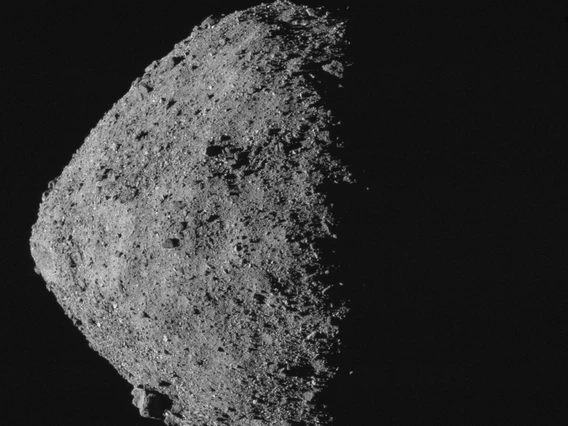
Scientists from the OSIRIS-REx and Hayabusa2 teams have a new theory about why the asteroids Bennu and Ryugu have their signature "spinning-top" shapes.
Asteroids Bennu and Ryugu May Have Formed Directly From Collision in Space

By Brittany Enos, Lunar and Planetary Laboratory - June 1, 2020
Scientists with NASA's first asteroid sample return mission, OSIRIS-REx, are gaining a new understanding of asteroid Bennu's carbon-rich material and signature "spinning-top" shape. The team, led by the University of Arizona, has discovered that the asteroid's shape and hydration levels provide clues to the origins and histories of this and other small bodies.
Bennu, the target asteroid for the OSIRIS-REx mission, and Ryugu, the target of the Japan Aerospace Exploration Agency's Hayabusa2 asteroid sample return mission, are composed of fragments of larger bodies that shattered upon colliding with other objects. The small fragments reaccumulated to form an aggregate body. Bennu and Ryugu may actually have formed in this way from the same original shattered parent body. Now, scientists are looking to discover what processes led to specific characteristics of these asteroids, such as their shape and mineralogy.
Bennu and Ryugu are both classified as "spinning-top" asteroids, which means they have a pronounced equatorial ridge. Until now, scientists thought that this shape formed as the result of thermal forces, called the YORP effect. The YORP effect increases the speed of the asteroid's spin, and over millions of years, material near the poles could have migrated to accumulate on the equator, eventually forming a spinning-top shape – meaning that the shape would have formed relatively recently.
However, in a new paper published in Nature Communications, scientists from the OSIRIS-REx and Hayabusa2 teams argue that the YORP effect may not explain the shape of either Bennu or Ryugu. Both asteroids have large impact craters on their equators, and their size suggests that these craters are some of Bennu's oldest surface features. Since the craters cover the equatorial ridges, their spinning-top shapes must also have been formed much earlier.
"Using computer simulations that model the impact that broke up Bennu's parent body, we show that these asteroids either formed directly as top-shapes, or achieved the shape early after their formation in the main asteroid belt," said Ronald Ballouz, co-lead author and OSIRIS-REx postdoctoral research associate at the UArizona. "The presence of the large equatorial craters on these asteroids, as seen in images returned by the spacecraft, rules out that the asteroids experienced a recent re-shaping due to the YORP effect. We would expect these craters to have disappeared with a recent YORP-induced re-shaping of the asteroid."
In addition to their shapes, Bennu and Ryugu also both contain water-bearing surface material in the form of clay minerals. Ryugu's surface material is less water-rich than Bennu's, which implies that Ryugu's material experienced more heating at some point.
Assuming Bennu and Ryugu formed simultaneously, the paper explores two possible explanations for the different hydration levels of the two bodies based on the team's computer simulations. One hypothesis suggests that when the parent asteroid was disrupted, Bennu formed from material closer to the original surface, while Ryugu contained more material from near the parent body's original center. Another possible explanation for the difference in hydration levels is that the fragments experienced different levels of heating during the parent asteroid's disruption. If this is the case, Ryugu's source material is likely from an area near the impact point, where temperatures were higher. Bennu's material would have come from a region that didn't undergo as much heating, and was likely farther from the point of impact. Analysis of the returned samples and further observational analysis of the asteroids' surfaces will provide a clearer idea of the possible shared history of the two asteroids.
"These simulations provide valuable new insights into how Bennu and Ryugu formed," said Dante Lauretta, OSIRIS-REx principal investigator and UArizona professor of planetary sciences. "Once we have the returned samples of these two asteroids in the lab, we may be able to further confirm these models, possibly revealing the true relationship between the two asteroids."
Scientists anticipate that the samples will also provide new insights into the origins, formation and evolution of other carbonaceous asteroids and meteorites. The Japan Aerospace Exploration Agency's Hayabusa2 mission is currently making its way back to Earth, and is scheduled to deliver its samples of Ryugu late this year. The OSIRIS-REx mission will perform its first sample collection attempt at Bennu on Oct. 20 and will deliver its samples to Earth on Sep. 24, 2023.

OSIRIS-REx Asteroid Sample Collection Set for October 20
The new date allows the team more time to assess Bennu's unexpectedly rugged terrain. The event will mark NASA's first-ever asteroid sample collection.
OSIRIS-REx Asteroid Sample Collection Set for October 20

By Mikayla Mace, University Communications - May 21, 2020
After more than a decade of work and much anticipation, the University of Arizona-led OSIRIS-REx mission will swipe a sample from the asteroid Bennu's rocky surface on Oct. 20 from the Nightingale sample site.
The mission team successfully completed a first rehearsal last month, and on Tuesday, NASA approved a second rehearsal date of Aug. 11 and the Touch-and-Go, or TAG, sample collection event in October.
The original target date for sample collection was planned for late August, but the new Oct. 20 date will allow the team more time to prepare, in the wake of the COVID-19 pandemic.
"From the project's inception, and from experience on previous missions, the principal investigator, Dante Lauretta, myself and the team laid out a methodical schedule with strategically placed schedule margin with the knowledge that we need to accommodate unexpected events along the way," said Heather Enos, deputy principal investigator for the OSIRIS-REx mission. "The fact that this is such a long mission means there's more opportunity to experience the unexpected. We knew that and planned for it. I'm in awe of how adaptable this team is."
OSIRIS-REx has three major partners: Lockheed Martin, NASA's Goddard Space Flight Center and the University of Arizona. They're currently using remote communications, Enos said, but for big operations, such as rehearsal and sample collection, there is a lot of value in having your team in one location.
After the first rehearsal on April 14, the team decided to schedule more time between the second rehearsal and sample collection.
"We want to provide the team more time to see if there's anything we can to do improve the mission's probability of success," Enos said. "We gave them two more weeks between rehearsal and sample collection. We were expecting a 25-meter (about 80-foot) target radius, but we quickly learned that Bennu's rocky surface would only allow for two to four meters (less than 14 feet) to work with."
The OSIRIS-REx spacecraft arrived at the asteroid Bennu in December 2018 and has since been surveying and studying the asteroid from orbit. The mission is scheduled to leave Bennu in March 2021 and return to Earth on Sept. 24, 2023.

UArizona Cameras Capture Asteroid Close-Up During OSIRIS-REx Rehearsal
The spacecraft of the LPL-led OSIRIS-REx asteroid sample return mission executed a series of maneuvers that brought it within a mere 200 feet of its designated sampling location on the surface of Bennu.
UArizona Cameras Capture Asteroid Close-Up During OSIRIS-REx Rehearsal

By Daniel Stolte, University Communications - April 21, 2020
A carefully choreographed dance on April 14 brought the spacecraft of the University of Arizona-led OSIRIS-REx asteroid sample return mission within just over 200 feet of the surface of the asteroid Bennu – closer than ever before.
During the maneuver, which marked the first rehearsal of the NASA mission's asteroid sample collection, the spacecraft engaged in a series of thruster burns and repositioning maneuvers to go through the exact same motions that planners mapped out for the mission's sample collection event, slated for late summer.
A series of images captured by the spacecraft's SamCam, one of several cameras designed and built at the University of Arizona's Lunar and Planetary Laboratory, shows the spacecraft's field of view as it approaches, hovers and then moves away from Bennu's surface.
The images were recorded over a 10-minute span between the execution of the rehearsal's checkpoint burn, approximately 394 feet above the surface, and the completion of the back-away burn, which occurred approximately 213 feet above the surface. During such burns, the spacecraft fires its thrusters in very precise and programmed sequences to maneuver in space.
"The goal of this checkpoint rehearsal is to make sure we get through the first two maneuvers needed to accomplish the sampling, and then safely back away," says Dani DellaGiustina, lead image processing scientist for the OSIRIS-REx mission. "What we're seeing here is the spacecraft as it approaches Bennu's surface, and once the spacecraft executes its checkpoint maneuver to initiate its descent, it pulls away. The image sequence captures that entire event."
During the April 14 rehearsal, the spacecraft – operating autonomously more than 140 million miles from Earth – deployed its sampling arm, called the Touch-And-Go Sample Acquisition Mechanism, or TAGSAM, which folded out from its parked position and extended to 11 feet. The arm has a round sampler head at the end, designed to collect a sample of loose surface material, called regolith, from Bennu.
During the touch-and-go sample collection event later this summer, the sampler head will be extended toward Bennu, and the momentum of the spacecraft's slow, downward trajectory will push it against the asteroid's surface for about five seconds—just long enough to obtain a sample. At contact, nitrogen gas will blow onto the surface to roil up dust and small pebbles, which will then be captured in the TAGSAM head.
The new series of images was taken as OSIRIS-REx swoops down toward Bennu's surface, with the arm and attached sample-collection head visible in the central part of the image frames. As it gets closer, the relatively clear, dark patch of Bennu's sample site, dubbed Nightingale, becomes visible. Just below it, a large, dark boulder, measuring 43 feet long, can be seen as the spacecraft approaches. The sequence was created using over 30 images taken by the spacecraft's SamCam camera. For context, the images are oriented with Bennu's west at the top. In other words, the asteroid's latitudinal lines would run vertically through the image.
"We're moving much more slowly than the animated image provides a sense for, and the majority of the movement you see is actually Bennu rotating underneath us," DellaGiustina said.
During the rehearsal, the spacecraft's suite of electronic eyes took images about every 20 seconds and sent them back to Earth. As soon as they arrived, DellaGiustina and her team got to work.
"I was scrolling through the images very quickly to see how much movement there was between the frames," she said. "Toward the end, when Nightingale came into view, it was so satisfying to see that right where we expected it to be before we backed off."
To create the animated sequence, DellaGiustina's team applied software algorithms, including components custom made by the mission team, to process them and stitch 30 frames together into the animated GIF.
"We don't use SamCam very often, because the imager was developed specifically to document the sampling event," she said. "To see SamCam in action, and to see it is doing exactly what it was designed to do, is very satisfying."
DellaGiustina said there really weren't any surprises during the checkpoint rehearsal.
"We've been planning this event for so long that all of us had a very concrete idea in our minds (of the checkpoint rehearsal), so you could say the only surprise was the fact that we saw exactly what we expected," DellaGiustina says. "I think that's a testament to our navigation team doing an extraordinary job."
The spacecraft is slated to go for the touch-and-go maneuver on Aug. 25, when it will gently descend onto its surface and collect the largest sample of extraterrestrial material since the Apollo moon landings.

A Martian Mash Up: Meteorites Tell Story of Mars' Water History
LPL researchers probed Martian meteorites to reconstruct Mars’ chaotic history. Their findings suggest that Mars might not have had a global magma ocean.
A Martian Mash Up: Meteorites Tell Story of Mars' Water History

By Mikayla Mace, University Communications - March 30, 2020
In Jessica Barnes' palm is an ancient, coin-sized mosaic of glass, minerals and rocks as thick as a strand of wool fiber. It is a slice of Martian meteorite, known as Northwest Africa 7034 or Black Beauty, that was formed when a huge impact cemented together various pieces of the Martian crust.
Barnes is an assistant professor of planetary sciences in the University of Arizona Lunar and Planetary Laboratory. She and her team chemically analyzed the Black Beauty meteorite and the infamous Allan Hills 84001 meteorite – controversial in the 1990s for allegedly containing Martian microbes – to reconstruct Mars' water history and planetary origins.
Their analysis, published today in Nature Geoscience, showed that Mars likely received water from at least two vastly different sources early in its history. The variability the researchers found implies that Mars, unlike Earth and the moon, never had an ocean of magma completely encompassing the planet.
"These two different sources of water in Mars' interior might be telling us something about the kinds of objects that were available to coalesce into the inner, rocky planets," Barnes said.
Two distinct planetary precursors with vastly different water contents could have collided and never fully mixed, she said. "This context is also important for understanding the past habitability and astrobiology of Mars."
Reading the Water
"A lot of people have been trying to figure out Mars' water history," Barnes said. "Like, where did water come from? How long was it in the crust (surface) of Mars? Where did Mars' interior water come from? What can water tell us about how Mars formed and evolved?"
Barnes and her team were able to piece together Mars' water history by looking for clues in two types, or isotopes, of hydrogen. One hydrogen isotope contains one proton in its nucleus; this is sometimes called "light hydrogen." The other isotope is called deuterium, which contains a proton and a neutron in the nucleus; this is sometimes referred to as "heavy hydrogen." The ratio of these two hydrogen isotopes signals to a planetary scientist the processes and possible origins of water in the rocks, minerals and glasses in which they're found.
Meteorite Mystery
For about 20 years, researchers have been recording the isotopic ratios from Martian meteorites, and their data were all over the place. There seemed to be little trend, Barnes said.
Water locked in Earth rocks is what's called unfractionated, meaning it doesn't deviate much from the standard reference value of ocean water – a 1:6,420 ratio of heavy to light hydrogen. Mars' atmosphere, on the other hand, is heavily fractionated – it is mostly populated by deuterium, or heavy hydrogen, likely because the solar wind stripped away the light hydrogen. Measurements from Martian meteorites – many of which were excavated from deep within Mars by impact events – ran the gamut between Earth and Mars' atmosphere measurements.
Barnes' team set out to investigate the hydrogen isotope composition of the Martian crust specifically by studying samples they knew originated from the crust: the Black Beauty and Allan Hills meteorites. Black Beauty was especially helpful because it's a mashup of surface material from many different points in Mars' history.
"This allowed us to form an idea of what Mars' crust looked like over several billions of years," Barnes said.
The isotopic ratios of the meteorite samples fell about midway between the value for Earth rocks and Mars' atmosphere. When the researchers' findings were compared with previous studies, including results from the Curiosity Rover, it seems that this was the case for most of Mars 4 billion-plus-year history.
"We thought, OK, this is interesting, but also kind of weird," Barnes said. "How do we explain this dichotomy where the Martian atmosphere is being fractionated, but the crust is basically staying the same over geological time?"
Barnes and her colleagues also grappled with trying to explain why the crust seemed so different from the Martian mantle – the rock layer that lies below.
"If you try and explain this fairly constant isotopic ratio of Mars' crust, you really can't use the atmosphere to do that," Barnes said. "But we know how crusts are formed. They're formed from molten material from the interior that solidifies on the surface."
"The prevailing hypothesis before we started this work was that the interior of Mars was more Earthlike and unfractionated, and so the variability in hydrogen isotope ratios within Martian samples was due to either terrestrial contamination or atmospheric implantation as it made its way off Mars," Barnes said.
The idea that Mars' interior was Earth-like in composition came from one study of a Martian meteorite thought to have originated from the mantle – the interior between the planet's core and its surface crust.
However, Barnes said, "Martian meteorites basically plot all over the place, and so trying to figure out what these samples are actually telling us about water in the mantle of Mars has historically been a challenge. The fact that our data for the crust was so different prompted us to go back through the scientific literature and scrutinize the data."
The researchers found that two geochemically different types of Martian volcanic rocks – enriched shergottites and depleted shergottites – contain water with different hydrogen isotope ratios. Enriched shergottites contain more deuterium than the depleted shergottites, which are more Earth-like, they found.
"It turns out that if you mix different proportions of hydrogen from these two kinds of shergottites, you can get the crustal value," Barnes said.
She and her colleagues think that the shergottites are recording the signatures of two different hydrogen – and by extension, water – reservoirs within Mars. The stark difference hints to them that more than one source might have contributed water to Mars and that Mars did not have a global magma ocean.

What Makes Saturn's Upper Atmosphere So Hot
New mapping of the giant planet's upper atmosphere reveals a likely reason why it's so hot.
What Makes Saturn's Upper Atmosphere So Hot

NASA Jet Propulsion Laboratory and University Communications - April 6, 2020
The upper layers in the atmospheres of gas giants – Saturn, Jupiter, Uranus and Neptune – are hot, just like Earth's. But unlike Earth, the sun is too far from these outer planets to account for the high temperatures. Their heat source has been one of the great mysteries of planetary science.
New analysis of data from NASA's Cassini spacecraft finds a viable explanation for what's keeping the upper layers of Saturn, and possibly the other gas giants, so hot: auroras at the planet's north and south poles. Electric currents, triggered by interactions between solar winds and charged particles from Saturn's moons, spark the auroras and heat the upper atmosphere. As with Earth's northern lights, studying auroras tells scientists what's going on in the planet's atmosphere.
The work, published today in Nature Astronomy, is the most complete mapping yet of both temperature and density of a Saturn's upper atmosphere – a region that has been poorly understood.
"Understanding the dynamics really requires a global view. This dataset is the first time we've been able to look at the upper atmosphere from pole to pole while also seeing how temperature changes with depth," said Zarah Brown, lead author of the study and a graduate student in the University of Arizona Lunar and Planetary Laboratory.
By building a complete picture of how heat circulates in the atmosphere, scientists are better able to understand how auroral electric currents heat the upper layers of Saturn's atmosphere and drive winds. The global wind system can distribute this energy, which is initially deposited near the poles toward the equatorial regions, heating them to twice the temperatures expected from the sun's heating alone.
"The results are vital to our general understanding of planetary upper atmospheres and are an important part of Cassini's legacy," said study co-author Tommi Koskinen, a member of Cassini's Ultraviolet Imaging Spectograph team. "They help address the question of why the uppermost part of the atmosphere is so hot, while the rest of the atmosphere – due to the large distance from the sun – is cold."
Managed by NASA's Jet Propulsion Laboratory in Southern California, Cassini was an orbiter that observed Saturn for more than 13 years before exhausting its fuel supply. The mission plunged it into the planet's atmosphere in September 2017, in part to protect its moon Enceladus, which Cassini discovered might hold conditions suitable for life. But before its plunge, Cassini performed 22 ultra-close orbits of Saturn, a final tour called the Grand Finale.
It was during the Grand Finale that the key data was collected for the new temperature map of Saturn's atmosphere. For six weeks, Cassini targeted several bright stars in the constellations of Orion and Canis Major as they passed behind Saturn. As the spacecraft observed the stars rise and set behind the giant planet, scientists analyzed how the starlight changed as it passed through the atmosphere.
Measuring the density of the atmosphere gave scientists the information they needed to find the temperatures. Density decreases with altitude, and the rate of decrease depends on temperature. They found that temperatures peak near the auroras, indicating that auroral electric currents heat the upper atmosphere.
Density and temperature measurements together helped scientists figure out wind speeds. Understanding Saturn's upper atmosphere, where planet meets space, is key to understanding space weather and its impact on other planets in our solar system and exoplanets around other stars.
"Even though thousands of exoplanets have been found, only the planets in our solar system can be studied in this kind of detail. Thanks to Cassini, we have a more detailed picture of Saturn's upper atmosphere right now than any other giant planet in the universe," Brown said.
The Cassini-Huygens mission is a cooperative project of NASA, the European Space Agency and the Italian Space Agency. NASA's Jet Propulsion Laboratory, or JPL, a division of Caltech in Pasadena, manages the mission for NASA's Science Mission Directorate in Washington. JPL designed, developed and assembled the Cassini orbiter.
UArizona-Led Mission to Io Selected as Finalist for NASA Discovery Program
If selected as the winner, the spacecraft mission to Jupiter's volcanic, vibrant moon will determine whether a magma ocean lurks beneath its surface.
UArizona-Led Mission to Io Selected as Finalist for NASA Discovery Program

By Makayla Mace, University Communications - February 13, 2020
A University of Arizona-led mission proposal to one of Jupiter's moons is among the four finalists for the next $500 million Discovery mission, NASA announced today. The Discovery Program funds midsize principal-investigator-led spacecraft missions designed to unlock the mysteries of the solar system and our origins.
The four finalists will now embark on a one-year study before NASA expects to make its final selection in 2021.
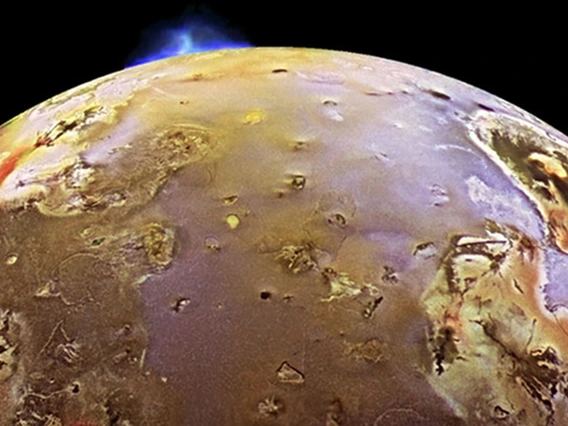
If selected, the Io Volcano Observer, or IVO, mission will orbit Jupiter and make 10 close flybys of its moon Io – the most volcanically active world in the solar system – to determine if the moon has a magma ocean hidden beneath its vibrant, pockmarked surface.
"IVO will revolutionize our understanding of a truly spectacular, volcanically active world, with volcanic eruption scales seen on Earth only during mass extinctions," said Alfred McEwen, IVO principal investigator and Regents Professor of planetary sciences.
"To become a finalist for the next phase of the NASA Discovery Program is a tremendous accomplishment," said University of Arizona President Robert C. Robbins. "If we are selected in the final round, IVO will become the second University of Arizona-led Discovery mission following the Phoenix Mars Lander, and the third University of Arizona-led NASA planetary mission, following the current OSIRIS-REx mission. The University of Arizona has a long history of space research that began with mapping the moon and has included most NASA planetary missions. This is a phenomenal step for our continuing leadership in space exploration."
The mission would carry a suite of science experiments to map Io's surface, measure its heat flow, monitor volcanic activity, measure the composition of surface lavas and gases erupting from Io, and measure the magnetic and gravitational fields near Io that inform us about the internal structure and distribution of magma.
"Magma oceans were common among the terrestrial planets – Mercury, Venus, Earth, Mars and the moon – soon after the planets formed," McEwen said, "and are an integral piece of planet formation and evolution. They are responsible for the formation of metal cores and degassing to produce the planet's oceans and atmosphere."
These magma oceans cooled and solidified billions of years ago, but great quantities of magma are currently produced in Io from tidal heating as it is stretched and squished by its gravitational dance with the giant Jupiter and sister moons, changing its shape every 42-hour orbit.
The tidal heating could be so great that it sustains an entire magma ocean. Or Io may lack a continuous liquid layer and instead resemble the terrestrial planets soon after their magma oceans solidified. Either way, Io can inform us about ancient volcanic and tectonic processes on Earth and other worlds, and about countless exoplanets that may resemble Io, according to McEwen.
"The NASA Discovery Program enables universities like ours to make exquisite use of our remarkable scientists to peer into the formations and workings of planetary bodies, comets and asteroids and truly discover new knowledge that illuminates our place in the universe," said Senior Vice President for Research and Innovation Elizabeth "Betsy" Cantwell. "The discoveries resulting from this program also advance our ability to innovate broadly around space technologies and new entrepreneurial opportunities, opening many more doors for advances that benefit life on Earth."
The IVO spacecraft and several science instruments would be built and managed by the Applied Physics Laboratory. UArizona would lead science operations and the potential development of a camera in collaboration with students. Other key partners are the Jet Propulsion Laboratory for gravity science and spacecraft navigation, the University of California, Los Angeles for magnetometers, the German Aerospace Center for an infrared instrument and the University of Bern in Switzerland for a mass spectrometer.
X Marks the Spot: NASA Selects Site for Asteroid Sample Collection
The OSIRIS-REx mission team evaluated data from four candidate sites in order to identify site Nightingale as the best option for the sample collection, with site Osprey named as the backup.
X Marks the Spot: NASA Selects Site for Asteroid Sample Collection

By Brittany Enos, OSIRIS-REx - December 12, 2019
After a year scoping out asteroid Bennu’s boulder-scattered surface, the team leading NASA’s first asteroid sample return mission has officially selected a sample collection site.
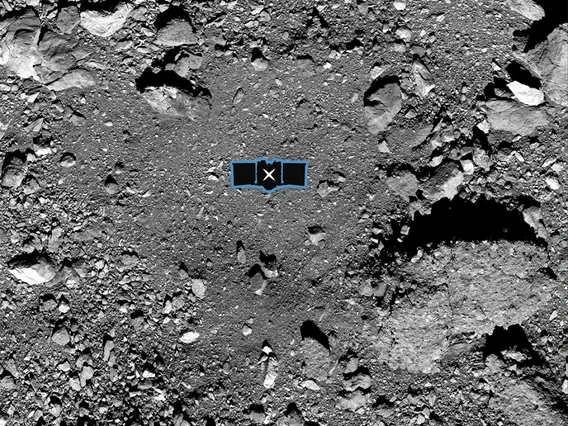
The Origins, Spectral Interpretation, Resource Identification, Security, Regolith Explorer, or OSIRIS-REx, mission team concluded a site designated “Nightingale” – located in a crater high in Bennu’s northern hemisphere – is the best spot for the OSIRIS-REx spacecraft to snag its sample.
The OSIRIS-REx team spent the past several months evaluating close-range data from four candidate sites in order to identify the best option for the sample collection. The candidate sites – dubbed Sandpiper, Osprey, Kingfisher and Nightingale – were chosen for investigation because, of all the potential sampling regions on Bennu, these areas pose the fewest hazards to the spacecraft’s safety while still providing the opportunity for great samples to be gathered.
“After thoroughly evaluating all four candidate sites, we made our final decision based on which site has the greatest amount of fine-grained material and how easily the spacecraft can access that material while keeping the spacecraft safe,” said Dante Lauretta, OSIRIS-REx principal investigator at the University of Arizona. “Of the four candidates, site Nightingale best meets these criteria and, ultimately, best ensures mission success.”
Site Nightingale is located in a northern crater 230 feet (70 meters) wide. Nightingale’s regolith – or rocky surface material – is dark, and images show that the crater is relatively smooth. Because it is located so far north, temperatures in the region are lower than elsewhere on the asteroid and the surface material is well-preserved. The crater also is thought to be relatively young, and the regolith is freshly exposed. This means the site would likely allow for a pristine sample of the asteroid, giving the team insight into Bennu’s history.
Although Nightingale ranks the highest of any location on Bennu, the site still poses challenges for sample collection. The original mission plan envisioned a sample site with a diameter of 164 feet (50 m). While the crater that hosts Nightingale is larger than that, the area safe enough for the spacecraft to touch is much smaller – approximately 52 feet (16 m) in diameter, resulting in a site that is only about one-tenth the size of what was originally envisioned This means the spacecraft has to very accurately target Bennu’s surface. Nightingale also has a building-size boulder situated on the crater’s eastern rim, which could pose a hazard to the spacecraft while backing away after contacting the site.
The mission also selected site Osprey as a backup sample collection site. The spacecraft has the capability to perform multiple sampling attempts, but any significant disturbance to Nightingale’s surface would make it difficult to collect a sample from that area on a later attempt, making a backup site necessary. The spacecraft is designed to autonomously “wave-off” from the site if its predicted position is too close to a hazardous area. During this maneuver, the exhaust plumes from the spacecraft’s thrusters could potentially disturb the surface of the site, due to the asteroid’s microgravity environment. In any situation where a follow-on attempt at Nightingale is not possible, the team will try to collect a sample from site Osprey instead.
"Bennu has challenged OSIRIS-REx with extraordinarily rugged terrain," said Rich Burns, OSIRIS-REx project manager at NASA’s Goddard Space Flight Center. "The team has adapted by employing a more accurate, though more complex, optical navigation technique to be able to get into these small areas. We'll also arm OSIRIS-REx with the capability to recognize if it is on course to touch a hazard within or adjacent to the site and wave-off before that happens."
With the selection of final primary and backup sites, the mission team will undertake further reconnaissance flights over Nightingale and Osprey, beginning in January and continuing through the spring. Once these flyovers are complete, the spacecraft will begin rehearsals for its "touch-and-go" sample collection event, which is scheduled for August. The spacecraft will depart Bennu in 2021 and is scheduled to return to Earth in September 2023.
NASA’s Goddard Space Flight Center in Greenbelt, Maryland, provides overall mission management, systems engineering, and the safety and mission assurance for OSIRIS-REx. Dante Lauretta of the University of Arizona is the principal investigator, and the University of Arizona also leads the science team and the mission’s science observation planning and data processing. Lockheed Martin Space in Denver built the spacecraft and provides flight operations. Goddard and KinetX Aerospace are responsible for navigating the OSIRIS-REx spacecraft. OSIRIS-REx is the third mission in NASA’s New Frontiers Program, which is managed by NASA’s Marshall Space Flight Center in Huntsville, Alabama, for the agency’s Science Mission Directorate in Washington.

Explaining Bennu’s Mysterious Particle Events
NASA's OSIRIS-REx science team has identified three possible explanations for the particles that asteroid Bennu is tossing into space.
Explaining Bennu’s Mysterious Particle Events

By Erin Morton, OSIRIS-REx - December 5, 2019
Shortly after NASA’s OSIRIS-REx spacecraft arrived at asteroid Bennu, an unexpected discovery by the mission’s science team revealed that the asteroid could be active, or consistently discharging particles into space. The ongoing examination of Bennu and the sample of it that will eventually be returned to Earth, could potentially shed light on why this intriguing phenomenon is occurring.
The OSIRIS-REx team first observed a particle ejection event in images captured by the spacecraft’s navigation cameras taken on Jan. 6, just a week after the spacecraft entered its first orbit around Bennu. At first glance, the particles appeared to be stars behind the asteroid, but on closer examination, the team realized that the asteroid was ejecting material from its surface. After concluding that these particles did not compromise the spacecraft’s safety, the mission began dedicated observations in order to fully document the activity.
“Among Bennu’s many surprises, the particle ejections sparked our curiosity, and we’ve spent the last several months investigating this mystery,” said Dante Lauretta, OSIRIS-REx principal investigator at the University of Arizona. “This is a great opportunity to expand our knowledge of how asteroids behave.”
After studying the results of the observations, the mission team released their findings in a Science paper published Dec. 6. The team observed the three largest particle ejection events on Jan. 6 and 19, and Feb. 11, and concluded that the events originated from different locations on Bennu’s surface. The first event originated in the southern hemisphere, and the second and third events occurred near the equator. All three events took place in the late afternoon on Bennu.
The team found that, after ejection from the asteroid’s surface, the particles either briefly orbited Bennu and fell back to its surface or escaped from Bennu into space. The observed particles traveled up to 10 feet (3 meters) per second, and measured from smaller than an inch up to 4 inches (10 cm) in size. Approximately 200 particles were observed during the largest event, which took place on Jan. 6.
The team investigated a wide variety of possible mechanisms that may have caused the ejection events and narrowed the list to three candidates: meteoroid impacts, thermal stress fracturing and released of water vapor.
Meteoroid impacts are common in the deep space neighborhood of Bennu, and it is possible that these small fragments of space rock could be hitting Bennu where OSIRIS-REx is not observing it, shaking loose particles with the momentum of their impact.
The team also determined that thermal fracturing is another reasonable explanation.
Bennu’s surface temperatures vary drastically over its 4.3-hour rotation period. Although it is extremely cold during the night hours, the asteroid’s surface warms significantly in the mid-afternoon, which is when the three major events occurred. As a result of this temperature change, rocks may begin to crack and break down, and eventually particles could be ejected from the surface. This cycle is known as thermal stress fracturing.
Water release may also explain the asteroid’s activity. When Bennu’s water-locked clays are heated, the water could begin to release and create pressure. It is possible that as pressure builds in cracks and pores in boulders where absorbed water is released, the surface could become agitated, causing particles to erupt.
But nature does not always allow for simple explanations.
"It could be that more than one of these possible mechanisms are at play," said Steve Chesley, an author on the paper and Senior Research Scientist at NASA's Jet Propulsion Laboratory in Pasadena, California. "For example, thermal fracturing could be chopping the surface material into small pieces, making it far easier for meteoroid impacts to launch pebbles into space."
If thermal fracturing, meteoroid impacts, or both, are in fact the causes of these ejection events, then this phenomenon is likely happening on all small asteroids, as they all experience these mechanisms. However, if water release is the cause of these ejection events, then this phenomenon would be specific to asteroids that contain water-bearing minerals, like Bennu.
Bennu’s activity presents larger opportunities once a sample is collected and returned to Earth for study. Many of the ejected particles are small enough to be collected by the spacecraft’s sampling mechanism, meaning that the returned sample may possibly contain some material that was ejected and returned to Bennu’s surface. Determining that a particular particle had been ejected and returned to Bennu might be a scientific feat similar to finding a needle in a haystack.
The material returned to Earth from Bennu, however, will almost certainly increase the understanding of asteroids and the ways they are both different and similar, even as the particle ejection phenomenon continues to be a mystery whose clues will also return home with in the form of data and further material for study.
Sample collection is scheduled for summer 2020, and the sample will be delivered to Earth in September 2023.
NASA’s Goddard Space Flight Center in Greenbelt, Maryland provides overall mission management, systems engineering, and the safety and mission assurance for OSIRIS-REx. Dante Lauretta of the University of Arizona is the principal investigator, and the University of Arizona also leads the science team and the mission’s science observation planning and data processing. Lockheed Martin Space in Denver built the spacecraft and is providing flight operations. Goddard and KinetX Aerospace are responsible for navigating the OSIRIS-REx spacecraft. OSIRIS-REx is the third mission in NASA’s New Frontiers Program, which is managed by NASA’s Marshall Space Flight Center in Huntsville, Alabama, for the agency’s Science Mission Directorate in Washington.

First Results from Spacecraft Exploring Sun
The sun is revealing itself in dramatic detail and shedding light on how other stars may form and behave throughout the universe. LPL researchers involved in the mission report exciting findings from the Parker Solar Probe's first close encounters with our very own star.
First Results from Spacecraft Exploring Sun

By NASA and Daniel Stolte, University Communications - December 5, 2019
No other spacecraft has traveled faster and closer to the sun than NASA's Parker Solar Probe. The spacecraft is enduring scorching temperatures to gather data, which are being shared for the first time in four new papers that illuminate previously unknown and only-theorized characteristics of our volatile celestial neighbor.
The information Parker has uncovered about how the sun constantly ejects material and energy will help scientists rewrite the models they use to understand and predict the space weather around our planet, and understand the process by which stars are created and evolve. It also will be vital to protecting astronauts and technology in space.
Four papers, available online from the journal Nature, describe Parker’s unprecedented near-sun observations through two record-breaking close flybys, which exposed the spacecraft to intense heat and radiation. They reveal new insights into the processes that drive the solar wind – the constant outflow of hot, ionized gas that streams outward from the sun and fills up the solar system – and how the solar wind couples with the sun's rotation. Through these flybys, the mission also has examined the dust in the environment of the sun's atmosphere, or corona, and spotted particle acceleration events so small that they are undetectable from Earth, which is nearly 93 million miles from the sun.
During its initial flybys, Parker studied the sun from a distance of about 15 million miles. That is already closer to the sun than Mercury, but the spacecraft will get even closer in the future, as it travels at more than 213,000 mph, faster than any previous spacecraft.
Among the findings are new understandings of how the sun's constant outflow of solar wind behaves. Seen near Earth, the solar wind plasma appears to be a relatively uniform flow – one that can interact with our planet's natural magnetic field and cause space weather effects that interfere with technology. Instead of that flow, near the sun, Parker's observations reveal a dynamic and highly structured system. For the first time, scientists are able to study the solar wind from its source, the corona, similar to how one might observe the stream that serves as the source of a river. This provides a much different perspective as compared to studying the solar wind were its flow impacts Earth.
"By the time it gets to Earth, the solar wind is relatively smooth and well behaved, but close to the sun, it appears to be much more dynamic," says Kristopher Klein, an assistant professor in the Lunar and Planetary Laboratory at the University of Arizona. "These local measurements of the solar wind represent the first steps into the region where the solar wind is still quite choppy and hasn't been smoothed out yet."
Klein is one of several scientists affiliated with the mission who are especially interested in studying the solar wind close to the sun, as it may bear signatures of whatever mechanism is heating the sun's atmoshpere, or corona, to a million degrees. How this happens is still a mystery that can't be studied by measuring the near-Earth solar wind.
Switchbacks
One type of event in particular caught the attention of the science teams – flips in the direction of the magnetic field, which flows out from the sun. These reversals – dubbed "switchbacks" – appear to be a very common phenomenon in the solar wind flow inside the orbit of Mercury, but not any farther from the sun, making them undetectable without flying directly through that solar wind the way Parker has.
During a switchback, the magnetic field whips back on itself until it is pointed almost directly back at the sun. These switchbacks, along with other observations of the solar wind, may provide early clues about what mechanisms heat and accelerate the solar wind.
Rotating Wind
In a separate publication, based on measurements by the Solar Wind Electrons Alphas and Protons, or SWEAP, instrument, researchers found surprising clues as to how the sun’s rotation affects the outflow of the solar wind.
Near Earth, the solar wind flows past our planet as if it travels initially in almost straight lines – or "radially," like spokes on a bicycle wheel – out from the sun in all directions. But the sun rotates as it releases the solar wind, and before it breaks free, the solar wind is expected to get a push in sync with the sun's rotation. The further out the solar wind continues to rotate with the sun, the faster it should go, Klein explains. As Parker ventured to a distance of around 20 million miles from the sun, researchers obtained their first observations of this effect.
"Think of children on a merry-go-round or playing crack-the-whip," says Klein, who co-authored the report. "We have theories for how far from the sun the solar wind should continue to rotate, and this distance controls how quickly the sun's rotation slows down due to a loss of angular momentum. As our sun is the only star where we can capture such measurements in close proximity, this data will be very important for describing the evolution of stars throughout the universe."
Dust in the Wind
Parker also observed the first direct evidence of dust starting to thin out around 7 million miles from the sun – an effect that has been theorized for nearly a century, but has been impossible to measure until now. These observations were made using Parker’s Wide-field Imager for Solar Probe, or WISPR, instrument, at a distance of about 4 million miles from the sun.
Scientists have long suspected that close to the sun, this dust would be heated to high temperatures, turning it into a gas and creating a dust-free region around the star. At the observed rate of thinning, scientists expect to see a truly dust-free zone beginning at a distance of about 2-3 million miles from the sun, which the spacecraft could observe as early as September 2020, during its sixth flyby. That dust-free zone would signal a place where the material of the dust has been evaporated by the sun’s heat, to become part of the solar wind flying past Earth.
Energetic Particles
Finally, Parker's Integrated Science Investigation of the Sun, or ISʘIS, energetic particle instruments have measured several never-before-seen events so small that all traces of them are lost before they reach Earth. These instruments have also measured a rare type of particle burst with a particularly high ratio of heavier elements, particularly helium, oxygen and iron – suggesting that both types of events may be more common than scientists previously thought.
Solar energetic particle events are important, as they can arise suddenly and lead to space weather conditions near Earth that can be potentially harmful to astronauts. Unraveling the sources, acceleration and transport of solar energetic particles will help us better protect humans in space in the future.
ISʘIS also observed energetic particles associated with an unusually slow-moving coronal mass ejection.
"This is the closest we have ever observed a coronal-mass-ejection related energetic particle event," says Joe Giacalone a Lunar and Planetary Laboratory professor and member of the ISʘIS instrument team. "Parker was about 50 solar radii from the sun at the time.
"We are observing the sun's outer atmosphere where we never have before," he added. "This is exciting. Much of what we have seen was not expected. These initial observations still require some interpretation, which will help us better understand how the sun – and, by extension, other stars – work."

Close Encounter with the Sun
Two LPL researchers involved in NASA's Parker Solar Probe mission are excited about the spacecraft's first close encounters with the sun.
Close Encounter with the Sun

By Daniel Stolte, University Communications - November 18, 2019
NASA’s Parker Solar Probe team released scientific data collected during the spacecraft's first two solar orbits to the general public on Nov. 12. Launched last year on Aug. 12, the Parker Solar Probe is the first attempt to get close to the sun and study the solar wind at its source.
Not unlike the more familiar wind in the Earth's atmosphere, the solar wind can be anything from a gentle particle breeze lighting up the Arctic night sky with green-glowing curtains of the Aurora borealis to violent gusts capable of causing global devastation. Scientists are hoping to find answers to questions that seem fundamental in nature yet have eluded them for decades – for example, where does the solar wind come from, and what causes flares and coronal mass ejections?
Billed by NASA as "humanity's first visit to a star," the Parker Solar Probe will conduct seven fly-bys, during which the spacecraft will approach the sun to within 10 solar radii, far enough to not burn up and close enough to dive into the sun's atmosphere, or corona.
One of the most vexing problems the probe is sent to investigate is the dramatic jump in temperature the solar wind undergoes as it leaves the sun's surface and enters its corona. Across the mere relative thickness of an onion's skin, some unknown mechanism heats the particles, also known as plasma, from about 9,000 degrees Fahrenheit at the surface to 2 million degrees or more in the corona.
According to mission co-investigator Kristopher Klein, an assistant professor in the Lunar and Planetary Laboratory at the University of Arizona, the results are expected to shed light on many fundamental physical processes.
The probe carries several instruments that have made the first local measurements of the solar wind plasma, the sun's extended atmosphere that is blown off the surface and fills the solar system. Klein is a team member for SWEAP, an instrument designed to take measurements the thermal properties of the charged electrons and atoms that are the main components of the solar wind and coronal plasma.
"By combining these measurements, we can work toward constructing a more complete picture of how the solar wind changes as it expands from the solar surface, and what physical processes continue to act to heat this system," Klein said.
"We'll get close enough to where most of the mechanisms that are pushing the particles out are still actively doing that pushing," he said, adding that the mission will provide a better understanding of the space weather around Earth and allow predictions when to send astronauts to Mars or protect a satellite before it gets ripped apart by a radiation burst.
The released encounter data encompasses measurements made during the first two solar encounters, spanning the time between Oct. 31 and Nov. 12, 2018, and March 30 and April 19, 2019, when the spacecraft was within 0.25 AU of the sun, as well as data collected at farther distances. One AU, or astronomical unit, is about 93 million miles, the average distance between the sun and Earth.
Science teams led by principal investigators from partner institutions have been busy poring over the wealth of information collected by the Parker Solar Probe in preparation for the mission's first science results, to be released later this year. The four instrument suites onboard – FIELDS, ISʘIS, SWEAP, and WISPR – have been observing the characteristics of the solar wind (fields, waves, flows, and particles) in the immediate environment surrounding the Sun, called the corona.
With three of 24 planned solar orbits under its belt, the Parker Solar Probe will continue to get closer to the sun in the coming years, eventually swooping to within 4 million miles of the sun's surface, facing heat and radiation like no spacecraft before.
"This is an exciting time to be a heliophysicist," said Lunar and Planetary Laboratory professor Joe Giacalone, who is on the team of ISʘIS, an instrument that detects very energetic particles. "The data that is now publicly available comes from a region of space we have never sampled previously. With many brilliant scientists now poring through this amazing data set, new discoveries about our star are soon coming."
Paying a close visit to the sun also provides an opportunity to learn about phenomena such as other stars, plasma accretion disks around black holes and the interstellar medium, a very low-density plasma that fills the galaxy.
Sending the Parker Solar Probe to the sun might even help with developing plasma on Earth – for example, developing fusion reactors that could someday provide sustainable energy.
"Releasing this data to the public will allow them not only to contribute to the success of the mission along with the scientific community, but also to raise the opportunity for new discoveries to the next level,” said the mission's project scientist Nour E. Raouafi of the Johns Hopkins Applied Physics Laboratory which manages the mission for NASA.
Data can be accessed through the NASA Space Physics Data Facility, the Solar Data Analysis Center, the APL Parker Solar Probe Gateway, and the Science Operation Centers of the four science investigation teams: the University of California, Berkeley; Princeton University; the Harvard-Smithsonian Center for Astrophysics; and the Naval Research Laboratory. The newly released data, in the form of data files and graphical displays, is available for interested public users to manipulate, analyze and plot in any way they choose.