

Life on Ancient Earth and Alien Planets: UArizona to Lead NASA Astrobiology Projects
Two of the eight interdisciplinary research teams selected by the NASA Astrobiology Program to inaugurate its Interdisciplinary Consortia for Interdisciplinary Research program are located at the University of Arizona. Led by Betül Kaçar and Dániel Apai, the teams were selected from a pool of more than 40 proposals.
Life on Ancient Earth and Alien Planets: UArizona to Lead NASA Astrobiology Projects

By Daniel Stolte, University Communications - November 9, 2020
The NASA Astrobiology Program has selected eight new interdisciplinary research teams to inaugurate its Interdisciplinary Consortia for Astrobiology Research program, including two teams at the University of Arizona. Led by Betül Kaçar and Dániel Apai, the teams were selected from a pool of more than 40 proposals. The breadth and depth of the research of these teams spans the spectrum of astrobiology research, from cosmic origins to planetary system formation, origins and evolution of life, and the search for life beyond Earth.
The two ICAR grants total approximately $12 million.
"Being part of this inaugural effort will position the University of Arizona in a leading role at the forefront of the most pressing and challenging questions in astrobiology," said University of Arizona President Robert C. Robbins. "It is an incredible honor to have two teams from the university selected for this important work and I look forward to following their progress in this groundbreaking research."
Astrobiology is a discipline devoted to the study of the origins, evolution and distribution of life in the universe, the declared goal of NASA's Astrobiology Program. The program is central to NASA's continued exploration of the solar system and beyond, and supports research into the origin and early evolution of life, the potential of life to adapt to different environments, and the implications for life elsewhere.
Kaçar's ICAR project team is named Metal Utilization and Selection Across Eons, or MUSE, and will explore "What Life Wants: Exploring the Natural Selection of Elements," which focuses on a question fundamental to the field of astrobiology as a whole, she said.
"What are the essential attributes of life, and how should they shape our notions of habitability and the search for life on other worlds?" Kaçar said. Motivated by this broad question, her project team will explore the natural selection of the chemical elements during the coevolution of life and environment on Earth.
"We will connect earth sciences with astronomy and biology, using tools drawn from synthetic biology, genomics and evolution, as well as geochemistry and biochemistry, to pioneer an entirely new scientific discipline – 'evolutionary metallomics' – studying the evolution of metal use in biological pathways, particularly the biological nitrogen cycle."
Kaçar's research program will cultivate a new cohort of scientists with experimental and analytical expertise who can combine earth and life science disciplines to inform astrobiology search strategies. Being able to tease apart the essential attributes of life would have a direct impact on scientists' ideas of habitability and the search for life on other worlds.
"While we have learned a tremendous amount about how nature uses these elements in the biochemistry of organisms, there remains deep uncertainty about why evolution selected for these elements," she said. "In other words, what does life want, and why does it want what it wants?"
Kaçar's team will approach this puzzle by studying life on early Earth. This will involve geochemical and biological investigations that involve ancient materials, experiments and modern natural systems, such as tracking down microbes in extreme environments and remote locations, as well as studying ancient variants of proteins and microbial metabolisms in the lab.
"ICAR will allow us to rewind the evolutionary clock in the laboratory, and explore the evolution of reconstructed ancient proteins, and experimentally study their characteristics," Kaçar said. "We look forward to supporting NASA's Science Mission Directorate on priority astrobiology goals."
The project will bring together earth scientists and life scientists in a unique, problem-focused collaboration closely aligned with NASA's strategies, Kaçar said.
"It is easy to see on Earth today that life depends on certain elements," she said. "We want to study whether this dependence is an inevitable consequence of the elements available to life, or whether it is an accident of history that might have worked out very differently if we replayed the tape of evolution under slightly different conditions – as seems inevitable on other worlds."
Apai is an associate professor in the UArizona departments of astronomy and planetary sciences, and Kaçar is an assistant professor with joint appointments in the departments of molecular and cellular biology and astronomy and planetary sciences. She also is a member of UArizona's BIO5 Institute.
The team led by Apai, "Alien Earths," is poised to transform scientists' understanding of the habitability of nearby planetary systems. Alien Earths will carry out 14 closely coordinated research projects, including theoretical, laboratory analysis and observational studies.
Recent discoveries suggest that habitable planets may be very common, Apai said, which begs the question, "Which nearby planetary systems are likely to host habitable planets and possibly life?" NASA and the astrobiology community are working on ideas for powerful next-generation space telescopes that could scan the atmospheres of nearby planets for gases that indicate the presence of life.
"Earthlike planets remain very difficult to find and, even more so, to characterize," Apai said. "Our team will help assess which nearby planetary systems are more likely to be good targets, an essential step in defining the optimal strategy for our search for life in the universe."
Apai's ICAR grant builds on and extends a major research program led by his group called "Earths in Other Solar Systems," or EOS, a five-year program that led to more than 140 refereed scientific papers and is now in its final year of funding. EOS is dedicated to finding out how habitable planets form, and the new ICAR project will take those insights, complement them with new projects, and apply the combined knowledge to nearby planets to investigate which ones may be suitable for life, Apai said.
"Like EOS, Alien Earths will not only be a fascinating research program," Apai said. "We defined it strategically to closely tie into upcoming and next-generation NASA exoplanet missions, with the goal to inform, guide and enhance the capabilities of future NASA missions that search for life on other worlds."
The NASA ICAR award is critically important to launch the work of the Alien Earths team, a team of more than 50 undergraduate and graduate students, plus junior and senior researchers from seven countries. The team will form a powerful, international, multidisciplinary hub for the exploration of habitable planetary systems.
Both projects will include interdisciplinary collaborations within UArizona, connecting Steward Observatory and the Lunar and Planetary Laboratory, with the departments of molecular and cellular biology, chemistry and biochemistry, computer science, ecology and evolutionary biology, and the BIO5 Institute.
"The University of Arizona has deep, unparalleled expertise and decades-long tradition in space science, and, perhaps now more than ever, we are focused on leading ambitious, imaginative research programs that leverage our unique capabilities while bringing together talented scientists from across the state and nation," said Elizabeth "Betsy" Cantwell, senior vice president for research and innovation. "Drs. Kaçar and Apai's astrobiological research is absolutely demonstrative of that effort."
The Alien Earths team is led by the University of Arizona and includes the following partner institutions: Arizona State University; the Massachusetts Institute of Technology; NSF O/IR Lab; the University of Chicago; Adolfo Ibáñez University; Bern University; Lund University; Paris Observatory; the University of Exeter; and Xiamen University.
Kaçar's project is a first of its kind and includes the following partner institutions:
Arizona State University; Stanford University; Utah State University; the University of Minnesota; the University of Tennessee, Knoxville; Iowa State University; and the University of Alberta.

Asteroid's Scars Tell Stories of its Past
Impact craters left by space debris in the boulders on asteroid Bennu's rugged surface allowed researchers to reconstruct the history of the near-Earth object in unprecedented detail.
Asteroid's Scars Tell Stories of its Past

By Daniel Stolte, University Communications - October 30, 2020
By studying impact marks on the surface of asteroid Bennu – the target of NASA's OSIRIS-REx mission – a team of researchers led by the University of Arizona has uncovered the asteroid's past and revealed that despite forming hundreds of millions of years ago, Bennu wandered into Earth's neighborhood only very recently.
The study, published in the journal Nature, provides a new benchmark for understanding the evolution of asteroids, offers insights into a poorly understood population of space debris hazardous to spacecraft, and enhances scientists' understanding of the solar system.
The researchers used images and laser-based measurements taken during a two-year surveying phase in which the OSIRIS-REx spacecraft, about the size of a 15-passenger van, orbited Bennu and broke the record for the smallest spacecraft to orbit a small body.
Presented at the opening day of the American Astronomical Society's Division of Planetary Science meeting on Oct. 26, the paper details the first observations and measurements of impact craters on individual boulders on an airless planetary surface since the Apollo missions to the moon 50 years ago, according to the authors.
The publication comes just a few days after a major milestone for NASA's University of Arizona-led OSIRIS-REx mission. On Oct. 20, the spacecraft successfully descended to asteroid Bennu to grab a sample from its boulder-scattered surface – a first for NASA. The sample has now been successfully stowed and will be returned to Earth for study in 2023, where it could give scientists insight into the earliest stages of the formation of our solar system.
Impact Craters on Rocks Tell a Story
Although Earth is being pelted with more than 100 tons of space debris each day, it is virtually impossible to find a rockface pitted by impacts from small objects at high velocities. Courtesy of our atmosphere, we get to enjoy any object smaller than a few meters as a shooting star rather than having to fear being struck by what essentially amounts to a bullet from outer space.
Planetary bodies lacking such a protective layer, however, bear the full brunt of a perpetual cosmic barrage, and they have the scars to show for it. High-resolution images taken by the OSIRIS-REx spacecraft during its two-year survey campaign allowed researchers to study even tiny craters, with diameters ranging from a centimeter to a meter, on Bennu's boulders.
The team found boulders of 1 meter or larger to be scarred, on average, by anywhere from one to 60 pits – impacted by space debris ranging in size from a few millimeters to tens of centimeters.
"I was surprised to see these features on the surface of Bennu," said the paper's lead author, Ronald Ballouz, a postdoctoral researcher in the UArizona Lunar and Planetary Laboratory and a scientist with the OSIRIS-REx regolith development working group. "The rocks tell their history through the craters they accumulated over time. We haven't observed anything like this since astronauts walked on the moon."
For Ballouz, who grew up during the 1990s in post-civil war Beirut, Lebanon, the image of a rock surface pitted with small impact craters evoked childhood memories of building walls riddled with bullet holes in his war-torn home country.
"Where I grew up, the buildings have bullet holes all over, and I never thought about it," he said. "It was just a fact of life. So, when I looked at the images from the asteroid, I was very curious, and I immediately thought these must be impact features."
The observations made by Ballouz and his team bridge a gap between previous studies of space debris larger than a few centimeters, based on impacts on the moon, and studies of objects smaller than a few millimeters, based on observations of meteors entering Earth's atmosphere and impacts on spacecraft.
"The objects that formed the craters on Bennu's boulders fall within this gap that we don't really know much about," Ballouz said, adding that rocks in that size range are an important field of study, mainly because they represent hazards for spacecraft in orbit around Earth. "An impact from one of these millimeter to centimeter-size objects at speeds of 45,000 miles per hour can be dangerous."
This composite image of a boulder on Bennu’s surface shows the cascading rim of one of the asteroid’s ancient craters that originated while Bennu resided in the asteroid belt. The image combines photos from OSIRIS-REx and reconstructed shape models built from the OSIRIS-REx laser altimeter instrument. The overlaid colors highlight the topography of the boulder (warmer colors are higher elevation).University of Arizona/Johns Hopkins APL/York University
Ballouz and his team developed a technique to quantify the strength of solid objects using remote observations of craters on the surfaces of boulders – a mathematical formula that allows researchers to calculate the maximum impact energy that a boulder of a given size and strength could endure before being smashed. In other words, the crater distribution found on Bennu today keeps a historical record of the frequency, size and velocity of impact events the asteroid has experienced throughout its history.
"The idea is actually pretty simple," Ballouz said, using a building exposed to artillery fire as an analogy to boulders on an asteroid. "We ask, 'What is the largest crater you can make on that wall before the wall disintegrates?' Based on observations of multiple walls of the same size, but with different sized craters, you can get some idea of the strength of that wall."
The same holds true for a boulder on an asteroid or other airless body, said Ballouz, who added that the approach could be used on any other asteroid or airless body that astronauts or spacecraft may visit in the future.
"If a boulder gets hit by something larger than an object that would leave a certain size cater, it would just disappear," he explained. In other words, the size distribution of boulders that have persisted on Bennu serve as silent witnesses to its geologic past.
A Newcomer to Earth's Neighborhood
Applying the technique to boulders ranging in size from pebbles to parking garages, the researchers were able to make inferences about the sizes and type of impactors to which the boulders were exposed, and for how long.
The authors conclude that the largest craters on Bennu's boulders were created while Bennu resided in the asteroid belt, where impact speeds are lower than in the near-Earth environment, but are more frequent and often near the limit of what the boulders could withstand. Smaller craters, on the other hand, were acquired more recently, during Bennu's time in near-Earth space, where impact speeds are higher but potentially disruptive impactors are much less common.
Based on these calculations, the authors determine that Bennu is a relative newcomer to Earth's neighborhood. Although it is thought to have formed in the main asteroid belt more than 100 million years ago, it is estimated that it was kicked out of the asteroid belt and migrated to its current territory only 1.75 million years ago. Extending the results to other near-Earth objects, or NEOs, the researchers also suggest that these objects likely come from parent bodies that fall in the category of asteroids, which are mostly rocky with little or no ice, rather than comets, which have more ice than rock.
While theoretical models suggest that the asteroid belt is the reservoir for NEOs, no observational evidence of their provenance was available other than meteorites that fell to Earth and were collected, Ballouz said. With these data, researchers can validate their models of where NEOs come from, according to Ballouz, and get an idea of how strong and solid these objects are – crucial information for any potential missions targeting asteroids in the future for research, resource extraction or protecting Earth from impact.
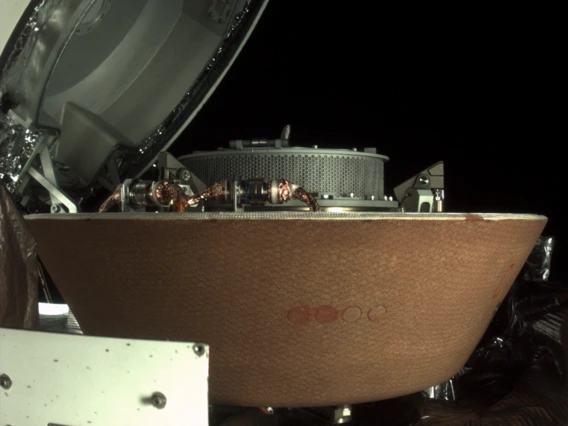
OSIRIS-REx Successfully Stows Sample of Asteroid Bennu
The mission team spent two days working around the clock to carry out the stowage procedure.
OSIRIS-REx Successfully Stows Sample of Asteroid Bennu

NASA Goddard Spaceflight Center - October 29, 2020
NASA's University of Arizona-led OSIRIS-REx mission has successfully stowed the spacecraft's Sample Return Capsule and its abundant sample of asteroid Bennu. On Oct. 28, the mission team sent commands to the spacecraft, instructing it to close the capsule – marking the end of one of the most challenging phases of the mission.
"I'm very thankful that our team worked so hard to get this sample stowed as quickly as they did,” said Dante Lauretta, OSIRIS-REx principal investigator and a professor of lunar and planetary sciences at the University of Arizona. "Now, we can look forward to receiving the sample here on Earth and opening up that capsule."
"This achievement by OSIRIS-REx on behalf of NASA and the world has lifted our vision to the higher things we can achieve together, as teams and nations," said NASA Administrator Jim Bridenstine. "Together, a team comprising industry, academia and international partners, and a talented and diverse team of NASA employees with all types of expertise, has put us on course to vastly increase our collection on Earth of samples from space. Samples like this are going to transform what we know about our universe and ourselves, which is at the base of all NASA's endeavors."
The OSIRIS-REx mission team celebrates as they receive confirmation that the spacecraft’s sample return capsule was successfully closed. The stow sequence was successfully completed on Oct. 28 from the Mission Support Area at Lockheed Martin Space in Littleton, Colorado.Lockheed Martin
The mission team spent two days working around the clock to carry out the stowage procedure, with preparations for the stowage event beginning Oct. 24. The process to stow the sample is unique compared to other spacecraft operations and required the team's continuous oversight and input over the two-day period. For the spacecraft to proceed with each step in the stowage sequence, the team had to assess images and telemetry from the previous step to confirm the operation was successful and the spacecraft was ready to continue. Given that OSIRIS-REx is currently more than 205 million miles from Earth, this required the team to also work with a greater than 18.5-minute time delay for signals traveling in each direction.
Throughout the process, the OSIRIS-REx team continually assessed the Touch-And-Go Sample Acquisition Mechanism's wrist alignment to ensure the collector head was being placed properly into the Sample Return Capsule. Additionally, the team inspected images to observe any material escaping from the collector head to confirm that no particles would hinder the stowage process. StowCam images of the stowage sequence show that a few particles escaped during the stowage procedure, but the team is confident that a plentiful amount of material remains inside of the head.
"Given the complexity of the process to place the sample collector head onto the capture ring, we expected that it would take a few attempts to get it in the perfect position," said Rich Burns, OSIRIS-REx project manager at NASA's Goddard Space Flight Center in Greenbelt, Maryland. "Fortunately, the head was captured on the first try, which allowed us to expeditiously execute the stow procedure."
By the evening of Oct. 27, the spacecraft's Touch-And-Go Sample Acquisition Mechanism, or TAGSAM, arm had placed the collector head into the Sample Return Capsule. The following morning, the OSIRIS-REx team verified that the collector head was thoroughly fastened into the capsule by performing a "backout check." This sequence commanded the TAGSAM arm to attempt to back out of the capsule – which tugged on the collector head and ensured the latches are well secured.
"I want to thank the OSIRIS-REx team from the University of Arizona, NASA Goddard, Lockheed Martin, and their partners, and also especially the SCaN and Deep Space Network people at NASA and JPL, who worked tirelessly to get us the bandwidth we needed to achieve this milestone, early and while still hundreds of millions of miles away," said Thomas Zurbuchen, NASA's associate administrator for science at the agency's headquarters in Washington, D.C. "What we have done is a real first for NASA, and we will benefit for decades by what we have been able to achieve at Bennu."
On the afternoon of Oct. 28, following the backout check, the mission team sent commands to disconnect the two mechanical parts on the TAGSAM arm that connect the sampler head to the arm. The spacecraft first cut the tube that carried the nitrogen gas that stirred up the sample through the TAGSAM head during sample collection, and then separated the collector head from the TAGSAM arm itself.
That evening, the spacecraft completed the final step of the sample stowage process –closing the Sample Return Capsule. To secure the capsule, the spacecraft closed the lid and then fastened two internal latches. As of late Oct. 28, the sample of Bennu is safely stored and ready for its journey to Earth.
The stowage process, originally scheduled to begin in early November, was expedited after sample collection when the mission team received images that showed the spacecraft's collector head overflowing with material. The images indicated that the spacecraft collected well over 2 ounces, or 60 grams, of Bennu's surface material, and that some of these particles appeared to be slowly escaping from the head. A mylar flap designed to keep the sample inside the head appeared to be wedged open by some larger rocks. Now that the head is secure inside the Sample Return Capsule, pieces of the sample will no longer be lost.
The OSIRIS-REx team will now focus on preparing the spacecraft for the next phase of the mission – Earth Return Cruise. The departure window opens in March 2021 for OSIRIS-REx to begin its voyage home, and the spacecraft is targeting delivery of the Sample Return Capsule to Earth on Sep. 24, 2023.
Goddard provides overall mission management, systems engineering and the safety and mission assurance for OSIRIS-REx. Lauretta of the University of Arizona is the principal investigator, and the University of Arizona also leads the science team and the mission's science observation planning and data processing. Lockheed Martin Space in Littleton, Colorado, built the spacecraft and provides flight operations. Goddard and KinetX Aerospace are responsible for navigating the OSIRIS-REx spacecraft. OSIRIS-REx is the third mission in NASA's New Frontiers Program, which is managed by NASA's Marshall Space Flight Center in Huntsville, Alabama, for the agency's Science Mission Directorate in Washington.

OSIRIS-REx Spacecraft Collects Significant Amount of Asteroid
The spacecraft seems to have bit off more than it can chew, so the mission team will expedite stowing the sample for the return trip home.
OSIRIS-REx Spacecraft Collects Significant Amount of Asteroid

NASA and Goddard Space Flight Center - October 23, 2020
Two days after touching down on asteroid Bennu, NASA's University of Arizona-led OSIRIS-REx mission team received images confirming that the spacecraft has collected more than enough material to meet one of its main mission requirements – acquiring at least 2 ounces, or 60 grams, of the asteroid's surface material.
The spacecraft captured images of the sample collector head as it moved through several different positions. In reviewing these images, the OSIRIS-REx team noticed both that the head appeared to be full of asteroid particles, and that some of these particles appeared to be escaping slowly from the sample collector, called the Touch-And-Go Sample Acquisition Mechanism, or TAGSAM, head. They suspect bits of material are passing through small gaps where a mylar flap – the collector's lid – is slightly wedged open by larger rocks.
"It's been another set of surprising days on the OSIRIS-REx mission," said principal investigator Dante Lauretta, a UArizona professor in the Lunar and Planetary Laboratory. "This is the mission that keeps on surprising us."
Lauretta leads the science team and the mission's science observation planning and data processing.
The original plan was to weigh the sample by spinning the spacecraft in the coming weeks, but images of the sample head indicate that more than enough sample was collected on Wednesday's Touch-And-Go, or TAG sample collection maneuver.
"Although we may have to move more quickly to stow the sample, it's not a bad problem to have. We are so excited to see what appears to be an abundant sample that will inspire science for decades beyond this historic moment," said Thomas Zurbuchen, NASA's associate administrator for science at the agency's headquarters in Washington, D.C.
The team believes it has collected a sufficient sample and is on a path to stow the sample as quickly as possible. The team came to this conclusion after comparing images of the empty collector head with Oct. 22 images of the TAGSAM head after the sample collection event on Oct. 21.
The images also show that any spacecraft or TAGSAM instrument movement may lead to further sample loss. To preserve the remaining material, the mission team decided to forgo the sample mass measurement activity originally scheduled for Oct. 24, and canceled a braking burn scheduled for Friday.
From here, the OSIRIS-REx team will focus on stowing the sample in the sample return capsule, where any loose material will be kept safe during the spacecraft's journey back to Earth.
"We are working to keep up with our own success here, and my job is to safely return as large a sample of Bennu as possible," Lauretta said. "The loss of mass is of concern to me, so I'm strongly encouraging the team to stow this precious sample as quickly as possible."
The TAGSAM head performed the sampling event in optimal conditions. Newly available analyses show that the collector head was flush with Bennu's surface when it made contact and when the nitrogen gas bottle was fired to stir surface material. It also penetrated several centimeters into the asteroid's surface material. All data so far suggest that the collector head is holding much more than 2 ounces of Bennu surface material.
The OSIRIS-REx spacecraft remains in good condition, and the mission team is finalizing a timeline for sample storage. An update will be provided once a decision is made on the sample storage timing and procedures.
OSIRIS-REx launched in Sept. 2016 and will return to Earth in 2023.
NASA's Goddard Space Flight Center in Greenbelt, Maryland, provides overall mission management, systems engineering and the safety and mission assurance for OSIRIS-REx. Lockheed Martin Space in Denver built the spacecraft and is providing flight operations. Goddard and KinetX Aerospace of Tempe, Arizona, are responsible for navigating the OSIRIS-REx spacecraft. OSIRIS-REx is the third mission in NASA's New Frontiers Program, which is managed by NASA's Marshall Space Flight Center in Huntsville, Alabama, for the agency's Science Mission Directorate in Washington.

Watch: OSIRIS-REx Touchdown Causes a Stir on Asteroid Bennu
The sampling arm of NASA's OSIRIS-REx spacecraft made contact with asteroid Bennu to stir up surface material and capture some of it for return to Earth in 2023.
Watch: OSIRIS-REx Touchdown Causes a Stir on Asteroid Bennu

By Daniel Stolte, University Communications - October 22, 2020
With a flick of its "wrist" and a blast from a nitrogen gas bottle, the sampling arm of NASA's OSIRIS-REx spacecraft made contact with asteroid Bennu yesterday to stir up surface material and capture some of it for return to Earth in 2023.
More than 200 million miles from Earth, the spacecraft touched down within 3 feet of the targeted location for about six seconds, then performed a back-away burn.
During the Touch-And-Go, or TAG, sample collection event, the spacecraft's sampling camera, or SamCam, recorded video of the sampling process. Once that footage was downloaded from the spacecraft, scientists at the University of Arizona OSIRIS-REx Science Operations Center went to work to process the footage.
The images were captured over an approximately five-minute period. The imaging sequence begins at about 82 feet above the surface and runs through the back-away maneuver. The sequence was created using 82 SamCam images, with one and a quarter seconds between frames. In the middle of the image sequence, the sampling head can be seen positioning itself on the "wrist" of the sampling arm to contact the asteroid's surface head on.
UArizona's Bashar Rizk, OSIRIS-REx camera suite instrument scientist, said the SamCam TAG image sequence – acquired just before, during and after sampling – is "simply remarkable."
"The TAGSAM arm and head plunged into the surface of Bennu and seemed to crush a small boulder, as if it were made of chocolate," he said. "When the nitrogen gas released, it created a cloud of particles so thick that it blocked the sunlight from the neighborhood of the Nightingale sampling site."
The mission's image processing team is now anxiously awaiting the first peek into the sampling head to get an idea what type of material and how much was captured during the TAG event. While the spacecraft has backed away to a safe distance from Bennu's surface, it will maneuver and tilt the sampling head into various positions while SamCam takes pictures. The mission team will also measure the amount of material collected through various spacecraft activities, such as a "pirouette" in space.
Media can access videos and GIFs at https://arizona.box.com/v/OsirisRExTAG-FirstImages.
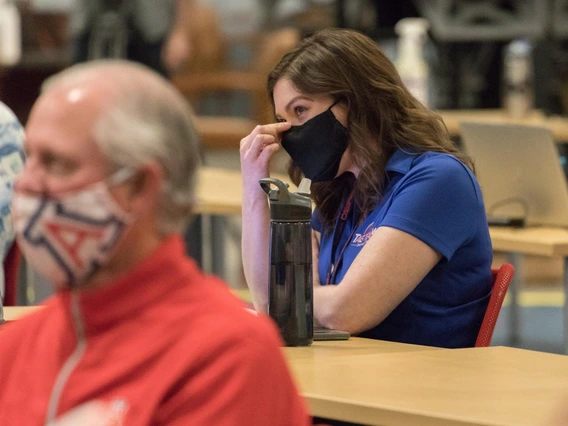
UArizona Mission Members Celebrate OSIRIS-REx Success
Members of the LPL-led OSIRIS-REx mission, along with UArizona leadership, gathered to watch NASA's live broadcast of the mission's much-anticipated Touch-and-Go, or TAG, sampling event.
UArizona Mission Members Celebrate OSIRIS-REx Success

By Daniel Stolte, University Communications - October 20, 2020
If NASA's OSIRIS-REx spacecraft could talk, today it might have said, "Finally!"
At 10:50 a.m. Tucson time, the van-sized spacecraft fired its thrusters to leave the safe-home orbit around asteroid Bennu and began descending toward the asteroid's surface, which the spacecraft spent two years photographing and mapping in tremendous detail. Its mission: Touch the asteroid for a few seconds and collect a sample to be later brought back to Earth.
Members of the University of Arizona-led OSIRIS-REx mission, along with UArizona leadership, gathered at the university's Michael J. Drake Building, where the mission is headquartered, to watch NASA's live broadcast of the mission's much-anticipated Touch-and-Go, or TAG, event and listen to status updates from the spacecraft.
At 3:13 p.m. Tucson time, the atmosphere inside the building changed from one of subdued anticipation to elation and relief as a physically distanced, masked crowd started to clap and cheer.
At that time, the mission's spacecraft confirmed that it had touched the surface of asteroid Bennu for 4.7 seconds and triggered a flush of nitrogen gas with the goal of collecting the largest sample of extraterrestrial material since the Apollo moon landings.
"I can't believe we pulled this off," Dante Lauretta, principal investigator of the OSIRIS-REx mission and a UArizona professor of planetary sciences, said from the mission control room at Lockheed Martin in Denver, where NASA's broadcast was based. "This is history. This is amazing."
Shortly after touching Bennu, the spacecraft communicated that it had backed safely away from the asteroid to return into orbit and await the next phase of the mission, in which the team will pore over images taken by the spacecraft's onboard sampling camera and perform a series of measurements and maneuvers to assess whether the sampling process was successful and how much material was collected. According to the data available to the mission team immediately after TAG, the spacecraft had touched down with amazing precision – less than three feet from its target site, according to Lauretta.
"We couldn't have asked for a better outcome," he said. "The spacecraft did everything it was supposed to do. It's up to Bennu now to see how the event went."
Collecting a sample from Bennu involved what essentially amounted to parallel parking a 15-passenger van and dodging hazards including a boulder as tall as a two-story building – all 200 million miles away from Earth. Because of the time delay between Bennu and Earth, the spacecraft had been programmed to steer itself during the entire sequence.
"We spent many late nights and weekends writing commands to go up to our instruments, so it's exciting to see them execute flawlessly," said Sara Knutson, the mission's science operations lead engineer, who watched the broadcast from the Drake Building in Tucson.
"I was definitely holding my breath today," said OSIRIS-REx image processing lead scientist Daniella DellaGiustina, who was also at Drake. "But what stands out to me is just how much according to plan everything went, and that has been a standard on this mission. The fact that we have been so spot on with every first-time event on this mission is a testament to the incredible engineering and scientific efforts of so many people that have worked tirelessly to make this happen."
"This kind of fundamental discovery and the research opportunities it creates make the University of Arizona the premier institution that it is," said UArizona President Robert C. Robbins, who joined the mission members at the Drake Building. "This work fulfills something at the core of who we are as a species, and as an institution, and you should all be very proud of what you've accomplished."
Elizabeth "Betsy" Cantwell, UArizona senior vice president for research and innovation, who has a long career in space systems engineering, praised the team's work with complex engineering.
"Massive kudos to the systems engineers who made this miracle happen. ... It is incredible that we have people like that here to support the science," she said.
While TAG was the most critical moment of the entire mission, the OSIRIS-REx team members will barely have time to catch their breath. The coming days will be spent analyzing images taken during the event and recreating the descent trajectory to get an idea of where exactly the spacecraft tagged the surface, which will provide clues to the quality and quantity of the sample that may have been caught in the spacecraft's sampling head.
"OSIRIS-REx is kind of like a relay race," said Carl Hergenrother, OSIRIS-REx lead astronomer. "First, you get the proposal; then, you have the people who build the spacecraft and the instruments, then the people who planned the mission, made the observations to study the asteroid up close; and now, the mission isn't over. We're just handing off the baton to the next leg – to the people who are going to study the samples on the ground and really learn what really is the goal of the mission: the history of the solar system."
EXTRA INFO
For the latest news on the OSIRIS-REx mission, visit news.arizona.edu/news/osirisrex.

OSIRIS-REx Successfully Touches Asteroid Bennu in Sample Grab
Ten years after NASA selected LPL to lead the OSIRIS-REx mission, the spacecraft successfully completed its most treacherous and rewarding task: sample collection.
OSIRIS-REx Successfully Touches Asteroid Bennu in Sample Grab

NASA Goddard Space Flight Center and University Communications - October 20, 2020
NASA's OSIRIS-REx spacecraft unfurled its robotic arm today, and in a first for the agency, briefly touched an asteroid in an attempt to collect dust and pebbles from the surface for delivery to Earth in 2023.
"After over a decade of planning, the team is overjoyed at the success of today’s sampling attempt," said Dante Lauretta, OSIRIS-REx principal investigator and a professor of planetary sciences at the University of Arizona. "Even though we have some work ahead of us to determine the outcome of the event – the successful contact, the TAGSAM (Touch-and-Go Sample Acquisition Mechanism) gas firing and back-away from Bennu are major accomplishments for the team. I look forward to analyzing the data to determine the mass of sample collected."
The well-preserved, ancient asteroid, known as Bennu, is currently more than 200 million miles from Earth. Bennu offers scientists a window into the early solar system as it was first taking shape billions of years ago and flinging ingredients that could have helped seed life on Earth. If today’s contact with the surface provided enough of a sample, teams will command the spacecraft to begin stowing the precious primordial cargo to begin its journey to Earth in March 2021. Otherwise, they will prepare for another attempt in January.
"This amazing first for NASA demonstrates how an incredible team from across the country came together and persevered through incredible challenges to expand the boundaries of knowledge," said NASA Administrator Jim Bridenstine. "Our industry, academic and international partners have made it possible to hold a piece of the most ancient solar system in our hands."
At 10:50 a.m. Tucson time on Oct. 20, the OSIRIS-REx spacecraft fired its thrusters to nudge itself out of orbit around Bennu. It extended the shoulder, then elbow, then wrist of its 11-foot sampling arm, known as the Touch-and-Go Sample Acquisition Mechanism, or TAGSAM, and transited across Bennu while descending about half a mile toward the surface. After a four-hour descent, at an altitude of approximately 410 feet, the spacecraft executed the "Checkpoint" burn, the first of two maneuvers to allow it to precisely target the sample collection site called Nightingale.
Ten minutes later, the spacecraft fired its thrusters for the second "Matchpoint" burn to slow its descent and match the asteroid's rotation at the time of contact. It then continued on a treacherous, 11-minute coast past a boulder the size of a two-story building, nicknamed "Mount Doom," to touch down in a clear spot in a crater on Bennu's northern hemisphere. The size of a small parking lot, site Nightingale is one of the few relatively clear spots on this unexpectedly boulder-covered space rock.
"This was an incredible feat – and today we've advanced both science and engineering and our prospects for future missions to study these mysterious ancient storytellers of the solar system," said Thomas Zurbuchen, associate administrator for NASA's Science Mission Directorate at the agency's headquarters in Washington, D.C. "A piece of primordial rock that has witnessed our solar system's entire history may now be ready to come home for generations of scientific discovery, and we can’t wait to see what comes next."
Next Steps
All spacecraft telemetry indicates that today's sample collection event, known as TAG, which stands for Touch-and-Go, executed as expected. However, it will take about a week for the OSIRIS-REx team to confirm how much sample the spacecraft collected.
Real-time data indicates the TAGSAM successfully contacted the surface and fired a burst of nitrogen gas. The gas should have stirred up dust and pebbles on Bennu's surface, some of which should have been captured in the TAGSAM sample collection head. OSIRIS-REx engineers also confirmed that shortly after the spacecraft made contact with the surface it fired its thrusters and safely backed away from Bennu.
"Today's TAG maneuver was historic," said Lori Glaze, Planetary Science Division director at NASA Headquarters in Washington, D.C. "The fact that we safely and successfully touched the surface of Bennu, in addition to all the other milestones this mission has already achieved, is a testament to the living spirit of exploration that continues to uncover the secrets of the solar system."
"It's hard to put into words how exciting it was to receive confirmation that the spacecraft successfully touched the surface and fired one of the gas bottles," said Michael Moreau, OSIRIS-REx deputy project manager at NASA's Goddard Space Flight Center in Greenbelt, Maryland. "The team can't wait to receive the imagery from the TAG event late tonight and see how the surface of Bennu responded to the TAG event."
The spacecraft carried out TAG autonomously, with pre-programmed instructions from engineers on Earth. Now, the OSIRIS-REx team will begin to assess whether the spacecraft grabbed any material, and, if so, how much; the goal is at least 60 grams, which is roughly equivalent to a full-sized candy bar.
OSIRIS-REx engineers and scientists will use several clever techniques to identify and measure the sample remotely. First, they'll compare images of the Nightingale site before and after TAG to see how much surface material moved around in response to the burst of gas.
"Our first indication of whether we were successful in collecting a sample will come on Oct. 21 when we downlink the back-away movie from the spacecraft," Moreau said. "If TAG made a significant disturbance of the surface, we likely collected a lot of material."
Next, the team will try to determine the amount of sample collected. One method involves taking pictures of the TAGSAM head with a camera known as SamCam, which is devoted to documenting the sample-collection process and determining whether dust and rocks made it into the collector head. One indirect indication will be the amount of dust found around the sample collector head. But OSIRIS-REx engineers will also attempt to snap photos that could show the inside of the head, given the right lighting conditions, so engineers can look for evidence of sample inside of it.
A couple of days after the SamCam images are analyzed, the spacecraft will attempt yet another method to measure the mass of the sample collected by determining the change in the spacecraft's "moment of inertia," a phrase that describes how mass is distributed and how it affects the rotation of the body around a central axis. This maneuver entails extending the TAGSAM arm out to the side of the spacecraft and slowly spinning the spacecraft about an axis perpendicular to the arm. This technique is analogous to a person spinning with their arm extended while holding a string with a ball attached to the end; the person can sense the mass of the ball by the tension in the string. Having done this maneuver before TAG, and now after, engineers can measure the change in the mass of the collection head as a result of the sample inside.
"We will use the combination of data from TAG and the post-TAG images and mass measurement to assess our confidence that we have collected at least 60 grams of sample," said Rich Burns, OSIRIS-REx project manager at Goddard. "If our confidence is high, we'll make the decision to stow the sample on Oct. 30."
To store the sample, engineers will command the robotic arm to place the sample collector head into the Sample Return Capsule located in the body of the spacecraft. The sample arm will then retract to the side of the spacecraft for the final time, the Sample Return Capsule will close, and the spacecraft will prepare for its departure from Bennu in March 2021 — this is the next time Bennu will be properly aligned with Earth for the most fuel-efficient return flight.
If, however, it turns out that the spacecraft did not collect enough sample at Nightingale, it will attempt another TAG on Jan. 12, 2021. Next time, it'll touch down at the back-up site called Osprey, which is another relatively boulder-free area inside a crater near Bennu’s equator.
NASA's University of Arizona-led OSIRIS-REx mission, which stands for Origins, Spectral Interpretation, Resource Identification, Security-Regolith Explorer, launched from the Cape Canaveral Air Force Station in Florida on Sept. 8, 2016. It arrived at Bennu on Dec. 3, 2018, and began orbiting the asteroid for the first time on Dec. 31, 2018. The spacecraft is scheduled to return to Earth on Sept. 24, 2023, when it will parachute the Sample Return Capsule into Utah's west desert where scientists will be waiting to collect it.
Goddard provides overall mission management, systems engineering and the safety and mission assurance for OSIRIS-REx. Lauretta of the University of Arizona is the principal investigator, and UArizona also leads the science team and the mission's science observation planning and data processing. Lockheed Martin Space in Denver built the spacecraft and is providing flight operations. Goddard and KinetX Aerospace are responsible for navigating the OSIRIS-REx spacecraft. OSIRIS-REx is the third mission in NASA's New Frontiers Program, which is managed by NASA's Marshall Space Flight Center in Huntsville, Alabama for the agency's Science Mission Directorate in Washington.

What Touching an Asteroid Can Teach Us
NASA will make history on Oct. 20 by attempting its first-ever sample collection maneuver at an asteroid. LPL professor Dante Lauretta, principal investigator for the OSIRIS-REx mission, discusses the significance of the mission for science and society.
What Touching an Asteroid Can Teach Us

By Mikayla Mace, University of Arizona - October 19, 2020
The University of Arizona-led OSIRIS-REx mission will make NASA's first attempt at collecting a sample from an asteroid on Oct. 20. The sample, which will be returned to Earth in 2023, has the potential to shed light on the origins of life and the solar system.
NASA's UArizona-led OSIRIS-REx mission is the agency's first attempt to bring back a sample from an asteroid.NASA
As the spacecraft prepares for its Touch-and-Go, or TAG, maneuver at asteroid Bennu, UArizona News spoke with Dante Lauretta, the mission's principal investigator and a professor of planetary science at the UArizona Lunar and Planetary Laboratory, about the significance of the mission and it impact on science and society.
Q: We often hear that the mission will shed light on the origins of life and the solar system, but how will it do that?
A: Bennu is a fragment from the earliest stages of solar system formation. It escaped the fate of so many other asteroids by not becoming a piece of a planet. Earth itself formed from asteroids like Bennu; Bennu just happened to survive that process. So, Bennu is like a fossil from a time in the solar system before life or Earth even formed.
Since life as we know it is made from DNA, we want to know if the building blocks of DNA are on Bennu. If the building blocks that make up DNA formed early in the solar system and were preserved in carbon-rich asteroids, then they could have been delivered to Earth, Mars, Europa, Titan and all these other places we're looking for life. It would mean the seeds of life were not unique to the Earth, so our search for life in the solar system gets more exciting.
If we don't find them on Bennu, it might mean that those life-seeding molecules had to form in Earth's early environment.
Also, we think water plays a key role in that life-forming chemistry. For example, advanced life first took hold in the oceans before moving to land, and we now know that Bennu is a water-rich asteroid. So, we think that the water that made Earth habitable came from asteroids like Bennu. If that's the case, then other planets, like Mars and definitely the icy worlds in the outer solar system, can trace their water linage and organic chemistry in the same way.
Q: One thing I hear a lot about is how pristine these samples will be. Why is that so important? Am I wrong in thinking that just because you burnt the pancake doesn't mean you can't scrape it off and eat it?
A: We have hints at the chemistry of the early solar system from meteorites, which are fragments of asteroids that land on Earth. The problem is that they are immediately contaminated: Bacteria crawl on them and eat the carbon-rich meteorites; people handle them and don't collect them in the cleanest way in the field. So, it's not just burning the pancake; it's like mixing dirt into the batter once it's on the surface.
So, when we say "pristine," we are removing that level of contamination from the problem. I like to compare it to a forensic investigation; you're trying to convince the jury in a court of law that this DNA was from a crime scene, but if that evidence wasn't in your control that entire time, the defense would say it could have been contaminated and you can't link to the crime scene. In our case, if we want to say the organic molecules from the sample came from the asteroid and aren't contaminants, then we have to control the full chain of history, from asteroid to sample return capsule to lab.
Q: What are you expecting to find in these samples that we haven't already found in meteorites that fall to Earth?
A: A bunch of our new published research is finding that the rocks on Bennu look different than meteorites in a couple of ways. Bennu's rocks are actually really weak, unlike meteorites found on Earth that you have to whack with hammer. Only the strongest fragments survive the fall to Earth, so what we collect from Bennu will be the material that would have likely burned up on entry. Back to the pancake analogy: The pancake could have had caramel glaze that went up in smoke and you wouldn't know. We're hoping to find something more delicate and fragile that's not in the meteorite collection.
Another really exciting thing we found are these veins of carbonate minerals – the white stuff that forms around faucets – on Bennu. These are like a meter long and tens of centimeters thick. We do find them in meteorites but they're tiny, like strands of hair. This material forms by the precipitation by hot water, similar to when a tea kettle boils water off and leaves behind white crud at the bottom. That white crud was dissolved minerals, like what we found on Bennu. If we can get these back in a sample, we speculate – and hope – that we might find pockets of water trapped inside. In any case, we'll have a detailed record of the chemistry of water on Bennu.
Q: This all touches on why sampling Bennu is important for science, but why is this important for society?
A: There are two big reasons. The first is that Bennu is a potentially hazardous asteroid. Pre-launch analysis showed that there was a 1 in 2,700 chance that Bennu will impact Earth in 150 years. It's still a low-likelihood event, but it's of big enough consequence that we should be mitigating and characterizing the risk. By 2135, when Bennu makes its next close approach between the Earth and the moon, we will be able to confirm that it won't hit. Should any asteroid pose an impact threat to Earth, data about the asteroid, like the data we've collected at Bennu, would be valuable to prepare. We've set the standard for characterizing the properties of an asteroid. This is like our gift to the future.
The second is the asteroid mining angle. The No. 1 commodity is water. You can break it into liquid oxygen and hydrogen to make rocket fuel. We've proven the value of Bennu as an ore deposit and water resource, and Bennu is very accessible from the Earth. It could eventually become a gas station in space.
Q: What is most exciting to you about the mission?
A: Sample science is my background, so I'm most excited to be transitioning to the sample science phase of the mission. Now, I get to think about all the fun things we're going to do with the sample once it's back on Earth and partnering with labs all over the world. I think of this as the third science campaign of OSIRIS-REx: The first was astronomy, where we determined its size, shape and orbital path. Then, we arrived and began remote sensing; the recent six papers are culmination of that work. Now, we're in the sample science phase. So, from telescope to spacecraft to microscope, it's a cool arch, scientifically and career-wise, to go through.
I'm also excited to think about what's next. I'm still three years out from sample return, but I'm starting to think about what I might do after OSIRIS-REx. I haven't had that thought for 20 years.
And, lastly, I'm excited to inspire the next generation, and I think we really nailed that. I'm proud of the students who grew up in this program. Some have even been hired on after graduation. And there's a lot of value to the education of school-age kids following along with this mission.
EXTRA INFO
NASA will provide live coverage of the Touch-and-Go, or TAG, event starting at 2 p.m. (PT) on Oct. 20, with sample collection schedule for 3:12 p.m. (PT). Viewers can tune in at https://www.nasa.gov/nasalive.
Hosted by Dante Lauretta, the mission's principal investigator and UArizona professor of lunar and planetary sciences, and Michelle Thaller, science communicator at NASA's Goddard Space Flight Center, the broadcast will cover milestones in the 90 minutes leading up to TAG and spacecraft back-away.
For the latest news on the OSIRIS-REx mission, visit news.arizona.edu/news/osirisrex.

Why Scooping a Sample from an Asteroid is Harder than it Looks
Here's what will happen on Oct. 20, when NASA's OSIRIS-REx spacecraft will descend to asteroid Bennu and pick up a sample of pristine material left over from the formation of our solar system.
Why Scooping a Sample from an Asteroid is Harder than it Looks

By Daniel Stolte, University Communications - October 15, 2020
When NASA's OSIRIS-REx spacecraft descends toward the surface of Bennu on Oct. 20, it will be the first time that a U.S.-led mission attempts to pick up a sample of pristine material from an asteroid. Bennu is likely an extraterrestrial accumulation of the original leftovers from the formation of our solar system.
The University of Arizona-led mission to sample an asteroid many millions of miles from Earth is anything but a walk on the beach. As a matter of fact, Bennu "is not nearly the sandy beach we hoped and were expecting," said Thomas Zurbuchen, associate administrator for the Science Mission Directorate at NASA, during a Sept. 24 media event. Once the spacecraft moved closer and began sending back the first detailed images of Bennu's surface, it surprised the mission team and the public alike by revealing a rocky surface littered with house-sized boulders.
Since its arrival on Dec. 3, 2018, the OSIRIS-REx spacecraft has spent its time flying around the asteroid while scanning, photographing, measuring and studying the dark, rocky rubble pile below – from afar at first, then up close. Using its laser altimeter instrument, or OLA, combined with the data from images taken with the spacecraft's PolyCam instrument, the mission has produced maps of unprecedented detail, better than those of any planetary body visited by spacecraft. The mission's primary sample site, which sits inside a crater dubbed Nightingale, was selected based on those maps.
"We selected Nightingale because, by far, it has the most fine-grained material of all the four sample site candidates," said Dante Lauretta, the mission's principal investigator and a professor at the UArizona Lunar and Planetary Laboratory, during the press event. "We spent early 2020 doing low-altitude reconnaissance passes over this site, ultimately imaging at about an eighth of an inch per pixel. We basically have incredibly detailed images covering the entire crater, and we counted all of those rocks."
Shortly before 11 a.m. Arizona time on Oct. 20, thrusters on the spacecraft will fire and gently nudge OSIRIS-REx out of its orbit around Bennu and steer it down toward the rugged surface. That burn will set in motion a sequence of events that has been planned meticulously by the mission team.
What Happens if Everything Goes as Planned? And if it Doesn't?
Once the spacecraft has set off on the descent to its target, it will rely on what the mission team calls a "hazard map" – a detailed representation of areas within the sample site that may present a risk to the spacecraft due to the presence of large rocks or uneven terrain.
Just prior to touching the surface, the spacecraft will compare images from one of its cameras with the hazard map stored in the spacecraft's memory. If the descent path would result in the spacecraft touching down in a potentially unsafe spot, the system would automatically trigger the spacecraft to back away, a scenario that has a probability of less than 6% based on simulations.
If everything goes well, the spacecraft will extend its Touch-and-Go Sample Acquisition Mechanism, or TAGSAM, which is suspended at the tip of an 11-feet-long arm. Reminiscent of an air filter used in an older car, it is designed to collect fine grained material, but is capable of ingesting material up to about three quarters of an inch.
The sample will be collected during a "touch-and-go" maneuver, or TAG, during which the sampling head will make contact with Bennu's surface for around 10 seconds. When the spacecraft detects contact, it will fire one of three nitrogen gas bottles, and much like a reverse vacuum cleaner, stir up surface material – called regolith – inside the sampler head, before the spacecraft backs away.
As a backup, the sampling head features a series of small discs designed to pick up dust like sticky pads, in case something were to go wrong with the gas-powered sampling process.
The team will examine footage taken by the spacecraft's sampling camera, or SamCam, of the sampling head as it makes contact with the surface. SamCam is one of three cameras aboard the spacecraft that were built at UArizona.
"We'll be able to tell if we were tilted, if gas blew out to the side, if material was sufficiently stirred up," Lauretta said. "We also will have a very good indication of the exact location in Nightingale where we made contact and we can compare that to our samplability map, to assess if we touched down in an area where there is abundant samplable material or one of the rockier locations."
SamCam also will be able to take images of the sampling head after the spacecraft has departed Nightingale crater and is a safe distance from the asteroid. Because the sampling head is mounted on a wrist joint, the team will be able to examine it at a different orientations relative to the sun and the sampling camera. The team also will see any dust or material on any other area of the TAGSAM, on the arm or on the blanketing over the gas bottles, Lauretta explained.
"This will tell us whether we moved enough material around when we made contact, and maybe, just maybe, we'll be able to see some of the particles in the interior of TAGSAM, if the particles are in the right location inside the head and if we get the right illumination conditions."
After TAG, the team will then spend one week assessing how much sample was collected. It will use several methods to estimate the amount of sample, beginning with imaging the sample collection head for visual inspection. The team will also be performing checkouts of the spacecraft and instruments to verify that didn't result in degradation to either.
A Pirouette in Space
Next, the spacecraft is prepared to perform a maneuver designed to give the scientists on the ground an estimate of how much sample was collected. With its sampling arm extended, it will slowly spin around an axis perpendicular to TAGSAM to measure the change in mass attributable to the collected sample by comparison to a previous measurement taken with the sampling head empty.
Due to uncertainty in the technique, the result of the measurement needs to exceed the required sample mass to have high confidence that an adequate sample is present.
"We'll be looking for a 90% chance that we have 60 actual grams or more," Lauretta said. "Anything below that, we'll have conversations with NASA to assess the status of the spacecraft, its ability to go in for a second TAG, and to decide whether we want to return with what we have or go for a second TAG attempt."
The spacecraft can make multiple sampling attempts, as it is equipped with three bottles of nitrogen gas. For example, if it were to touch down in a safe location but failed to come up with a good sample, the team has developed contingency measures to ensure the mission still meets its primary science objective: collect at least 60 grams (just under 2 ounces) of surface material and return it to Earth.
"In case the decision is made we need to go in again, we have to get the spacecraft back into orbit and conduct a series of burns to line up its position in orbit for the next tag attempt," said Mike Moreau, deputy project manager at NASA's Goddard Space Flight Center in Maryland.
While Nightingale was identified as the best place to get a sample on all of Bennu, it still presents a lot of challenges, Lauretta said.
"By far, the most likely outcome we will have on Oct. 20 is we will contact the surface and came away with a large sample that exceeds our requirements. But Bennu has thrown us a number of curve balls already, which is why we are fully prepared to tag at Osprey (the backup site) if that becomes necessary," he said.
Once the decision is made to stow the sample, the team will proceed to place the head inside the sample return capsule and seal it for return to Earth in 2023. And when that time comes, chances are that it'll bring back even more than the minimum of 60 grams, as TAGSAM was designed to capture at least 150 grams, and under optimal conditions up to 4 pounds – enough to keep generations of researchers busy in laboratories on Earth.
EXTRA INFO
Watch a video about the sampling process and possible what-if scenarios here.
NASA will provide live coverage of the Touch-and-Go, or TAG, event starting at 2 p.m. (PT) on Oct. 20, with sample collection schedule for 3:12 p.m. (PT). Viewers can tune in at https://www.nasa.gov/nasalive.
Hosted by Dante Lauretta, the mission's principal investigator and UArizona professor of lunar and planetary sciences, and Michelle Thaller, science communicator at NASA's Goddard Space Flight Center, the broadcast will cover milestones in the 90 minutes leading up to TAG and spacecraft back-away.

An Asteroid of a Different Color … and Other Secrets of Bennu Unlocked
The LPL-led OSIRIS-REx mission is gearing up for its first attempt to collect a sample from asteroid Bennu this month. But before even touching the surface, scientists are learning more than ever about the material that makes up the asteroid.
An Asteroid of a Different Color … and Other Secrets of Bennu Unlocked

By University Communications and OSIRIS-REx - October 8, 2020
Scientists now know much more about the material NASA's first asteroid sample return mission will be collecting in just a few weeks.
In a special collection of six papers published today in the journals Science and Science Advances, scientists with the University of Arizona-led OSIRIS-REx mission present new findings on asteroid Bennu's surface material, geological characteristics and dynamic history. They also say that the sample delivered from Bennu may be unlike anything we have in the meteorite collection on Earth.
These discoveries complete the OSIRIS-REx mission's pre-sample collection science requirements and offer insight into an asteroid sample that scientists will study for generations to come.
Rocks in Rouge
One of the papers – published in Science and led by Dani DellaGiustina, lead scientist on the mission's image processing team and senior staff scientist at the UArizona Lunar and Planetary Laboratory – details a striking discovery at the mission's primary sample site, Nightingale, where OSIRIS-REx will make its first sample collection attempt on Oct. 20. The rocky debris covering the site has only recently been exposed to the harsh space environment. That means the mission will be collecting and returning some of the most pristine material on the asteroid.
Using spectroscopy – a technique that reveals a material's composition based on the pattern of reflected wavelengths of light – the scientists found that Nightingale is part of a population of young craters whose composition reflects mostly red light. Bennu's colors, as revealed through spectroscopy, are much more diverse than originally anticipated. This diversity results from a combination of different materials inherited from Bennu's parent body and different durations of exposure to the space environment.
While Bennu appears quite black to the naked eye, the authors illustrate the diversity of Bennu's surface by using false-color renderings of spectral data collected by the mission's MapCam camera. The freshest material on Bennu, such as that found at the Nightingale site, is spectrally redder than average and thus appears red in the images. Surface material turns vivid blue when it has been exposed to space weathering for an intermediate period of time. As the surface material continues to weather over long periods of time, it ultimately brightens across all wavelengths, becoming a less intense blue – the average spectral color of Bennu.
"When a material is exposed to the space environment, its surface weathers, but in a very different way than things do on Earth," DellaGiustina said. "In space, weathering is caused by exposure to solar wind and the rain of tiny micrometeorites. On the moon's surface and many asteroids, we have observed that space weathering darkens and reddens surfaces. On Bennu, however, the opposite is true. We see that over time Bennu has become brighter and bluer in response to space weathering. This is an exciting finding because it tells us that something about Bennu is quite different than other planetary surfaces we've observed."
The paper led by DellaGiustina also distinguishes two main types of boulders on Bennu's surface: dark and rough, and, less commonly, bright and smooth. The different types may have formed at different depths in the parent asteroid of Bennu.
A 'Scientific Triumph'
Another paper published in Science, led by Amy Simon from NASA's Goddard Space Flight Center in Greenbelt, Maryland, shows that carbon-bearing, organic material is widespread on the asteroid's surface, including at the Nightingale site. These findings indicate that hydrated minerals and organic material will likely be present in the collected sample.
This organic matter may contain carbon in a form often found in biology or in compounds associated with biology. Scientists are planning detailed experiments on these organic molecules and expect that the returned sample will help answer complex questions about the origins of water and life on Earth.
"The abundance of carbon-bearing material is a major scientific triumph for the mission. We are now optimistic that we will collect and return a sample with organic material – a central goal of the OSIRIS-REx mission," said Dante Lauretta, OSIRIS-REx principal investigator and UArizona planetary science professor, who co-authored all six papers in the collection.
History Hidden in Rocks
During fall 2019, NASA’s OSIRIS-REx spacecraft captured this image, which shows one of asteroid Bennu’s boulders with a bright vein that appears to be made of carbonate. The image within the circle (lower right) shows a focused view of the vein.NASA/Goddard/University of Arizona
Another study in the collection, published in Science and led by Hannah Kaplan from Goddard, found that carbonate minerals – which are compounds containing special combinations of carbon, oxygen and metals – make up some of the asteroid's geological features and might be present in the returned sample. Because these carbonate minerals form under certain conditions, scientists theorize that Bennu's parent asteroid likely hosted an environment where water interacted with and altered the rock on Bennu's parent body.
A Science Advances paper led by Ben Rozitis from The Open University in the U.K. shows that the dark boulders are weaker and more porous, whereas the bright boulders are stronger and less porous. However, both boulder types are weaker than scientists expected. Rozitis and colleagues suspect that Bennu's dark boulders – the weaker, more porous and more common type – would not survive the journey through Earth's atmosphere. It's therefore likely that the returned samples of asteroid Bennu will provide a missing link for scientists, as this type of material is not currently represented in meteorite collections.
A Surprising Shape
Bennu is a diamond-shaped pile of rubble floating in space, but there's more to it than meets the eye. Data obtained by the OSIRIS-REx Laser Altimeter, or OLA, has allowed the mission team to develop a 3D digital terrain model of the asteroid that, at nearly 8-inch resolution, is unprecedented in detail and accuracy.
In a Science Advances paper led by Michael Daly of York University, scientists explain how detailed analysis of the asteroid's shape revealed ridge-like mounds on Bennu that extend from pole-to-pole but are subtle enough that they could be easily missed by the human eye. Their presence has been hinted at before but only became clear when the northern and southern hemispheres were split apart in the OLA data for comparison.
The digital terrain model also shows that Bennu's northern and southern hemispheres have different shapes. The southern hemisphere appears to be smoother and rounder, which the scientists believe is a result of loose material getting trapped by the region's numerous large boulders.
What's at the Center of Bennu?
Another Science Advances paper in the special collection, led by Daniel Scheeres of University of Colorado Boulder, examines the gravity field of Bennu, which has been determined by tracking the trajectories of the OSIRIS-REx spacecraft and the particles that are naturally ejected from Bennu's surface.
The reconstructed gravity field shows that the interior of Bennu is not uniform. Instead, there are pockets of higher and lower density material inside the asteroid. It's as if there is a void at its center, within which you could fit a couple of football fields.
All six publications in the special collection use global and local datasets collected by the OSIRIS-REx spacecraft from February through October 2019. The special collection underscores that sample return missions like OSIRIS-REx are essential to fully understanding the history and evolution of the solar system.
The mission is less than two weeks away from fulfilling its biggest goal – collecting a piece of a pristine, hydrated, carbon-rich asteroid. OSIRIS-REx will depart Bennu in 2021 and deliver the sample to Earth on Sept. 24, 2023.