

How Microbes in Iceland Can Teach Us About Possible Life on Mars
Dr Solange Duhamel and Dr Christopher Hamilton, based at the University of Arizona, have brought together their respective expertise in environmental microbiology and planetary science to investigate how life could survive on Mars. Fascinatingly, this has been done by exploring an area in Iceland that resembles the red planet.
How Microbes in Iceland Can Teach Us About Possible Life on Mars

Futurum - March 9, 2021
When we think of astronauts, deep-sea exploration is not the first thing that springs to mind. Similarly, space walks are not usually associated with oceanographers. And yet, oceans are often used in the preparation for space exploration. For instance, lengthy dives in weighted diving suits mimic the Moon’s low-gravity environment, and underwater research labs provide a practice setting for life on the International Space Station.
Nonetheless, the connection between our oceans and space can go far beyond space walking and deep-sea diving. Dr Solange Duhamel, an oceanographer, and Dr Christopher Hamilton, a planetary scientist, both based at the University of Arizona, have pooled their expertise in two very different disciplines to work on collaborative research projects in astrobiology, including investigations of hydrothermal systems in Iceland, to uncover what life in these extreme environments might reveal about life on Mars.
WHY DID SOLANGE AND CHRISTOPHER GO ON AN EXPEDITION TOGETHER?
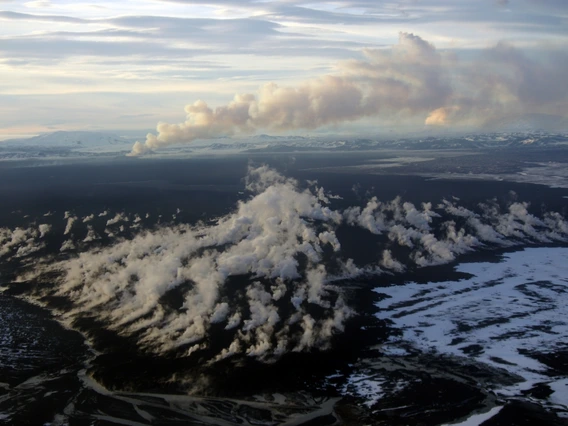
Six months after the end of the 2014–2015 Holuhraun eruption in Iceland, Christopher led a team that studied the lava flow-field and observed a lava-induced hydrothermal system where the lava had entered a segment of the Jokulsa a Fjollum river. However, the initial team did not include any biologists and so, Christopher invited Solange – an oceanographer and expert in environmental microbiology and biogeochemistry – to join them the following year. With Solange on board, the team returned to the field site to investigate the unusual forms of life that had developed within Holuhraun’s hydrothermal systems.
Christopher is a planetary volcanologist and the Holuhraun eruption – which took place in a pristine part of the Iceland highlands – was immediately important as an analogue for Mars. In contrast, Solange is an oceanographer, with expertise in how life can thrive in extreme environments. Solange explains, “When I joined the expedition led by Christopher, the team was composed of geologists and planetary scientists – I was the only biologist. I brought new competences to the group and together we have been able to gather a complementary set of physical, chemical and biological data to characterise the ecology and biogeochemistry of the system at Holuhraun.”
WHAT MAKES A TERRAIN, SUCH AS HOLUHRAUN, ANALOGOUS WITH MARS?
Holuhraun is located within a barren sand sheet in Icelandic highlands, between the Vatnajokull ice cap and the Askja central volcano. “This high-altitude location has very little vegetation and resembles the surface of Mars. Volcanic eruptions on Mars also tend to be larger than recent eruptions on Earth, but the 2014–2015 Holuhraun eruption generated the largest outpouring of lava in Iceland during the past 235 years,” explains Christopher. “This makes the terrain similar to Martian lava flows.”
WHAT HAVE THE LAVA-INDUCED HYDROTHERMAL SYSTEMS REVEALED ABOUT MARS?
Solange explains, “When the Holuhraun lava flow inundated a segment of the Jokulsa a Fjollum river, it created unusual forms of hydrothermal activity. This was very exciting because those conditions could mimic those found on Mars in the past.”
Given the extreme conditions on Mars, if there is life on the Red Planet, it must be adapted to extreme environments. On Earth, thermophiles (organisms that thrive at high temperatures between 50⁰C and 122⁰C), may be among the oldest forms of life on the planet. With so many volcanoes on Mars, it is possible that large lava flows – similar to the ones in Iceland – may have interacted with near-surface water to generate hydrothermal environments.
“One of the astonishing things about the recent Holuhraun eruption is how quickly life populated its lava-induced hydrothermal systems,” says Christopher. “Just months after the end of the eruption, hot springs emerging from the lava flow contained algae and other microorganisms that may have been hiding dormant in the sand, just waiting for the right conditions to spring back to life.” If similar microbes live on Mars, large volcanic eruptions might hold the key to the episodic flourishing of microbial life on Mars.
COULD THERE BE LIFE ON MARS?
Solange and Christopher’s studies have shown that life very quickly emerged in the lava-induced hydrothermal systems, which gives rise to the possibility that there could well be life in similar environments on Mars. The identification of potentially habitable locations on other planets is a fundamentally important issue, and NASA’s Mars 2020 mission – currently en route to Mars – will be the first rover capable of collecting astrobiologically relevant samples for return to laboratories on the Earth. This mission is particularly exciting because it will land in Jezero Crater, which includes volcanic units that may have generated hydrothermal systems just like the ones observed in Iceland.
A MARRIAGE OF DISCIPLINES
Solange and Christopher met while working on separate research projects in Hawaii twelve years ago. Now married, they have not only established their own successful careers investigating different scientific problems in environmental microbiology (Solange) and planetary science (Christopher), but have also come together to work on fascinating projects, such as this one in Iceland.
From those individual research projects in Hawaii, to travelling the world and conducting their own novel research, to collaborating together to investigate life in extreme environments, Solange and Christopher remind us just how much there is to explore in our world and how individual strengths and interdisciplinary collaboration reap rewards. The question is, where in the world will your explorations take you?

UArizona-Led HiRISE Camera Helped Guide Mars Rover to the Perfect Spot
The camera also captured the descent of NASA's Mars 2020 Perseverance rover.
UArizona-Led HiRISE Camera Helped Guide Mars Rover to the Perfect Spot

By Daniel Stolte, University Communications - February 24, 2021
The University of Arizona-operated High Resolution Imaging Experiment camera aboard the Mars Reconnaissance Orbiter captured the Feb. 18 descent of NASA's Mars 2020 Perseverance rover, the latest rover to touch down on the Red Planet. In the image above, Perseverance's landing capsule can be seen falling through the Martian atmosphere, with its parachute trailing behind.
Since entering the orbit of Mars in March of 2006, the HiRISE camera, provided and operated by the UArizona Lunar Planetary Laboratory, has photographed the surface of the Red Planet in unprecedented detail. The camera also provided data that helped Perseverance navigate to its designated landing site.
NASA's Mars 2020 mission is the first to land not just a surface vehicle, but also an air-going vehicle in the form of a drone strapped to the underside of the rover.
The mission faced a challenging landing on the Red Planet. It touched down in Jezero Crater, a 28-mile-wide expanse full of steep cliffs, boulder fields and other obstacles that could have jeopardized the landing. In the HiRISE image, an ancient river delta, which is the target of the Perseverance mission, can be seen entering Jezero Crater from the left.
A new technology called Terrain Relative Navigation, or TRN, allows spacecraft to avoid hazards autonomously.
Shane Byrne, a UArizona planetary sciences professor and acting principal investigator of HiRISE, explained how TRN works: "The lander takes pictures of the ground as it approaches and compares that to an onboard map of the surface, so it can figure out where it is and can actually fly to the right location and achieve a very accurate landing position."
The HiRISE camera captured images of the landing site at a resolution of less than a foot per pixel, Byrne explained. Maps were then created from that data and stored in the memory of the Perseverance lander.
"Especially when the rover gets close to the surface, it needs the higher resolution images to be able to compare what its cameras are seeing to what is actually on the ground below," he said.
At the time the descent image was taken, HiRISE was approximately 435 miles from Perseverance and traveling at about 6,750 mph. The extreme distance and high speeds of the two spacecraft were challenging conditions that required precise timing and for the Mars Reconnaissance Orbiter to pitch upward and roll hard to the left so that Perseverance was viewable by HiRISE at just the right moment.
To make the descent image possible, the HiRISE team worked closely with the spacecraft team at Lockheed Martin and the mission team at NASA's Jet Propulsion Laboratory. The group put together a sequence of maneuvers so that HiRISE's field of view swept across the descending rover at exactly the right time and exactly the right speed, Byrne said.
"On our end, we take parameters for the settings of the camera, such as exposure times and the best amount of contrast, that will result in the best possible image," Byrne said. "So, there are some calculations that go into this, but there also is some intuitive skill involved that our team has accumulated by taking these pictures for over a decade now."
Even prior to the Perseverance landing, HiRISE had been instrumental in determining landing sites for surface missions, including NASA's UArizona-led Phoenix Mars Lander and the Mars Curiosity Rover, which has been roaming the surface of the Red Planet since 2012.
Maneuvering the Mars Reconnaissance Orbiter into position for taking a descent image like this one takes fuel, obviously, but according to Byrne, the orbiter carries enough fuel onboard to continue operating at least until the late 2020s and possibly beyond.
NASA's Jet Propulsion Laboratory in Southern California, a division of Caltech, manages the Mars Reconnaissance Orbiter for NASA's Science Mission Directorate in Washington, D.C. Lockheed Martin Space in Denver built the spacecraft. The University of Arizona provided and operates HiRISE.

A New Way to Look for Life-Sustaining Planets
Associate Professor Daniel Apai is a member of an international team of astronomers that developed new capabilities that make it possible to directly image planets that could potentially harbor life within the habitable zone of a neighboring star system.
A New Way to Look for Life-Sustaining Planets

By Daniel Stolte, University Communications - February 10, 2021
It is now possible to capture images of planets that could potentially sustain life around nearby stars, thanks to advances reported today by an international team of astronomers in the journal Nature Communications.
Using a newly developed system for mid-infrared exoplanet imaging, in combination with a very long observation time, the study's authors say they can now use ground-based telescopes to directly capture images of planets about three times the size of Earth within the habitable zones of nearby stars.
Efforts to directly image exoplanets – planets outside our solar system – have been hamstrung by technological limitations, resulting in a bias toward the detection of easier-to-see planets that are much larger than Jupiter and are located around very young stars and far outside the habitable zone – the "sweet spot" in which a planet can sustain liquid water. If astronomers want to find alien life, they need to look elsewhere.
"If we want to find planets with conditions suitable for life as we know it, we have to look for rocky planets roughly the size of Earth, inside the habitable zones around older, sun-like stars," said the paper's first author, Kevin Wagner, a Sagan Fellow in NASA's Hubble Fellowship Program at the University of Arizona's Steward Observatory.
The method described in the new paper provides more than a tenfold improvement over existing capabilities to directly observe exoplanets, Wagner said. Most studies on exoplanet imaging have looked in infrared wavelengths of less than 10 microns, stopping just short of the range of wavelengths where such planets shine the brightest, he said.
"There is a good reason for that because the Earth itself is shining at you at those wavelengths," Wagner said. "Infrared emissions from the sky, the camera and the telescope itself are essentially drowning out your signal. But the good reason to focus on these wavelengths is that's where an Earthlike planet in the habitable zone around a sun-like star is going to shine brightest."
The team used the Very Large Telescope, or VLT, of the European Southern Observatory in Chile to observe our closest neighbor star system: Alpha Centauri, just 4.4 light-years away. Alpha Centauri is a triple star system; it consists of two stars – Alpha Centauri A and B – that are similar to the sun in size and age and orbit each other as a binary system. The third star, Alpha Centauri C, better known as Proxima Centauri, is a much smaller red dwarf orbiting its two siblings at a great distance.
A planet not quite twice the size of Earth and orbiting in the habitable zone around Proxima Centauri has already been indirectly detected through observations of the star's radial velocity variation, or the tiny wobble a star exhibits under the tug of the unseen planet. According to the study's authors, Alpha Centauri A and B could host similar planets, but indirect detection methods are not yet sensitive enough to find rocky planets in their more widely separated habitable zones, Wagner explained.
"With direct imaging, we can now push beneath those detection limits for the first time," he said.
To boost the sensitivity of the imaging setup, the team used a so-called adaptive secondary telescope mirror that can correct for the distortion of the light by the Earth's atmosphere. In addition, the researchers used a starlight-blocking mask called a coronagraph that they optimized for the mid-infrared light spectrum to block the light from one of the stars at a time. To enable observing both stars' habitable zones simultaneously, they also pioneered a new technique to switch back and forth between observing Alpha Centauri A and Alpha Centauri B very rapidly.
"We're moving one star on and one star off the coronagraph every tenth of a second," Wagner said. "That allows us to observe each star for half of the time, and, importantly, it also allows us to subtract one frame from the subsequent frame, which removes everything that is essentially just noise from the camera and the telescope."
Using this approach, the undesired starlight and "noise" – unwanted signal from within the telescope and camera – become essentially random background noise, possible to further reduce by stacking images and subtracting the noise using specialized software.
Similar to the effect to noise-canceling headphones, which allow soft music to be heard over a steady stream of unwanted noise, the technique allowed the team to remove as much of the unwanted noise as possible and detect the much fainter signals created by potential planet candidates inside the habitable zone.
The team observed the Alpha Centauri system for nearly 100 hours over the course of a month in 2019, collecting more than 5 million images. They collected about 7 terabytes of data, which they made publicly available.
"This is one of the first dedicated multinight exoplanet imaging campaigns, in which we stacked all of the data we accumulated over nearly a month and used that to achieve our final sensitivity," Wagner said.
After removing so-called artifacts – false signals created by the instrumentation and residual light from the coronagraph – the final image revealed a light source designated as "C1" that could potentially hint at the presence of an exoplanet candidate inside the habitable zone.
"There is one point source that looks like what we would expect a planet to look like, that we can't explain with any of the systematic error corrections," Wagner said. "We are not at the level of confidence to say we discovered a planet around Alpha Centauri, but there is a signal there that could be that with some subsequent verification."
Simulations of what planets within the data are likely to look like suggest that "C1" could be a Neptune- to Saturn-sized planet at a distance from Alpha Centauri A that is similar to the distance between the Earth and the sun, Wagner said. However, the authors clearly state that without subsequent verification, the possibility that C1 might be due to some unknown artifact caused by the instrument itself cannot be ruled out yet.
Finding a potentially habitable planet within Alpha Centauri has been the goal of the initiative Breakthrough Watch/NEAR, which stands for New Earths in the Alpha Centauri Region. Breakthrough Watch is a global astronomical program looking for Earthlike planets around nearby stars.
"We are very grateful to the Breakthrough Initiatives and ESO for their support in achieving another steppingstone towards the imaging of Earthlike planets around our neighbor stars," said Markus Kasper, lead scientist of the NEAR project and a co-author on the paper.
The team intends to embark on another imaging campaign in a few years, in an attempt to catch this potential exoplanet in the Alpha Centauri system in a different location, and to see whether it would be consistent with what would be expected based on modeling its expected orbit. Further clues may come from follow-up observations using different methods.
The next generation of large telescopes, such as the Extremely Large Telescope of the European Southern Observatory and the Giant Magellan Telescope, for which UArizona produces the primary mirrors, are expected to be able to increase direct observations of nearby stars that might harbor planets in their habitable zones by a factor of 10, Wagner said. Candidates to look at include Sirius, the brightest star in the night sky, and Tau Ceti, which hosts an indirectly observed planetary system that Wagner and his colleagues will try to directly image.
"Making the capability demonstrated here a routine observing mode – to be able to pick up heat signatures of planets orbiting within the habitable zones of nearby stars – will be a game changer for the exploration of new worlds and for the search for life in the universe," said study co-author Daniel Apai, a UArizona associate professor of astronomy and planetary science who leads the NASA-funded Earths in Other Solar Systems program that partly supported the study.
Funding for NEAR was provided primarily by the Breakthrough Watch program and the European Southern Observatory. Breakthrough Watch is managed by the Breakthrough Initiatives, sponsored by the Breakthrough Foundation. Breakthrough Watch provided the instrument upgrades that made the observations possible, and the European Southern Observatory contributed the telescope time.

OSIRIS-REx to Fly a Farewell Tour of Bennu
The OSIRIS-REx spacecraft will swoop around Bennu one more time to collect information about how the Tough-and-Go sample collection affected the asteroid before returning home.
OSIRIS-REx to Fly a Farewell Tour of Bennu

NASA Goddard Space Flight Center - February 8, 2021
On April 7, NASA's University of Arizona-led OSIRIS-REx mission will give asteroid Bennu one last glance before saying farewell. Before departing for Earth on May 10, the OSIRIS-REx spacecraft will perform a final flyby of Bennu – capturing its last images of sample collection site Nightingale to look for transformations on Bennu's surface after the Oct. 20, 2020, sample collection event.
"We are really excited that we get to take one last look at Bennu and are really curious about any way the surface might have changed as a result of TAG (the Touch-and-Go sample collection event)," said Dani DellaGiustina, lead scientist on the mission's image processing team and senior staff scientist at the UArizona Lunar and Planetary Laboratory. "We hope to compare the data in a really quantitative way with some observations we took of Bennu before TAG, almost two years ago."
The image processing team is interested in three main characteristics of the asteroid's surface.
"The first is if Bennu has gotten brighter or darker as a result of TAG," DellaGiustina said.
The second area of interest is the asteroid's color, said DellaGiustina, who was lead author of a paper that found newer material on Bennu was redder than older, bluer material.
"Our hypothesis is that Bennu will be a little redder as a result of TAG. We'll have the data to confirm or refute this," she said. "The last thing we're interested in examining for large-scale changes of Bennu's terrain."
Mission principal investigator and UArizona planetary science professor Dante Lauretta leads the mission. The university also leads the science team and the mission's science observation planning and data processing.
The OSIRIS-REx mission team recently completed a detailed safety analysis of a trajectory to observe sample site Nightingale from a distance of approximately 2.4 miles. The spacecraft's flight path is designed to keep OSIRIS-REx a safe distance from Bennu, while ensuring the science instruments can collect precise observations. The single flyby will mimic one of the observation sequences conducted during the mission's Detailed Survey phase in 2019. OSIRIS-REx will image Bennu for a full 4.3-hour rotation to obtain high-resolution images of the asteroid's northern and southern hemispheres and its equatorial region. The team will then compare these new images with the previous high-resolution imagery of Bennu obtained during 2019.
This final flyby of Bennu was not part of the original mission schedule, but the observation run will provide the team an opportunity to learn how the spacecraft's contact with Bennu's surface altered the sample site. Bennu's surface was considerably disturbed after TAG, with the collector head sinking 1.6 feet into the asteroid's surface while firing a pressurized charge of nitrogen gas. The spacecraft's thrusters also mobilized a substantial amount of surface material during the back-away burn.
During this new mission phase, called the Post-TAG Observation, or PTO, phase, the spacecraft will perform five separate navigation maneuvers in order to return to the asteroid and position itself for the flyby. OSIRIS-REx executed the first maneuver on Jan. 14, which acted as a braking burn and put the spacecraft on a trajectory to rendezvous with the asteroid one last time. Since October's sample collection event, the spacecraft has been slowly drifting away from the asteroid, and ended up approximately 1,635 miles from Bennu. After the braking burn, the spacecraft is now slowly approaching the asteroid and will perform a second approach maneuver on March 6, when it is approximately 155 miles from Bennu. OSIRIS-REx will then execute three subsequent maneuvers, which are required to place the spacecraft on a precise trajectory for the final flyby on April 7.
OSIRIS-REx is scheduled to depart Bennu on May 10 and begin its two-year journey back to Earth. The spacecraft will deliver the samples of Bennu to the Utah Test and Training Range on Sept. 24, 2023.

UArizona-Led OSIRIS-REx Mission Plans for May Asteroid Departure
Since its launch in September 2016, the OSIRIS-REx spacecraft has traveled billions of miles, mapped the surface of an asteroid in unprecedented detail, and made new scientific discoveries about near-Earth asteroids. Now, it's preparing to bring a piece of asteroid Bennu home.
UArizona-Led OSIRIS-REx Mission Plans for May Asteroid Departure

University Communications and Goddard Space Flight Center - January 26, 2021
On May 10, NASA's OSIRIS-REx spacecraft will say farewell to asteroid Bennu and begin its two-year journey back to Earth, where the dust and rocks collected during the Touch-And-Go maneuver in October will be studied by scientists, including OSIRIS-REx mission principal investigator and University of Arizona planetary scientist Dante Lauretta.
During its Oct. 20, 2020, sample collection event, the spacecraft collected a substantial amount of material from Bennu's surface, likely exceeding the mission's requirement of 2 ounces, or 60 grams. The spacecraft is scheduled to deliver the sample to Earth on Sep. 24, 2023 in the Utah desert.
The May departure date allows the spacecraft to consume the least amount of fuel and also provides the OSIRIS-REx team with the opportunity to plan a final spacecraft flyby of Bennu. This activity was not on the original mission schedule, but the team is studying the feasibility of a final observation run of the asteroid. They want to learn how the spacecraft's contact with Bennu's surface altered the sample site.
If feasible, the flyby will take place in early April and will observe sample site Nightingale from a distance of approximately 2 miles. Bennu's surface was considerably disturbed after the Touch-and-Go, or TAG, sample collection event, with the collector head sinking 1.6 feet into the asteroid's surface. The spacecraft's thrusters also disturbed a substantial amount of surface material during the back-away burn.
The mission is planning a single flyby, mimicking one of the observation sequences conducted during the mission's Detailed Survey phase in 2019. OSIRIS-REx would image Bennu for a full rotation to obtain high-resolution images of the asteroid's northern and southern hemispheres and equatorial region. The team would then be able to compare these new images with the previous high-resolution imagery of Bennu obtained during 2019 to inspect how the sample site was altered as a result of the sample collection event.
These post-TAG observations would also give the team a chance to assess the current functionality of science instruments onboard the spacecraft – specifically the OSIRIS-REx Camera Suite, OSIRIS-REx Thermal Emission Spectrometer, OSIRIS-REx Visible and Infrared Spectrometer and OSIRIS-REx Laser Altimeter. It's possible that the instruments were coated by dust during the sample collection event, and the mission team wants to evaluate the status of each. Understanding the health of the instruments is also part of the team's assessment of possible extended mission opportunities after the sample is delivered to Earth.
The spacecraft will remain in asteroid Bennu's vicinity until May 10, when the mission will enter its Earth Return Cruise phase. Upon arrival to Earth, OSIRIS-REx will jettison the Sample Return Capsule. The capsule will then travel through the Earth's atmosphere and land under parachutes at the Utah Test and Training Range.
Upon recovery, the capsule will be transported to the curation facility at NASA's Johnson Space Flight Center in Houston. The sample will be distributed to laboratories worldwide, including the University of Arizona, allowing scientists to study the formation of the solar system and Earth as a habitable planet.
With $3M NASA Grant, UArizona Scientists Will Test Mars Exploration Drones in Iceland
NASA has awarded $3.1 million to Christopher Hamilton in UArizona's Lunar and Planetary Laboratory to develop a drone that could act as a "field assistant" to a rover and explore previously inaccessible regions on Mars.
With $3M NASA Grant, UArizona Scientists Will Test Mars Exploration Drones in Iceland

By Daniel Stolte, University Communications - January 13, 2021
A team of scientists led by Christopher Hamilton of the University of Arizona is gearing up to send drones on exploration missions across a vast lava field in Iceland to test a next-generation Mars exploration concept.
Hamilton is the principal investigator on a project that has been awarded a $3.1 million NASA grant to develop a new concept combining rovers and unmanned aerial systems, commonly known as drones, to explore regions of the red planet that have been previously inaccessible. These new Rover–Aerial Vehicle Exploration Networks will be tested in Iceland to explore volcanic terrains similar to those observed on Mars.
NASA selected the RAVEN project as one of only four proposals out of 48 proposals competing for funding from NASA's Planetary Science and Technology Through Analog Research program.
RAVEN adds an entirely new approach to NASA's paradigm of planetary exploration, which traditionally has centered around four steps, each building on the scientific findings of the previous one: flyby, orbit, land and rove, according to Hamilton, an associate professor in the UArizona Lunar and Planetary Laboratory who oversees a team of 20 scientists and engineers involved in the RAVEN project.
The first spacecraft sent to a previously unvisited body in the solar system commonly executes a flyby pass to collect as many data as possible to inform subsequent robotic missions, which consist of another space probe placed into orbit, then a lander, which studies the surface in one place, and, finally, a rover built to move around to visit and analyze various points of scientific interest.
"With RAVEN, we're adding 'fly' to that list," Hamilton said. "And not only that – the whole concept is really geared towards building new technology and procedures for two robots to work together on an extraterrestrial body. We are going to look at how a rover and a drone can work together to maximize the scientific output of such a mission."
When the RAVEN team members looked for suitable proving grounds that would provide a realistic backdrop for their work, they found it in a vast lava field in the highlands of Iceland. This pristine area is otherworldly enough that NASA used it in preparing the Apollo astronauts for walking on the moon. After extensive exploration, the team homed in on the Holuhraun lava flow field, created by an eruption only five years ago.
"It's some of the newest real estate in the world," Hamilton said about the barren landscape, which is devoid of vegetation or topsoil. "What makes it especially interesting to us is that the lava was emplaced in a sandy area, which is very similar to what some Martian terrains look like."
Analog landscapes, such as Holuhraun, are invaluable to planetary scientists because they provide the next best thing to an alien world right here on Earth. Often shaped by similar geologic processes as their extraterrestrial counterparts, they serve as realistic mock environments to prepare explorers – both human and robotic – to safely navigate the real thing. A major challenge in exploring young volcanic terrains on Mars is that the surfaces are too rough for a rover to traverse. RAVEN will open new opportunities for exploration by enabling a rover and drone to work together. The drone will provide reconnaissance to scout the best path forward, and even be able to collect and return remote samples that are inaccessible to the rover.
"Volcanic terrains offer exciting targets for exploration because of their potential to generate habitable hydrothermal systems, which could support or preserve microbial life," Hamilton said. "RAVEN would make such locations accessible for the first time."
RAVEN builds upon recent developments in drone technology – such as the Mars Helicopter, accompanying NASA's Mars 2020 rover, which launched last July, and the DragonFly mission to Saturn's moon Titan.
RAVEN will provide a test platform for innovative technologies like remote sample acquisition and navigation based on computer-generated, 3D terrain models. Insights gathered during the three-year duration of the RAVEN project will directly inform next-generation follow-up missions to NASA's upcoming Mars 2020 mission, which will include a lightweight, twin-rotor drone named Ingenuity that will be used as a technology demonstration to test powered flight on Mars for the first time.
"Once Mars Helicopter demonstrates the ability to fly on Mars, we would design the next-generation system capabilities," Hamilton said. "Specifically, we'd be looking at what you would do with the next-generation architecture."
A centerpiece of the project is the RAVEN Claw, a prototype grabbing device attached to a drone that can be configured in various ways, for example to pick up rocks or scoop up sand, and to return cached samples to the rover. Also tested will be alternative payload configurations, including lidar, hyperspectral imaging and drilling technology.
Lidar, which is a method for measuring distances using laser light, is what allowed the UArizona-led OSIRIS-REx sample return mission to maneuver a spacecraft into the closest orbit ever accomplished around a solar system body.
A hyperspectral imaging camera enables RAVEN to see light of many wavelengths, promising greater scientific return from local operations by improving the scouting that directs the rover to the target location.
"It is a testament to the University of Arizona's long-standing track record in planetary exploration that NASA continues to trust our experts with finding solutions to some of our biggest challenges," said University of Arizona President Robert C. Robbins. "RAVEN is no exception, as this project is part of the bold vision to land humans on Mars in the not-too-distant future. I am excited to see where this project will lead."
The RAVEN project brings together institutions in three nations: the University of Arizona, the California Institute of Technology/Jet Propulsion Laboratory, Honeybee Robotics, the University of Tennessee and United States Geological Survey in the U.S.; the University of Western Ontario, the Canadian Space Agency and MacDonald, Dettwiler and Associates Ltd. in Canada; and the University of Iceland and Vatnajökull National Park Service in Iceland.

Striped or Spotted? Winds and Jet Streams Found on the Closest Brown Dwarf
Planetary scientists wondered if bands of winds or swirling storms dominated the atmospheres of brown dwarfs. UArizona-led research has solved the mystery.
Striped or Spotted? Winds and Jet Streams Found on the Closest Brown Dwarf

By Mikayla Mace Kelley, University Communications - January 7, 2021
A University of Arizona-led research team has found bands and stripes on the brown dwarf closest to Earth, hinting at the processes churning the brown dwarf's atmosphere from within.
Brown dwarfs are mysterious celestial objects that are not quite stars and not quite planets. They are about the size of Jupiter but typically dozens of times more massive. Still, they are less massive than the smallest stars, so their cores do not have enough pressure to fuse atoms the way stars do. They are hot when they form and gradually cool, glowing faintly and dimming slowly throughout their lives, making them hard to find. No telescope can clearly see the atmospheres of these objects.
"We wondered, do brown dwarfs look like Jupiter, with its regular belts and bands shaped by large, parallel, longitudinal jets, or will they be dominated by an ever-changing pattern of gigantic storms known as vortices like those found on Jupiter's poles?" said UArizona researcher Daniel Apai, an associate professor in the Department of Astronomy and Steward Observatory and the Lunar and Planetary Laboratory.
Apai is lead author of a new study published today in The Astrophysical Journal that seeks to answer that question using a novel technique.
He and his team found that brown dwarfs look strikingly similar to Jupiter. The patterns in the atmospheres reveal high-speed winds running parallel to to the brown drawfs' equators. These winds are mixing the atmospheres, redistributing heat that emerges from the brown dwarfs' hot interiors. Also, like Jupiter, vortices dominate the polar regions.
Some atmospheric models predicted this atmospheric pattern, Apai said, including models by the late Adam Showman, a UArizona Lunar and Planetary Laboratory professor and a leader in brown dwarf atmosphere models.
"Wind patterns and large-scale atmospheric circulation often have profound effects on planetary atmospheres, from Earth's climate to Jupiter's appearance, and now we know that such large-scale atmospheric jets also shape brown dwarf atmospheres," said Apai, whose co-authors on the paper include the Astronomical Observatory of Padua's Luigi Bedin and Domenico Nardiello, who is also affiliated with Laboratoire d'Astrophysique de Marseille in France.
"Knowing how the winds blow and redistribute heat in one of the best-studied and closest brown dwarfs helps us to understand the climates, temperature extremes and evolution of brown dwarfs in general," Apai said.
Apai's group at UArizona is a world leader in mapping the atmospheres of brown dwarfs and planets outside of our solar system using space telescopes and a new method.
The team used NASA's Transiting Exoplanet Survey Satellite, or TESS, space telescope to study the two brown dwarfs closest to Earth. At only 6 1/2 light-years away, the brown dwarfs are called Luhman 16 A and B. While both are about the same size as Jupiter, they are both more dense and therefore contain more mass. Luhman 16 A is about 34 times more massive than Jupiter, and Luhman 16 B – which was the main subject of Apai's study – is about 28 times more massive than Jupiter and about 1,500 degrees Fahrenheit hotter.
"The TESS space telescope, although designed to hunt for extrasolar planets, also provided this incredibly rich and exciting dataset on the closest brown dwarf to us," Apai said. "With advanced algorithms developed by members of our team, we were able to obtain very precise measurements of the brightness changes as the two brown dwarfs rotated. The brown dwarfs get brighter whenever brighter atmospheric regions turn into the visible hemisphere and darker when these rotate out of view."
Since the space telescope provides extremely precise measurements and it is not interrupted by daylight, the team collected more rotations than ever before, providing the most detailed view of a brown dwarf's atmospheric circulation.
"No telescope is large enough to provide detailed images of planets or brown dwarfs," Apai said. "But by measuring how the brightness of these rotating objects changes over time, it is possible to create crude maps of their atmospheres – a technique that, in the future, could also be used to map Earthlike planets in other solar systems that might otherwise be hard to see."
The researchers' results show that there is a lot of similarity between the atmospheric circulation of solar system planets and brown dwarfs. As a result, brown dwarfs can serve as more massive analogs of giant planets existing outside of our solar system in future studies.
"Our study provides a template for future studies of similar objects on how to explore – and even map – the atmospheres of brown dwarfs and giant extrasolar planets without the need for telescopes powerful enough to resolve them visually," Apai said.
Apai's team hopes to further explore the clouds, storm systems and circulation zones present in brown dwarfs and extrasolar planets to deepen our understanding of atmospheres beyond the solar system.

New Data Confirm 2020 SO to be the Upper Centaur Rocket Booster from the 1960’s
Using data collected at NASA’s Infrared Telescope Facility (IRTF) and orbit analysis from the Center for Near-Earth Object Studies (CNEOS) at NASA’s Jet Propulsion Laboratory, scientists have confirmed that Near-Earth Object (NEO) 2020 SO is, in fact, a 1960’s-Era Centaur rocket booster.
New Data Confirm 2020 SO to be the Upper Centaur Rocket Booster from the 1960’s

NASA - December 2, 2020
The object, discovered in September by astronomers searching for near-Earth asteroids from the NASA-funded Pan-STARRS1 survey telescope on Maui, garnered interest in the planetary science community due to its size and unusual orbit and was studied by observatories around the world.
Further analysis of 2020 SO’s orbit revealed the object had come close to Earth a few times over the decades, with one approach in 1966 bringing it close enough to suggest it may have originated from Earth. Comparing this data with the history of previous NASA missions, Paul Chodas, CNEOS director, concluded 2020 SO could be the Centaur upper stage rocket booster from NASA’s ill-fated 1966 Surveyor 2 mission to the Moon.
Equipped with this knowledge, a team led by Vishnu Reddy, an associate professor and planetary scientist at the Lunar and Planetary Laboratory at the University of Arizona, performed follow up spectroscopy observations of 2020 SO using NASA’s IRTF on Maunakea, Hawai’i.
“Due to extreme faintness of this object following CNEOS prediction it was a challenging object to characterize” said Reddy. “We got color observations with the Large Binocular Telescope or LBT that suggested 2020 SO was not an asteroid.”
Through a series of follow up observations, Reddy and his team analyzed 2020 SO’s composition using NASA’s IRTF and compared the spectrum data from 2020 SO with that of 301 stainless steel, the material Centaur rocket boosters were made of in the 1960’s. While not immediately a perfect match, Reddy and his team persisted, realizing the discrepancy in spectrum data could be a result of analyzing fresh steel in a lab against steel that would have been exposed to the harsh conditions of space weather for 54 years. This led Reddy and his team to do some additional investigation.
“We knew that if we wanted to compare apples to apples, we’d need to try to get spectral data from another Centaur rocket booster that had been in Earth orbit for many years to then see if it better matched 2020 SO’s spectrum,” said Reddy. “Because of the extreme speed at which Earth-orbiting Centaur boosters travel across the sky, we knew it would be extremely difficult to lock on with the IRTF long enough to get a solid and reliable data set.”
However, on the morning of Dec. 1, Reddy and his team pulled off what they thought would be impossible. They observed another Centaur D rocket booster from 1971 launch of a communication satellite that was in Geostationary Transfer Orbit, long enough to get a good spectrum. With this new data, Reddy and his team were able to compare it against 2020 SO and found the spectra to be consistent with each another, thus definitively concluding 2020 SO to also be a Centaur rocket booster.
“This conclusion was the result of a tremendous team effort,” said Reddy. “We were finally able to solve this mystery because of the great work of Pan-STARRS, Paul Chodas and the team at CNEOS, LBT, IRTF, and the observations around the world.”
2020 SO made its closest approach to Earth on Dec. 1, 2020 and will remain within Earth’s sphere of gravitational dominance—a region in space called the “Hill Sphere” that extends roughly 930,000 miles (1.5 million kilometers) from our planet—until it escapes back into a new orbit around the Sun in March 2021. As NASA-funded telescopes survey the skies for asteroids that could pose an impact threat to Earth, the ability to distinguish between natural and artificial objects is valuable as nations continue to explore and more artificial objects find themselves in orbit about the Sun. Astronomers will continue to observe this particular relic from the early Space Age until it’s gone.

Plumes on Icy Worlds Hold Clues About What Lies Beneath
A new model shows how brine on Jupiter’s moon Europa can migrate within the icy shell to form pockets of salty water that erupt to the surface when freezing. The findings are important for the upcoming Europa Clipper mission and may explain cryovolcanic eruptions across icy bodies in the solar system.
Plumes on Icy Worlds Hold Clues About What Lies Beneath

By Stanford University and University Communications - December 16, 2020
On Jupiter's icy moon Europa, powerful eruptions may spew into space, raising questions among hopeful astrobiologists on Earth: What would blast out from miles-high plumes? Could they contain signs of extraterrestrial life? And where in Europa would they originate? A new explanation points to a source closer to the frozen surface than might be expected.
Rather than originating from deep within Europa's oceans, some eruptions may originate from water pockets embedded in the icy shell itself, according to new evidence from researchers at the University of Arizona, Stanford University, the University of Texas and NASA's Jet Propulsion Laboratory.
Using images collected by the NASA spacecraft Galileo, the researchers developed a model to explain how a combination of freezing and pressurization could lead to a cryovolcanic eruption, or a burst of water. The results, published in Geophysical Research Letters, have implications for the habitability of Europa's underlying ocean – and may explain eruptions on other icy bodies in the solar system.
"Plumes are great sources to get information from the interior and subsurface of a planetary body that is otherwise very hard to access far away from our home planet," said Joana Voigt, co-lead author of the paper and a graduate research assistant in Christopher Hamilton's research group at the UArizona Lunar and Planetary Laboratory. "However, we need to better understand the mechanisms driving eruptions and where the plumes were fed from. In the case of Europa there are two possible plumbing systems: transported liquids directly from the ocean below or feeding from a reservoir closer to the surface."
Harbingers of Life?
Scientists have speculated that the vast ocean hidden beneath Europa's icy crust could contain elements necessary to support life. But short of sending a submersible to the moon to explore, it's difficult to know for sure. That's one reason Europa's plumes have garnered so much interest: If the eruptions are coming from the subsurface ocean, the elements could be more easily detected by a spacecraft like the one planned for NASA's upcoming Europa Clipper mission.
But if the plumes originate in the moon's icy shell, they may be less hospitable to life, because it is more difficult to sustain the chemical energy to power life there. In this case, the chances of detecting habitability from space are diminished.
"Understanding where these water plumes are coming from is very important for knowing whether future Europa explorers could have a chance to actually detect life from space without probing Europa's ocean," said the other co-lead author Gregor Steinbrügge, a postdoctoral researcher at Stanford's School of Earth, Energy & Environmental Sciences.
The researchers focused their analyses on Manannán, an 18-mile-wide crater on Europa that was created by an impact with another celestial object some tens of millions of years ago. Reasoning that such a collision would have generated a tremendous amount of heat, they modeled how melting and subsequent freezing of a water pocket within the icy shell could have caused the water to erupt.
The model indicates that as Europa's water transformed into ice during the later stages of the impact, pockets of water with increased salinity could be created in the moon's crust. Furthermore, these salty water pockets can migrate sideways through Europa's ice shell by melting adjacent regions of less brackish ice, and consequently become even saltier in the process.
"We developed a way that a water pocket can move laterally – and that's very important," Steinbrügge said. "It can move along thermal gradients, from cold to warm, and not only in the down direction as pulled by gravity."
A Salty Driver
The model predicts that when migrating brine pockets reached the center of Manannán crater, they became stuck and began freezing, generating pressure that eventually resulted in a plume, estimated to have been over a mile high. The eruption of this plume left a distinguishing mark: a spider-shaped feature on Europa's surface that was observed by Galileo imaging and incorporated in the researchers' model.
Voigt said the spider feature looked immediately familiar, as it reminded her of similar features she had studied in images taken by the UArizona-led HiRISE camera on Mars, but she was skeptical because the geologic settings of Mars and Europa are drastically different.
"But geology doesn't lie," she said. "The features we observe on the surface are a result of the underlying processes, even if our current theories and ideas can't provide an answer – that only means we might need to think outside the box."
The relatively small size of the plume that would form at Manannán indicates that impact craters probably can't explain the source of other, larger plumes on Europa that have been hypothesized based on Hubble and Galileo data, the researchers say. But the process modeled for the Manannán eruption could happen on other icy bodies, even without an impact event.
"We are not suggesting that recently observed plumes on Europa were caused by the same impact triggering mechanism as the older deposits, but brine migration may be a factor," said UArizona's Hamilton, an associate professor of planetary sciences who co-authored the report. He added that the mechanism described in the paper is also applicable to other icy worlds, such as Jupiter's moon Ganymede, Saturn's moons Enceladus and Titan, and the dwarf planet Ceres, which is the largest object in the asteroid belt between Mars and Jupiter.
The study also provides estimates of how salty Europa's frozen surface and ocean may be, which in turn could affect the transparency of its ice shell to radar waves. The calculations, based on imaging from Galileo from 1995 to 1997, show Europa's ocean may be about one-fifth as salty as Earth's ocean – a factor that will improve the capacity for the Europa Clipper mission's radar sounder to collect data from its interior.
The new model offers insights that help untangle Europa's complex surface features, which are subject to hydrological processes, the pull of Jupiter's gravity and hidden tectonic forces within the icy moon.
"Even though plumes generated by brine pocket migration would not provide direct insight into Europa's ocean, our findings are exciting because they suggest that Europa's ice shell itself is very dynamic," Voigt said.
The other co-authors on the paper are Don Blankenship, Krista Soderlund, Natalie Wolfenbarger and Duncan Young from the University of Texas at Austin; Dustin Schroeder at the Stanford's School of Earth, Energy & Environmental Sciences and Steven Vance from NASA's Jet Propulsion Laboratory.
The research was supported by the G. Unger Vetlesen Foundation. A portion of the work was carried out by the Jet Propulsion Laboratory, Caltech, under a contract with NASA.

Escape from Mars: How Water Fled the Red Planet
New LPL-led research updates our understanding of how water escaped Mars – not like a leaky faucet but with a sudden splash.
Escape from Mars: How Water Fled the Red Planet

By Mikayla Mace, University Communications - November 12, 2020
Mars once had oceans but is now bone-dry, leaving many to wonder how the water was lost. University of Arizona researchers have discovered a surprisingly large amount of water in the upper atmosphere of Mars, where it is rapidly destroyed, explaining part of this Martian mystery.
Shane Stone, a graduate student in the UArizona Lunar and Planetary Laboratory and lead author of a new paper to be published in Science, describes himself as a planetary chemist. Once a laboratory chemist who helped to develop polymers that could be used to wrap and deliver therapeutic drugs more efficiently, he now studies the chemistry of planetary atmospheres.
Since 2014, he has worked on NASA's MAVEN mission, short for Mars Atmosphere and Volatile Evolution. The MAVEN spacecraft began orbiting Mars in 2014 and has been recording the composition of the upper atmosphere of Earth's planetary neighbor ever since.
"We know that billions of years ago, there was liquid water on the surface of Mars," Stone said. "There must have been a thicker atmosphere, so we know that Mars somehow lost the majority of its atmosphere to space. MAVEN is trying to characterize the processes responsible for this loss, and one portion of that is understanding exactly how Mars lost its water."
Co-authors of the study include Roger Yelle, a UArizona planetary sciences professor and Stone's research adviser, as well as researchers from NASA Goddard Space Flight Center and the Center for Research and Exploration in Space Science and Technology in Maryland.
Watching for Water
As MAVEN orbits Mars, it dips into the planet's atmosphere every 4 1/2 hours. The onboard NGIMS instrument – short for Neutral Gas and Ion Mass Spectrometer – has been measuring the abundance of charged water molecules called ions in the upper Martian atmosphere, about 100 miles from the planet's surface. From this information, scientists can infer how much water is present in the atmosphere.
Past observations using MAVEN and the Hubble Space Telescope showed that loss of water from the Martian upper atmosphere varies with the seasons. Compared to Earth, Mars takes a more oval-shaped path around the sun and is closest to it during summer in the Martian southern hemisphere.
Stone and his team found that when Mars is nearest the sun, the planet warms, and more water – found on the surface in the form of ice – moves from the surface to the upper atmosphere where it is lost to space. This happens once every Martian year or about every two Earth years. The regional dust storms that occur on Mars every Martian year and the global dust storms that occur across the planet about once every 10 years lead to further heating of the atmosphere and a surge in the upward movement of water.
The processes that make this cyclical movement possible contradict the classical picture of water escape from Mars, showing it is incomplete, Stone said. According to the classical process, ice formed from water is converted to a gas and is destroyed by the sun's rays in the lower atmosphere. This process, however, would play out as a slow, steady trickle, unaffected by the seasons or dust storms, which doesn't mesh with current observations.
"This is important because we didn't expect to see any water in the upper atmosphere of Mars at all," Stone said. "If we compare Mars to Earth, water on Earth is confined close to the surface because of something called the hygropause. It's just a layer in the atmosphere that's cold enough to condense (and therefore stop) any water vapor traveling upward."
The team argues that water is moving past what should be Mars' hygropause, which is likely too warm to stop the water vapor. Once in the upper atmosphere, water molecules are broken apart by ions very quickly – within four hours, they calculate – and the byproducts are then lost to space.
"The loss of its atmosphere and water to space is a major reason Mars is cold and dry compared to warm and wet Earth. This new data from MAVEN reveals one process by which this loss is still occurring today," Stone said.
A Dry and Dusty World
When the team extrapolated their findings back 1 billion years, they found that this process can account for the loss of a global ocean about 17 inches deep.
"If we took water and spread it evenly over the entire surface of Mars, that ocean of water lost to space due to the new process we describe would be over 17 inches deep," Stone said. "An additional 6.7 inches would be lost due solely to the effects of global dust storms."
During global dust storms, 20 times more water can be transported to the upper atmosphere. For example, one global dust storm lasting 45 days releases the same amount of water to space as Mars would lose during a calm Martian year, or 687 Earth days.
And while Stone and his team can't extrapolate farther back than 1 billion years, he thinks that this process likely didn't work the same before that, because Mars might have had a stronger hygropause long ago.
"Before the process we describe began to operate, there must have been a significant amount of atmospheric escape to space already," Stone said. "We still need to nail down the impact of this process and when it began to operate."
In the future, Stone would like to study the atmosphere of Saturn's moon Titan.
"Titan has an interesting atmosphere in which organic chemistry plays a significant role," Stone said. "As a former synthetic organic chemist, I'm eager to investigate these processes."