
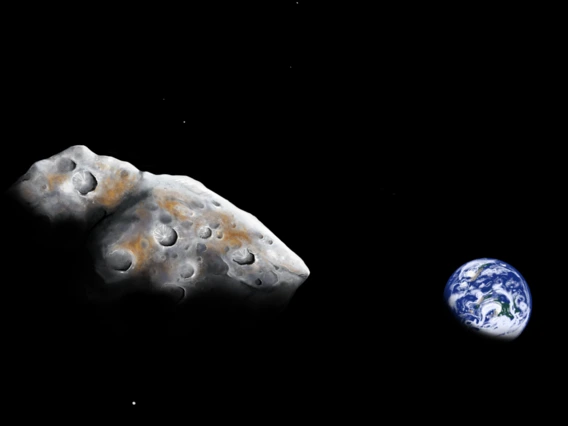
'Mini Psyches' Give Insights into Mysterious Metal-Rich Near-Earth Asteroids
New research into metal-rich asteroids reveals information about the origins and compositions of these rare bodies that could one day be mined.
'Mini Psyches' Give Insights into Mysterious Metal-Rich Near-Earth Asteroids

University Communications - October 1, 2021
Metal-rich near-Earth asteroids, or NEAs, are rare, but their presence provides the intriguing possibility that iron, nickel and cobalt could someday be mined for use on Earth or in Space.
New research, published in the Planetary Science Journal, investigated two metal-rich asteroids in our own cosmic backyard to learn more about their origins, compositions and relationships with meteorites found on Earth.
These metal-rich NEAs were thought to be created when the cores of developing planets were catastrophically destroyed early in the solar system's history, but little more is known about them. A team of students co-led by University of Arizona planetary science associate professor Vishnu Reddy studied asteroids 1986 DA and 2016 ED85 and discovered that their spectral signatures are quite similar to asteroid 16 Psyche, the largest metal-rich body in the solar system. Psyche, located in the main asteroid belt between the orbits of Mars and Jupiter rather than near Earth, is the target of NASA's Psyche mission.
"Our analysis shows that both NEAs have surfaces with 85% metal such as iron and nickel and 15% silicate material, which is basically rock," said lead author Juan Sanchez, who is based at the Planetary Science Institute. "These asteroids are similar to some stony-iron meteorites such as mesosiderites found on Earth."
Astronomers have been speculating as to what the surface of Psyche is made of for decades. By studying metal-rich NEAs that come close to the Earth, they hope to identify specific meteorites that resemble Psyche’s surface.
"We started a compositional survey of the NEA population in 2005, when I was a graduate student, with the goal of identifying and characterizing rare NEAs such as these metal-rich asteroids," said Reddy, principal investigator of the NASA grant that funded the work. "It is rewarding that we have discovered these 'mini Psyches' so close to the Earth."
"For perspective, a 50-meter (164-foot) metallic object similar to the two asteroids we studied created the Meteor Crater in Arizona," said Adam Battle, who is a co-author of the paper along with fellow Lunar and Planetary Laboratory graduate students Benjamin Sharkey and Theodore Kareta, and David Cantillo, an undergraduate student in the Department of Geosciences.
The paper also explored the mining potential of 1986 DA and found that the amount of iron, nickel and cobalt that could be present on the asteroid would exceed the global reserves of these metals.
Additionally, when an asteroid is catastrophically destroyed, it produces what is called an asteroid family – a bunch of small asteroids that share similar compositions and orbital paths.
The team used the compositions and orbits of asteroids 1986 DA and 2016 ED85 to identify four possible asteroid families in the outer region of the main asteroid belt, which is home to the largest reservoir of small bodies in the inner part of the solar system. This also happens to be the region where most of the largest known metallic asteroids including 16 Psyche reside.
"We believe that these two 'mini Psyches' are probably fragments from a large metallic asteroid in the main belt, but not 16 Psyche itself," Cantillo said. "It's possible that some of the iron and stony-iron meteorites found on Earth could have also come from that region in the solar system too."
The paper's findings are based on observations from the NASA Infrared Telescope Facility on the island of Hawaii. The work was funded by the NASA Near-Earth Object Observations Program, which also funds the NASA Infrared Telescope Facility.

Earth and Venus Grew up as Rambunctious Planets
What doesn't stick comes around: Using machine learning and simulations of giant impacts, researchers at the Lunar and Planetary Laboratory found that the planets residing in the inner solar systems were likely born from repeated hit-and-run collisions, challenging conventional models of planet formation.
Earth and Venus Grew up as Rambunctious Planets

By Daniel Stolte, University Communications - September 23, 2021
Planet formation – the process by which neat, round, distinct planets form from a roiling, swirling cloud of rugged asteroids and mini planets – was likely even messier and more complicated than most scientists would care to admit, according to new research led by researchers at the University of Arizona Lunar and Planetary Laboratory.
The findings challenge the conventional view, in which collisions between smaller building blocks cause them to stick together and, over time, repeated collisions accrete new material to the growing baby planet.
Instead, the authors propose and demonstrate evidence for a novel "hit-and-run-return" scenario, in which pre-planetary bodies spent a good part of their journey through the inner solar system crashing into and ricocheting off of each other, before running into each other again at a later time. Having been slowed down by their first collision, they would be more likely to stick together the next time. Picture a game of billiards, with the balls coming to rest, as opposed to pelting a snowman with snowballs, and you get the idea.
The research is published in two reports appearing in the Sept. 23 issue of The Planetary Science Journal, with one focusing on Venus and Earth, and the other on Earth's moon. Central to both publications, according to the author team, which was led by planetary sciences and LPL professor Erik Asphaug, is the largely unrecognized point that giant impacts are not the efficient mergers scientists believed them to be.
"We find that most giant impacts, even relatively 'slow' ones, are hit-and-runs. This means that for two planets to merge, you usually first have to slow them down in a hit-and-run collision," Asphaug said. "To think of giant impacts, for instance the formation of the moon, as a singular event is probably wrong. More likely it took two collisions in a row."
One implication is that Venus and Earth would have had very different experiences in their growth as planets, despite being immediate neighbors in the inner solar system. In this paper, led by Alexandre Emsenhuber, who did this work during a postdoctoral fellowship in Asphaug's lab and is now at Ludwig Maximilian University in Munich, the young Earth would have served to slow down interloping planetary bodies, making them ultimately more likely to collide with and stick to Venus.
"We think that during solar system formation, the early Earth acted like a vanguard for Venus," Emsenhuber said.
The solar system is what scientists call a gravity well, the concept behind a popular attraction at science exhibits. Visitors toss a coin into a funnel-shaped gravity well, and then watch their cash complete several orbits before it drops into the center hole. The closer a planet is to the sun, the stronger the gravitation experienced by planets. That's why the inner planets of the solar system on which these studies were focused – Mercury, Venus, Earth and Mars – orbit the sun faster than, say, Jupiter, Saturn and Neptune. As a result, the closer an object ventures to the sun, the more likely it is to stay there.
So when an interloping planet hit the Earth, it was less likely to stick to Earth, and instead more likely to end up at Venus, Asphaug explained.
"The Earth acts as a shield, providing a first stop against these impacting planets," he said. "More likely than not, a planet that bounces off of Earth is going to hit Venus and merge with it."
Emsenhuber uses the analogy of a ball bouncing down a staircase to illustrate the idea of what drives the vanguard effect: A body coming in from the outer solar system is like a ball bouncing down a set of stairs, with each bounce representing a collision with another body.
"Along the way, the ball loses energy, and you'll find it will always bounce downstairs, never upstairs," he said. "Because of that, the body cannot leave the inner solar system anymore. You generally only go downstairs, toward Venus, and an impactor that collides with Venus is pretty happy staying in the inner solar system, so at some point it is going to hit Venus again."
Earth has no such vanguard to slow down its interloping planets. This leads to a difference between the two similar-sized planets that conventional theories cannot explain, the authors argue.
"The prevailing idea has been that it doesn't really matter if planets collide and don't merge right away, because they are going to run into each other again at some point and merge then," Emsenhuber said. "But that is not what we find. We find they end up more frequently becoming part of Venus, instead of returning back to Earth. It's easier to go from Earth to Venus than the other way around."
To track all these planetary orbits and collisions, and ultimately their mergers, the team used machine learning to obtain predictive models from 3D simulations of giant impacts. The team then used these data to rapidly compute the orbital evolution, including hit-and-run and merging collisions, to simulate terrestrial planet formation over the course of 100 million years. In the second paper, the authors propose and demonstrate their hit-and-run-return scenario for the moon's formation, recognizing the primary problems with the standard giant impact model.
"The standard model for the moon requires a very slow collision, relatively speaking," Asphaug said, "and it creates a moon that is composed mostly of the impacting planet, not the proto-Earth, which is a major problem since the moon has an isotopic chemistry almost identical to Earth."
In the team's new scenario, a roughly Mars-sized protoplanet hits the Earth, as in the standard model, but is a bit faster so it keeps going. It returns in about 1 million years for a giant impact that looks a lot like the standard model.
"The double impact mixes things up much more than a single event," Asphaug said, "which could explain the isotopic similarity of Earth and moon, and also how the second, slow, merging collision would have happened in the first place."
The researchers think the resulting asymmetry in how the planets were put together points the way to future studies addressing the diversity of terrestrial planets. For example, we don't understand how Earth ended up with a magnetic field that is much stronger than that of Venus, or why Venus has no moon.
Their research indicates systematic differences in dynamics and composition, according to Asphaug.
"In our view, Earth would have accreted most of its material from collisions that were head-on hits, or else slower than those experienced by Venus," he said. "Collisions into the Earth that were more oblique and higher velocity would have preferentially ended up on Venus."
This would create a bias in which, for example, protoplanets from the outer solar system, at higher velocity, would have preferentially accreted to Venus instead of Earth. In short, Venus could be composed of material that was harder for the Earth to get ahold of.
"You would think that Earth is made up more of material from the outer system because it is closer to the outer solar system than Venus. But actually, with Earth in this vanguard role, it makes it actually more likely for Venus to accrete outer solar system material," Asphaug said.
The co-authors on the two papers are Saverio Cambioni and Stephen R. Schwartz at the Lunar and Planetary Laboratory and Travis S. J. Gabriel at Arizona State University in Tempe, Arizona.

OSIRIS-REx Improves Understanding of Potentially Hazardous Asteroids
NASA and UArizona scientists were able to significantly reduce uncertainties about asteroid Bennu's orbit and determine the likelihood of the asteroid impacting Earth between now and the year 2300.
OSIRIS-REx Improves Understanding of Potentially Hazardous Asteroids

NASA and University Communications - August 11, 2021
In a study released in the journal Icarus today, NASA and University of Arizona researchers used precision-tracking data from the OSIRIS-REx spacecraft to better understand movements of the potentially hazardous asteroid Bennu. The findings confirm that Bennu has a significantly decreased risk of impacting Earth late in the next century, and improve our ability to predict orbits of many other asteroids.
Using NASA's Deep Space Network and a state-of-the-art computer model, scientists pinpointed Bennu's future orbits with unprecedented accuracy, effectively reducing the asteroid's orbit uncertainties to determine the total impact probability through the year 2300.
In 2135, asteroid Bennu will make a very close approach with Earth. Although the near-Earth object will not hit the planet at that time, scientists must understand Bennu's exact trajectory during that encounter in order to predict how Earth's gravity will alter the asteroid's path around the sun and affect its risk of Earth impact in the future.
Scientists were able to significantly shrink uncertainties about Bennu's orbit, determining its impact probability through the year 2300 is about 1 in 1,750, or 0.057%. The researchers were also able to identify Sept. 24, 2182 as the most significant single date, with an impact probability of 1 in 2,700, or about 0.037%.
"The orbital data from this mission helped us better appreciate Bennu's impact risk over the next couple of centuries and our overall understanding of potentially hazardous asteroids – an incredible result," said Dante Lauretta, OSIRIS-REx principal investigator and a professor in the Lunar and Planetary Laboratory at the University of Arizona.
Although the chances of hitting Earth are low, Bennu is still one of the two most hazardous known objects in the solar system, along with another asteroid called 1950 DA.
"NASA's Planetary Defense mission is to find and monitor asteroids and comets that can come near Earth and may pose a hazard to our planet," said Kelly Fast, program manager for NASA's Near-Earth Object Observations Program. "We carry out this endeavor through continuing astronomical surveys that collect data to discover previously unknown objects and refine our orbital models for them. The OSIRIS-REx mission has provided an extraordinary opportunity to refine and test these models, helping us better predict where Bennu will be when it makes its close approach to Earth more than a century from now."
Before leaving Bennu on May 10, 2021, OSIRIS-REx spent over two years in close proximity to the asteroid, gathering information about its size – about a third of a mile, or 500 meters, wide – as well as its shape, mass, and composition, spin and orbital trajectory. The spacecraft is on its way back to Earth with a bounty of dust, pebbles and small rocks collected from the asteroid's surface. OSIRIS-REx will deliver the sample to Earth on Sept. 24, 2023, for further scientific investigation.
"The OSIRIS-REx data give us so much more precise information, we can test the limits of our models and calculate the future trajectory of Bennu to a very high degree of certainty through 2135," said study lead author Davide Farnocchia of the Center for Near Earth Object Studies, which is managed by NASA's Jet Propulsion Laboratory in Southern California. "We've never modeled an asteroid's trajectory to this precision before."
Gravitational Keyholes
The precision measurements on Bennu help to better determine how the asteroid's orbit will evolve over time and whether it will pass through a "gravitational keyhole" during its close approach in the year 2135. These keyholes are areas in space that if passed through by Bennu at a certain time and location would set the asteroid on a path where Earth's gravitational pull could cause a potential future impact.
To calculate exactly where the asteroid will be during its 2135 close approach – and whether it might pass through a gravitational keyhole – Farnocchia and his team evaluated various types of small forces that may affect the asteroid as it orbits the sun. Even the smallest force can significantly deflect its orbital path over time, causing it to pass through or completely miss a keyhole.
Among those forces, the sun's heat plays a crucial role. As an asteroid travels around the sun, sunlight heats up the side facing it. As the asteroid spins, the heated side will cool down as it rotates away. As it cools, the surface releases infrared energy, which generates a small amount of thrust on the asteroid – a phenomenon called the Yarkovsky Effect. Over short timeframes, this thrust is minuscule, but over long periods, the effect on the asteroid's position builds up and can play a significant role in changing an asteroid's path.
"The Yarkovsky Effect will act on all asteroids of all sizes, and while it has been measured for a small fraction of the asteroid population from afar, OSIRIS-REx gave us the first opportunity to measure it in detail as Bennu traveled around the sun," said Steve Chesley, senior research scientist at JPL and study co-investigator. "The effect is equivalent to the weight of three grapes constantly acting on the asteroid – tiny, yes, but significant when determining Bennu's future impact risks over the decades and centuries to come."
The team accounted for many other perturbing forces as well, including the gravity of the planets, their moons and over 100 other asteroids; the drag caused by interplanetary dust; the pressure of the solar wind; and Bennu's particle-ejection events. The researchers even evaluated the force OSIRIS-REx exerted when performing its Touch-And-Go, or TAG, sample collection event on Oct. 20, 2020, to see how it might have slightly altered Bennu's orbit.
"The force exerted on Bennu's surface during the TAG event was tiny even in comparison to the effects of other small forces considered," said Rich Burns, OSIRIS-REx project manager at NASA Goddard Space Flight Center. "TAG did not alter Bennu's likelihood of impacting Earth in any meaningful way."
Tiny Risk, Huge Gain
Although a 0.057% impact probability through the year 2300 and an impact probability of 0.037% in 2182 are exceedingly low, the study highlights the crucial role that OSIRIS-REx operations played in precisely characterizing Bennu's orbit.
"The spacecraft is now returning home, carrying a precious sample from this fascinating ancient object that will help us better understand not only the history of the solar system but also the role of sunlight in altering Bennu's orbit since we will measure the asteroid thermal properties at unprecedented scales in laboratories on Earth," UArizona's Lauretta said.
The University of Arizona leads the science team and the mission's science observation planning and data processing. NASA's Goddard Space Flight Center in Greenbelt, Maryland, provides overall mission management, systems engineering and the safety and mission assurance for OSIRIS-REx. Lockheed Martin Space Systems in Denver built the spacecraft and is providing flight operations. Goddard and KinetX Aerospace are responsible for navigating the OSIRIS-REx spacecraft. OSIRIS-REx, which stands for Origins, Spectral Interpretation, Resource Identification, Security-Regolith Explorer, is the third mission in NASA's New Frontiers Program. NASA's Marshall Space Flight Center in Huntsville, Alabama, manages the agency's New Frontiers Program for the Science Mission Directorate in Washington, D.C.
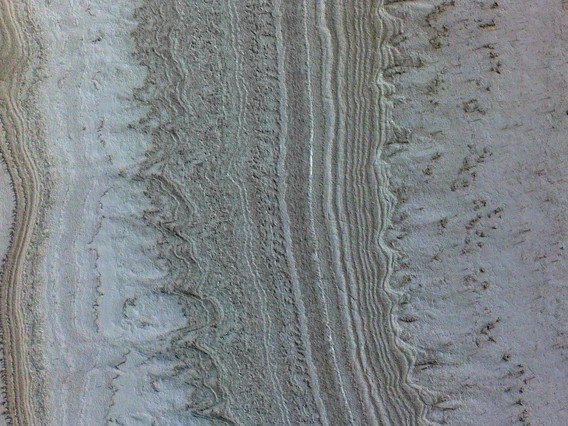
Mars Lake Hypothesis on Ice After Study Offers Different Explanation
Scientists have long debated what's under the surface of Mars' south pole. A new study points to clays being more likely than a subsurface lake.
Mars Lake Hypothesis on Ice After Study Offers Different Explanation

By University Communications and York University - July 29, 2021
For years, scientists have been debating what might lay under the Martian planet's south polar cap after bright radar reflections were discovered and initially attributed to water.
Now, a new study involving a researcher from the University of Arizona puts that theory to rest and demonstrates that another material is most likely the answer.
The research, published in Geophysical Research Letters and led by York University planetary scientists in Canada, uses multiple lines of evidence to show that smectites, a common type of clay, can explain all of the observations – putting the Mars lake theory on ice.
"Since being first reported as bodies of water, the scientific community has shown skepticism about the lake hypothesis," said principal investigator Isaac Smith, Canada Research Chair and assistant professor of earth and space science at York University. "And recent publications questioned if it was even possible to have liquid water."
Papers in 2018 and 2021 demonstrated that the amount of salt and heat required to thaw ice at the bottom of the polar cap was many times more than Mars provides, and recent evidence showing these radar detections are much more widespread – to places even harder to thaw ice – put the idea further into question.
The research team – which included Stefano Nerozzi, a postdoctoral fellow in the University of Arizona Lunar and Planetary Laboratory and Department of Geosciences, as well as researchers from Cornell, Purdue and Tulane universities – used experimental and modelling work to demonstrate that smectites can better explain the radar observations made by the MARSIS instrument aboard the European Space Agency's Mars Express orbiter. Further, they found spectral evidence that smectites are present at the edges of the south polar cap.
"Smectites are very abundant on Mars, covering about half the planet, especially in the Southern Hemisphere," said Smith. "That knowledge, along with the radar properties of smectites at cryogenic temperatures, points to them being the most likely explanation to the riddle."
"Based on observations, the first reason the bright reflectors cannot be water is because some of them continue from underground onto the surface. If that is the case, then we should see springs, which we don't," Nerozzi said. "Not only that, but multiple reflectors are stacked on top of each other, and some are even found right in the middle of the polar cap. If this were water, this would be physically impossible."
Experiments also measured the radar characteristics of hydrated smectites at room temperature and cryogenic temperatures. The radar characteristics in question are two numbers that represent the real and imaginary parts of the permittivity, which tells you about the material's electrical properties and response to the radio waves employed by radars. Both numbers are important for fully characterizing a material, but the 2018 study used modeling that included only the real part of the dielectric value, leaving out certain classes of materials from being considered – namely clays.
Once the experimental measurements were completed, data was evaluated using code. It was in these simulations that researchers found that unlike the original liquid water hypothesis, frozen clays have numbers just right to explain all the reflections.
Smectites are a class of clay that is formed when basalt – the volcanic rock that comprises most of Mars' surface – breaks down chemically in the presence of liquid water.
"Detecting possible clay minerals in and below the south polar ice cap is important because it tells us that the ice includes sediments that have interacted with water sometime in the past, either in the ice cap or before the ice was there," said Briony Horgan, co-author and associate professor of earth, atmospheric and planetary sciences at Purdue University. "So, while our work shows that there may not be liquid water and an associated habitable environment for life under the cap today, it does tell us about water that existed in this area in the past."
To support the new hypothesis, Smith conducted experiments in his lab with equipment designed for measuring dielectric values. To simulate the conditions beneath Mars' south polar cap as best as possible, his team froze the clays to minus 50 degrees Celsius and measured them again, something that had never been done before. Smith adds that the infrared absorptions attributable to these minerals are present in south polar orbital visible-near infrared reflectance spectra. Because these minerals are both present at the south pole and can cause the reflections, the team believes this to be a more viable scenario than the presence of liquid water. No salt or heat is required.
"We used our lab measurements of clay minerals as the input for a radar reflection model and found that the results of the model matched very well with the real, observed data," said Dan Lalich, postdoctoral researcher at the Cornell Center for Astrophysics and Planetary Science at Cornell University and second author on the study. "While it's disappointing that liquid water might not actually be present below the ice today, this is still a cool observation that might help us learn more about conditions on ancient Mars."
"We analyzed the MARSIS radar data and identified observations with high-power values at the base of the south polar layered deposits, both in the proposed lake region and elsewhere," said Jenny Whitten, co-author and planetary scientist in the Department of Earth and Environmental Sciences at Tulane University.
Putting the results in perspective Smith says the answer is clear.
"Now, we have the trifecta. One, we measured dielectric properties of materials that are known to exist over 50% of Mars' surface and found them to have very high values. Two, we modelled how those numbers would respond in Mars' south-polar conditions and found them to match the radar observations well. Three, we demonstrated that these minerals are at the south pole. Because the liquid water theory required incredible amounts of heat, which is six to eight times more than Mars provides, and more salt than Mars has, it was already implausible. Now, the clays can explain the observations with absolutely no qualifiers or asterisks."
Researchers Trace Dust Grain's Journey Through Newborn Solar System
Combining atomic-scale sample analysis and models simulating likely conditions in the nascent solar system, a new study reveals clues about the origin of crystals that formed more than 4.5 billion years ago.Researchers Trace Dust Grain's Journey Through Newborn Solar System

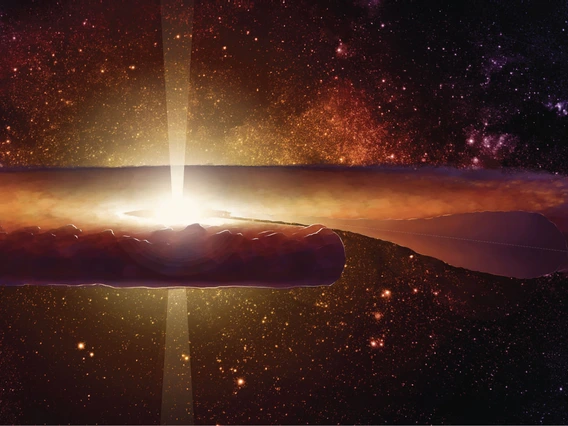
Artist’s illustration of the early solar system, at a time when no planets had formed yet. A swirling cloud of gas and dust surrounded the young sun. The cutaway through this so-called protoplanetary disk shows its three-dimensional structure. Heather Roper
A research team led by the University of Arizona has reconstructed in unprecedented detail the history of a dust grain that formed during the birth of the solar system more than 4.5 billion years ago. The findings provide insights into the fundamental processes underlying the formation of planetary systems, many of which are still shrouded in mystery.
For the study, the team developed a new type of framework, which combines quantum mechanics and thermodynamics, to simulate the conditions to which the grain was exposed during its formation, when the solar system was a swirling disk of gas and dust known as a protoplanetary disk or solar nebula. Comparing the predictions from the model to an extremely detailed analysis of the sample's chemical makeup and crystal structure, along with a model of how matter was transported in the solar nebula, revealed clues about the grain's journey and the environmental conditions that shaped it along the way.
The grain analyzed in the study is one of several inclusions, known as calcium-aluminum rich inclusions, or CAIs, discovered in a sample from the Allende meteorite, which fell over the Mexican state of Chihuahua in 1969. CAIs are of special interest because they are thought to be among the first solids that formed in the solar system more than 4.5 billion years ago.
Similar to how stamps in a passport tell a story about a traveler's journey and stops along the way, the samples' micro- and atomic-scale structures unlock a record of their formation histories, which were controlled by the collective environments to which they were exposed.
"As far as we know, our paper is the first to tell an origin story that offers clues about the likely processes that happened at the scale of astronomical distances with what we see in our sample at the scale of atomic distances," said Tom Zega, a professor in the University of Arizona's Lunar and Planetary Laboratory and the first author of the paper, published in The Planetary Science Journal.
Zega and his team analyzed the composition of the inclusions embedded in the meteorite using cutting-edge atomic-resolution scanning transmission electron microscopes – one at UArizona's Kuiper Materials Imaging and Characterization Facility, and its sister microscope located at the Hitachi factory in Hitachinaka, Japan.
The inclusions were found to consist mainly of types of minerals known as spinel and perovskite, which also occur in rocks on Earth and are being studied as candidate materials for applications such as microelectronics and photovoltaics.
Similar kinds of solids occur in other types of meteorites known as carbonaceous chondrites, which are particularly interesting to planetary scientists as they are known to be leftovers from the formation of the solar system and contain organic molecules, including those that may have provided the raw materials for life.
Precisely analyzing the spatial arrangement of atoms allowed the team to study the makeup of the underlying crystal structures in great detail. To the team's surprise, some of the results were at odds with current theories on the physical processes thought to be active inside protoplanetary disks, prompting them to dig deeper.
"Our challenge is that we don't know what chemical pathways led to the origins of these inclusions," Zega said. "Nature is our lab beaker, and that experiment took place billions of years before we existed, in a completely alien environment."
Zega said the team set out to "reverse-engineer" the makeup of the extraterrestrial samples by designing new models that simulated complex chemical processes, which the samples would be subjected to inside a protoplanetary disk.
"Such models require an intimate convergence of expertise spanning the fields of planetary science, materials science, mineral science and microscopy, which was what we set out to do," added Krishna Muralidharan, a study co-author and an associate professor in the UArizona's Department of Materials Science and Engineering.
Based on the data the authors were able to tease from their samples, they concluded that the particle formed in a region of the protoplanetary disk not far from where Earth is now, then made a journey closer to the sun, where it was progressively hotter, only to later reverse course and wash up in cooler parts farther from the young sun. Eventually, it was incorporated into an asteroid, which later broke apart into pieces. Some of those pieces were captured by Earth's gravity and fell as meteorites.
The samples for this study were taken from the inside of a meteorite and are considered primitive – in other words, unaffected by environmental influences. Such primitive material is believed to not have undergone any significant changes since it first formed more than 4.5 billion years ago, which is rare. Whether similar objects occur in asteroid Bennu, samples of which will be returned to Earth by the UArizona-led OSIRIS-REx mission in 2023, remains to be seen. Until then, scientists rely on samples that fall to Earth via meteorites.
"This material is our only record of what happened 4.567 billion years ago in the solar nebula," said Venkat Manga, a co-author of the paper and an assistant research professor in the UArizona Department of Materials Science and Engineering. "Being able to look at the microstructure of our sample at different scales, down to the length of individual atoms, is like opening a book."
The authors said that studies like this one could bring planetary scientists a step closer to "a grand model of planet formation" – a detailed understanding of the material moving around the disk, what it is composed of, and how it gives rise to the sun and the planets.
Powerful radio telescopes like the Atacama Large Millimeter/submillimeter Array, or ALMA, in Chile now allow astronomers to see stellar systems as they evolve, Zega said.
"Perhaps at some point we can peer into evolving disks, and then we can really compare our data between disciplines and begin answering some of those really big questions," Zega said. "Are these dust particles forming where we think they did in our own solar system? Are they common to all stellar systems? Should we expect the pattern we see in our solar system – rocky planets close to the central star and gas giants farther out – in all systems?
"It's a really interesting time to be a scientist when these fields are evolving so rapidly," he added. "And it's awesome to be at an institution where researchers can form transdisciplinary collaborations among leading astronomy, planetary and materials science departments at the same university."
The study was co-authored by Fred Ciesla at the University of Chicago and Keitaro Watanabe and Hiromi Inada, both with the Nano-Technology Solution Business Group at Hitachi High-Technologies Corp. in Japan.
Funding was provided through NASA's Emerging Worlds Program; NASA's Origins Program; and NASA's Nexus for Exoplanet System Science (NExSS) research coordination network, which is sponsored by NASA's Science Mission Directorate. NASA and the National Science Foundation provided the funding for the instrumentation in LPL's Kuiper Materials Imaging and Characterization Facility.

Asteroid 16 Psyche Might Not Be What Scientists Expected
New UArizona research finds that the target asteroid of NASA's Psyche mission may not be as metallic or dense as previously predicted.
Asteroid 16 Psyche Might Not Be What Scientists Expected

By Mikayla Mace Kelley, University Communications - June 9, 2021
The widely studied metallic asteroid known as 16 Psyche was long thought to be the exposed iron core of a small planet that failed to form during the earliest days of the solar system. But new University of Arizona-led research suggests that the asteroid might not be as metallic or dense as once thought, and hints at a much different origin story.
Scientists are interested in 16 Psyche because if its presumed origins are true, it would provide an opportunity to study an exposed planetary core up close. NASA is scheduled to launch its Psyche mission in 2022 and arrive at the asteroid in 2026.
UArizona undergraduate student David Cantillo is lead author of a new paper published in The Planetary Science Journal that proposes 16 Psyche is 82.5% metal, 7% low-iron pyroxene and 10.5% carbonaceous chondrite that was likely delivered by impacts from other asteroids. Cantillo and his collaborators estimate that 16 Psyche's bulk density – also known as porosity, which refers to how much empty space is found within its body – is around 35%.
These estimates differ from past analyses of 16 Psyche's composition that led researchers to estimate it could contain as much as 95% metal and be much denser.
"That drop in metallic content and bulk density is interesting because it shows that 16 Psyche is more modified than previously thought," Cantillo said.
Rather than being an intact exposed core of an early planet, it might actually be closer to a rubble pile, similar to another thoroughly studied asteroid — Bennu. UArizona leads the science mission team for NASA's OSIRIS-REx mission, which retrieved a sample from Bennu's surface that is now making its way back to Earth.
"Psyche as a rubble pile would be very unexpected, but our data continues to show low-density estimates despite its high metallic content," Cantillo said.
Asteroid 16 Psyche is about the size of Massachusetts, and scientists estimate it contains about 1% of all asteroid belt material. First spotted by an Italian astronomer in 1852, it was the 16th asteroid ever discovered.
"Having a lower metallic content than once thought means that the asteroid could have been exposed to collisions with asteroids containing the more common carbonaceous chondrites, which deposited a surface layer that we are observing," Cantillo said. This was also observed on asteroid Vesta by the NASA Dawn spacecraft.
Asteroid 16 Psyche has been estimated to been worth $10,000 quadrillion (that's $10,000 followed by 15 more zeroes), but the new findings could slightly devalue the iron-rich asteroid.
"This is the first paper to set some specific constraints on its surface content. Earlier estimates were a good start, but this refines those numbers a bit more," Cantillo said.
The other well-studied asteroid, Bennu, contains a lot of carbonaceous chondrite material and has porosity of over 50%, which is a classic characteristic of a rubble pile.
Such high porosity is common for relatively small and low-mass objects such as Bennu – which is only as large as the Empire State Building – because a weak gravitational field prevents the object's rocks and boulders from being packed together too tightly. But for an object the size of 16 Psyche to be so porous is unexpected.
"The opportunity to study an exposed core of a planetesimal is extremely rare, which is why they're sending the spacecraft mission there," Cantillo said, "but our work shows that 16 Psyche is a lot more interesting than expected."
Past estimates of 16 Psyche's composition were done by analyzing the sunlight reflected off its surface. The pattern of light matched that of other metallic objects. Cantillo and his collaborators instead recreated 16 Psyche's regolith – or loose rocky surface material – by mixing different materials in a lab and analyzing light patterns until they matched telescope observations of the asteroid. There are only a few labs in the world practicing this technique, including the UArizona Lunar and Planetary Laboratory and the Johns Hopkins Applied Physics Laboratory in Maryland, where Cantillo worked while in high school.
"I've always been interested in space," said Cantillo, who is also president of the UArizona Astronomy Club. "I knew that astronomy studies would be heavy on computers and observation, but I like to do more hands-on kind of work, so I wanted to connect my studies to geology somehow. I'm majoring geology and minoring in planetary science and math."
"David's paper is an example of the cutting-edge research work done by our undergraduate students," said study co-author Vishnu Reddy, an associate professor of planetary sciences who heads up the lab in which Cantillo works. "It is also a fine example of the collaborative effort between undergraduates, graduate students, postdoctoral fellows and staff in my lab."
The researchers also believe the carbonaceous material on 16 Psyche's surface is rich in water, so they will next work to merge data from ground-based telescopes and spacecraft missions to other asteroids to help determine the amount of water present.

$2M Gift Advances UArizona Space Science Initiatives
The gift will enable the purchase of a nanoscale secondary ion mass spectrometer, an instrument the analysis team will use to help find answers to fundamental questions about the origins of the solar system.
$2M Gift Advances UArizona Space Science Initiatives

University of Arizona Foundation - May 25, 2021
In October, NASA's OSIRIS-REx spacecraft made the agency's first attempt to collect a sample from the asteroid Bennu during a mission led by the University of Arizona.
Among those following along was assistant professor and cosmochemist Jessica Barnes, assistant professor of planetary sciences and a collaborating sample scientist on the mission. She and her colleagues at the UArizona Lunar and Planetary Laboratory were elated when the touch-and-go event succeeded. Then they worried after the mission team learned some particles were escaping the sample collector and spent two days working around the clock to secure the material.
"That was a really surreal time," Barnes said.
Around the time Barnes learned the collector head had been closed with an abundant sample, she received more good news: Someone had made a $1.5 million gift toward sample analysis. The gift will enable the purchase of a nanoscale secondary ion mass spectrometer, an instrument the analysis team will use to help find answers to fundamental questions about the origins of the solar system. The project is funded in part by a grant from the Gordon and Betty Moore Foundation, as well as the university.
Barnes called Dante Lauretta, professor of planetary sciences and principal investigator of OSIRIS-REx, to share the news.
"I was emotional, as was Dante. To hear we have this wonderful gift that enables us to get this amazing piece of equipment – I had no idea that would happen at that time. It was just amazing," Barnes said.
The timing was noteworthy, Lauretta said, not only because he'd just learned the sample collection was successful, but because 2020 had presented so many difficulties.
"I was overwhelmed with emotion and joy and excitement – for Jessica, for the university, for our samples, for science, for our students and staff and everybody that's going to be involved in the continuation of this amazing scientific adventure," he said.
The donor, who asked to remain anonymous, is a UArizona graduate who made a previous major gift so that the university’s students and faculty will have more time using the Giant Magellan Telescope when it's completed and begins operations at its home in Chile's Atacama Desert. This gift allocated another $500,000 in support of UArizona’s role in the GMT project as well as the $1.5 million to provide the balance required for the sample analysis instrument.
"I am immensely grateful for this donor's vision and support of space science exploration at the University of Arizona," said university President Robert C. Robbins. "One of the most thrilling aspects of both of these projects is realizing how many members of our faculty and staff, as well as our students, are contributing to their success. It is incredible to have a graduate continue engaging with the university and supporting these missions.”
The donor's decision to contribute to the OSIRIS-REx mission arose partly from admiration for Barnes' expertise in sample analysis and from an interest in supporting an early-career female scientist, said Elliott Cheu, interim dean of the College of Science.
Barnes joined the Lunar and Planetary Laboratory in 2019 following a postdoctoral fellowship at NASA's Johnson Space Center in Houston. She received her doctorate from The Open University in the U.K.
The College of Science is fortunate to be able to attract world-leading faculty, said Cheu, who will continue as interim dean until June, when Carmala Garzione will become permanent dean.
"When donors step up to become partners in discovery, they empower those researchers to realize their potential and accelerate our progress. This remarkable gift ensures we can make the most of our team's knowledge and the sample so many have worked long and hard to retrieve," Cheu said.
Private gifts are often a crucial component of university research projects, said John-Paul Roczniak, president and CEO of the UArizona Foundation.
"This gift helps accelerate scientific breakthroughs. I'm grateful to this donor and all our supporters who make generous investments in research with far-reaching consequences for society," Roczniak said.
The OSIRIS-REx spacecraft is scheduled to return to Earth in September 2023, with the sample capsule touching down at the Utah Test and Training Range. Following initial identification and processing at the Johnson Space Center, a team led by Lauretta will begin detailed analysis at UArizona. The goal is to explore the solar system's past and secure its future, according to Lauretta.
The nanoscale secondary ion mass spectrometer allows investigation to the nanometer scale, Barnes said. She expects the instrument to provide a wealth of information over many years without destroying the samples, thereby extending the discovery timeline.
"Depending on how much material we brought back from Bennu, scientists and students could be analyzing those materials a decade or even two or three decades into the future," Barnes said.

Bennu in the Sky, on the Canvas and (Soon) in Zoe Zeszut's Hands
Zoe Zeszut painted mythological birds perched on the Bennu features that carry their names.
Bennu in the Sky, on the Canvas and (Soon) in Zoe Zeszut's Hands

By Mikayla Mace Kelley, University Communications - May 17, 2021
The near-Earth asteroid Bennu is nearly always on Zoe Zeszut's mind.
As a former operations engineer for NASA's University of Arizona-led OSIRIS-REx mission, she coded and verified commands to maneuver the spacecraft and capture images of the asteroid's surface.
In her new role in the Kuiper Materials Imaging and Characterization Facility, she will analyze the asteroid rocks and dust upon the sample's return.
Her work with space rocks also bleeds into her hobbies. As an artist, she interprets the data and mission symbolism in creative ways through her paintings.
During a typical planning cycle on the OSIRIS-REx mission, Zeszut and her teammates started by building plans weeks ahead of time. The plans were designed to capture images of the surface with good exposure and lighting with the least risk to the spacecraft. Next, the team turned the plans into coding language that the onboard systems could understand. Then, the commands went through layers of reviews by mission members before they were sent to Lockheed Martin, which built the spacecraft and provides flight operations. At Lockheed, the code was run through a spacecraft simulator and the results were reviewed by the University of Arizona team to ensure there were no conflicting or harmful commands. If everything ran smoothly, Lockheed sent the commands to the spacecraft. After the spacecraft completed an observation, Zeszut and the operations team monitored the operations to confirm that all acquired data was sent to Earth.
Zeszut, pronounced zes-zoot, joined OSIRIS-REx in March 2018, right before an operational readiness test in which the team ran through what would happen during actual mission operations. Since then, she's been there for arrival, orbital insertion, mapping, site selection, the touch-and-go sample collection in October 2020 and the final flyby last month.
Her contract with the OSIRIS-REx mission expired in mid-April, around the same time the spacecraft was preparing to return home with its sample on board.
But before she joined the team that will analyze the samples in 2023, Zeszut made many Bennu-inspired paintings.
"The name Bennu comes from a heron in an Egyptian creation story, so it was determined that features – such as boulders and craters – on Bennu would be named after other legendary birds," Zeszut said. "Some of them are quite vicious, like a Mayan parrot that decapitates people, a winged pterodactyl-like creature that breaks boats apart and a witch owl that kidnaps children. But others seem much friendlier – like benevolent birds of creation or even the Dodo bird from 'Alice in Wonderland.'"
Zeszut has created about 20 Bennu paintings. Each one portrays a feature of the asteroid's surface with the associated mythical bird flying just above. She also has painted more realistic depictions of Bennu's surface.
For inspiration, she turns to artists such as William Hartmann, whose paintings are found hanging in the Lunar and Planetary Laboratory and on the covers of some of Zeszut's textbooks.
Zeszut herself displayed some of her paintings to the annual "Art of Planetary Science" exhibit.
Zeszut loves nature, which is reflected by her choice of subjects. She often paints landscapes, animals, fossils, rocks and crystals.
"I like that my work and my hobbies are both creative in some way," she said. "You have to be innovative and insightful to do science. Like putting a puzzle together, you're trying to fit observation guidelines, science goals and spacecraft requirements together into one plan that runs successfully. I approach my art in a similar way. I like that I can bring work into hobbies and enjoy thinking about it even when I'm off the clock."
Zeszut found herself on the OSIRIS-REx team after graduating with a master's degree in planetary geology from Case Western Reserve University. There, she specifically studied asteroid and meteorite minerology and physical properties.
"During my graduate research, I kept coming across OSIRIS-REx stuff," she said. "I've always been interested in the mission, so when I finally finished my program and started searching for jobs, I found my position at OSIRIS-REx."
She started her undergraduate career in astrophysics at Ohio University, but quickly discovered it wasn't a perfect fit.
"I've always been interested in natural sciences, and I knew I wanted to have one of those majors. But shortly after starting in astrophysics, I switched because the program was mostly theoretical classes. I wanted my eye to the telescope, or at least something more hands on. Some friends in the geology department were taking classes like the geology of Mars and planetary geology, so I thought, 'Maybe that's the way to get into this.' I ended up switching to that major and got a bachelor's in geological sciences."
At the same time, she also completed a bachelor's degree in digital media and communications. She's always been drawn to graphics, art and video, she said.
Now, at the Kuiper Imaging Facility, her main duty will be managing and maintaining the labs that house the scanning electron microscope and the focused-ion-beam scanning electron microscope. Housed in the basement of the Kuiper Space Sciences Building, the faculty was founded in 2016 to support research on extraterrestrial materials.
"Going back to working with this kind of equipment is more like what I was doing in grad school, though some of the machines I used back then were decades older, so it's a bit like stepping into the 21st century as I'm learning about the equipment at Kuiper," she said.
She will also be part of the OSIRIS-REx sample analysis team when the sample return capsule is released from the spacecraft and lands in the Utah desert on Sept. 21, 2023. In the meantime, she and her new team will spend the next few years preparing for microscopic analysis.
Similar to her first days with the OSIRIS-REx mission, "we will be doing a sample analysis readiness test – a sort of practice run – in a few months. The Kuiper Imaging Facility will be at the center of the University's sample analysis work."
And just like before, it's likely her work will continue to find its way into her paintings.

OSIRIS-REx Spacecraft is Headed Home with Asteroid Sample
After nearly five years in space, the OSIRIS-REx spacecraft is on its way back to Earth with an abundance of rocks and dust from near-Earth asteroid Bennu.
OSIRIS-REx Spacecraft is Headed Home with Asteroid Sample

University Communications and NASA Goddard Space Flight Center - May 10, 2021
On Monday, May 10 at 1:23 p.m. Arizona time, the University of Arizona-led OSIRIS-REx spacecraft fired its main engines full throttle for seven minutes – its most significant maneuver since it arrived at asteroid Bennu in 2018. The burn thrust the spacecraft away from the asteroid at 600 mph, setting it on a two-and-a-half-year cruise toward Earth.
"As we leave the asteroid, I'm feeling very proud," said mission principal investigator Dante Lauretta, a UArizona professor of planetary sciences. "This team has performed phenomenally. We've learned a lot throughout this whole mission and now we're looking forward to the final science campaign of sample analysis, which is why I got involved in this program so long ago in the first place. The samples will yield decades of science once they are safely returned to Earth."
After orbiting the sun twice, the OSIRIS-REx spacecraft is due to reach Earth on Sept. 24, 2023. Upon return, the capsule containing pieces of Bennu will separate from the rest of the spacecraft and enter Earth's atmosphere. The capsule will parachute to the Utah Test and Training Range in Utah's West Desert, where scientists will be waiting to retrieve it.
"OSIRIS-REx's many accomplishments demonstrated the daring and innovate way in which exploration unfolds in real time," said Thomas Zurbuchen, associate administrator for science at NASA Headquarters. "The team rose to the challenge, and now we have a primordial piece of our solar system headed back to Earth where many generations of researchers can unlock its secrets."
To realize the mission's multi-year plan, a dozen navigation engineers made calculations and wrote computer code to instruct the spacecraft when and how to push itself away from Bennu. After departing from Bennu, getting the sample to Earth safely is the team's next critical goal. This includes planning future maneuvers to keep the spacecraft on course throughout its journey.
"Our whole mindset has been, 'Where are we in space relative to Bennu?'" said Mike Moreau, OSIRIS-REx deputy project manager at NASA's Goddard Space Flight Center in Greenbelt, Maryland. "Now our mindset has shifted to 'Where is the spacecraft in relation to Earth?'"
The navigation cameras that helped orient the spacecraft in relation to Bennu were turned off April 9, after snapping their last images of the asteroid. With Bennu in the rearview mirror, engineers are using NASA's Deep Space Network of global spacecraft communications facilities to steer the spacecraft by sending it radio signals. By measuring the frequency of the waves returned from the spacecraft transponder, engineers can tell how fast OSIRIS-REx is moving. Engineers measure how long it takes for radio signals to get from the spacecraft back to Earth in order to determine its location.
Exceeding Mission Expectations
The May 10 departure date was precisely timed based on the alignment of Bennu with Earth. The goal of the return maneuver is to get the spacecraft within about 6,000 miles of Earth in September 2023. Although OSIRIS-REx still has plenty of fuel remaining, the team is trying to preserve as much as possible for a potential extended mission to another asteroid after returning the sample capsule to Earth. The team will investigate the feasibility of such a mission this summer.
The spacecraft's course will be determined mainly by the sun's gravity, but engineers will need to occasionally make small course adjustments via engine burns.
"We need to do regular corrections to bring the trajectory increasingly closer to Earth's atmosphere for the sample release, and to account for small errors that might have accumulated since the last burn," said Peter Antreasian, OSIRIS-REx navigation lead at KinetX Aerospace, which is based in Simi Valley, California.
The team will perform course adjustments a few weeks prior to Earth re-entry in order to precisely target the location and angle for the sample capsule’s release into Earth's atmosphere. Coming in too low could cause the capsule to bounce out of the atmosphere like a pebble skipping off a lake; too high and the capsule could burn up due to friction and heat from the atmosphere. If OSIRIS-REx fails to release the capsule, the team has a backup plan to divert it away from Earth and try again in 2025.
"There's a lot of emotion within the team about departure," Moreau said. "I think everyone has a great sense of accomplishment, because we faced all these daunting tasks and were able to accomplish all the objectives thrown at us. But there's also some nostalgia and disappointment that this part of the mission is coming to an end."
OSIRIS-REx exceeded many expectations. Most recently, in the midst of a global pandemic, the team flawlessly executed the most mission’s critical operation, collecting more than 2 ounces, or 60 grams, of soil from Bennu's surface.
Leading up to sample collection, a number of surprises kept the team on its toes. For example, a week after the spacecraft entered its first orbit around Bennu on Dec. 31, 2018, the team realized that the asteroid was releasing small pieces of rock into space.
"We had to scramble to verify that the small particles being ejected from the surface did not present a hazard to the spacecraft," Moreau said.
Upon arrival at the asteroid, team members also were astonished to find that Bennu is littered with boulders.
"We really had this idea that we were arriving on an asteroid with open real estate," said Heather Enos, OSIRIS-REx deputy principal investigator, based at UArizona. "The reality was a big shocker."
To overcome the extreme and unexpected ruggedness of Bennu's surface, engineers had to quickly develop a more accurate navigation technique to target smaller-than-expected sites for sample collection.
The OSIRIS-REx mission was instrumental in both confirming and refuting several scientific expectations. Among those confirmed was the success of a technique that used observations from Earth to predict that the minerals on the asteroid would be carbon-rich and show signs of ancient water. One expectation that was disproved was that Bennu would have a smooth surface, which scientists predicted by measuring how much heat radiated off its surface.
Scientists will use the information gleaned from Bennu to refine theoretical models and improve future predictions.
"This mission emphasizes why we have to do science and exploration in multiple ways – both from Earth and from up-close in space – because assumptions and models are just that," Enos said.
The University of Arizona leads the OSIRIS-REx science team and the mission's science observation planning and data processing. NASA's Goddard Space Flight Center in Greenbelt, Maryland, provides overall mission management, systems engineering, and the safety and mission assurance for OSIRIS-REx. Lockheed Martin Space in Littleton, Colorado, built the spacecraft and provides flight operations. Goddard and KinetX Aerospace are responsible for navigating the OSIRIS-REx spacecraft. OSIRIS-REx is the third mission in NASA's New Frontiers Program, managed by NASA's Marshall Space Flight Center in Huntsville, Alabama, for the agency's Science Mission Directorate Washington, D.C.

Volcanoes on Mars Could be Active, Raising Possibility that the Planet was Recently Habitable
New observations reveal that Mars could still be volcanically active, raising the possibility for habitable conditions below the surface of Mars in recent history.
Volcanoes on Mars Could be Active, Raising Possibility that the Planet was Recently Habitable

By Daniel Stolte, University Communications, and Alan Fischer, Planetary Science Institute - May 6, 2021
Evidence of recent volcanic activity on Mars shows that eruptions could have taken place in the past 50,000 years, according to new study by researchers at the University of Arizona's Lunar and Planetary Laboratory and the Planetary Science Institute.
Most volcanism on the Red Planet occurred between 3 and 4 billion years ago, with smaller eruptions in isolated locations continuing perhaps as recently as 3 million years ago. But, until now, there was no evidence to indicate Mars could still be volcanically active.
Using data from satellites orbiting Mars, researchers discovered a previously unknown volcanic deposit. They detail their findings in the paper "Evidence for geologically recent explosive volcanism in Elysium Planitia, Mars," published in the journal Icarus.
"This may be the youngest volcanic deposit yet documented on Mars," said lead study author David Horvath, who did the research as a postdoctoral researcher at UArizona and is now a research scientist at the Planetary Science Institute. “If we were to compress Mars' geologic history into a single day, this would have occurred in the very last second.”
The volcanic eruption produced an 8-mile-wide, smooth, dark deposit surrounding a 20-mile-long volcanic fissure.
"When we first noticed this deposit, we knew it was something special," said study co-author Jeff Andrews-Hanna, an associate professor at the UArizona Lunar and Planetary Laboratory and the senior author on the study. "The deposit was unlike anything else found in the region, or indeed on all of Mars, and more closely resembled features created by older volcanic eruptions on the Moon and Mercury."
Further investigation showed that the properties, composition and distribution of material match what would be expected for a pyroclastic eruption – an explosive eruption of magma driven by expanding gasses, not unlike the opening of a shaken can of soda.
The majority of volcanism in the Elysium Planitia region and elsewhere on Mars consists of lava flowing across the surface, similar to recent eruptions in Iceland being studied by co-author Christopher Hamilton, a UArizona associate professor of lunar and planetary sciences. Although there are numerous examples of explosive volcanism on Mars, they occurred long ago. However, this deposit appears to be different.
"This feature overlies the surrounding lava flows and appears to be a relatively fresh and thin deposit of ash and rock, representing a different style of eruption than previously identified pyroclastic features," Horvath said. "This eruption could have spewed ash as high as 6 miles into Mars' atmosphere. It is possible that these sorts of deposits were more common but have been eroded or buried."
The site of the recent eruption is about 1,000 miles (1,600 kilometers) from NASA's InSight lander, which has been studying seismic activity on Mars since 2018. Two Marsquakes, the Martian equivalent of earthquakes, were found to originate in the region around the Cerberus Fossae, and recent work has suggested the possibility that these could be due to the movement of magma deep underground.
"The young age of this deposit absolutely raises the possibility that there could still be volcanic activity on Mars, and it is intriguing that recent Marsquakes detected by the InSight mission are sourced from the Cerberus Fossae," Horvath said. In fact, the team of researchers predicted this to be a likely location for Marsquakes several months before NASA's InSight lander touched down on Mars.
A volcanic deposit such as this one also raises the possibility for habitable conditions below the surface of Mars in recent history, Horvath said.
"The interaction of ascending magma and the icy substrate of this region could have provided favorable conditions for microbial life fairly recently and raises the possibility of extant life in this region," he said.
Similar volcanic fissures in this region were the source of enormous floods, perhaps as recently as 20 million years ago, as groundwater erupted out onto the surface.
Elysium Planitia, the region of recent explosive volcanism (white box) and NASA's InSight lander. Overlooking the plain is Elysium Mons, a volcano towering nearly 8 miles above its base.MOLA Science Team
Andrews-Hanna's research group continues to investigate the causes of the eruption. Pranabendu Moitra, a research scientist in the UArizona Department of Geosciences, has been probing the mechanism behind the eruption.
An expert in similar explosive eruptions on Earth, Moitra developed models to look at the possible cause of the Martian eruption. In a forthcoming paper in the journal Earth and Planetary Science Letters, he suggests that the explosion either could have been a result of gases already present in the Martian magma, or it could have happened when the magma came into contact with Martian permafrost.
"The ice melts to water, mixes with the magma and vaporizes, forcing a violent explosion of the mixture," Moitra said. "When water mixes with magma, it's like pouring gasoline on a fire."
He also points out that the youngest volcanic eruption on Mars happened only 6 miles (10 kilometers) from the youngest large-impact crater on the planet – a 6-mile-wide crater named Zunil.
"The ages of the eruption and the impact are indistinguishable, which raises the possibility, however speculative, that the impact actually triggered the volcanic eruption," Moitra said.
Several studies have found evidence that large quakes on Earth can cause magma stored beneath the surface to erupt. The impact that formed the Zunil crater on Mars would have shaken the Red Planet just like an earthquake, Moitra explained.
While the more dramatic giant volcanoes elsewhere on Mars – such as Olympus Mons, the tallest mountain in the solar system – tell a story of the planet's ancient dynamics, the current hotspot of Martian activity seems to be in the relatively featureless plains of the planet's Elysium region.
Andrews-Hanna said it's remarkable that one region hosts the epicenters of present-day earthquakes, the most recent floods of water, the most recent lava flows, and now an even more recent explosive volcanic eruption.
"This may be the most recent volcanic eruption on Mars," he said, "but I think we can rest assured that it won't be the last."
The volcanic deposit described in this study, along with ongoing seismic rumbling in the planet's interior detected by InSight and possible evidence for releases of methane plumes into the atmosphere detected by NASA's MAVEN orbiter, suggest that Mars is far from a cold, inactive world, Andrews-Hanna said.
"All these data seem to be telling the same story," he said. "Mars isn't dead."