

LPL Expertise Key in Mapping the Moon's Surface
Press Release, UA
LPL Expertise Key in Mapping the Moon's Surface

Press Release, UA Communications - June 5, 2019
On July 20, 1969, the first humans stepped onto the moon completing a feat that would not have been possible without the groundbreaking research and lunar mapping projects undertaken at the University of Arizona's Lunar and Planetary Laboratory.
When Gerard P. Kuiper founded the laboratory nine years earlier, in 1960, there was skepticism and a lack of interest in humans visiting the moon. But reaching the moon became a priority as the space race ramped up in the early '60s. Kuiper and his UA laboratory was suddenly in demand.
Almost nothing was known about the lunar surface at that time. For example, some feared the astronauts' lander would be swallowed up by bottomless layers of dust.
Now, on the 50th anniversary of the first manned mission to the moon marked by the Apollo 11 landing, UA scientists celebrate the pioneering and pivotal role the UA has held in the explosion of space science research, helping to shape what we know about our solar system and beyond.
"The UA has been a part of nearly every NASA planetary exploration mission, and with leadership roles on many of them," said Tim Swindle, director of the UA Department of Planetary Sciences and the Lunar and Planetary Laboratory, or LPL. "Our graduates and alumni have also been involved in many missions. That is our goal."
William K. Hartmann, a UA alumnus who studied with Kuiper, was instrumental in helping to create some of the first maps of the moon.
"We projected photos of the moon onto a white globe, then photographed the globe from different angles to make an atlas of lunar features from overhead, as they would be seen by astronauts orbiting the moon," Hartmann said.
He also shaped early theories around the origins of Earth's moon and has made other significant contributions to the field of lunar science.
Over the course of his scientific career, Hartmann discovered several impact basins on the moon. During the 1960s, he predicted the age of the lunar lava plains. His predictions were confirmed through samples returned by the Apollo missions.
The Apollo missions also influenced Kuiper while at the UA. He took his students on field trips to places on Earth that he felt were representative of what students might see on the moon or in the solar system, such as Meteor Crater in northern Arizona, dune fields or the extensive lava flows blanketing the Big Island of Hawaii. Those types of instructive field trips continue today.
"During our field trips, students visit planetary analog sites," Swindle said. "It's an important part of our department culture. We can send a robotic spacecraft to places in our solar system and beyond, but we'll never be able to see them as well as we can see places on Earth," he explained. "By comparing those sites using every scientific technique we can think of, we can learn what those places out there in space might be like."

On Mars, Sands Shift to a Different Drum
In the most detailed analysis of how sands move around on Mars, a team of planetary scientists led by LPL found that processes not involved in controlling sand movement on Earth play major roles on Mars.
On Mars, Sands Shift to a Different Drum

By Daniel Stolte, University Communications - May 22, 2019
In the most detailed analysis of how sands move around on Mars, a team of planetary scientists led by the UA found that processes not involved in controlling sand movement on Earth play major roles on Mars.
Wind has shaped the face of Mars for millennia, but its exact role in piling up sand dunes, carving out rocky escarpments or filling impact craters has eluded scientists until now.
In the most detailed analysis of how sands move around on Mars, a team of planetary scientists led by Matthew Chojnacki at the University of Arizona Lunar and Planetary Lab set out to uncover the conditions that govern sand movement on Mars and how they differ from those on Earth.
The results, published in the current issue of the journal Geology, reveal that processes not involved in controlling sand movement on Earth play major roles on Mars, especially large-scale features on the landscape and differences in landform surface temperature.
"Because there are large sand dunes found in distinct regions of Mars, those are good places to look for changes," said Chojnacki, associate staff scientist at the UA and lead author of the paper, "Boundary conditions controls on the high-sand-flux regions of Mars." "If you don't have sand moving around, that means the surface is just sitting there, getting bombarded by ultraviolet and gamma radiation that would destroy complex molecules and any ancient Martian biosignatures."
Compared to Earth's atmosphere, the Martian atmosphere is so thin its average pressure on the surface is a mere 0.6 percent of our planet's air pressure at sea level. Consequently, sediments on the Martian surface move more slowly than their Earthly counterparts.
The Martian dunes observed in this study ranged from 6 to 400 feet tall and were found to creep along at a fairly uniform average speed of two feet per Earth year. For comparison, some of the faster terrestrial sand dunes on Earth, such as those in North Africa, migrate at 100 feet per year.
"On Mars, there simply is not enough wind energy to move a substantial amount of material around on the surface," Chojnacki said. "It might take two years on Mars to see the same movement you'd typically see in a season on Earth."
Planetary geologists had been debating whether the sand dunes on the red planet were relics from a distant past, when the atmosphere was much thicker, or whether drifting sands still reshape the planet's face today, and if so, to what degree.
"We wanted to know: Is the movement of sand uniform across the planet, or is it enhanced in some regions over others?" Chojnacki said. "We measured the rate and volume at which dunes are moving on Mars."
The team used images taken by the HiRISE camera aboard NASA's Mars Reconnaissance Orbiter, which has been surveying Earth's next-door neighbor since 2006. HiRISE, which stands for High Resolution Imaging Science Experiment, is led by the UA's Lunar and Planetary Laboratory and has captured about three percent of the Martian surface in stunning detail.
The researchers mapped sand volumes, dune migration rates and heights for 54 dune fields, encompassing 495 individual dunes.
"This work could not have been done without HiRISE," said Chojnacki, who is a member of the HiRISE team. "The data did not come just from the images, but was derived through our photogrammetry lab that I co-manage with Sarah Sutton. We have a small army of undergraduate students who work part time and build these digital terrain models that provide fine-scale topography."
Across Mars, the survey found active, wind-shaped beds of sand and dust in structural fossae – craters, canyons, rifts and cracks – as well as volcanic remnants, polar basins and plains surrounding craters.
In the study's most surprising finding, the researchers discovered that the largest movements of sand in terms of volume and speed are restricted to three distinct regions: Syrtis Major, a dark spot larger than Arizona that sits directly west of the vast Isidis basin; Hellespontus Montes, a mountain range about two-thirds the length of the Cascades; and North Polar Erg, a sea of sand lapping around the north polar ice cap. All three areas are set apart from other parts of Mars by conditions not known to affect terrestrial dunes: stark transitions in topography and surface temperatures.
"Those are not factors you would find in terrestrial geology," Chojnacki said. "On Earth, the factors at work are different from Mars. For example, ground water near the surface or plants growing in the area retard dune sand movement."
On a smaller scale, basins filled with bright dust were found to have higher rates of sand movement, as well.
"A bright basin reflects the sunlight and heats up the air above much more quickly than the surrounding areas, where the ground is dark," Chojnacki said, "so the air will move up the basin toward the basin rim, driving the wind, and with it, the sand."
Understanding how sand and sediment move on Mars may help scientists plan future missions to regions that cannot easily be monitored and has implications for studying ancient, potentially habitable environments.

Researchers Find Ice Feature on Saturn’s Giant Moon
Rain, seas and a surface of eroding organic material can be found both on Earth and on Saturn’s largest moon, Titan. However, on Titan it is methane, not water, that fills the lakes with slushy raindrops.
Researchers Find Ice Feature on Saturn’s Giant Moon

By Mikayla Mace, University Communications - April 29, 2019
Rain, seas and a surface of eroding organic material can be found both on Earth and on Saturn’s largest moon, Titan. However, on Titan it is methane, not water, that fills the lakes with slushy raindrops.
While trying to find the source of Titan's methane, University of Arizona researcher Caitlin Griffith and her team discovered something unexpected – a long ice feature that wraps nearly half way around Titan.
Griffith, a professor in the UA Lunar and Planetary Laboratory, is the lead author on the paper published today in Nature Astronomy.
On Titan, atmospheric methane molecules are continuously broken apart by sunlight. The resulting atmospheric haze settles to the surface and accumulates as organic sediments, rapidly depleting the atmospheric methane.
This organic veneer is made up of the material of past atmospheres.
There is no obvious source of methane, except from the evaporation of methane from the polar lakes. But Titan’s lakes contain only one-third of the methane in Titan’s atmosphere and will be exhausted soon by geological time scales.
One theory is that the methane could be supplied by subsurface reservoirs that vent methane into the atmosphere. Prior studies of Titan indicate the presence of a singular region called Sotra, which looks like cryo-volcano, with icy flow features.
Griffith’s team set out to study the composition of Titan’s surface, partly hoping to find subtle small cryo-volcanos candidates. They analyzed half of Titan’s surface and none were detected, but Sotra was found to be exceptional in that it exhibits the strongest ice features.
Yet the major ice feature the researchers found was completely unexpected. It consists of a linear ice corridor that wraps around 40 percent of Titan's circumference.
“This icy corridor is puzzling, because it doesn’t correlate with any surface features nor measurements of the subsurface," Griffith said. "Given that our study and past work indicate that Titan is currently not volcanically active, the trace of the corridor is likely a vestige of the past. We detect this feature on steep slopes, but not on all slopes. This suggests that the icy corridor is currently eroding, potentially unveiling presence of ice and organic strata.”
The team’s analysis also indicates a diversity of organic material in certain regions. These surface deposits are of interest because laboratory simulations of Titan’s atmosphere produce biologically interesting compounds such as amino acids.
Griffith analyzed tens of thousands of spectral images taken of the topmost layer of the surface by Cassini’s Visible and Infrared Mapping Spectrometer, using a method that enabled the detection of weak surface features.
This feat was accomplished by Griffith’s application of the principal components analysis, or PCA. It allowed her to tease out subtle features caused by ice and organic sediments on Titan’s surface from the ubiquitous haze and more obvious surface features. Instead of measuring the surface features individually for each pixel in an image, the PCA uses all of the pixels to recognize the main and more subtle signatures.
Griffith’s team compared their results with past studies including the Huygens probe, which landed on Titan in 2005. The comparison validated both the technique and the results. Plans are underway to use the technique to explore the poles where methane seas reside.
“Both Titan and Earth followed different evolutionary paths, and both ended up with unique organic-rich atmospheres and surfaces,” Griffth said. “But it is not clear whether Titan and Earth are common blueprints of the organic-rich of bodies or two among many possible organic-rich worlds.”
A portion of the funding for this research came from NASA space grants.

What Deep Learning Reveals About Saturn’s Storms
A new technique allows researchers to dive deep into the ringed-giant's atmosphere to gain insights into Saturn's storms on a large-scale.
What Deep Learning Reveals About Saturn’s Storms

By Mikayla Mace, University Communications - April 29, 2019
A "deep learning" approach to detecting storms on Saturn is set to transform our understanding of planetary atmospheres, according to University College London and University of Arizona researchers.
The new technique, called PlanetNet, identifies and maps the components and features in turbulent regions of Saturn’s atmosphere, giving insights into the processes that drive them.
A study, published today in Nature Astronomy, provides results from the first demonstration of the PlanetNet algorithm. The results clearly show the vast regions affected by storms and that dark storm clouds contain material swept up from the lower atmosphere by strong vertical winds.
Developed by UA and UCL researchers, PlanetNet was trained and tested using infrared data from the Visible and Infrared Mapping Spectrometer instrument on Cassini, a joint mission between NASA, the European Space Agency and the Italian Space Agency.
A dataset containing multiple, adjacent storms observed at Saturn in February 2008 was chosen to provide a range of complex atmospheric features to challenge PlanetNet’s capabilities.
“PlanetNet enables us to analyze much bigger volumes of data, and this gives insights into the large-scale dynamics of Saturn,” said UA professor Caitlin Griffith, who co-authored the paper. “The results reveal atmospheric features that were previously undetected. PlanetNet can easily be adapted to other datasets and planets, making it an invaluable potential tool for many future missions.”
Previous analysis of the dataset indicated a rare detection of ammonia in Saturn’s atmosphere, in the form of an S-shaped cloud.
The map produced through PlanetNet shows that this feature is a prominent part of a much larger upwelling of ammonia ice clouds around a central dark storm. PlanetNet identifies similar upwelling around another small storm, suggesting such features are quite common.
The map also shows pronounced differences between the center of storms and the surrounding areas, indicating that the eye gives a clear view into the warmer, deep atmosphere.
“Missions like Cassini gather enormous amounts of data, but classical techniques for analysis have drawbacks, either in the accuracy of information that can be extracted or in the time they take to perform. Deep learning enables pattern recognition across diverse, multiple data sets,” said Ingo Waldmann, lead author and deputy director of the UCL Centre for Space and Exoplanet Data.
“This gives us the potential to analyze atmospheric phenomena over large areas and from different viewing angles, and to make new associations between the shape of features and the chemical and physical properties that create them,” he said.
Initially, PlanetNet searches the data for signs of clustering in the cloud structure and gas composition. For areas of interest, it trims the data to remove uncertainties at the edges and runs a parallel analysis of the spectral and spatial properties. Recombining the two data streams, PlanetNet creates a map that presents quickly and accurately the major components of Saturn’s storms with unprecedented precision.
PlanetNet’s accuracy has been validated on Cassini data not included in the training phase. The whole dataset has also been rotated and resampled to create synthetic data for further testing. PlanetNet has achieved over 90 percent classification accuracy in both test cases.
The project received funding from the European Research Council and the Science and Technology Funding Council.

Ashes of a Dying Star Hold Clues about Solar System's Birth
A dust grain forged in a stellar explosion predating our solar system reveals new insights about how stars end their lives and seed the universe with the building blocks of new stars and planets.
Ashes of a Dying Star Hold Clues about Solar System's Birth

By Daniel Stolte, University Communications - April 29, 2019
A grain of dust forged in the death throes of a long-gone star was discovered by a team of researchers led by the University of Arizona.
The discovery challenges some of the current theories about how dying stars seed the universe with raw materials for the formation of planets and, ultimately, the precursor molecules of life.
Tucked inside a chondritic meteorite collected in Antarctica, the tiny speck represents actual stardust, most likely hurled into space by an exploding star before our own sun existed. Although such grains are believed to provide important raw materials contributing to the mix from which the sun and our planets formed, they rarely survive the turmoil that goes with the birth of a solar system.
"As actual dust from stars, such presolar grains give us insight into the building blocks from which our solar system formed," said Pierre Haenecour, lead author of the paper that was published in Nature Astronomy. "They also provide us with a direct snapshot of the conditions in a star at the time when this grain was formed."
Dubbed LAP-149, the dust grain represents the only known assemblage of graphite and silicate grains that can be traced to a specific type of stellar explosion called a nova. Remarkably, it survived the journey through interstellar space and traveled to the region that would become our solar system some 4.5 billion years ago, perhaps earlier, where it became embedded in a primitive meteorite.
Novae are binary star systems in which a core remnant of a star, called a white dwarf, is on its way to fading out of the universe, while its companion is either a low-mass main sequence star or a red giant. The white dwarf then begins syphoning material off its bloated companion. Once it accretes enough new stellar material, the white dwarf re-ignites in periodic outbursts violent enough to forge new chemical elements from the stellar fuel and spew them deep into space, where they can travel to new stellar systems and become incorporated in their raw materials.
Since shortly after the Big Bang, when the universe consisted of only hydrogen, helium and traces of lithium, stellar explosions have contributed to the chemical enrichment of the cosmos, resulting in the plethora of elements we see today.
Taking advantage of sophisticated ion and electron microscopy facilities at the UA's Lunar and Planetary Laboratory, a research team led by Haenecour analyzed the microbe-sized dust grain down to the atomic level. The tiny messenger from outer space turned out to be truly alien – highly enriched in a carbon isotope called 13C.
"The carbon isotopic compositions in anything we have ever sampled that came from any planet or body in our solar system varies typically by a factor on the order of 50," said Haenecour, who will join the Lunar and Planetary Laboratory as an assistant professor in the fall. "The 13C we found in LAP-149 is enriched more than 50,000-fold. These results provide further laboratory evidence that both carbon- and oxygen-rich grains from novae contributed to the building blocks of our solar system."
Although their parent stars no longer exist, the isotopic and chemical compositions and microstructure of individual stardust grains identified in meteorites provide unique constraints on dust formation and thermodynamic conditions in stellar outflows, the authors wrote.
Detailed analysis revealed even more unexpected secrets: Unlike similar dust grains thought to have been forged in dying stars, LAP-149 is the first known grain consisting of graphite that contains an oxygen-rich silicate inclusion.
"Our find provides us with a glimpse into a process we could never witness on Earth," Haenecour added. "It tells us about how dust grains form and move around inside as they are expelled by the nova. We now know that carbonaceous and silicate dust grains can form in the same nova ejecta, and they get transported across chemically distinct clumps of dust within the ejecta, something that was predicted by models of novae but never found in a specimen."
Unfortunately, LAP-149 does not contain enough atoms to determine its exact age, so researchers hope to find similar, larger specimens in the future.
"If we could date these objects someday, we could get a better idea of what our galaxy looked like in our region and what triggered the formation of the solar system," said Tom Zega, scientific director of the UA's Kuiper-Arizona Laboratory for Astromaterials and associate professor in the Lunar and Planetary Laboratory and UA Department of Materials Science and Engineering. "Perhaps we owe our existence to a nearby supernova explosion, compressing clouds of gas and dust with its shockwave, igniting stars and creating stellar nurseries, similar to what we see in Hubble's famous 'Pillars of Creation' picture."
The meteorite containing the speck of stardust is one of the most pristine meteorites in the Lunar and Planetary Laboratory's collection. Classified as a carbonaceous chondrite, it is believed to be analogous to the material on Bennu, the target asteroid of the UA-led OSIRIS-REx mission. By taking a sample of Bennu and bringing it back to Earth, the OSIRIS-REx mission team hopes to provide scientists with material that has seen little, if any, alteration since the formation of our solar system.
Until then, researchers depend on rare finds like LAP-149, which survived being blasted from an exploding star, caught in a collapsing cloud of gas and dust that would become our solar system and baked into an asteroid before falling to the earth.
"It's remarkable when you think about all the ways along the way that should have killed this grain," Zega said.
For a complete list of authors who contributed to this study and their affiliations, please see the paper, "Laboratory evidence for co-condensed oxygen- and carbon-rich meteoritic stardust from nova outbursts," Nature Astronomy, DOI: 10.1038/s41550-019-0757-4. Support for this study was provided by organizations including NASA and the National Science Foundation, which also supports the UA Kuiper Material Imaging and Characterization Facility, which made the detailed analysis of the LAP-149 sample possible.
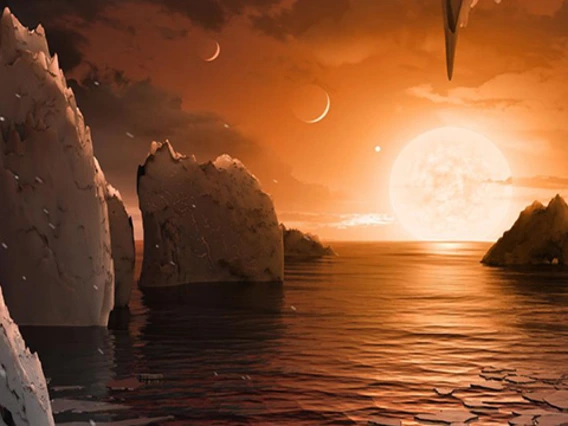
Powerful Particles and Tugging Tides May Affect Extraterrestrial Life
Two new studies by UA space scientists may bring into question the habitability of TRAPPIST-1 exoplanets, three of which are in the habitable zone of space.
Powerful Particles and Tugging Tides May Affect Extraterrestrial Life

By Emily Walla, University Communications - April 16, 2019
Since its discovery in 2016, planetary scientists have been excited about TRAPPIST-1, a system where seven Earth-sized rocky planets orbit a cool star. Three of the planets are in the habitable zone, the region of space where liquid water can flow on the planets’ surfaces. But two new studies by scientists in the University of Arizona’s Lunar and Planetary Laboratory may lead astronomers to redefine the habitable zone for TRAPPIST-1.
The three planets in the habitable zone are likely facing a formidable opponent to life: high-energy particles spewed from the star. For the first time, Federico Fraschetti and a team of scientists from the Center for Astrophysics | Harvard & Smithsonian have calculated how hard these particles are hitting the planets.
Meanwhile, Hamish Hay, a graduate student in the Lunar and Planetary Laboratory, has found that the gravitational tug-of-war the TRAPPIST-1 planets are playing with one another is raising tides on their surfaces, possibly driving volcanic activity or warming ice-insulated oceans on planets that are otherwise too cold to support life.
Both Fraschetti’s paper and Hay's study, “Tides between TRAPPIST-1 planets,” are recently published in the Astrophysical Journal.
Punchy Protons
The system’s star, TRAPPIST-1A, is smaller, less massive and 6,000 degrees Fahrenheit cooler than our 10,000-degree sun. It is also extremely active, meaning it emits huge amounts of high-energy protons – the same particles that cause auroras on Earth.
Fraschetti and his team simulated the journeys of these high-energy particles through the magnetic field of the star. They found that the fourth planet – the innermost of the worlds inside the TRAPPIST-1 habitable zone– may be experiencing a powerful bombardment of protons.
"The flux of these particles in the TRAPPIST-1 system can be up to 1 million times more than the particles flux on Earth," Fraschetti said.
This came as a surprise to the scientists, even though the planets are much closer to their star than Earth is to the sun. High-energy particles are carried through space along magnetic fields, and TRAPPIST-1A’s magnetic field is tightly wound around the star.
"You expect that the particles would get trapped in these tightly wrapped magnetic field lines, but if you introduce turbulence, they can escape, moving perpendicularly to the average stellar field," Fraschetti said.
Flares on the surface of the star cause turbulence in the magnetic field, allowing the protons to sail away from the star. Where the particles go depends on how the star’s magnetic field is angled away from its axis of rotation. In the TRAPPIST-1 system, the most likely alignment of this field will bring energetic protons directly to the fourth planet’s face, where they could break apart complex molecules that are needed to build life – or perhaps they could serve as catalysts for the creation of these molecules.
While Earth’s magnetic field protects most of the planet from energetic protons emitted by our sun, a field strong enough to deflect TRAPPIST-1’s protons would need to be improbably strong – hundreds of times more powerful than Earth’s. But this does not necessarily spell death for life in the TRAPPIST-1 system.
The TRAPPIST-1 planets are likely tidally locked, for one thing, meaning that the same hemisphere of each planet always faces the star, while perpetual night enshrouds the other.
"Maybe the night side is still warm enough for life, and it doesn’t get bombarded by radiation," said Benjamin Rackham, a research associate with UA Department of Astronomy who was not involved with either study.
Oceans could also shield against destructive high-energy protons, as deep water could absorb the particles before they tear apart the building blocks of life. Tides raised in these oceans and even in the rocks of the planets might have other interesting implications for life.
Tugging Tides
On Earth, the moon raises tides not only in the oceans – tidal forces deform the spherical shape of Earth’s mantle and crust, as well. In the TRAPPIST-1 system, the planets are close enough together that scientists hypothesized the worlds might be raising tides on one another, as the moon does to Earth.
"When a planet or moon deforms from tides, friction inside it will create heating," said Hay, lead author of the second study.
By calculating how the gravity of TRAPPIST-1’s planets would tug on and deform each other, Hay explored how much heat tides bring to the system.
TRAPPIST-1 is the only known system where planets can raise significant tides on each other because the worlds are so tightly packed around their star.
"It’s such a unique process that no one’s thought about in detail before, and it’s kind of amazing that it’s actually a thing that happens," Hay said. In the past, scientists had only considered tides raised by the star.
Hay found that the inner two planets of the system come close enough together that they raise powerful tides on each other. It is possible the subsequent tidal heating may be strong enough to fuel volcanic activity, which can in turn sustain atmospheres. Though TRAPPIST-1’s innermost planets are likely too hot on their day side to sustain life, a volcano-fueled atmosphere could help move some heat to their otherwise-too-cold night side, warming it enough to keep living things from freezing.
The sixth planet in the system, called TRAPPIST-1g, is experiencing tidal tugging from both the star and the other planets. It is the only planet in the system where tidal heating due to the other planets is as strong as that caused by the central star. If TRAPPIST-1g is an ocean world, like Europa or Enceladus in our own solar system, tidal heating could keep its waters warm.
M-dwarf star systems like TRAPPIST-1 offer astronomers the best opportunity to search for life outside the solar system, and Fraschetti and Hay’s studies may help scientists choose how to explore the system in the future.
"We need to really understand the suitability of these systems for life, and energetic particle fluxes and tidal heating are important factors to constrain our ability to do that," Rackham said.

Congratulations to Dr. Michael M. Sori!
Dr. Michael Sori was
Congratulations to Dr. Michael M. Sori!

Dr. Michael Sori was presented with the Outstanding Postdoctoral Scholar Award at the 2019 Awards of Distinction Luncheon and Ceremony, on April 1st.
After receiving his PhD in Planetary Science at the Massachusetts Institute of Technology, Dr. Michael Sori joined the University of Arizona Lunar and Planetary Sciences Laboratory in 2014 to pursue postdoctoral training under the mentorship of Dr. Christopher Hamilton and Dr. Shane Byrne. Dr. Sori’s research spans a variety of topics in planetary geophysics, including the origin and evolution of ices and what they tell us about the climates and orbital histories of planets, and how volcanism helps to shape planetary surfaces. Using remote sensing data from spacecraft to inform his geophysical models, he has contributed greatly to the study the Moon, Mars, Ceres, and Uranian satellites.
Dr. Sori has made outstanding contributions to University of Arizona’s research, outreach, and teaching missions. Since beginning his tenure as a postdoctoral scholar, he has obtained his own funding through NASA and published 14 peer-reviewed articles in high-profile journals such as Nature and Science. These publications illustrate the breadth of his technical ability and understanding of fundamental scientific problems. His discoveries have caught the public’s eye, with one being among the University’s highest profile news stories in 2018. His classroom teaching and mentoring have also earned him the reputation of being a “natural educator.” The University of Arizona is privileged to serve as the postdoctoral home for Michael Sori who is, in the words of his nominators, “a talented and reliable collaborator, an insightful scientist, a great mentor, and a respected role model within our department and within the broader Planetary Sciences community.”

Alfred McEwen Appointed Regents' Professor
University
Alfred McEwen Appointed Regents' Professor

University Communications - April 15, 2019
The Arizona Board of Regents on April 11 confirmed the appointments of University of Arizona faculty members Alfred McEwen, John Rutherfoord, Dr. Marvin Slepian, Rod Wing and Lucy Ziurys as Regents' Professors.
The title of Regents’ Professor is reserved for full professors whose exceptional achievements merit national and international distinction. Regents' Professor appointments are limited to no more than 3 percent of the total number of the university’s tenured and tenure track faculty members.
Alfred McEwen is the principal investigator for the High Resolution Imaging Science Experiment, or HiRISE, on the Mars Reconnaissance Orbiter. HiRISE has produced extremely-high-resolution images of the Martian surface since the launch of the Mars Reconnaissance Orbiter in 2005.
McEwen has made two discoveries about the geology of Mars from his detailed analyses of HiRISE and other Martian data. First, McEwen says Martian slopes show enigmatic flows that are actively forming at the present day and may provide evidence for water on Mars. Second, McEwen has shown that the practice of counting small craters is not always a reliable indicator of the age of a planetary surface, as many small craters can be produced from the high-velocity ejecta of larger impacts.
McEwen’s work has helped change the scientific viewpoint of Mars from that of a dead planet to one with a dynamic surface, largely as a result of science done using the HiRISE camera, the construction and operations of which he has led for more than a decade.
McEwen’s accomplishments were recognized with a NASA Distinguished Public Service Medal in 2011, the American Geophysical Union Whipple Award in 2015, and designation as a UA College of Science Galileo Circle Fellow in 2015.
McEwen, a planetary geologist, has been a member of the UA faculty since 1996. He is a professor of planetary sciences at the UA Lunar and Planetary Laboratory, a professor of geosciences and director of the Planetary Image Research Laboratory. In addition to HiRISE, his spacecraft involvement currently includes being co-investigator on the Colour and Stereo Surface Imaging System on the ExoMars Trace Gas Orbiter, launched in 2016, co-investigator on the LROC team on the Lunar Reconnaissance Orbiter mission to the moon, and deputy principle investigator of the Europa Imaging System on the Europa Clipper million, to launch in 2022 or later. Previously, McEwen was a member of the imaging science team of the Cassini mission to Saturn, which began in 1990 and ended in 2018, among other missions.
He is also a devoted educator. McEwen designed the “Mars” course for upper-level graduates and has served as a mentor for many students at all degree levels.

UA Study Suggests Possibility of Recent Underground Volcanism on Mars
A new study conducted by LPL scientists suggests volcanoes may have been recently boiling deep below the surface of the Red Planet, which could explain the potential presence of liquid water underneath the polar ice caps.
UA Study Suggests Possibility of Recent Underground Volcanism on Mars

By American Geophysical Union - February 14, 2019
A study published last year suggested liquid water is present beneath the south polar ice cap of Mars. Now, a new study in the American Geophysical Union journal Geophysical Research Letters argues there needs to be an underground source of heat for liquid water to exist underneath the polar ice cap.
The new research does not take sides as to whether the liquid water exists. Instead, the authors suggest that recent magmatic activity – the formation of a magma chamber within the past few hundred thousand years – must have occurred underneath the surface of Mars for there to be enough heat to produce liquid water underneath the thick ice cap. On the flip side, the study’s authors argue that if there was not recent magmatic activity underneath the surface of Mars, then it is not likely there is liquid water underneath the ice cap.
“Different people may go different ways with this, and we’re really interested to see how the community reacts to it,” said Michael Sori, an associate staff scientist in the Lunar and Planetary Laboratory at the University of Arizona and a co-lead author of the new paper.
The potential presence of recent underground magmatic activity on Mars lends weight to the idea that Mars is an active planet, geologically speaking. That notion could give scientists a better understanding of how planets evolve over time.
The new study is intended to further the debate around the possibility of liquid water on Mars. The presence of liquid water on the Red Planet has implications for potentially finding life outside of Earth and could also serve as a resource for future human exploration of our neighboring planet.
“We think that if there is any life, it likely has to be protected in the subsurface from the radiation,” said Ali Bramson, a postdoctoral research associate at the Lunar and Planetary Laboratory and a co-lead author of the paper. “If there are still magmatic processes active today, maybe they were more common in the recent past and could supply more widespread basal melting. This could provide a more favorable environment for liquid water and thus, perhaps, life.”
Examining the environment
Mars has two giant ice sheets at its poles, both about a mile thick. On Earth, it is common for liquid water to be present underneath thick ice sheets, with the planet’s heat causing the ice to melt where it meets the Earth’s crust.
In a paper published last year in Science, scientists said they detected a similar phenomenon on Mars. They claimed radar observations detected evidence of liquid water at the base of Mars’ south polar ice cap; however, the study did not address how liquid water could have gotten there.
Mars is much cooler than Earth, so it was unclear what type of environment would be needed to melt the ice at the base of the ice cap. Although previous research examined if liquid water could exist at the base of Mars’ ice caps, no one had yet looked at the specific location where scientists claimed to have detected water.
“We thought there was a lot of room to figure out if (the liquid water) is real, what sort of environment would you need to melt the ice in the first place, what sort of temperatures would you need, what sort of geological process would you need? Because under normal conditions, it should be too cold,” Sori said.
Looking for the heat
In the new study, Sori and his co-authors first assumed the detection of liquid water underneath the ice cap was correct and then worked to figure out what parameters were needed for the water to exist. They performed physical modeling of Mars to understand how much heat is coming out of the interior of the planet and if there could be enough salt at the base of the ice cap to melt the ice. Salt lowers the melting point of ice significantly, so it was thought that salt could have led to melting at the base of the ice cap.
The model showed salt alone would not raise the temperature high enough to melt the ice. Instead, the authors propose there needs to be additional heat coming from Mars’ interior.
One plausible heat source would be volcanic activity in the planet’s subsurface. The study’s authors argue that magma from the deep interior of Mars rose towards the planet’s surface about 300,000 years ago. It did not break the surface, like a volcanic eruption, but pooled in a magma chamber below the surface. As the magma chamber cooled, it released heat that melted the ice at the base of the ice sheet. The magma chamber is still providing heat to the ice sheet to generate liquid water today.
The idea of volcanic activity on Mars is not new – there is a lot of evidence of volcanism on the planet’s surface. But most of the volcanic features on Mars are from millions of years ago, leading scientists to believe that volcanic activity below and above the planet’s surface stopped long ago.
The new study, however, proposes that there could have been more recent underground volcanic activity. And, according to the study’s authors, if there was volcanic activity happening hundreds of thousands of years ago, there’s a possibility it could be happening today.
“This would imply that there is still active magma chamber formation going on in the interior of Mars today, and it is not just a cold, sort of dead place, internally,” Bramson said.
Jack Holt, a professor at the at the Lunar and Planetary Laboratory, said the question of how water could exist underneath the south polar ice cap came to his mind immediately after the Science paper was published, and the new paper adds an important constraint on the possibility of water being there. He said it will likely add to the debate within the planetary science community about the finding and point out that more research needs to be done.
“I think it was a great idea to do this type of modeling and analysis because you have to explain the water, if it’s there. It’s really a critical piece of the puzzle,” said Holt, who was not involved in the research. “The original paper just left it hanging. There could be water there, but you have to explain it, and these guys did a really nice job of saying what is required and that salt is not sufficient.”

NASA’s OSIRIS-REx Spacecraft Enters Close Orbit Around Bennu, Breaking Record
By Erin Morton
NASA’s OSIRIS-REx Spacecraft Enters Close Orbit Around Bennu, Breaking Record

By Erin Morton, OSIRIS-REx Asteroid Sample Return Mission - December 31, 2018
At 2:43 p.m. EST on December 31, while many on Earth prepared to welcome the New Year, NASA’s OSIRIS-REx spacecraft, 70 million miles (110 million kilometers) away, carried out a single, eight-second burn of its thrusters – and broke a space exploration record. The spacecraft entered into orbit around the asteroid Bennu, and made Bennu the smallest object ever to be orbited by a spacecraft.
“The team continued our long string of successes by executing the orbit-insertion maneuver perfectly,” said Dante Lauretta, OSIRIS-REx principal investigator at the University of Arizona, Tucson. “With the navigation campaign coming to an end, we are looking forward to the scientific mapping and sample site selection phase of the mission.”
Lauretta, along with his team, spent the last day of 2018 with his feet planted on Earth, but his mind focused on space. “Entering orbit around Bennu is an amazing accomplishment that our team has been planning for years,” Lauretta said.
Inching around the asteroid at a snail’s pace, OSIRIS-REx’s first orbit marks a leap for humankind. Never before has a spacecraft from Earth circled so close to such a small space object – one with barely enough gravity to keep a vehicle in a stable orbit.
Now, the spacecraft will circle Bennu about a mile (1.75 kilometers) from its center, closer than any other spacecraft has come to its celestial object of study. (Previously the closest orbit of a planetary body was in May 2016, when the Rosetta spacecraft orbited about four miles (seven kilometers) from the center of the comet 67P/Churyumov-Gerasimenko.) The comfortable distance is necessary to keep the spacecraft locked to Bennu, which has a gravity force only 5-millionths as strong as Earth’s. The spacecraft is scheduled to orbit Bennu through mid-February at a leisurely 62 hours per orbit.
Now that the OSIRIS-REx spacecraft is closer to Bennu, physical details about the asteroid will leap into sharper focus, and the spacecraft’s tour of this rubble pile of primordial debris will become increasingly detailed and focused.
“Our orbit design is highly dependent on Bennu’s physical properties, such as its mass and gravity field, which we didn’t know before we arrived,” said OSIRIS-REx’s flight dynamics system manager Mike Moreau, who is based at NASA’s Goddard Space Flight Center in Greenbelt, Maryland.
“Up until now, we had to account for a wide variety of possible scenarios in our computer simulations to make sure we could safely navigate the spacecraft so close to Bennu. As the team learned more about the asteroid, we incorporated new information to hone in on the final orbit design,” he said.
The simulations have played a critical role. The OSIRIS-REx mission, after all, was designed based on complex computer programs that predicted — quite accurately, as it turns out — the properties of Bennu and how the spacecraft’s trajectory would behave. This diligent preparation allowed the team to navigate the vehicle safely to Bennu in December and put some questions to rest (there are, indeed, signs of ancient water preserved in Bennu’s rocks) and to fly over its poles and equator in a preliminary survey that led to some surprises (Bennu has many large boulders).
Having completed the preliminary survey of Bennu with a flyby of its south pole on December 16, the spacecraft moved to a safe 31 miles (50 kilometers) away from the asteroid to give the navigation team a chance to regroup and prepare for orbit insertion. Next, Lockheed Martin engineers programmed the spacecraft to begin moving back to a position about nine miles (15 kilometers) over Bennu’s north pole to prepare for three burns of its thrusters over the course of 10 days that would place the spacecraft into orbit.
Even though OSIRIS-REx is in the most stable orbit possible, Bennu’s gravitational pull is so tenuous that keeping the spacecraft safe will require occasional adjustments, said Dan Wibben, OSIRIS-REx maneuver and trajectory design lead at KinetX Aerospace in Simi Valley, California.
“The gravity of Bennu is so small, forces like solar radiation and thermal pressure from Bennu’s surface become much more relevant and can push the spacecraft around in its orbit much more than if it were orbiting around Earth or Mars, where gravity is by far the most dominant force,” he said.
The OSIRIS-REx navigation team will use “trim” maneuvers to slightly thrust the spacecraft in one direction or another to correct its orbit and counter these small forces. If the spacecraft drifts away from Bennu, or some other problem forces it into safe mode, it has been programmed to fly away from the asteroid to stay safe from impact.
“It’s simple logic: always burn toward the Sun if something goes wrong,” said Coralie Adam, OSIRIS-REx lead optical navigation engineer at KinetX. Engineers can navigate the spacecraft back into orbit if it drifts away, Adam said, though that’s unlikely to happen.
The navigation and spacecraft operations teams are focused on the first orbital phase. Their primary goal is to transition away from star-based navigation, which allowed the team to locate the spacecraft based on pictures of the star formations around it taken by the cameras onboard. Navigators use methods like this since there is no GPS in deep space and we can’t see the spacecraft from Earth-based telescopes. From this point forward, though, the OSIRIS-REx team will rely on landmarks on Bennu’s surface to track OSIRIS-REx, a more precise technique that will ultimately guide them to a sample-collection site clear of boulders and large rocks, said Adam.
“After conducting a global imaging and mapping campaign during our recent preliminary survey phase, the science team has created 3-D models of Bennu’s terrain that we’re going to begin using for navigation around the asteroid,” she said.
Another critical objective of this orbital phase, Adam said, is to get a better handle on Bennu’s mass and gravity, features that will influence the planning of the rest of the mission, notably the short touchdown on the surface for sample collection in 2020. In the case of Bennu, scientists can only measure these features by getting OSIRIS-REx very close to the surface to see how its trajectory bends from Bennu’s gravitational pull.
“The Orbital A phase will help improve our detailed models for Bennu’s gravity field, thermal properties, orientation, and spin rate,” said Wibben. “This, in turn, will allow us to refine our trajectory designs for the even more challenging flight activities we will perform in 2019.”
The December 31 maneuver to place the spacecraft into orbit about Bennu is the first of many exciting navigation activities planned for the mission. The OSIRIS-REx team will resume science operations in late February. At that point, the spacecraft will perform a series of close flybys of Bennu for several months to take high-resolution images of every square inch of the asteroid to help select a sampling site. During the summer of 2020, the spacecraft will briefly touch the surface of Bennu to retrieve a sample. The OSIRIS-REx mission is scheduled to deliver the sample to Earth in September 2023.