Spring

The Kuiper-Arizona Laboratory for Astromaterials Analysis awards the Hitachi Scholarship in Electron Microscopy annually to two graduate students generating cutting-edge research and publications in the area of electron microscopy. The scholarship was established by Hitachi High-Technologies as part of their partnership with the University of Arizona


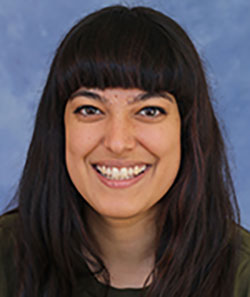
PTYS Graduate Student Maizey BennerMaizey Benner

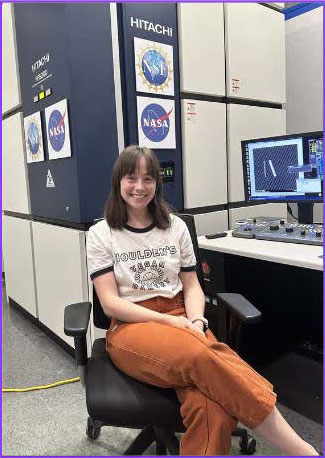
Maizey is a third-year Ph.D. student at the Lunar and Planetary Laboratory. Her research focuses on unraveling the thermodynamic history of phosphorus- and sulfur-bearing minerals in aqueously altered carbonaceous chondrites using coordinated electron microscopy techniques. Maizey uses the Hitachi HF5000 S/TEM and S-4800 SEM to characterize the structure and chemistry of these materials from the millimeter to atomic scale. About the award, Maizey says, "Receiving the Hitachi Electron Microscopy Scholarship has given me great confidence in my work, and encouragement to pursue further training in electron microscopy. I am honored to receive such an award and look forward to completing my Ph.D. research using the Hitachi microscopes."


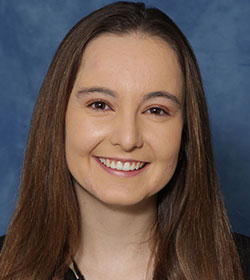
Lucas SmithPTYS Grad Student Lucas Smith
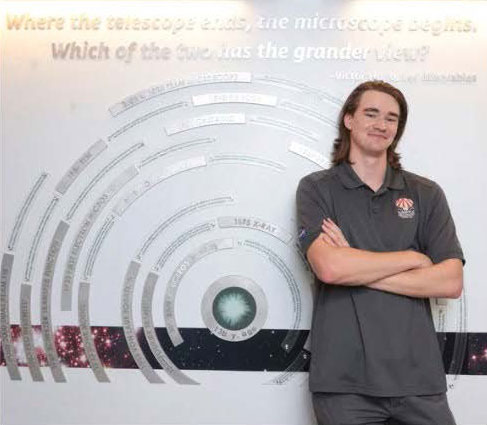
LPL graduate student Lucas Smith uses the Hitachi instruments in the Kuiper-Arizona Laboratory for Astromaterials Analysis to study presolar stardust grains in aqueously-altered meteorites. In particular, he says, "the Hitachi HF5000 TEM allows me to obtain critical information on the chemical composition, structure, and mineralogy of presolar grains in the context of their host meteorites. This information also allows me to understand the conditions under which the presolar grains formed in their parent star as well as how aqueous processing on asteroids affects presolar phases."

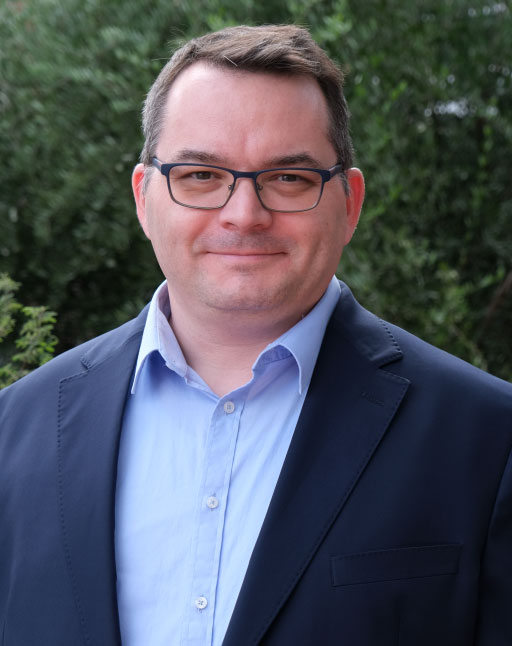
Associate Professor Kristopher Klein was named as the esteemed recipient of the 2024 Karen Harvey Prize. The award is made by the Solar Physics Division of the American Astronomical Society and honors the memory of the late Karen Harvey, recognizing significant contributions in solar physics research made by an early career scientist. Dr. Klein was awarded for his outstanding contributions to the understanding of space plasma turbulence. 

Professor Klein’s innovative research includes in situ observations of the solar wind, novel data analysis methods, theoretical frameworks, and simulations. The work has resulted in groundbreaking insights into the kinetics of solar wind evolution and the nature of plasma turbulence dissipation.

The award also recognizes Dr. Klein’s leadership in the scientific community, including as Project Scientist for the Solar Wind Electrons Alphas and Protons instrument on NASA’s Parker Solar Probe. Professor Klein is also Deputy Principal Investigator of the upcoming NASA HelioSwarm mission.

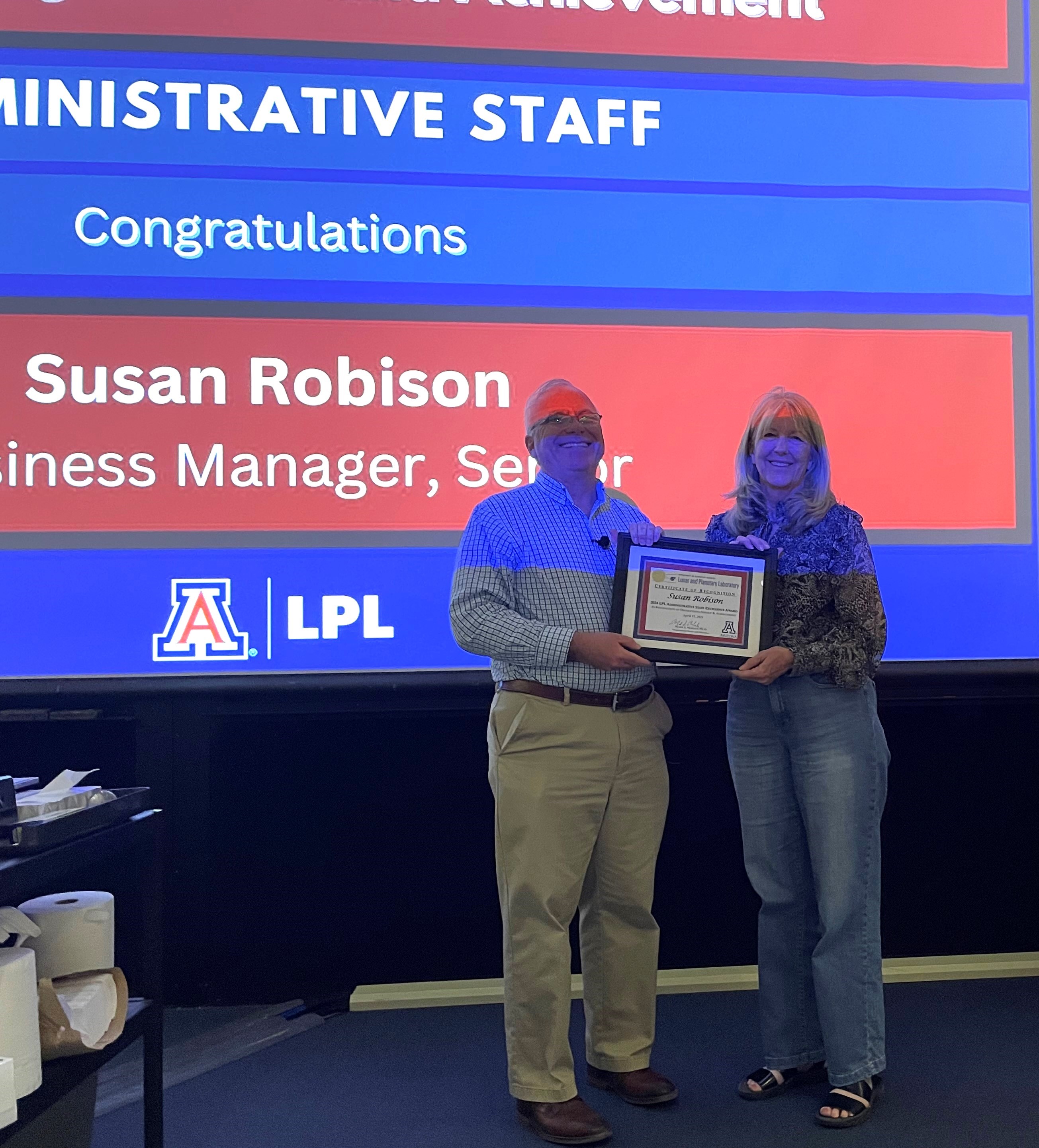
Susan Robison receiving award.Susan Robison is the recipient of the LPL Staff Excellence Award for 2024 in the category of Administrative Staff. Sue was recognized for her outstanding work in supporting a multitude of projects to achieve their highest potential. Her nominators described the diversity of her responsibilities as enormous and her performance in meeting them as exceptional. 

Sue has been a Senior Business Manager at LPL since 2012, starting her career with project support for the High Resolution Imaging Science Experiment (HiRISE) project. She currently manages finances for several spacecraft mission instrument teams at LPL, each with unique funding mechanisms and reporting requirements.  Sue creates complex proposal budgets, manages complicated subcontracts, and interfaces with business managers of several external institutions - all while doing the “routine” work of preparing required forms and reimbursements, overseeing travel reports and equipment purchases, and seeking out required approvals and submitting required reports. 

In addition to mission support, Sue plays a key role in proposal budget preparation for programs ranging from graduate-student support programs (e.g., NASA FINESST) to medium-sized data analysis proposals, to large-scale mission proposals.

Sue recently took on the role of building manager for LPL’s Sonett Building; this job grew in complexity with the moves and renovations that came with the installation of the Arizona Astrobiology Center and the anticipated arrival of the APEX mission. Sue obtained required renovation quotes, oversaw the reorganization of staff offices, and cataloged and surplussed unused equipment. All these changes involved not only a great deal of planning and logistical effort, but also the ability to work with an entirely new set of building occupants. Sue has handled all these transitions and duties with great competence, regularly going above-and-beyond to keep projects large and small, planned and unplanned, moving forward. 

Sue is an incredible asset to LPL and to the missions projects and researchers she supports.

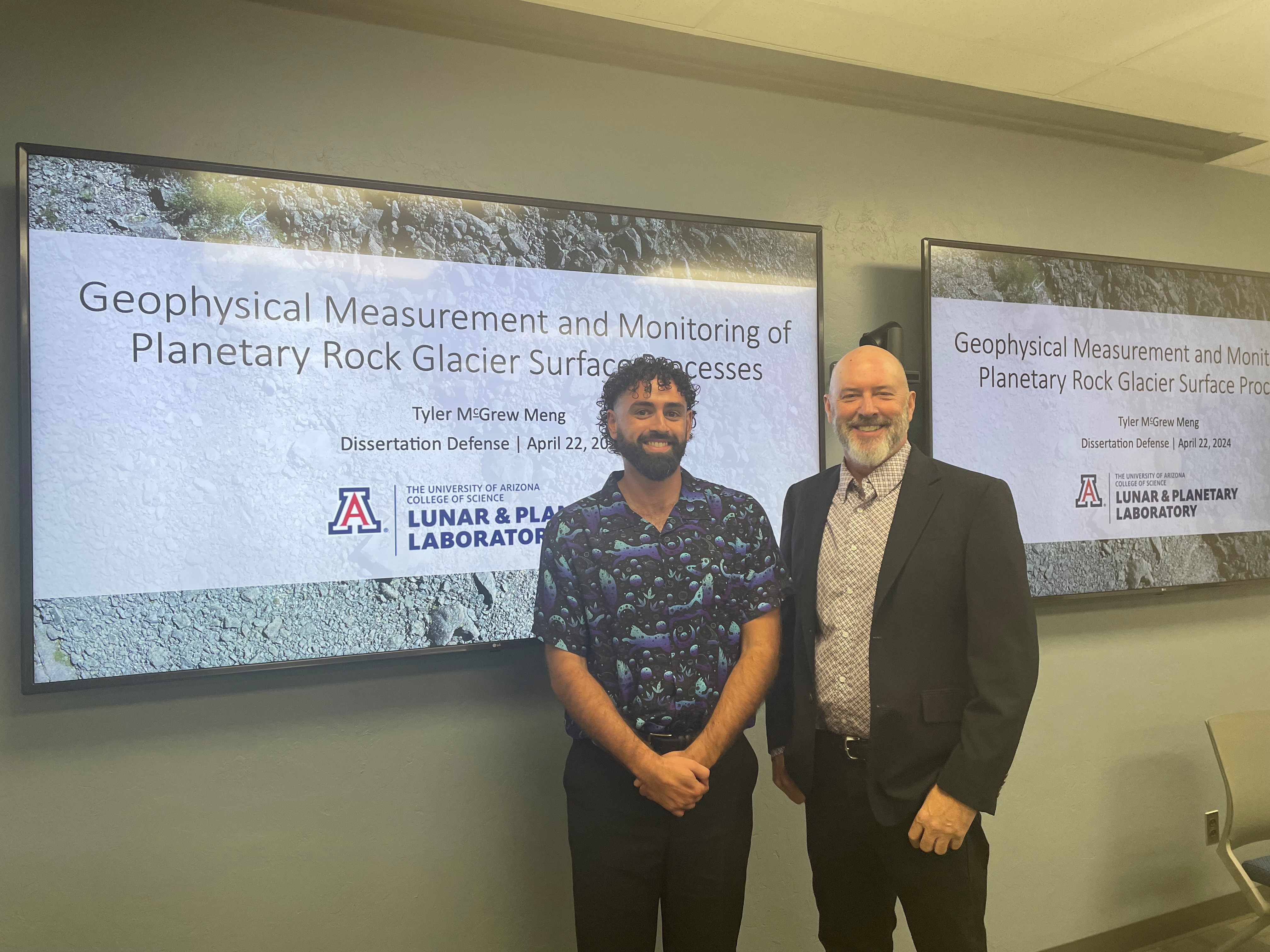
Tyler Meng
April 22, 2024 


Geophysical Measurement and Monitoring of Planetary Rock Glacier Surface Process

Advisor: Professor Jack Holt

New position: Postdoctoral Research Associate, Washington University, St. Louis


Theodore Broeren

(Applied Mathematics)
PTYS Graduate Minor
April 3, 2024 
Multi-Spacecraft Observatory Data Analysis Techniques: Uncertainty Quantification & Comparison

Advisor: Associate Professor Kristopher Klein

New position: Raytheon (data science technologies)


UNDERGRADUATE MINORS

Astrobiology

Planetary Science

Luisa Becerra
Fernando Jaime
Shae Henley
Grace Peek

Severance Graham
Travis Matlock
Kaycee Ridenhour

Norton Newsom

LPL alumnus Dr. Horton Newsom passed away on April 19, 2024. 

Horton earned his Ph.D. in Geosciences at UArizona in 1982 with a dissertation titled The Experimental Partitioning Behavior of Tungsten and Phosphorus: Implications for the Composition and Formation of the Earth, Moon and Eucrite Parent Body. His dissertation committee was chaired by LPL Professor Michael J. Drake and included then LPL head and director Laurel Wilkening as a member. 

Dr. Newsom worked as a senior research scientist and research professor within the Institute of Meteoritics and Department of Earth and Planetary Sciences at the University of New Mexico. He was a geologist and geochemist with expertise in the origin and composition of the Earth and Moon, and the study of terrestrial impact craters around the world and their hydrothermal systems. He studied surface processes on Mars including impact craters, sedimentary deposits, and phyllosilicate (clay) bearing terrains. His research also included the origin and chemistry of Martian surficial materials using data from the Mars Odyssey Gamma Ray spectrometer experiment. 

Horton was engaged with landing site selection for several Mars missions, including the Mars Exploration Rover (MER), Mars Science Laboratory (MSL), and future human landing sites. He was a co-investigator and science team member on the ChemCam Laser Induced Breakdown Spectroscopy (LIBS) instrument on the MSL Curiosity Rover, and was engaged with planning its science observations. Dr. Newsom was also a dedicated educator who mentored undergraduate and graduate students as well as postdoctoral scholars. He was active in NASA-funded educational outreach to K-12 teachers, and to local middle school and high school students, and Native American colleges.

Professors Daniel Apai and Dante Lauretta were elected Fellows of the American Association for the Advancement of Science, the world’s largest general scientific society. 

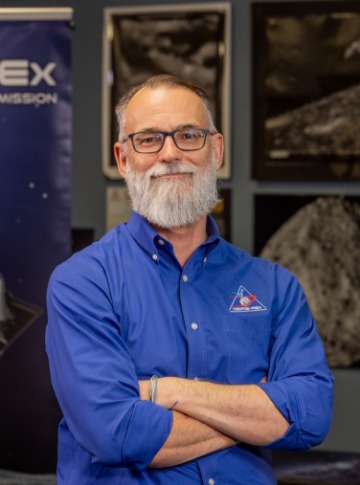
Regents Professor Dante LaurettaDante Lauretta is a Regents Professor of Planetary Sciences at LPL. He has been recognized as a AAAS Fellow for “distinguished contributions to the field of astrobiology, particularly for leadership and advancements through the OSIRIS-REx mission.” Professor Lauretta is the director of the University of Arizona’s Arizona Astrobiology Center, which focuses on astrobiological research on the origins, evolution and distribution of life in the universe. 

Daniel Apai is a professor in both LPL and the Department of Astronomy and Steward Observatory. He is being honored for hisProfessor Daniel Apai “distinguished contributions to the field of astrobiology and astrophysics, particularly for advancements in understanding of habitable exoplanets and planetary systems.” He is the principal investigator for the NASA-funded Alien Earths project that explores the potential of nearby planetary systems for supporting life. Apai also leads the Nautilus Space Telescope project, whose objective is to characterize 1,000 potentially Earth-like exoplanets to search for signatures of life. 
The annual Fellows Forum will be held in Washington, D.C., on Sept. 21 in conjunction with the 150th anniversary celebration of the AAAS Fellows program.

The Curson Education Plus Fund in Planetary Sciences and LPL was established by Shirley Curson, a generous donor and friend of LPL, for the purpose of supporting travel expenses outside the state of Arizona during summer break. The award is open to students in the Department of Planetary Sciences and Lunar and Planetary Laboratory who propose to fund study, museum visits, special exhibits, seminars, instruction, competitions, research and other endeavors that are beyond those provided by the normal campus environment and are not part of the student’s regular curriculum during the recipient’s school year.

To donate to the Curson Travel fund, visit the University of Arizona Foundation.


Roberto Aguilar

Advisor: Jack Holt
Mars Polar Conference, Whitehorse, Yukon, Canada.

Studying the formation and evolution of glaciers on Mars and their potential as water resources for future human landing missions.

Read about Roberto's travel to the Mars Polar Conference.


Namya Baijal

Advisor: Erik Asphaug
Psyche Collaboration Meetings, University of Bern.

Seeking to understand how collisions have shaped the surface of asteroid (16) Psyche.

Read about Namya's collaboration while in Bern.


Melissa Kontogiannis 
Advisor: Dante Lauretta
Goldschmidt Conference, Chicago

Analyzing samples of asteroid Bennu, recently returned by the OSIRIS-REx mission.

Read about Melissa's presentation at the Goldschmidt Conference.


Previous Curson Award Recipients

The Graduate Teaching Assistant Excellence Award is an LPL initiative which is intended to promote, recognize, and reward exemplary performance among graduate teaching assistants assigned to PTYS undergraduate courses. The award consists of funding intended to be used toward travel and expenses to professional meeting chosen by the recipient. All graduate teaching assistants assigned to PTYS courses are eligible, whether or not their home department is PTYS.


Nicole Kerrison won this year’s Graduate Teaching Assistant Excellence Award for her support of PTYS/ASTR 170A1 Alien Earths, with instructor Dr. Steve Kortenkamp, during the Fall 2023 semester. 
Nicole had a large number of students attend her office hours, which speaks to her willingness and ability to help students with revisions of their assignments but also to her ability to make students feel at ease with visiting a TA for help with the class. The 170A1 section was taught in the Flaundrau Science Center theater (planetarium dome), so Nicole learned how to use the digital planetarium projection software and gave several full-dome presentations to the class related to concepts, including extrasolar planets, asteroids, and moons of giant planets. Nicole became so adept with the full-dome system that she volunteered to give a public planetarium talk for the solar eclipse that occurred on April 8. 

Nicole also played a lead role in facilitating evening telescope observing sessions for the class on UArizona Mall. Thanks to her support, the course offered 18 consecutive nights of observing, with 60 students participating in each session. Nicole also helped to supervise the undergraduate TA/preceptor group involved with this class. Because Nicole herself had been an undergraduate preceptor, she was able to maintain a comfortable and professional atmosphere for the class teaching team.

Zarah graduated from LPL in December and is currently a postdoctoral research associate working with Associate Professor Tyler Robinson. She joined LPL as a grad student in 2017 from the University of Colorado, Boulder, where she had already co-authored two papers on Saturn’s rings. As an LPL graduate student working with Associate Professor Tommi Koskinen, Zarah published 6 papers, including three as first author (one being a first-author paper in Nature Astronomy). 

Zarah’s dissertation research provides the first global view of a giant planet middle and upper atmosphere, which is based on her analysis of stellar occultations obtained during the Cassini Grand Finale tour. Zarah’s observational results contradicted existing models and showed that auroral heating and global redistribution of energy is a viable solution to the giant planet “energy crisis” problem. These results had fundamental implications for the energy balance and circulation in the upper atmosphere and were published by Nature Astronomy (Brown et al. 2020)

Zarah’s second paper (Brown et al. 2022) in Geophysical Research Letters describes the atmospheric gravity waves that she detected in the Cassini/UVIS dataset. She showed that the deposition of momentum by these waves enhances redistribution of energy from the aurora to lower latitudes, providing a mechanism to support her previous findings.

Zarah’s thesis work culminated in a third Icarus paper (Brown et al. 2024), which extends the analysis of the stellar occultations from the highest altitudes in the atmosphere to the middle atmosphere. This paper provides the first global constraints on photochemistry and dynamics in Saturn’s mesosphere where photochemical production peaks. The results have already supported a study that produced significant new constraints on the nature and flux of external material flowing in from the rings to Saturn’s atmosphere and demonstrates the full power of multi-instrument observations in probing giant planet atmospheres for the purposes of future missions. Zarah presented her proposed circulation pattern at the DPS meeting last fall, resulting in interest for testing the ideas presented. 

In addition to her academic accomplishments, Zarah had an exemplary record in service and outreach, including contributions to The Art of Planetary Science exhibition at LPL and leading the installation of the Arizona Scale Model Solar System on the UA campus as part of a NASA Arizona Space Grant Graduate Fellowship.


The Gerard P. Kuiper Memorial Award is presented to students who best exemplify, through the high quality of their research and the excellence of their scholastic achievements, the goals and standards established and maintained by Gerard P. Kuiper, founder of the Lunar and Planetary Laboratory and the Department of Planetary Sciences at the University of Arizona. To support students with the Kuiper Award, visit the University of Arizona Foundation.

Previous Kuiper Award Recipients