Department News

Dolores Hill

On December 4, Senior Research Specialist Dolores Hill was surprised with a Star Award from CoSSAC, the College of Science Staff Advisory Committee. Star Awards recognize staff members for outstanding achievement and contributions to teamwork on the job.

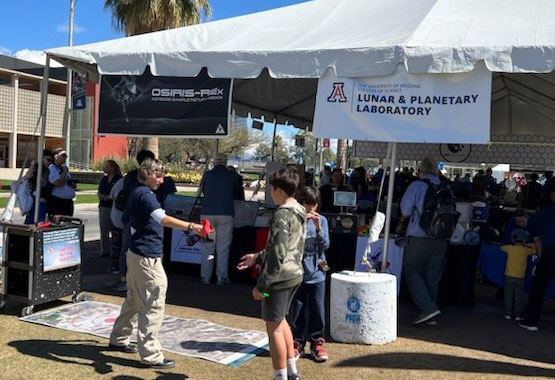
Dolores is a star at LPL, where she serves as laboratory safety manager and expert sample analysis technician, but she really shines in her role as outreach coordinator for LPL and OSIRIS-REx. Dolores is well known and always in-demand for her hands-on lessons about meteorites (and meteor-wrongs) and she is a respected colleague and liaison to amateur and professional meteoriticists alike. Dolores has been with LPL since 1981.

Dante Lauretta, AABCThe Arizona Astrobiology Center (AABC) was launched in October with LPL Regents Professor Dante Lauretta as Director. AABC brings together more than 40 faculty members from 4 colleges and 13 disciplines to conduct cutting-edge research, train diverse future leaders and encourage collaborative dialogue with communities about the existence, origin and evolution of life in the universe. Part of what the center will explore – in addition to life's origins and existence on other worlds – is what such discoveries might mean to different cultures and traditions around the world. The center also seeks to share these grand ideas through public engagement efforts.

OSIRIS-REx Capsule ReturnThe OSIRIS-REx team was honored with the 2024 Robert H. Goddard Award  from the National Space Club and Foundation. The Goddard Memorial Trophy is the most prestigious award given by the National Space Club to honor a breakthrough discovery or achievement in rocketry and aeronautics within the calendar year. The trophy will be presented at the Goddard Memorial Dinner in March.

OSIRIS-REx also won the 2023 SpaceNews Icon Award for Civil Space Achievement of the Year.

OSIRIS-REx successfully returned its asteroid sample payload of approximately 250 grams of material from asteroid Bennu on September 24.

PTYS 554: Evolution of Planetary Surfaces, Northern Arizona, Meteor Crater
Professor Shane Byrne, Instructor
You can support the LPL Graduate Field Trip by donating to the Wilkening-Sill endowment.

PTYS 554 Fieldtrip 1

PTYS 554 Fieldtrip 2


Zarah Brown

ZARAH BROWN

November 3, 2023

Saturn's Upper Atmosphere in the Ultraviolet: Temperature and Compositional Trends from Cassini UVIS with Implications for Energy Balance and Dynamics

Advisor: Associate Professor Tommi Koskinen

New position: Postdoctoral Research Associate, LPL


Xiaohang Chen

Xiaohang Chen

November 9, 2023

Solar Energetic Particle Acceleration and Transport at the Curved and Evolving Shock Driven by Coronal Mass Ejections

Advisor: Professor Joe Giacalone

New position: Postdoctoral Research Associate, University of Michigan

The Kuiper Materials Imaging and Characterization Facility awards the Hitachi Scholarship in Electron Microscopy annually to two graduate students generating cutting-edge research and publications in the area of electron microscopy. The scholarship was established by Hitachi High-Technologies as part of their partnership with the University of Arizona.

Kelsey E. Hanson is a Ph.D. candidate in the School of Anthropology, specializing in the archaeology of the U.S. Southwest. She is particularly interested in how specialized knowledge is cultivated and circulated in communities and how this is encoded in material culture. In contemporary Pueblo communities, paint recipes are often maintained and passed down by ritual sodalities, making paint an ideal medium to understand sociopolitical organization through time. Drawing from anthropological archaeology, Indigenous philosophy, and conservation science, Hanson’s dissertation research problematizes paint technology to understand the circulation of specialized knowledge in the rise and fall of the Chaco World of northern New Mexico (A.D. 850–1300).

To characterize paint recipes, Hanson is currently analyzing particulate samples collected from archaeological pigments, paint production tools, and painted media using a combination of polarized light, microscopy, X-ray fluorescence, Fourier transform infrared spectroscopy, Raman spectroscopy, and scanning electron microscopy. Thus far, these analyses are revealing new mineral colorants, specialized processing techniques, and previously unrecognized traditions of paint production. By treating paint technology as a material proxy for specialized knowledge, Hanson is using the circulation of paint technology to understand changing power relations through time, offering a new perspective on the sociopolitical history of the Chaco World. Her work has been funded by the National Science Foundation, P.E.O. International, Crow Canyon Archaeological Center's Lister Fellowship, the Getty Foundation, the Society for American Archaeology, and many others.


Anton A. Samoylov is a third-year year Chemical Engineering Ph.D. student advised by Dr. Adam D. Printz in the Dept. of Chemical and Environmental Engineering. Anton’s research interests are motivated by a vision for a sustainable future, sparked by undergraduate research in sustainable plastics. His research currently focuses on engineering the mechanical stability of perovskite for applications in thin film photovoltaics through nano-compositing.

Advanced electron microscopy is crucial in guiding the development of composite perovskite thin films in Anton's experiments. "The Hitachi Electron Microscopy Scholarship is of great help when it comes to providing financial support to help me focus on my research as I prepare to submit my results for publication within the upcoming months. I hope my work will also help highlight the role Hitachi and the Kuiper Imaging Facility play in advancing quality research at the University of Arizona for a diverse set of departments."

Searra is beginning her second year as a graduate student at LPL. She studies exoplanets to determine potential suitability for life, drawing from the fields of astrobiology and exoplanets. Searra develops and uses models to understand exoplanet atmospheres, which helps researchers learn not only more about the behavior of these planets, but also about other planets similar to Earth. Searra hopes that expanding research in the fields of astrobiology and exoplanets promotes public interest in science and inspires young people, especially girls, to pursue research in space science. Searra's faculty advisor is Associate Professor Ty Robinson.

On Oct. 24, 2005, SPACEWATCH® observer Mike Read discovered a main-belt comet using the SPACEWATCH® 0.9m telescope on Kitt Peak mountain. Now, astronomers using the James Webb Space Telescope's Near-Infrared Spectrograph instrument, have discovered water vapor around that very object, Comet 238P/Read. This observation marks the first time that a gas – specifically water vapor – has been found around a comet in the main asteroid belt, indicating that water ice from the primordial solar system can be preserved there. However, the successful detection of water comes with a new puzzle: unlike other comets, Comet 238P/Read had no detectable carbon dioxide.

Comet Read is a main belt comet – an object that resides in the main asteroid belt but which periodically displays a halo, or coma, and tail like a comet. Main belt comets are a fairly new classification, and Comet Read was one of the original three comets used to establish the category. Before that, comets were understood to reside in the Kuiper Belt and Oort Cloud, beyond the orbit of Neptune, where their ices could be preserved farther from the Sun. Frozen material that vaporizes as they approach the Sun is what gives comets their distinctive coma and streaming tail, differentiating them from asteroids.

Scientists have long speculated that water ice could be preserved in the warmer asteroid belt, inside the orbit of Jupiter, but definitive proof was elusive – until Webb. But the missing carbon dioxide was a bigger surprise. Carbon dioxide generally makes up about 10% of the volatile material in a comet that can be easily vaporized by the Sun’s heat. The science team presents two possible explanations for the lack of carbon dioxide. One possibility is that Comet Read had carbon dioxide when it formed but has lost that because of warm temperatures. Another is that Comet Read may have formed in a particularly warm pocket of the solar system, where no carbon dioxide was available.

The next step is taking the research beyond Comet Read to see how other main belt comets compare.

The research is published in the journal Nature (Kelley et al., May 15, 2023): https://rdcu.be/dcBbV.


Image of 238P/Read captured by the NIRCam (Near-Infrared Camera) instrument on NASA’s James Webb Space Telescope on September 8, 2022. It displays the hazy halo, called the coma, and tail that are characteristic of comets, as opposed to asteroids. The dusty coma and tail result from the vaporization of ices as the Sun warms the main body of the comet. Credits: NASA, ESA, CSA, M. Kelley (Univ. of Maryland). Image processing: H. Hsieh (Planetary Science Inst.), A. Pagan (STScI)


Discovery image of Comet 238P/Read taken with the SPACEWATCH®.0.9m telescope.


Nancy Ramos is the recipient of the LPL Staff Excellence Award for 2023.

In her role as Executive Assistant for the OSIRIS-REx management team, Nancy provides administrative, technical, and logistical support for the mission team. Nancy excels in her high-pressure role, making the organization of meetings, calendars, and large team events seem effortless. She ensures efficient team communication and manages special projects such as the team's recent move from the Drake building to the Kuiper building. In addition to her many professional contributions, Nancy volunteers to support department activities of all types and to foster a sense of community with LPL as well as the OSIRIS-REx team.

Prior to joining the OSIRIS-REx team, Nancy spent six years in similar administrative roles, first at Northern Arizona University and then at the University of Arizona. Nancy has a Bachelor’s degree in English from Northern Arizona University.

In her free time, Nancy enjoys spending time with her husband and two cats. Nancy adores all things feline and was founding president of Northern Arizona University’s student-run “trap, neuter, vaccinate, return, manage” organization, the Feral Cat Alliance.

Asteroid 47862 Nancyramos was named in her honor.