

Scientists Solve Mystery of Blinking Brown Dwarfs
By UniversityScientists Solve Mystery of Blinking Brown Dwarfs

By University Communications - August 17, 2017
Dim objects called brown dwarfs, less massive than the sun but more massive than Jupiter, have powerful winds and clouds -- specifically, hot patchy clouds made of iron droplets and silicate dust. Scientists recently realized these giant clouds can move and thicken or thin surprisingly rapidly, in less than an Earth day, but did not understand why.
Now, researchers have a new model for explaining how clouds move and change shape in brown dwarfs, using insights from NASA's Spitzer Space Telescope. Giant waves cause large-scale movement of particles in brown dwarfs' atmospheres, changing the thickness of the silicate clouds, researchers report in the journal Science. The study also suggests these clouds are organized in bands confined to different latitudes, traveling with different speeds in different bands.
"This is the first time we have seen atmospheric bands and waves in brown dwarfs," said lead author Daniel Apai, associate professor of astronomy and planetary sciences at the University of Arizona's Steward Observatory.
Just as in Earth's ocean, different types of waves can form in planetary atmospheres. For example, in Earth's atmosphere, very long waves mix cold air from the polar regions to mid-latitudes, which often lead clouds to form or dissipate.
The distribution and motions of the clouds on brown dwarfs in this study are more similar to those seen on Jupiter, Saturn, Uranus and Neptune. Neptune has cloud structures that follow banded paths too, but its clouds are made of ice. Observations of Neptune from NASA's Kepler spacecraft, operating in its K2 mission, were important in this comparison between the planet and brown dwarfs.
"The atmospheric winds of brown dwarfs seem to be more like Jupiter's familiar regular pattern of belts and zones than the chaotic atmospheric boiling seen on the Sun and many other stars," said study co-author Mark Marley at NASA's Ames Research Center in California's Silicon Valley.
Brown dwarfs can be thought of as failed stars because they are too small to fuse chemical elements in their cores. They can also be thought of as "super planets" because they are more massive than Jupiter, yet have roughly the same diameter. Like gas giant planets, brown dwarfs are mostly made of hydrogen and helium, but they are often found apart from any planetary systems. In a 2014 study using Spitzer, scientists found that brown dwarfs commonly have atmospheric storms.
Due to their similarity to giant exoplanets, brown dwarfs are windows into planetary systems beyond our own. It is easier to study brown dwarfs than planets because they often do not have a bright host star that obscures them.
"It is likely the banded structure and large atmospheric waves we found in brown dwarfs will also be common in giant exoplanets," Apai said.
Using Spitzer, scientists monitored brightness changes in six brown dwarfs over more than a year, observing each of them rotate 32 times. As a brown dwarf rotates, its clouds move in and out of the hemisphere seen by the telescope, causing changes in the brightness of the brown dwarf. Scientists then analyzed these brightness variations to explore how silicate clouds are distributed in the brown dwarfs.
Researchers had been expecting these brown dwarfs to have elliptical storms resembling Jupiter's Great Red Spot, caused by high-pressure zones. The Great Red Spot has been present in Jupiter for hundreds of years and changes very slowly: Such "spots" could not explain the rapid changes in brightness that scientists saw while observing these brown dwarfs. The brightness levels of the brown dwarfs varied markedly just over the course of an Earth day.
To make sense of the ups and downs of brightness, scientists had to rethink their assumptions about what was going on in the brown dwarf atmospheres. The best model to explain the variations involves large waves, propagating through the atmosphere with different periods. These waves would make the cloud structures rotate with different speeds in different bands.
UA researcher Theodora Karalidi used a supercomputer and a new computer algorithm to create maps of how clouds travel on these brown dwarfs.
"When the peaks of the two waves are offset, over the course of the day there are two points of maximum brightness," Karalidi said. "When the waves are in sync, you get one large peak, making the brown dwarf twice as bright as with a single wave."
(Watch a video animation of this phenomenon)
The results explain the puzzling behavior and brightness changes that researchers previously saw. The next step is to try to better understand what causes the waves that drive cloud behavior.
JPL manages the Spitzer Space Telescope mission for NASA's Science Mission Directorate, Washington. Science operations are conducted at the Spitzer Science Center at Caltech in Pasadena, California. Spacecraft operations are based at Lockheed Martin Space Systems Company, Littleton, Colorado. Data are archived at the Infrared Science Archive housed at the Infrared Processing and Analysis Center at Caltech. Caltech manages JPL for NASA.

PTYS Undergrad Minor and the 2017 Eclipse
By Daniel StoltePTYS Undergrad Minor and the 2017 Eclipse

By Daniel Stolte, University Communications - Aug. 16, 2017
Asked about her favorite planet in the solar system, Adriana Mitchell responds without hesitation: "Earth."
What about Mars? "Mars is very interesting, too," she says. "I hope to go there someday, actually."
And the way she says that, somehow, leaves no room for doubt.
Mitchell, an undergraduate student at the University of Arizona who majors in optical sciences and engineering, will start her junior year at the UA this fall. But while many of her peers are busy moving into residence halls and ordering textbooks, she is getting ready to start the first day of classes pointing a telescope outfitted with a polarimeter at the sun.
On Monday, Aug. 21, while the moon glides in front of the sun's blinding disc of light, Mitchell will focus her attention on an unprecedented effort to help solve some of the mysteries surrounding our home star. The mysteries are many, which is surprising if one considers that our species has looked up to, and studied, the sun ever since the first humans roamed the planet.
"One of the big questions in solar physics is: Why is the sun's corona hotter than the surface?" Mitchell says. "Or: Why does the solar wind accelerate dramatically as it streams out, going from one mile per second to a hundred?"
To pursue answers to some of these questions, Mitchell plays an important part in the most ambitious citizen science projects ever done during a total solar eclipse: the Continental-America Telescopic Eclipse Experiment, or Citizen CATE for short, a research project supported by federal, private and corporate contributions.
Passing the Torch
Sixty-eight telescopes, lined up like beads on a string along the path of totality, will be linked together to generate the longest movie of a solar eclipse ever made, resulting in 90 minutes of totality. To an observer within that path, the slowly moving moon will occult the sun for a maximum of two and a half minutes, before the famous "diamond ring" shape — the anticipated highlight for any eclipse chaser — announces the end of totality.
"We'll be passing the torch of collecting data all across the continent," explains Mitchell, who has been busy for more than a year readying science equipment, all to make sure everything goes smoothly during a natural spectacle that doesn't offer much opportunity for dress rehearsals.
CATE brings together volunteers from high schools, universities, informal education groups, astronomy clubs across the country, national science research labs and five corporate sponsors. Together, they will attempt what not even spacecraft dedicated to studying the sun have accomplished: to produce the first dataset of high-resolution, rapid-sequence, white-light images of the sun's inner corona over 90 minutes. The corona refers to a region of the solar atmosphere that typically is very challenging to image.
"The Earth and sun are intimately connected with the solar wind," says Matthew Penn, an astronomer at the National Solar Observatory, or NSO, in Tucson and CATE's principal investigator, who hired Mitchell in early 2016 to help get the project ready for the big moment. "This stream of particles blows through the entire solar system, and on bad days it can interfere with satellites and disrupt communications. With CATE, we want to better understand the sun's corona so we can better predict the solar wind."
For reasons physical and technical, even spacecraft can't observe the regions of the sun's corona that are closer to the star's surface than a little over one sun's diameter. And coronagraphs — devices placed in front of telescopes that block out the blinding glare — create issues by blurring the edges of the image. That is why scientists get so excited about the eclipse: When the moon moves into the path between Earth and sun, it functions as a distant, natural coronagraph that makes for much better observing conditions.
What Milkshakes Say About Solar Wind
With the string of telescopes operated by CATE volunteers, scientists such as Penn hope to measure the solar wind streaming out from the sun. Mitchell will perform a special and critical role during these observations, as she will operate one of only two sites where telescopes are outfitted with polarimeters, specialized filters that see only light waves that are synchronized in one plane. This allows them to track the so-called polar plumes, blobs of gas hurled from the sun's surface into space.
"It's a bit like sitting across the table from someone slurping a milkshake through a straw," Penn explains. "If you look closely, you'll see blobs of milkshake moving up the straw. By tracking those blobs of hot gas streaming from the sun and measuring their velocity, we can find out which of the models that solar physicists have proposed is correct."
Because safety is a critical part of the project, the sun's antics will be visible only to the cameras attached to the telescopes.
"Our telescopes don't have eyepieces," Mitchell says. "Looking into the sun through a telescope would immediately burn your retina. We want to make sure nobody gets injured."
Long before embarking to her site of study in Carbondale, Illinois, Mitchell was busy at the NSO, located across the street from the UA's Steward Observatory. To make sure that CATE's army of telescopes marches to the same beat, her duties included preparing truckloads — literally — of equipment.
"Everything was coming through Tucson," she says. "We got all this equipment, and we were setting up what seemed like a million computers. I remember all that stuff being in a room, and everything going like 'beep-beep-beep-beep' all day."
In practice runs conducted during a total eclipse in Indonesia in 2016, several sites unfortunately had their telescopes out of focus. Mitchell worked closely with a programmer from one of CATE's sponsoring companies to develop a way to make sure that wouldn't happen this time.
"This is actually more difficult than it sounds," Penn says. "In our recent practice runs, all of our volunteer groups have images that are in focus, due in a large part to Adriana's efforts."
"It's all automated," Mitchell says. "To capture the totality, all the volunteers have to do is push a start button and a stop button."
Getting Ready for 2024
When Mitchell isn't programming computers or adjusting telescope control motors, she brings her passion for science to the public. In June, Penn flew Mitchell out to Boulder, Colorado, to present the project during a national press conference about the eclipse.
"Adriana is a very talented undergraduate student," Penn says. "Her involvement in the project, which is really just something she's done on her own, has been remarkable. In addition to presenting poster papers at national meetings and being a co-author on our science papers, she is the best public speaker that I have among the students in the program."
Because all sites involved in CATE get to keep their telescopes after the eclipse, the project's scientists already are hatching plans about what they should set their sights on next.
"We're thinking about short-lived targets like comet flybys or the brightness fluctuations in variable stars," Mitchell says, "anything that would benefit from observing with multiple telescopes spread out over large areas."
"There is another solar eclipse coming up in 2024," Penn says, "and ideally we'd like to have polarimeters set up along the path of totality for that one."
By that time, Mitchell, may already have a Ph.D.
"I'm definitely going to grad school," she says. "Since I'm mostly interested in planetary science, I'd like to build instruments. Like an infrared imager or some type of spectrometer that could someday fly through the geysers on Saturn's moon Enceladus. That would be really cool."
The way Adriana Mitchell says that, somehow, leaves no room for doubt.

Asteroid Flyby to Help NASA Observation
By Daniel StolteAsteroid Flyby to Help NASA Observation

By Daniel Stolte, University Communications - July 27, 2017
For the first time, NASA will use an actual space rock for an observational campaign to test NASA's network of observatories and scientists who work with planetary defense. The asteroid, named 2012 TC4, does not pose a threat to the Earth, but NASA is using it as a test object for an observational campaign because of its close flyby on Oct. 12, 2017.
NASA has conducted such preparedness drills rehearsing various aspects of an asteroid impact, such as deflection, evacuation and disaster relief, with other entities in the past. Traditionally, however, these exercises involved hypothetical impactors, prompting Vishnu Reddy of the University of Arizona's Lunar and Planetary Laboratory to propose a slightly more realistic scenario, one that revolves around an actual close approach of a near-Earth asteroid, or NEA.
"The question is: How prepared are we for the next cosmic threat?" said Reddy, an assistant professor of planetary science at the Lunar and Planetary Laboratory. "So we proposed an observational campaign to exercise the network and test how ready we are for a potential impact by a hazardous asteroid."
NASA's Planetary Defense Coordination Office, or PDCO, the federal entity in charge of coordinating efforts to protect Earth from hazardous asteroids, accepted Reddy's idea to conduct an observational campaign as part of assessing its Earth-based defense network and identified the upcoming close approach of 2012 TC4 as a good opportunity to conduct the exercise. Reddy will assist Michael Kelley, who serves as a program scientist with NASA PDCO and as the lead on the exercise.
The goal of the TC4 exercise is to recover, track and characterize 2012 TC4 as a potential impactor in order to exercise the entire system from observations, modeling, prediction and communication.
Measuring between 30 and 100 feet, roughly the same size as the asteroid that exploded over Chelyabinsk, Russia, on Feb. 15, 2013, TC4 was discovered by the Pan-STARRS 1 telescope on Oct. 5, 2012, at Haleakala Observatory on Maui, Hawaii. Given its orbital uncertainty, the asteroid will pass as close as 6,800 kilometers (4,200 miles) above the Earth’s surface.
"This is a team effort that involves more than a dozen observatories, universities and labs across the globe so we can collectively learn the strengths and limitations of our planetary defense capabilities," said Reddy, who is coordinating the campaign for NASA PDCO.
Since its discovery in 2012, the uncertainty in the asteroid's orbit has slowly increased, as it would for any asteroid as time passes. Therefore, the first order of business will be to "recover" the object — in other words, nail down its exact path. Reddy and his collaborators hope that depending on its predicted brightness, the asteroid would be visible again to large ground-based telescopes in early August.
"One of the strengths of UA research is partnering with federal agencies or industry to work together in solving some of the grand challenges we face," said Kimberly Andrews Espy, the UA's senior vice president for research. "This project is a perfect example of matching UA capabilities — from our world-class imaging to our expertise in space sciences — with an external need."
The UA is home to the Catalina Sky Survey, one of the most prolific asteroid discoverers, and the SPACEWATCH® project that recovers and tracks faint NEAs. Both teams will take part in the planetary defense exercise.

UA Trains Visually Impaired Youth for STEM
By La Monica EverettUA Trains Visually Impaired Youth for STEM

By La Monica Everett-Haynes, University Communications - July 5, 2017
Using images and data from the University of Arizona's Mars HiRISE camera, Sunggye Hong and Stephen Kortenkamp are creating educational experiences and tactile tools about the Red Planet to help students gain insight and interest in scientific exploration and study — and motivate students to imagine their future as scientists.
Their interdisciplinary work at the UA has gained the attention of the National Science Foundation, which has provided a grant at more than $1 million to fund a research and engagement project.
"Opening up STEM careers through better awareness among pre-college-age students is a real need," said UA President Robert C. Robbins. "I very much admire that UA faculty in the College of Education are helping create this awareness for students with visual impairments through their engaging approach to learning. This project and the NSF's support for it are outstanding examples of what the UA can do for students through collaboration and the creativity of our faculty members."
Called Project POEM, short for Project-Based Learning Opportunities and Exploration of Mentorship for Students With Visual Impairments in STEM, the effort will involve 35 middle and high school students with visual impairments in a 14-month program meant to train them toward the science, technology, engineering and mathematics fields.
"Mars is one of the most fascinating topics in the world of science today. If a student has an opportunity to study and to analyze data collected from Mars, that would be a very exciting and motivational component to helping students' interest in science," said Hong, associate professor in the UA College of Education's Department of Disability and Psychoeducational Studies and principal investigator on the NSF grant.
Other Project POEM collaborators are the UA Sky School, the UA Department of Mining and Geological Engineering, the UCAR Center for Science Education, the American Printing House for the Blind and Denver-based educational consultant McREL International.
In developing the program, Hong and his partners were attentive and responsive to the Next Generation Science Standards, a multistate effort developed by a team of researchers commissioned by the Carnegie Foundation.
Mentors to Lend Support
As such, the program will be project-based, rich in content and complemented by the support of mentors — UA undergraduate and graduate students and also STEM industry professionals who have visual impairments.
The educational tools being designed also address the problem of students with visual impairments having too little access to the types of resources that can help them understand complex scientific topics and drive their interests in science.
"Much of the STEM curricula is so visual, so you must make appropriate adaptations and modifications for the materials to be used," Hong said.
"We know that there are these difficulties, but there are also techniques we can use to navigate such barriers," he said. "If students are frustrated with not having properly modified materials, they can talk through problems with people who have gone through the same frustrations, and students with visual impairments can figure out ways to overcome those difficulties."
Using images and data from Mars sourced by the UA's Lunar and Planetary Laboratory, the team led by Hong is also creating tactile, 3-D models of the surface of Mars that students can use to study the planet's physical characteristics.
Over the course of the program, the middle and high school students will learn about STEM concepts and Mars through learning models and other forms of engagement. They then will work alongside their mentors to develop and execute a research project about Mars, relying on adapted images and also data from the UA's HiRISE camera currently operating on the Mars Reconnaissance Orbiter.
The project draws heavily on the child education expertise of Kortenkamp, associate professor of practice in the Lunar and Planetary Laboratory in the College of Science, who also written and published children's books on topical issues related to science.
Kortenkamp also said he is especially dedicated to improving resources for students with visual impairments after having worked early in his UA career with a student who was blind.
"Astronomy is such a visual field, so it became a challenge for me in how I was teaching the course," Kortenkamp said. He began to more readily employ audio components and also introduced tactile tools — resources he would use for years.
"Finding other ways of presenting the material, rather than just lecturing, is so fascinating. And putting that extra effort of finding materials and presenting them — whether your student can see them or not — helps to show that you are truly invested in learning," Kortenkamp said.
Also motivating Hong and Kortenkamp is the need for improved STEM-related educational resources and the problem of underemployment among individuals with disabilities, especially in STEM fields.
Creating a 'Set of Experiences'
Individuals with visual impairments are highly underemployed, with the U.S. Census Bureau and the American Foundation for the Blind reporting that only 30 to 38 percent of that adult population is employed.
"When you see 70 percent of a population unemployed, that is a huge problem," Hong said. "Our idea was that if we could create a set of experiences for students with visual impairments to give them knowledge about STEM fields and find ways to keep them motivated in considering the STEM field as a potential occupation, we could raise their persistence toward STEM."
Ultimately, the team plans to develop curricula that K-12 teachers may use to replicate the program in other parts of Arizona and the nation.
"Students with visual impairments are capable of becoming successful scientists — if all the pieces of the puzzle are given appropriately," Hong said. "It is not the limitation of an individual, it is more about awareness of the public and working to bring STEM experiences to people with visual impairments."
Also, a research initiative is embedded within the project, and the team will be evaluating best approaches and methods for designing the effective and immersive experience to actively engage students.
"Not everyone will become a scientist. But if they can gain interest in these technical areas, they may take a different route in life or have a deeper appreciation for the field and become more technologically savvy," Kortenkamp said. "It never hurts to have some of that background, or at least be comfortable around science and math."

UA Scientists and the Curious Case of the Warped Kuiper Belt
By Daniel StolteUA Scientists and the Curious Case of the Warped Kuiper Belt

By Daniel Stolte, University Communications - June 20, 2017
An unknown, unseen "planetary mass object" may lurk in the outer reaches of our solar system, according to new research on the orbits of minor planets to be published in the Astronomical Journal. This object would be different from — and much closer than — the so-called Planet Nine, a planet whose existence yet awaits confirmation.
In the paper, Kat Volk and Renu Malhotra of the University of Arizona's Lunar and Planetary Laboratory, or LPL, present compelling evidence of a yet-to-be- discovered planetary body with a mass somewhere between that of Mars and Earth. The mysterious mass, the authors show, has given away its presence — for now — only by controlling the orbital planes of a population of space rocks known as Kuiper Belt objects, or KBOs, in the icy outskirts of the solar system.
While most KBOs — debris left over from the formation of the solar system — orbit the sun with orbital tilts (inclinations) that average out to what planetary scientists call the invariable plane of the solar system, the most distant of the Kuiper Belt's objects do not. Their average plane, Volk and Malhotra discovered, is tilted away from the invariable plane by about eight degrees. In other words, something unknown is warping the average orbital plane of the outer solar system.
"The most likely explanation for our results is that there is some unseen mass," says Volk, a postdoctoral fellow at LPL and the lead author of the study. "According to our calculations, something as massive as Mars would be needed to cause the warp that we measured."
The Kuiper Belt lies beyond the orbit of Neptune and extends to a few hundred Astronomical Units, or AU, with one AU representing the distance between Earth and the sun. Like its inner solar system cousin, the asteroid belt between Mars and Jupiter, the Kuiper Belt hosts a vast number of minor planets, mostly small icy bodies (the precursors of comets), and a few dwarf planets.
For the study, Volk and Malhotra analyzed the tilt angles of the orbital planes of more than 600 objects in the Kuiper Belt in order to determine the common direction about which these orbital planes all precess. Precession refers to the slow change or "wobble" in the orientation of a rotating object.
KBOs operate in an analogous way to spinning tops, explains Malhotra, who is a Louise Foucar Marshall Science Research Professor and Regents' Professor of Planetary Sciences at LPL.
"Imagine you have lots and lots of fast-spinning tops, and you give each one a slight nudge," she says. "If you then take a snapshot of them, you will find that their spin axes will be at different orientations, but on average, they will be pointing to the local gravitational field of Earth.
"We expect each of the KBOs' orbital tilt angle to be at a different orientation, but on average, they will be pointing perpendicular to the plane determined by the sun and the big planets."
If one were to think of the average orbital plane of objects in the outer solar system as a sheet, it should be quite flat past 50 AU, according to Volk.
"But going further out from 50 to 80 AU, we found that the average plane actually warps away from the invariable plane," she explains. "There is a range of uncertainties for the measured warp, but there is not more than 1 or 2 percent chance that this warp is merely a statistical fluke of the limited observational sample of KBOs."
In other words, the effect is most likely a real signal rather than a statistical fluke. According to the calculations, an object with the mass of Mars orbiting roughly 60 AU from the sun on an orbit tilted by about eight degrees (to the average plane of the known planets) has sufficient gravitational influence to warp the orbital plane of the distant KBOs within about 10 AU to either side.
"The observed distant KBOs are concentrated in a ring about 30 AU wide and would feel the gravity of such a planetary mass object over time," Volk said, "so hypothesizing one planetary mass to cause the observed warp is not unreasonable across that distance."
This rules out the possibility that the postulated object in this case could be the hypothetical Planet Nine, whose existence has been suggested based on other observations. That planet is predicted to be much more massive (about 10 Earth masses) and much farther out at 500 to 700 AU.
"That is too far away to influence these KBOs," Volk said. "It certainly has to be much closer than 100 AU to substantially affect the KBOs in that range."
Because a planet, by definition, has to have cleared its orbit of minor planets such as KBOs, the authors refer to the hypothetical mass as a planetary mass object. The data also do not rule out the possibility that the warp could result from more than one planetary mass object.
So why haven't we found it yet? Most likely, according to Malhotra and Volk, because we haven't yet searched the entire sky for distant solar system objects. The most likely place a planetary mass object could be hiding would be in the galactic plane, an area so densely packed with stars that solar system surveys tend to avoid it.
"The chance that we have not found such an object of the right brightness and distance simply because of the limitations of the surveys is estimated to be to about 30 percent," Volk said.
A possible alternative to an unseen object that could have ruffled the plane of outer Kuiper Belt objects could be a star that buzzed the solar system in recent (by astronomical standards) history, the authors said.
"A passing star would draw all the 'spinning tops' in one direction," Malhotra said. “Once the star is gone, all the KBOs will go back to precessing around their previous plane. That would have required an extremely close passage at about 100 AU, and the warp would be erased within 10 million years, so we don't consider this a likely scenario."
Humankind's chance to catch a glimpse of the mysterious object might come fairly soon once construction of the Large Synoptic Survey Telescope is completed. Run by a consortium that includes the UA and scheduled for first light in 2020, the instrument will take unprecedented, real-time surveys of the sky, night after night.
"We expect LSST to bring the number of observed KBOs from currently about 2000 to 40,000," Malhotra said. "There are a lot more KBOs out there — we just have not seen them yet. Some of them are too far and dim even for LSST to spot, but because the telescope will cover the sky much more comprehensively than current surveys, it should be able to detect this object, if it's out there."

Amazonia's Future Will Be Jeopardized by Dams
By Mari N. JensenAmazonia's Future Will Be Jeopardized by Dams

By Mari N. Jensen, UA College of Science, and Rachel Griess, University of Texas, Austin - June 14, 2017
Building the hundreds of hydroelectric dams proposed for the Amazon River Basin will cause massive environmental damage all the way from the eastern slopes of the Andes to the Atlantic Ocean, according to new findings by an international team of researchers that includes a University of Arizona hydrologist.
The Amazon River and its watershed — the largest river system on Earth — cover 6.1 million square kilometers (2.4 million square miles) and include nine countries.
"The Amazon is the most important river basin on the planet. It’s a microcosm of our issues of today involving environment, energy and health of the planet," said co-author Victor R. Baker, University of Arizona Regents' Professor of Hydrology and Atmospheric Sciences.
The 428 current and proposed dams will have environmental impact throughout the entire system, the team reports in the June 15 issue of the journal Nature. About one-third of the 428 dams are built or are under construction.
While these hydroelectric dams have been justified for providing renewable energy and avoiding carbon emissions, little attention has been paid to the major disturbances dams present to the Amazon floodplains, rainforests, the northeast coast of South America and the regional climate, the researchers write.
Generally, only the local environmental impact of a dam is considered, not the regional or systemwide effect.
"The river and its individual pieces cannot be separated out. That an individual dam assessment can be separated from the rest of the system isn't scientifically valid,” said Baker, who is also a UA professor of planetary sciences and of geosciences.
The research team conducted a large-scale assessment of how the current and future dams will affect the entire Amazon Basin. The researchers developed a Dam Environmental Vulnerability Index to quantify their assessment. The DEVI ranges from one to 100, with 100 being the most vulnerable.
The DEVI incorporates overall changes to the river systems from dams, including the potential land use changes, erosion, runoff, changes in sediment deposition, the effects on the region's rich biodiversity and impact to the regional food supply.
The researchers found the watershed of the Madeira River, the largest Amazon tributary, will sustain the greatest negative impact from the current and future dams. The team assigned that region a DEVI above 80.
Lead author Edgardo Latrubesse, a geography and the environment professor at the University of Texas, Austin, said, "The impacts can be not only regional, but also on an interhemispheric scale. If all the planned dams in the basin are constructed, their cumulative effect will trigger a change in sediment flowing into the Atlantic Ocean that may hinder the regional climate."
The paper by Latrubesse, Baker and their 14 colleagues is titled, "Damming the Rivers of the Amazon Basin." The National Science Foundation, NASA, the National Geographic Society, LLILAS-Mellon, the Brazilian Council for Scientific and Technological Development-CNPq and CAPES Foundation funded the research.
Rivers in the Amazon Basin move like a dance, exchanging sediments across continental distances to deliver nutrients to a mosaic of wetlands, Latrubesse said.
Sediment transported by rivers provides nutrients that sustain wildlife, contribute to the regional food supplies and modulate river dynamics that result in high habitat and biotic diversity for both aquatic and nonaquatic organisms.
Many current and proposed dams are located far upstream in the Andean region. Research indicates that the Andes provide more than 90 percent of the sediment to the entire Amazon Basin. Dams trap the nutrient-rich sediment and prevent it from moving downstream.
The Madeira River is home to the most diverse fish population in the Amazon. Since the huge Santo Antônio and Jiaru dams were constructed on the Madeira, the river's average sediment concentration decreased by 20 percent. Researchers expect the 25 dams planned for further upstream will trap additional nutrient-rich sediment behind them.
The largest preserved mangrove region of South America is along the coastline of northeast Brazil and the three Guianas and needs sediment from the Amazon, Latrubesse said.
Baker added that the cumulative impact from the dams affects rainfall and storm patterns from the Amazon Basin to the Gulf of Mexico. In addition to changes in sediment flow, the impact includes the storage of water behind the dams, the water flows and the timing of flows to the mouth of the river.
The study's authors conclude: "Citizens of the Amazon Basin countries will ultimately have to decide whether hydropower generation is worth the price of causing profound damage to the most diverse and productive river system in the world. If those decisions are made within the context of a comprehensive understanding of the fluvial system as a whole, the many benefits the rivers provide to humans and the environment could be retained."
Students Build Telescopes to Track Satellites
By Emily Litvack, UA
Students Build Telescopes to Track Satellites

By Emily Litvack, UA Research, Dicovery and Innovation - May 22, 2017
Why should you buy what you can make for yourself?
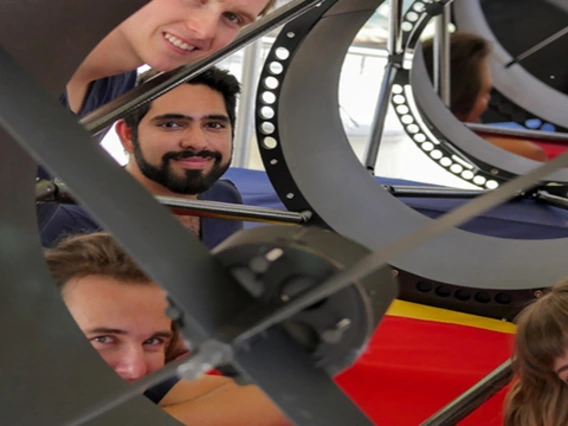
That's the principle that drove five undergraduate students from the University of Arizona's College of Engineering, led by assistant professor Vishnu Reddy of the Lunar and Planetary Laboratory, to build two telescopes from the ground up to track satellites and space junk.
Reddy joined the UA faculty eight months ago, offering expertise in space situational awareness. A large part of SSA involves tracking satellites and space junk around Earth. Federal entities such as the U.S. Department of Defense do so on a regular basis. It's work that requires a large amount of observing time on small telescopes.
While the UA runs more than 20 large telescopes across the globe, few of them are suited for tracking satellites. Having a telescope on campus provides an easy opportunity for student access without a trip to Kitt Peak or Mount Lemmon.
Reddy identified the perfect — and conveniently vacant — space for a small telescope. In the 1990s, a room on the sixth floor of the Kuiper Space Sciences Building was transformed into a small observatory, complete with a retractable roof, so that Bob McMillan, Reddy's colleague in the Lunar and Planetary Lab, could observe stars. The room was last used for observation in 1995, later becoming a storage facility.
Instead of buying the telescopes off the shelf for upward of $50,000 apiece, Reddy recruited five undergraduate engineers to build them through the Engineering Design Program. The program, aimed at preparing the students for careers in engineering, requires all engineering students at the UA to spend their senior year designing, building and testing technologies in teams of four to six, culminating in an annual Engineering Design Day, which this year was held on May 1.
Reddy's team included Lindsie Jeffries, senior in biomedical engineering and mathematics; Sameep Arora, senior in mechanical engineering; Ryan Bronson, senior in optical sciences and mathematics; Damon Marco Colpo, senior in optical sciences and mathematics; and Evelyn Hunten, senior in electrical and computer engineering.
Asked if anything about the project surprised him, Reddy responded unequivocally.
"(It's) the students," he said. "Undergrads are some of the most optimistic people on campus. They're full of life, they feel positive about the future, and they inspire me to be enthusiastic."
Hunten, who landed a post-graduation position at IBM, said she loves space science and exploration.
"This project was the one I wanted to work on," she said. "It was my first choice. I love the instrumentation behind scientific discoveries."
Together, the students built two 24-inch telescopes in seven months for $30,000 total. The mirrors they installed in the new telescopes were recycled from the telescope in the old Kuiper observatory. Written off as junk, the mirrors were headed for the UA's Surplus Store.
A local astronomy business, Starizona, was instrumental in training the students and testing the telescopes' optics, Reddy said.
Starting June 20, after a first light ceremony at 6 p.m., one of the telescopes will run autonomously each night in the place where the old one once stood. It's the first time that a telescope has been installed on campus since the 1990s. The location for the second telescope has yet to be determined, but Biosphere 2 has been discussed as a possibility.
Arora, who designed the telescope model in SolidWorks, a design program, said that making "an actual product that will be used for science" — rather than a prototype — was a rewarding experience.
Jeffries, who will pursue a graduate degree in biomechanical engineering at Stanford University, said, "It was exciting putting the telescope together and confirming that everything fit and worked. I also enjoyed getting to know my teammates. They were all hard workers who cared about the project and pushed me to do my best."
While the team was building the telescopes, Reddy was writing a proposal to the Air Force Research Laboratory, requesting funding for a spectroscopic survey of satellites in the geostationary orbit. Satellites in geostationary orbit revolve around Earth at the same rate that Earth rotates on its axis. This makes them hover above the same location on Earth.
Because their rotation matches ours — moving from west to east — they appear as fixed in space when we look at them from telescopes on Earth. More than 500 such satellites are in orbit today.
Rather than tracking satellites as mere nondescript dots in space — which is not uncommon — Reddy will be able to use the telescopes to identify some unique color signatures of satellites, to find out exactly which one is which.
"The UA is going to be a leader in space situational awareness, and we really want to capitalize on our exceptional undergraduate students," Reddy said. "This is also workforce development. We need an American workforce that can rise to the challenges of our national security needs, and the needs of our nation."

So You Want to Analyze Asteroid Dirt
By Emily Litvack -
So You Want to Analyze Asteroid Dirt

By Emily Litvack - May 18, 2017
In the year 2023, priceless property of the American people will land somewhere in the Utah desert. And when it does, a team of engineers and scientists will be waiting on the ground. Thousands will watch with eyes glued to smart phones and televisions. Headlines around the world will tell of its journey.
The priceless property is 2 to 70 ounces of asteroid dirt.
This 4.5-billion-year-old dirt, formally known as “regolith,” will look like a small pile of dusty rubble, gleaned in the five-second moment during which NASA’s OSIRIS-REx spacecraft vacuumed the surface of a carbon-rich, near-Earth asteroid called Bennu.
Landing, encapsulated, at the Utah Test and Training Range on the planet Earth will begin a new phase in its existence in the universe: analysis. After being transported to the Johnson Space Center in Houston, the dirt will be removed from its capsule, and then allocated to scientists for study.
OSIRIS-REx is the United States’ first mission to return an asteroid sample to Earth, but for scientists like Tom Zega, return to Earth is just the beginning. Zega is a sample scientist at the University of Arizona. As a collaborator on the OSIRIS-REx mission, led by NASA and the UA, he will be one of the first scientists to analyze regolith from Bennu.
Why Return Samples?
One of the main goals of the OSIRIS-REx mission, he says, is understanding the earliest history of our solar system, and the origins of life. Regolith from an asteroid might be our best shot at this.
“Sample return is great because otherwise you’re at the mercy of what falls from the sky,” says Zega. Simply, you get what you get. The regolith from Bennu will be untouched. Uncontaminated by our atmosphere. Pristine. “Sample return is a treasure trove of information.”
“You’re getting samples that are older than Earth. I can literally hold in my hand a piece of the origins of our solar system that predated Earth, predated human beings, predated everything we know,” says Zega. “These are atoms that assembled four and a half billion years ago and became the building blocks of our planet.”
The only question left is what to do with such a scientifically valuable pile of dirt.
Building a Lab Fit for Analysis
“Analysis” can mean many things. In the case of using asteroid regolith to understand the origins of the solar system, analysis means two things, both of which require large equipment in a stable environment. The first: high-resolution imaging. The second: measuring chemistry. Respectively, answering the questions “What does it look like?” and “What is it made of?”
“We’re sort of like forensic scientists,” says Zega. “Nature grew these materials, and we’re analyzing it at a fundamental level to figure out under what conditions.”
Zega does this in the 5,000-square-foot basement of the Kuiper Space Sciences building, constructed at the UA in 1964 with funds from NASA. The basement was once a mirror lab for telescopes and a publications vault. Telescopes got bigger, and so did the mirror lab. It now lives under UA’s Arizona Stadium. Publications went online. Now, the UA’s collection of high-tech electron microscopes—to be used for studying the returned asteroid dirt—live here.
Sensitive to stimulus, electron microscopes need a place with minimal vibrations, minimal electromagnetic interference, and good acoustics. As it turns out, explains Zega as he stands outside the two frosted doors of the lab, basements make good spots for these kinds of microscopes. As of today, the lab is “ready to hit the ground running” when the asteroid sample from OSIRIS-REx shows up.
In fact, the lab is in the process of studying a sample from Hayabusa 1, an asteroid sample return mission by JAXA, the Japanese equivalent of NASA. Like OSIRIS-REx, Hayabusa 2 is now cruising towards its target, the asteroid Ryugu.
He opens the doors, revealing a long, clean, fluorescent-lit corridor.
Analyzing the Sample
At the end of the corridor, in a room on the left, is where the asteroid sample’s time in the lab will truly begin. After it’s mounted on a glass slide and polished smooth, Zega will place the sample in an electron microprobe.
“The microprobe gives us the most context, and a lay of the land,” says Zega. It allows him to photograph the entire sample in high-resolution, and map out its chemistry, element by element. Those elements, like iron and nickel and magnesium, show up as colors on a computer screen.
“You want to sit down and really process that data. You might want to play around with the maps and overlay them onto the high-res images that you also created before you decide what the next step is. That can take some time,” says Zega. “You really want to take your time here before going onto a more detailed level of analysis.”
Then, all the way at the other end of the corridor, near the doorway, there are two scanning electron microscopes. Like the microprobe, they too image and chemically map the sample, but at an even more detailed level. Here, Zega can look at the dirt in micrometers and nanometers—a billionth of a meter. A single sheet of paper is about 100,000 nanometers thick.
In the room next door, a focused-ion-beam scanning-electron microscope can look at the sample in even greater detail. It can also drill a hole in a piece of dust from the asteroid by shooting gallium ions at it, like teeny-tiny bullets.
“Every atom has something to tell us,” says Zega, walking toward the final destination for the asteroid sample: the transmission electron microscope, or TEM. It’s a towering box of off-white and blue, about 12-feet-tall. There’s an innate humor in its largeness, because a TEM is the only machine in the world that can see something as tiny as an individual atom. The TEM, purchased from Hitachi High Technologies in 2016, was shipped by boat from Japan months earlier. A team of engineers from the company’s headquarters outside of Tokyo have been here since November, installing and calibrating the microscope. They are expected to head home in June.
“Looking at microstructures is useful for figuring out origins,” explains Zega. Which atoms of an element are next to, or layered on top of, which other atoms is critically important when you want to figure out how something formed.
Looking to the Stars for Answers
In the best case scenario, analyzing the asteroid dirt means “we rewrite the textbooks on our understanding of the origins of our solar system,” says Zega. “I think that’s the neatest thing about a mission like this. It can be full of surprises.”
“Scientist or not, we all look to the stars and ask ‘How?’ and ‘Why?’ We wonder how it all came to be,” says Zega. “The work that we do here at the University of Arizona contributes to answering those questions.”

HiRISE Brings the Red Planet's Beauty to Your Coffee Table
By Daniel Stolte
HiRISE Brings the Red Planet's Beauty to Your Coffee Table

By Daniel Stolte, University Communications - May 15, 2017
A gorgeous, sumptuous tome chock-full of stunning images taken by the most powerful camera ever sent to another planet now brings Mars to armchair explorers on Earth.
Weighing in at nearly eight pounds, "Mars: The Pristine Beauty of the Red Planet" features close to 200 carefully selected photographs taken by the University of Arizona-led HiRISE camera, which has been orbiting Mars on NASA's Mars Reconnaissance Orbiter since 2006.
Arranged into chapters that guide the reader/viewer from familiar features such as sand dunes to more alien landscapes one cannot glimpse on our own planet, the photos and accompanying captions amount to 425 pages compiled by UA HiRISE scientists. Published by UA Press, the book is available at bookstores and online.
In a sense, the volume represents a "best of" from the treasure trove of high-resolution images snapped by the HiRISE camera for more than a decade. Orbiting Mars anywhere from 125 to 186 miles above the surface, the HiRISE camera has revealed a Red Planet that is anything but dead — at least in geological and climatic terms.
"Throughout the lifetime of this mission, I had been saving favorite images that I thought were interesting," says Alfred McEwen, principal investigator of the HiRISE project and one of the book's authors. "We encouraged our roughly 50 team members who work with the images coming down from the spacecraft to submit their favorites to the project."
Ari Espinoza, outreach coordinator for HiRISE and a co-author of the book, recalls how the project started.
"Through our 'Beautiful Mars' project, volunteers around the world had already translated some of the image captions into 24 other languages," he says, "and with that in mind, I wrote the book proposal and pitched it to UA Press. Fortunately for us, the editorial board was excited about the project."
The result is a visual journey across the surface of Mars. With artistic glimpses at actively eroding slopes, impact craters, strange polar landscapes, avalanches and even spectacular pictures capturing the Phoenix Lander and the Curiosity Rover descending on their parachutes, the reader gets to see what researchers are seeing.
"The really difficult part was to cull the photo material down to a couple of hundred," McEwen says.
Co-author Candice Hansen-Koharcheck, senior scientist at the Planetary Science Institute and deputy principal investigator of HiRISE, adds: "In the end, there were many hard decisions to make when we saw how many images hadn't made the cut. There were so many we looked at and realized, 'No, this has to go back in.'"
In the spirit of "the people's camera at Mars," all images beamed back to Earth are published on the HiRISE website, but for the book, the authors optimized each image to bring out the best possible detail or highlight the most interesting features. Because the captions had been written by members of the entire team, McEwen and Hansen-Koharcheck rewrote each of them to ensure they read with one voice.
"Even though we had a big head start with a huge pool of pictures and their initial captions, putting this together for a dedicated book format still required a lot of work," Hansen-Koharcheck says, explaining that the material is presented in a way that resembles what geologists call stratigraphy: an assembly of rock layers deposited over time.
"Except that in the book, we go from top to bottom, or youngest to oldest, which is the opposite of how a geologist would normally do it," Hansen-Koharcheck says. "We realized that because our images have so much detail, you almost have to train people how to look at them."
And so, the visual journey of the Red Planet begins "with the features that are the most obvious and ubiquitous when you first look at the Martian surface — the sand dunes," Hansen-Koharcheck explains. "Then, we explore more recent features like fresh impact craters, all the way to the bedrock at the bottom of ancient craters. But you can't start there, it's just too foreign."
McEwen says the book covers just a sampling, a small selection of Mars' surface, by necessity.
"Mars has so many different landforms, so much diversity, that we can include just a sampling in this publication," he says. "Everything you see here is at HiRISE scale, so if you zoomed out, you could see large, iconic features like Olympus Mons, for example, but here all we see is a small detail of the volcano."
Since HiRISE began collecting data in 2006, the camera has acquired more than 50,000 images, each one a giant, gigapixel-size file. To date, HiRISE has covered just 2.83 percent of the Martian surface, and that is by design, according to McEwen.
"The goal of HiRISE was never to make an exhaustive survey of Mars," he says. "We are looking at such high resolution that this simply would not be possible. HiRISE was designed to focus on identifying the best landing sites and the most scientifically interesting locations."
Instead of systematically mapping Mars, the HiRISE scientists put time and effort on very specific targets.
"We study the Red Planet at a geologist's scale," McEwen says, "and we follow up with previously imaged sites, too. We are learning about the forces that shape Mars as we go, we are documenting what changes are happening today, and we try to gather clues as to what ancient Mars looked like by studying bedrock composition and structures."
Each day, the HiRISE camera makes 13 trips around Mars, and it is scheduled to continue to do so for the foreseeable future.
"Every day at the HiRISE operations center here at the UA, we send the commands to the spacecraft, and we process the data and interpret the images," McEwen says.