
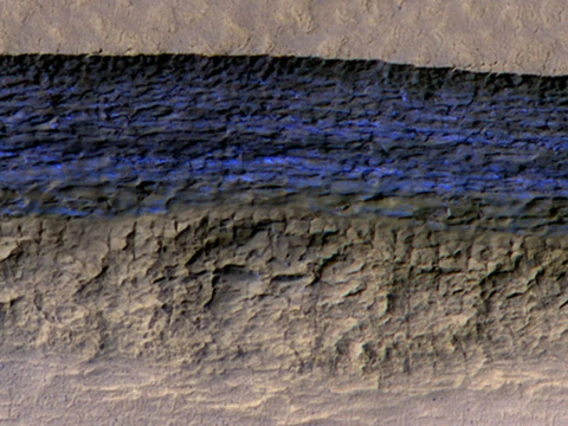
Steep Slopes on Mars Reveal Structure of Buried Ice
By UniversitySteep Slopes on Mars Reveal Structure of Buried Ice

By University Communications - January 12, 2018
Researchers using the University of Arizona-led HiRISE camera aboard NASA's Mars Reconnaissance Orbiter, or MRO, have found eight sites where thick deposits of ice beneath Mars' surface are exposed in faces of eroding slopes.
These eight scarps, with slopes as steep as 55 degrees, reveal new information about the internal layered structure of previously detected underground ice sheets in Mars' middle latitudes.
The ice was likely deposited as snow long ago. The deposits are exposed in cross section as relatively pure water ice, capped by a layer 1 to 2 yards (or meters) thick of ice-cemented rock and dust. They hold clues about Mars' climate history. They also may make frozen water more accessible than previously thought to future robotic or human exploration missions.
Researchers who located and studied the scarp sites with the HiRISE, or High Resolution Imaging Science Experiment, camera on MRO reported the findings on Jan. 11 in the journal Science. The sites are in both the northern and southern hemispheres of Mars, at latitudes from about 55 to 58 degrees, equivalent on Earth to Scotland or the tip of South America.
"There is shallow ground ice under roughly a third of the Martian surface, which records the recent history of Mars," said the study's lead author, Colin Dundas, of the U.S. Geological Survey's Astrogeology Science Center in Flagstaff, Arizona. "What we've seen here are cross sections through the ice that give us a 3-D view with more detail than ever before."
Windows Into Underground Ice
The scarps directly expose bright glimpses into vast underground ice previously detected with spectrometers on NASA's Mars Odyssey orbiter, with ground-penetrating radar instruments on MRO and on the European Space Agency's Mars Express orbiter, and with observations of fresh impact craters that uncover subsurface ice. NASA sent the Phoenix lander to Mars in response to the Odyssey findings; in 2008, the Phoenix mission confirmed and analyzed the buried water ice at 68 degrees north latitude, about one-third of the way to the pole from the northernmost of the eight scarp sites.
"The discovery gives us surprising windows where we can see right into these thick underground sheets of ice," said Shane Byrne of the UA Lunar and Planetary Laboratory, a co-author on the new report. "It's like having one of those ant farms where you can see through the glass on the side to learn about what's usually hidden beneath the ground."
Scientists have not determined how these particular scarps initially form. However, once the buried ice becomes exposed to Mars' atmosphere, a scarp likely grows wider and taller as it "retreats," due to sublimation of the ice directly from solid form into water vapor. At some of them, the exposed deposit of water ice is more than 100 yards, or meters, thick. Examination of some of the scarps with MRO's Compact Reconnaissance Imaging Spectrometer for Mars, or CRISM, confirmed that the bright material is frozen water. A check of the surface temperature using Odyssey's Thermal Emission Imaging System, or THEMIS, camera helped researchers determine they're not seeing just thin frost covering the ground.
Researchers previously used MRO's Shallow Radar, or SHARAD, to map extensive underground water-ice sheets in middle latitudes of Mars and estimate that the top of the ice is less than about 10 yards beneath the ground surface. How much less? The radar method did not have sufficient resolution to say. The new ice-scarp studies confirm indications from fresh-crater and neutron-spectrometer observations that a layer rich in water ice begins within just 1 or 2 yards of the surface in some areas.
Astronauts' Access to Martian Water
The new study not only suggests that underground water ice lies under a thin covering over wide areas, it also identifies eight sites where ice is directly accessible, at latitudes with less hostile conditions than at Mars' polar ice caps.
"Astronauts could essentially just go there with a bucket and a shovel and get all the water they need," Byrne said.
The exposed ice has scientific value apart from its potential resource value because it preserves evidence about long-term patterns in Mars' climate. The tilt of Mars' axis of rotation varies much more than Earth's, over rhythms of millions of years. Today the two planets' tilts are about the same. When Mars tilts more, climate conditions may favor buildup of middle-latitude ice. Dundas and co-authors say that banding and color variations apparent in some of the scarps suggest layers "possibly deposited with changes in the proportion of ice and dust under varying climate conditions."
This research benefited from coordinated use of multiple instruments on Mars orbiters, plus the longevities at Mars now exceeding 11 years for MRO and 16 years for Odyssey. Orbital observations will continue, but future missions to the surface could seek additional information.
"If you had a mission at one of these sites, sampling the layers going down the scarp, you could get a detailed climate history of Mars," suggested MRO deputy project scientist Leslie Tamppari of NASA's Jet Propulsion Laboratory in Pasadena, California. "It's part of the whole story of what happens to water on Mars over time: Where does it go? When does ice accumulate? When does it recede?"
The UA operates HiRISE, which was built by Ball Aerospace & Technologies Corp. of Boulder, Colorado. The Johns Hopkins University Applied Physics Laboratory, Laurel, Maryland, leads MRO's CRISM investigation. The Italian Space Agency provided MRO's SHARAD instrument; Sapienza University of Rome leads SHARAD operations; and the Planetary Science Institute, based in Tucson, leads U.S. involvement in SHARAD. Arizona State University leads the Odyssey mission's THEMIS investigation. JPL, a division of Caltech in Pasadena, California, manages the MRO and Odyssey projects for the NASA Science Mission Directorate in Washington. Lockheed Martin Space, Denver, built both orbiters and supports their operation.

UA in the Running for a New NASA Mission
By UniversityUA in the Running for a New NASA Mission

By University Communications - December 21, 2017
NASA has chosen a planetary mission involving a team from the University of Arizona as one of two finalists to be the next robotic solar system explorer. The proposed mission, named CAESAR, for Comet Astrobiology Exploration Sample Return, seeks to return a sample from a comet to determine its origin and history.
UA Lunar and Planetary Laboratory professor Dante Lauretta is CAESAR's mission sample scientist, responsible for leading the analysis of the returned comet sample. He also is tasked with advising on all aspects of the mission's design that influence the scientific value and integrity of the sample. Lauretta is currently principal investigator of NASA's OSIRIS-REx asteroid sample return mission, which launched in September 2016 and will return NASA's first asteroid sample to Earth in 2023.
LPL associate professor Tom Zega is a co-investigator on the CAESAR mission and would analyze the comet sample material once it is back on Earth. Zega, currently a collaborator on the OSIRIS-REx mission, will be one of the first scientists to analyze samples from the asteroid Bennu.
"We are excited to bring the UA's leadership in sample science innovation to the challenges posed by the CAESAR mission and its target comet," Lauretta said. "The work done on CAESAR will ensure that the UA continues to stand at the forefront of extraterrestrial sample analysis for the next 20 years."
If selected, CAESAR would be the fourth mission in NASA's $1 billion New Frontiers program, which sends robotic spacecraft to conduct science-intensive planetary investigations. The UA leads the third New Frontiers mission, OSIRIS-REx, currently on its way to the asteroid Bennu to retrieve a sample of its surface for study on Earth.
"This is a wonderful opportunity to apply the experience that the UA has gained from OSIRIS-REx to another frontier in planetary science," said Kimberly Andrews Espy, UA senior vice president for research. "We are delighted to be able to continue the University's tradition of leadership in exceptional NASA missions."
CAESAR's target comet is 67P/Churyumov-Gerasimenko, which previously was explored by the European Space Agency's Rosetta spacecraft. If the mission is ultimately chosen, the CAESAR spacecraft could launch by 2025 and return to Earth in 2038. The mission is led by Steve Squyres of Cornell University and managed by NASA's Goddard Space Flight Center. NASA intends to make the final mission selection in summer 2019. Between now and then, the two finalist missions will receive funding from NASA to further advance the missions' concepts and designs.
The other finalist mission, Dragonfly, is led by LPL alumna Elizabeth Turtle, who earned her Ph.D. in planetary science in 1998 and then continued at LPL as both a postdoctoral fellow and as research faculty before joining the Johns Hopkins University Applied Physics Laboratory in Laurel, Maryland. The Dragonfly spacecraft is a dronelike rotorcraft that would explore the prebiotic chemistry and habitability of dozens of sites on Saturn's moon Titan, an ocean world in our solar system.

UA Students Participate in First Global Planetary Defense Exercise
By Emily Walla, NASAUA Students Participate in First Global Planetary Defense Exercise

By Emily Walla, NASA Space Grant Intern, University Communications - December 4, 2017
University of Arizona students recently took part in a NASA-led international exercise that used a real asteroid flyby to test global planetary defense capabilities. The project was designed to exercise how astronomers' efficiency in determining the orbit, rotation, shape, size and composition of an asteroid that could potentially impact the Earth. The campaign was led by Vishnu Reddy, assistant professor in the UA's Lunar and Planetary Laboratory.
The exercise's target was the asteroid 2012 TC4. The small asteroid — only 50 feet long and 25 feet wide — was on course to closely approach Earth. On Oct. 12, TC4 safely passed the planet, coming within 27,200 miles of the surface (that's about 5,000 miles above the orbit of geostationary satellites). In the months before the flyby, astronomers from the U.S., Canada, Colombia, Germany, Israel, Italy, Japan, the Netherlands, Russia and South Africa tracked TC4 using ground- and space-based telescopes from around the world.
Planning for the so-called TC4 Observation Campaign started in April, under the sponsorship of NASA's Planetary Defense Coordination Office. The exercise commenced in earnest in late July, when the European Southern Observatory's Very Large Telescope spotted the asteroid. The finale was a close approach to Earth in mid-October.
Graduate and undergraduate students at the UA were given the opportunity to participate in the project as part of a class Reddy taught with Walt Harris, professor in the Department of Planetary Sciences.
Using observations collected during the campaign, scientists at NASA's Jet Propulsion Laboratory, or JPL, were able to precisely calculate TC4's orbit, predict its flyby distance on Oct. 12 and rule out the possibility of a collision between Earth and the asteroid.
RAPTORS Network Put to Use
A network of telescopes, including the student-built Rapid Astronomical Pointing Telescopes for Optical Reflectance Spectroscopy, or RAPTORS, housed on the UA campus, was used to study how fast TC4 rotates. Given that TC4 is small, astronomers expected it to be rotating fast. They were surprised to find that the object was not only spinning once every 12 minutes, it also was tumbling.
A team of UA undergraduate students from Reddy's class observed the asteroid using RAPTORS.
"Observing using RAPTORS went beautifully," said Collin Lewin, one of Reddy's undergraduate students. "The opportunity to operate a telescope like RAPTORS is rare for undergraduates, so this was a valuable experience for many students."
Finding out what TC4 is made of turned out to be more challenging. Is the asteroid rich in carbon, or does it consist of bright rocky materials? Infrared observations made with NASA's Infrared Telescope Facility, or IRTF, at the Mauna Kea Observatory in Hawaii would allow scientists to identify the asteroid's composition. On a trip funded by the Lunar and Planetary Laboratory's external advisory board, graduate students from the UA traveled to Hawaii to perform the necessary observations.
The work done by Reddy's students would allow NASA to know exactly what materials comprised which parts of the asteroid. Although they were able to collect some data before the asteroid's close approach, adverse weather conditions and technical difficulties prevented Reddy's graduate students at IRTF from taking observations during TC4's flyby on Oct. 12.
"Something always goes wrong. You have to learn how to deal with it," said Cassandra Lejoly, a doctoral student in Reddy's class.
Others in Reddy's class, such as doctoral student Ben Sharkey, noted that the experience was useful for students who were unsure of the direction in which they wished to take their careers.
"This experience gave them an idea of what observing takes. It might help those students decide if they want to have to deal with the difficulties that come with observing," Sharkey said.
"Whether or not our graduate students are going to use telescopes in their professional careers, they are going to work with people who do," said Timothy Swindle, director of the Lunar and Planetary Laboratory. "One of the important things in a graduate student's education is learning about the tools that you use, and the tools used by the people you work with. This was one opportunity for them to see how a telescope really works."
Rare Opportunity for Students
Most observing can be done remotely, as the telescopes can send data to computers far from the observatories.
"Learning how to use a telescope as complicated as IRTF is something that few people get to do in person," said Teddy Kareta, a first-year doctoral student at LPL. Witnessing the inner workings of the telescope granted students such as Kareta a deeper understanding and respect for the instruments and the people who operate and repair them.
"No one expected the observing trip to be quite as tumultuous as it was, but the students learned that when trying to do great things, they will face setbacks along the way," Swindle said.
Although the setbacks at IRTF threw a small wrench in the observation campaign, scientists at JPL were nevertheless able to determine what materials were present at the surface of the asteroid. Radar scattering properties of TC4 are consistent with a bright, rocky surface, similar to a particular class of meteorites that reflect 50 percent of light that hits them.
In addition to the observation campaign, NASA used this exercise to test communications between the many observers and also to test internal U.S. government messaging and communications up through the executive branch and across government agencies. Such would be necessary during an actual impact emergency.
"We demonstrated that we could organize a large, worldwide observing campaign on a short timeline, and communicate results efficiently," Reddy said.

Recurring Martian Streaks: Flowing Sand, Not Water?
Jet PropulsionRecurring Martian Streaks: Flowing Sand, Not Water?

Jet Propulsion Laboratory/Caltech and University Communications - Nov. 21, 2017
Dark features on Mars previously considered evidence for subsurface flowing of water are interpreted by new research as granular flows, where grains of sand and dust slip downhill to make dark streaks, rather than the ground being darkened by seeping water.
Continuing examination of these still-perplexing seasonal dark streaks with the UA-led High Resolution Imaging Science Experiment, or HiRISE, camera on NASA's Mars Reconnaissance Orbiter, or MRO, shows they exist only on slopes steep enough for dry grains to descend the way they do on faces of active dunes.
The findings published in Nature Geoscience argue against the presence of enough liquid water for microbial life to thrive at these sites. However, exactly how these numerous flows begin and gradually grow has not yet been explained. Authors of the report propose possibilities that include the involvement of small amounts of water, indicated by detection of hydrated salts observed at some of the flow sites.
These features have evoked fascination and controversy since their 2011 discovery, as possible markers for unexpected liquid water or brine on an otherwise dry planet. They are dark streaks that extend gradually downhill in warm seasons, then fade away in winter and reappear the next year. On Earth, only seeping water is known to have these behaviors, but how they form in the dry Martian environment remains unclear.
Many thousands of these Martian features, collectively called "recurring slope lineae," or RSL, have been identified in more than 50 rocky-slope areas, from the equator to about halfway to the poles.
'Mars Today Is Very Dry'
"We've thought of RSL as possible liquid water flows, but the slopes are more like what we expect for dry sand," said Colin Dundas of the U.S. Geological Survey's Astrogeology Science Center in Flagstaff, Arizona. "This new understanding of RSL supports other evidence that shows that Mars today is very dry."
Dundas is lead author of the report, which is based on observations with the HiRISE camera on MRO. The data include 3-D models of slope steepness using pairs of images for stereo information. Dundas and co-authors examined 151 RSL features at 10 sites.
The RSL are almost all restricted to slopes steeper than 27 degrees. Each flow ends on a slope that matches the dynamic "angle of repose" seen in the slumping dry sand of dunes on Mars and Earth. A flow due to liquid water should readily extend to less steep slopes.
"The RSL don't flow onto shallower slopes, and the lengths of these are so closely correlated with the dynamic angle of repose, it can't be a coincidence," said HiRISE principal investigator Alfred McEwen at the UA's Lunar and Planetary Laboratory, a co-author of the new report.
The seasonal dark streaks have been thought of as possible evidence for biologically significant liquid water — sufficient water for microbial life — although explaining how so much liquid water could exist on the surface in Mars' modern environment would be challenging. A granular-flow explanation for RSL fits with the earlier understanding that the surface of modern Mars, exposed to a cold, thin atmosphere, lacks flowing water. A 2016 report also cast doubt on possible sources of underground water at RSL sites. Liquid water on today's Mars may be limited to traces of dissolved moisture from the atmosphere and thin films, which are challenging environments for life as we know it.
However, RSL remain puzzling. Traits with uncertain explanations include their gradual growth, their seasonal reappearance, their rapid fading when inactive, and the presence of hydrated salts, which have water molecules bound into their crystal stucture.
RSL Formation a Mystery
The new report describes possible connections between these traits and how RSL form. For example, salts can become hydrated by pulling water vapor from the atmosphere, and this process can form drops of salty water. Seasonal changes in hydration of salt-containing grains might result in some trigger mechanism for RSL grainflows, such as expansion, contraction or release of some water. Darkening and fading might result from changes in hydration. If atmospheric water vapor is a trigger, then a question is why the RSL appear on some slopes but not others.
"RSL probably form by some mechanism that is unique to the environment of Mars," McEwen said, "so they represent an opportunity to learn about how Mars behaves, which is important for future surface exploration."
"Full understanding of RSL is likely to depend upon on-site investigation of these features," said MRO project scientist Rich Zurek of NASA's Jet Propulsion Laboratory in Pasadena, California. "While the new report suggests that RSL are not wet enough to favor microbial life, it is likely that on-site investigation of these sites will still require special procedures to guard against introducing microbes from Earth, at least until they are definitively characterized. In particular, a full explanation of how these enigmatic features darken and fade still eludes us. Remote sensing at different times of day could provide important clues."
Operated by the UA, HiRISE was built by Ball Aerospace & Technologies Corp. of Boulder, Colorado. JPL, a division of Caltech in Pasadena, California, manages the MRO project for the NASA Science Mission Directorate in Washington. Lockheed Martin Space Systems of Denver built the orbiter and supports its operations.
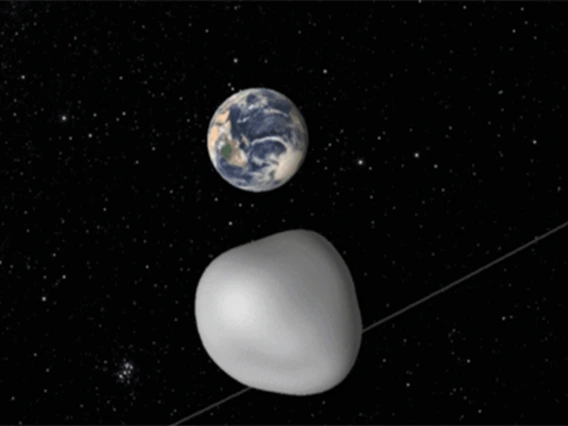
Earth's New Buddy Is Asteroid, Not Space Junk
By Daniel StolteEarth's New Buddy Is Asteroid, Not Space Junk

By Daniel Stolte, University Communications and Vishnu Reddy,LPL - Oct. 17, 2017
Is it a bird? Is it a plane? Or maybe, as some have speculated, a burned-out rocket booster, trapped in a near-Earth orbit around the sun and only occasionally getting close enough to be studied with even the largest telescopes?
Not at all, as it turns out. Based on previous observations, most astronomers had strongly suspected that object (469219) 2016 HO3 was an ordinary asteroid and not space junk. But it took a team of astronomers led by Vishnu Reddy, assistant professor at the University of Arizona's Lunar and Planetary Laboratory, working with one of the world's largest telescopes, the Large Binocular Telescope, or LBT, on Mount Graham in southeastern Arizona, to learn the true nature of this near-Earth object.
2016 HO3 is a small near-Earth object, or NEO, measuring no more than 100 meters (330 feet) across that, while orbiting the sun, also appears to circle around the Earth as a "quasi-satellite." Only five quasi-satellites have been discovered so far, but 2016 HO3 is the most stable of them. The provenance of this object is unknown. On timescales of a few centuries, 2016 HO3 remains within 38-100 lunar distances from us.
"While HO3 is close to the Earth, its small size — possibly not larger than 100 feet — makes it challenging target to study," Reddy said. "Our observations show that HO3 rotates once every 28 minutes and is made of materials similar to asteroids."
Soon after its discovery in 2016, astronomers were not sure where this object came from, but in a recent presentation at the annual Division for Planetary Sciences Conference of the American Astronomical Society in Provo, Utah, Reddy and his colleagues showed that Earth's new traveling buddy is an asteroid and not space junk. The new observations confirm that 2016 HO3 is a natural object of similar provenance to other small NEOs that zip by the Earth each month.
"In an effort to constrain its rotation period and surface composition, we observed 2016 HO3 on April 14 and 18 with the Large Binocular Telescope and the Discovery Channel Telescope," Reddy said. "The derived rotation period and the spectrum of emitted light are not uncommon among small NEOs, suggesting that 2016 HO3 is a natural object of similar provenance to other small NEOs."
In their presentation "Ground-based Characterization of Earth Quasi Satellite (469219) 2016 HO3" at the 49th annual Division for Planetary Sciences meeting in Utah, Reddy and his co-authors, Olga Kuhn, Audrey Thirouin, Al Conrad, Renu Malhotra, Juan Sanchez and Christian Veillet, point out that the light reflected off the surface of 2016 HO3 is similar to meteorites we have on Earth.
One way to visualize HO3's orbit is by picturing a hula hoop dancer — the sun in this analogy — twirling two hoops around the hips at the same time, ever so slightly out of sync. While it orbits the sun, the object makes yearly loops around the Earth. As a result, the object appears to orbit the Earth, but it is not gravitationally bound to our planet.
"Of the near-Earth objects we know of, these types of objects would be the easiest to reach, so they could potentially make suitable targets for exploration," said Veillet, director of the LBT Observatory. "With its binocular arrangement of two 8.4-meter mirrors, coupled with a very efficient pair of imagers and spectrographs like MODS, LBT is ideally suited to the characterization of these Earth's companions."
NASA Near-Earth Object Observations Program Grant NNX17AJ19G (PI: Reddy) funded parts of this work.

Earth to OSIRIS-REx Cameras: I'm Ready for My Close-Up
UniversityEarth to OSIRIS-REx Cameras: I'm Ready for My Close-Up

University Communications - October 4, 2017
On Sept. 22, OSIRIS-REx soared under the South Pole, coming within 10,600 miles of Earth before using the planet's gravity to slingshot itself onto the path to the asteroid Bennu.
The flyby was the perfect opportunity for the OSIRIS-REx team to calibrate and test the science instruments on the craft — and exercise the team.
"It’s really important that all of the team members know where they fit in the processes and that the lines of communication are well understood," said Heather Enos, deputy principal investigator of the mission led by the University of Arizona.
NavCam 1 — a navigational camera operated by Lockheed Martin — captured OSIRIS-REx's first black-and-white image of Earth, taken at a distance of 69,000 miles. Hurricane Maria and the remnants of Hurricane Jose can be seen in the upper right of the image.
About 37,000 miles farther away, MapCam snapped a series of images of Earth, using five different filters. The mission's image processing team at the UA combined the images to create the color composite of Earth.
MapCam is designed to photograph Bennu, a body that reflects only 4 percent of the sunlight that hits it; it is darker than coal. Earth is much, much brighter than that, so the image had to be taken using extremely short exposure times, causing the appearance of dark "icicles" at the top of the color portrait of Earth.
"MapCam was taking the data as quickly as it can," principal investigator Dante Lauretta said. "There was just some noise left on the detector. We won't have any of those features when we're at Bennu."
As it flew away from Earth, OSIRIS-REx aimed its spectrometers at our home planet. Those instruments performed a unique observation: collecting spectral data over Earth's entire visible surface.
"We’ll be doing some interesting science with it, so stay tuned," Lauretta said.
OSIRIS-REx is scheduled to get up close and personal with the 4.5 billion-year-old asteroid in November 2018. After searching the sky around Bennu for other bodies, assessing the asteroid's risk of impact with Earth, using the spectrometers to analyze its chemistry and collecting a sample from its surface, OSIRIS-REx will return to Earth in 2023.
From the mission, researchers hope to learn more about the origins of life and the solar system.
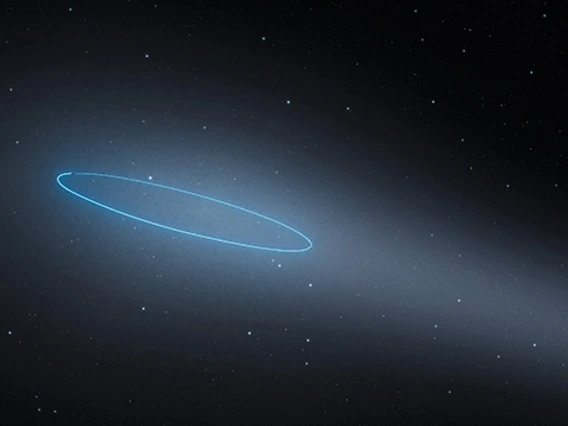
Asteroid-Comet Is New Type of Object
By ESA/Hubble SpaceAsteroid-Comet Is New Type of Object

By ESA/Hubble Space Telescope and Daniel Stolte, University Communications - Sept. 25, 2017
With the help of the NASA/ESA Hubble Space Telescope, astronomers have observed the intriguing characteristics of an unusual type of object in the asteroid belt between Mars and Jupiter: two asteroids orbiting each other and exhibiting cometlike features, including a bright coma and a long tail. This is the first known binary asteroid also classified as a comet. The research is published in the journal Nature.
Asteroid 288P was discovered by the University of Arizona's SPACEWATCH® program in 2006, according to Stephen Larson, a senior staff scientist at the UA's Lunar and Planetary Laboratory and a co-author on the paper. Cometary activity was noticed in Hawaii Pan-Starrs data in 2011 as it approached perihelion — close approach to the sun — and is the first known "main belt comet" as it orbits in the main asteroid belt between Mars and Jupiter.
In September 2016, just before the asteroid 288P made its closest approach to the sun, it was close enough to Earth to allow astronomers a detailed look at it using the NASA/ESA Hubble Space Telescope. Like any object orbiting the sun, 288P travels along an elliptical path, bringing it closer to and farther away from the sun during the course of one orbit.
The images of 288P revealed that it actually was not a single object but two asteroids of almost the same mass and size, orbiting each other at a distance of about 100 kilometers (62 miles). That discovery was in itself an important find; because they orbit each other, the masses of the objects in such systems can be measured.
But the observations also revealed ongoing activity in the binary system. The team of authors of this paper has been working for several years trying to identify the mechanism for the observed activity using the Hubble Space Telescope, Larson said.
"These so-called active asteroids are likely comets that have lost most of their volatile ices and may provide the link between comets and some asteroids," he said. "There are about 20 known active asteroids that result from collisions, volatile gas outgassing and splitting due to rotational spin-up."
"We detected strong indications of the sublimation of water ice due to the increased solar heating — similar to how the tail of a comet is created," explained Jessica Agarwal of the Max Planck Institute for Solar System Research in Germany, the team leader and main author of the research paper. This makes 288P the first known binary asteroid that also is classified as a main-belt comet.
Understanding the origin and evolution of main-belt comets — asteroids orbiting between Mars and Jupiter that show comet-like activity — is a crucial element in our understanding of the formation and evolution of the whole solar system. Among the questions main-belt comets can help to answer is how water came to Earth. Current research indicates that water came to Earth not via comets, as long thought, but via icy asteroids. Since only a few objects of this type are known, 288P presents itself as an extremely important system for future studies.
"The high resolution of the Hubble Space Telescope provides unique data constraining the various processes at work in active asteroids," Larson said. "A few of these have been discovered by the UA Catalina Sky Survey, which also provides 14 years of data on historical activity of these active asteroids."
The various features of 288P — wide separation of the two components, near-equal component size, high eccentricity and cometlike activity — also make it unique among the few known wide asteroid binaries in the solar system. The observed activity of 288P also reveals information about its past, Agarwal noted: "Surface ice cannot survive in the asteroid belt for the age of the solar system but can be protected for billions of years by a refractory dust mantle, only a few meters thick."
From this, the team concluded that 288P has existed as a binary system for only about 5,000 years. Agarwal elaborated on the formation scenario: "The most probable formation scenario of 288P is a breakup due to fast rotation. After that, the two fragments may have been moved further apart by sublimation torques."
The fact that 288P is so different from all other known binary asteroids raises some questions about whether it is not just a coincidence that it presents such unique properties. As finding 288P included a lot of luck, it is likely to remain the only example of its kind for a long time. "We need more theoretical and observational work, as well as more objects similar to 288P, to find an answer to this question," Agarwal concludes.
The Hubble Space Telescope is a project of international cooperation between ESA and NASA.
The international team of astronomers in this study consists of Jessica Agarwal (Max Planck Institute for Solar System Research, Göttingen, Germany), David Jewitt (Department of Earth, Planetary and Space Sciences and Department of Physics and Astronomy, University of California, Los Angeles), Max Mutchler (Space Telescope Science Institute, Baltimore), Harold Weaver (Johns Hopkins University Applied Physics Laboratory, Maryland) and Stephen Larson (Lunar and Planetary Laboratory, UA).

OSIRIS-REx Swings by Earth
By Daniel StolteOSIRIS-REx Swings by Earth

By Daniel Stolte, University Communications - September 20, 2017
As you are reading this, a spacecraft is coming right at you.
Hurtling toward Earth at 19,058 mph, the OSIRIS-REx spacecraft has completed one orbit around the sun since its launch on Sept. 8, 2016. The robotic explorer of the University of Arizona-led asteroid sample return mission is now readying itself for a maneuver that will place it on a trajectory to catch up with Bennu, its target asteroid, a year from now.
In preparation for the Earth gravity assist maneuver, members of all teams involved in the mission are flocking to the UA's Michael J. Drake Building to rehearse operations that the spacecraft will have to perform once it reaches Bennu and begins its surveying campaign to get ready to grab a sample of asteroid material and bring that back to Earth.
"This is the first time for members of all teams to be located here at the Drake Building and lace together as one team," says deputy principal investigator Heather Enos, who has been involved in several NASA missions in which the UA participated. "Our biggest challenge is coordinating all the moving parts. Staying organized requires knowing each other very well and, most of all, trust. Whoever you delegate to can open your door at any time and say, 'We need to talk.'"
During the weeklong, carefully orchestrated move, the probe will approach Earth to within 10,700 miles, well below the orbit of geostationary satellites. It will then dive south under Antarctica, and up over the Pacific Ocean, before setting sail for its journey through outer space to rendezvous with Bennu. As it speeds away from Earth, it will look back and take pictures of the Earth and moon.
Unlike most such maneuvers, which are designed to accelerate a spacecraft by "stealing" momentum from a planetary body's orbit around the sun, OSIRIS-REx will use Earth to change its orbital plane, in a similar way that a skillful throw of a line onto a mooring pole can help a skipper maneuver a boat around a dock.
According to Erin Morton, communications lead for the OSIRIS-REx mission, OSIRIS-REx is one of only a few NASA spacecraft that have performed an Earth gravity assist maneuver, or EGA.
A Need for Speed? Not Really
"This is not about gaining speed," Morton says. "We have all the speed we need to catch up with Bennu. But to get onto the asteroid's orbit, OSIRIS-REx has to boost itself slightly above the plane on which Earth travels around the solar system. Placing it onto that trajectory at launch would have required excessive amounts of rocket fuel, so we're using Earth's gravity instead."
The close encounter provides mission scientists and engineers with the first opportunity since the spacecraft's launch to gather at the OSIRIS-REx Science Processing Operations Center, or SPOC, in the Drake Building, which is a short distance northwest of the UA main campus. Referred to as a co-location by mission managers, the weeklong activities provide a valuable opportunity to rehearse procedures and test and calibrate scientific instruments. As many as 30 scientists, technicians, engineers and other mission members — including several representatives from out of state — are expected to work together during the flyby. Once OSIRIS-REx gets to asteroid Bennu, SPOC will bustle with about 120 people at any given time.
Unlike most space missions, in which the science team members leave most of the spacecraft's day-to-day operations to the flight and system engineers and only spring into action once the craft begins to send science data back to Earth, OSIRIS-REx is more similar to a 17th-century expedition aboard a sailing ship. Just as the naturalists were part of the trip, studying foreign waters and lands as they encountered them, discoveries made by the OSIRIS-REx scientists will be used to inform the spacecraft's operations. Such a high level of intertwined overlap among teams is unusual, according to Morton.
"Much of this mission is about reconnaissance," she explains. "Until we actually get to the asteroid, we won't know what to expect, and what potential hazards might be awaiting the spacecraft."
Lead science operations engineer Sara Knutson, who graduated from the UA with a master's degree in engineering management, has spent the year since launch with her team mapping out what actions the science payload instruments aboard the spacecraft will be performing once at the asteroid — down to the hour. This includes planning all the observations the science instruments will be performing while it orbits Bennu to survey the asteroid in preparation for selecting a sample site.
"Let's say one of the mission scientists wanted to look at a particular swath of material on the asteroid surface," Knutson says. "My team members would then determine where we have to point the spacecraft, and what we have to do once we are in that position — for example, which cameras or spectrometers have to be turned on at what times."
Precision for the Payload
Knutson's team writes commanding sequence products that lay out the exact steps for any given operation of the spacecraft's science payload — in a sense, they allow the ground crew to talk to the spacecraft and control every one of its activities.
"For example, how do we need to orient the spacecraft if we want to point a camera at a science target?" Knutson says. "How do we need to orient the solar panels to ensure we have enough power to acquire the science objective we are looking for, and how long can we remain in that position before we run out of power? Those are the kinds of questions that we ask and develop protocols for."
Before any commands are sent, her team thoroughly tests each data product and works with the spacecraft team to make sure everything is within specs. Once a science operation has been performed, Knutson's team verifies that every task was completed as planned.
"Let's say a scientist asked for pictures or spectrometric data of a site on the asteroid," Knutson says. "Our job is then to check: Did we get all 250 images from the spacecraft, or are we missing an hour's worth of spectrometer data? Our team monitors all that. There is a constant cycle of reviewing an action and feeding the results back into future plans. We want to make sure we keep track of what we have learned to adjust our procedures for future operations."
Taking pictures of the Earth and moon provides a critical opportunity to calibrate the spacecraft's instruments, according to Knutson, as it ensures that the instruments work as intended once they are at the asteroid.

After Farewell Kiss, Cassini Takes the Plunge
By Daniel StolteAfter Farewell Kiss, Cassini Takes the Plunge

By Daniel Stolte, University Communications - September 13, 2017
When NASA's Cassini spacecraft careens to its final destination, the upper atmosphere of Saturn, it will take with it a sizable chunk of University of Arizona space research history. After a journey of 4.9 billion miles, and one month shy of 20 years in space, the probe is programmed to end its voyage exploring the Saturnian system through a deliberate plunge into the second-largest planet of the solar system.
The spacecraft's fateful dive on Friday will be the final beat in the mission's Grand Finale — 22 weekly dives, begun in late April, through the gap between Saturn and its rings. According to NASA, no spacecraft has ever ventured so close to the planet before.
"Cassini-Huygens is a classic example of a 'flagship' mission, accomplishing tremendous science in many disciplines over many years," said Alfred McEwen, a UA professor of planetary sciences, on Monday as he prepared to leave for Pasadena, California. There, at NASA's Jet Propulsion Laboratory, he would attend the final moments of the mission, along with other UA planetary scientists who have participated in the project.
NASA chose to end the mission by safely disposing of the spacecraft, burning it up in Saturn's atmosphere rather than allowing it to run out of fuel and committing its fate to an aimless tumble and potential crash onto one of Saturn's moons. Mission scientists were especially concerned about contaminating Titan or Enceladus, the two Saturnian moons where life as we know it might be possible — a possibility discovered by Cassini's multiple flybys.
When it launched, Cassini-Huygens was the biggest, most complex interplanetary spacecraft ever flown. In 2004, it arrived in the Saturn system, carrying with it a robotic passenger in form of the Huygens probe, contributed to the mission by the European Space Agency, or ESA. On Jan. 14, 2005, Huygens would make history as the first — and, so far, only — humanmade object to touch down on a world in the outer solar system. Through the eyes of Huygens, an instrument built by UA scientists and engineers, people on Earth could watch as the probe hurtled through the opaque and hazy atmosphere enshrouding Titan.
The probe was equipped with an instrument called DISR, short for Descent Imager/Spectral Radiometer. Led by Martin Tomasko, a now-retired research professor at the Lunar and Planetary Laboratory, UA scientists joined their ESA colleagues in Germany to follow Huygens with six science experiments as it descended through Titan's thick atmosphere until it touched down on a virtually unseen surface. In addition to images taken with DISR, the lander recorded data that enabled LPL staff scientist Erich Karkoschka to gather surprising clues about Titan's surface many years after the event.
Monitoring the Moon Titan
During many flybys, Cassini monitored the dynamic Titan using its camera suite and an instrument called VIMS, a Visual and Infrared Mapping Spectrometer. Built at Jet Propulsion Laboratory under the leadership of Robert Brown, operations for VIMS moved to the UA when Brown assumed a position as professor at LPL. According to Brown, VIMS has been taking spectra over areas of Saturn, its rings and moons so scientists can discover what these objects are made of.
Those observations revealed details about the cycle of methane, which on Titan takes the role of water on Earth — forming clouds, raining down and forming lakes, as well as freezing into ice. In all those observations, Cassini's cameras played an important role, said McEwen, who is a team member of the craft's imaging science subsystem. Those cameras, over the years of photographing Saturn, its rings and moons, created some of the most visually beautiful images of the solar system.
Cassini's imaging team leader Carolyn Porco was appointed to the mission while on the faculty at LPL, where she had been working on NASA's Voyager mission, and was a co-originator of the idea to use Voyager-1 to take portraits of the planets, including the famous Pale Blue Dot image of Earth.
Surface observations on Titan are planned at LPL, and then sent to the Cassini Imaging Central Laboratory for Operations, or CICLOPS, at the University of Colorado, Boulder, which Porco heads as director.
"From there, the necessary commands are sent to JPL and then to the spacecraft," McEwen explains.
Another one of Saturn's moons, ice-clad Enceladus, rose to stardom during several flybys over the course of the mission. Enceladus plows along the orbit of the E Ring, Saturn's second-from-outermost ring, which reaches extremely far out into space, brushing up against the orbit of Titan.
"There was speculation that the moon had something to do with the E Ring," McEwen says.
During multiple close flybys, Cassini used its full science payload to detect and analyze water-rich plumes erupting from the moon's south pole far into space, a spectacular discovery that McEwen considers one of the highlights of the entire mission.
"We saw that these plumes are quite large and extensive," he recalls. "Because we were able to measure their composition with Cassini's instruments, we could show that (tiny particles from those eruptions) are the source of the E Ring."
The Last Closest Approach
Evidence for subsurface oceans of water were discovered by Cassini inside both Enceladus and Titan, making them prime targets for future NASA missions.
Cassini made its last closest approach to Titan on Sept. 11 at 12:04 p.m. PDT, at an altitude of 73,974 miles (119,049 kilometers) above the moon's surface, causing the spacecraft to slingshot into its final approach to Saturn — but not before it would send final images from Titan to Earth, eagerly awaited by scientists, including McEwen.
"Previously, we saw thunderstorms in Titan's southern hemisphere when it was summer there," he says, "and because it's now the northern summer solstice, we are hoping to see cloud activity and perhaps thunderstorms in the northern hemisphere."
Cassini will be doing science even after being gripped by Saturn's gravity, pulling it into destruction, by measuring the composition, temperature and other properties of Saturn's atmosphere.
"The spacecraft will be transmitting data until the very end, and we'll be there when it stops," McEwen says. "It won't go very deep, because it is not a probe designed to go deep, but still deeper than anything else."
When Cassini arrived at Saturn, where one "year" lasts 29.5 Earth years, the gas giant went through northern winter, and Cassini was there to witness the planet's change of seasons.
The end of the mission, McEwen says, is "not unexpected," adding that the plan to end with a solstice mission, followed by a plunge into Saturn, was put in place about seven years ago.
Still, "this mission has been going for so long, it's a little hard to believe that it's over," he says.

Stellar Corpse Sheds Light on Cosmic Rays
By Daniel StolteStellar Corpse Sheds Light on Cosmic Rays

By Daniel Stolte, University Communications - September 4, 2017
The origin of cosmic rays, high-energy particles from outer space unceasingly impinging on Earth, is among the most challenging open questions in astrophysics.
Discovered more than 100 years ago and considered a potential health risk to airplane crews and astronauts, cosmic rays are believed to be produced by shock waves — for example, those resulting from supernovae explosions. The most energetic cosmic rays streaking across the universe carry 10 to 100 million times the energy generated by particle colliders such as the Large Hadron Collider at CERN. New research published in the Monthly Notices of the Royal Astronomical Society sheds new light on the origin of those energetic particles.
"The new result represents a significant advance in our understanding of particle acceleration at shock waves, traditionally regarded as the main sources of energetic particles in the universe," said the study's lead author, Federico Fraschetti, a staff scientist at the University of Arizona's Departments of Planetary Sciences and Astronomy.
The Crab Nebula, remnant of a supernova explosion that was observed almost 1,000 years ago, is one of the best studied objects in the history of astronomy and a known source of cosmic rays. It emits radiation across the entire electromagnetic spectrum, from gamma rays, ultraviolet and visible light, to infrared and radio waves.
"Most of what we observe comes from very energetic particles such as electrons that did not yet leave the source," said Fraschetti. "Since we can only observe the electromagnetic radiation that they emit from the source itself, we rely on models to reproduce the radiation spectrum we see from the nebula."
The new study, co-authored by Martin Pohl at the University of Potsdam, Germany, revealed that the entire zoo of electromagnetic radiation streaming from the Crab Nebula can arise from a single population of electrons, previously deemed impossible, and that they originate in a different way than scientists have traditionally thought.
According to the generally accepted model, once the particles reach the shock, they bounce back and forth many times due to the magnetic turbulence. During this process they gain energy — in a similar way to a tennis ball being bounced between two rackets that are steadily moving nearer to each other — and are pushed closer and closer to the speed of light. Such a model follows an idea introduced by Italian physicist Enrico Fermi in 1949.
"The current models do not include what happens when the particles reach their highest energy," said Federico Fraschetti. "Only if we include a different process of acceleration can we explain the entire electromagnetic spectrum we see, and that tells us that while the shock wave still is the source of the acceleration of the particles, the mechanisms must be different."
At the heart of the Crab Nebula lies a pulsar, a rapidly rotating neutron star originating from the explosion of a star a few times more massive than the sun. When it exploded, the star shredded its outer layers, creating the stunning colorscape that makes the Crab Nebula so popular with professional and amateur astronomers. The pulsar emits a wind of electrons and positrons traveling at what astrophysicists call relativistic speed — close to the speed of light.
"Those particles are the fastest things in the universe," Fraschetti said. "Anything we experience in our everyday lives is very far from relativistic effects. But these highly energetic particles still need to be accelerated even more to produce the electromagnetic radiation that we see coming from the Crab Nebula."
That acceleration, scientists believe, happens at a boundary called the termination shock, where the particle wind slams into the cloud of gas and dust that the star blew off into space when it went supernova.
Except that just when the particles become energetic enough to leave the system and become cosmic radiation, they go beyond the limits of the models traditionally used to account for the origin of cosmic radiation, Fraschetti and Pohl found. The authors conclude that a better understanding is needed of how particles are accelerated in cosmic sources, and how the acceleration works when the energy of the particles become very large.
Several NASA missions, including ACE, STEREO and WIND, are dedicated to studying the effects of shocks caused by plasma explosions on the surface of the sun as they travel to Earth. Scientists hope that results from those experiments may shed light on the mechanisms of acceleration in objects such as the Crab Nebula.