

Moon's Biggest Impact Crater Made a Radioactive Splash
New analyses of the largest impact crater on the moon reveal unexpected insights into its tumultuous past. They also suggest that once astronauts return to the moon they will have access to a veritable gold mine of scientific clues.Moon's Biggest Impact Crater Made a Radioactive Splash

Daniel Stolte, University Communications - October 8, 2025
When astronauts land near the moon's south pole as part of NASA's Artemis program in a few years, they likely will find themselves in an unexpected treasure trove of clues that could help scientists better understand how Earth's only natural satellite came to be. That's according to a new study led by Jeffrey Andrews-Hanna, a planetary scientist at the University of Arizona.
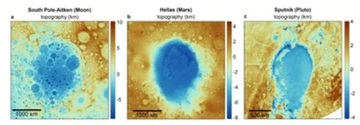
Impact craters on planets share common shapes across vastly different worlds in the solar system, according to Jeffrey Andrews-Hanna. The South Pole-Aitken basin on the moon described in this study (left), the Hellas basin on Mars (center) and the Sputnik basin on Pluto (right) all formed in oblique impacts. Their outlines get narrower in the down-range direction (bottom) like a raindrop or an avocado. Elevations range from low (blue) to high (orange). - Jeff Andrews-Hanna/University of Arizona/NASA
Published today in the journal Nature, the paper also provides a snapshot of the moon's tumultuous past that could help explain longstanding puzzles such as why the moon's crater-riddled far side is so dramatically different from its smooth near side, which provided the backdrop for the Apollo moon landings in the 1960s and 1970s.
Roughly 4.3 billion years ago, when the solar system was still in its infancy, a giant asteroid slammed into the far side of the moon, blasting an enormous crater referred to as the South Pole-Aitken basin, or SPA. This impact feature is the largest crater on the moon, spanning more than 1,200 miles north to south, and 1,000 miles east to west. The oblong shape of the basin is the result of a glancing blow rather than a head-on impact.
By comparing the shape of SPA to other giant impact basins across the solar system, Andrews-Hanna and his team found that these features get narrower in the down-range direction, with a shape resembling a teardrop or an avocado. Upending conventional wisdom that SPA was formed by an asteroid coming in from a southern direction, the new analysis reveals that SPA's shape narrows toward the south, indicating an impact coming from the north instead. The down-range end of the basin should be covered by a thick layer of material excavated from the lunar interior by the impact, while the up-range end should not, Andrews-Hanna explained.

Jeff Andrews-Hanna is a
professor of planetary
sciences at the U of A
Lunar and Planetary Laboratory.
"This means that the Artemis missions will be landing on the down-range rim of the basin – the best place to study the largest and oldest impact basin on the moon, where most of the ejecta, material from deep within the moon's interior, should be piled up," said Andrews-Hanna, who is with the U of A Lunar and Planetary Laboratory.
In the paper, the group presents additional evidence supporting a southward impact from analyses of the topography, the thickness of the crust and the surface composition. In addition, the results offer new clues about on the interior structure of the moon and its evolution through time, according to the authors.
It has long been thought that the early moon was melted by the energy released during its formation, creating a magma ocean covering the entire moon. As that magma ocean crystallized, heavy minerals sunk to make the lunar mantle, while light minerals floated to make the crust. However, some elements were excluded from the solid mantle and crust and instead became concentrated in the final liquids of the magma ocean. Those "leftover" elements included potassium, rare earth elements and phosphorus, collectively referred to as "KREEP " – the acronym's first letter reflecting potassium's symbol in the periodic table of elements, "K." According to Andrews-Hanna these elements were found to be particularly abundant on the moon's near side.
"If you've ever left a can of soda in the freezer, you may have noticed that as the water becomes solid, the high fructose corn syrup resists freezing until the very end and instead becomes concentrated in the last bits of liquid," he said. "We think something similar happened on the moon with KREEP."
As it cooled over many millions of years, the magma ocean gradually solidified into crust and mantle. "And eventually you get to this point where you just have that tiny bit of liquid left sandwiched between the mantle and the crust, and that's this KREEP-rich material," he said.
"All of the KREEP-rich material and heat-producing elements somehow became concentrated on the moon's near side, causing it to heat up and leading to intense volcanism that formed the dark volcanic plains that make for the familiar sight of the "face" of the Moon from Earth, according to Andrews-Hanna. However, the reason why the KREEP-rich material ended up on the nearside, and how that material evolved over time, has been a mystery.
The moon's crust is much thicker on its far side than on its near side facing the Earth, an asymmetry that has scientists puzzled to this day. This asymmetry has affected all aspects of the moon's evolution, including the latest stages of the magma ocean, Andrews-Hanna said.
"Our theory is that as the crust thickened on the far side, the magma ocean below was squeezed out to the sides, like toothpaste being squeezed out of a tube, until most of it ended up on the near side," he said.
The new study of the SPA impact crater revealed a striking and unexpected asymmetry around the basin that supports exactly that scenario: The ejecta blanket on its western side is rich in radioactive thorium, but not in its eastern flank. This suggests that the gash left by the impact created a window through the moon's skin right at the boundary separating the crust underlain by the last remnants of the KREEP-enriched magma ocean from the "regular" crust.
"Our study shows that the distribution and composition of these materials match the predictions that we get by modeling the latest stages of the evolution of the magma ocean," Andrews-Hanna said. "The last dregs of the lunar magma ocean ended up on the near side, where we see the highest concentrations of radioactive elements. But at some earlier time, a thin and patchy layer of magma ocean would have existed below parts of the far side, explaining the radioactive ejecta on one side of the SPA impact basin."
Many mysteries surrounding the moon's earliest history still remain, and once astronauts bring samples back to Earth, researchers hope to find more pieces to the puzzle. Remote sensing data collected by orbiting spacecraft like those used for this study provide researchers with a basic idea of the composition of the moon's surface, according to Andrews-Hanna. Thorium, an important element in KREEP-rich material, is easy to spot, but getting a more detailed analysis of the composition is a heavier lift.
"Those samples will be analyzed by scientists around the world, including here at the University of Arizona, where we have state -of-the-art facilities that are specially designed for those types of analyses," he said.
"With Artemis, we'll have samples to study here on Earth, and we will know exactly what they are," he said. "Our study shows that these samples may reveal even more about the early evolution of the moon than had been thought."
UA News - Moon's Biggest Impact Crater Made a Radioactive Splash

Asteroid Bennu is a Time Capsule of Materials Bearing Witness to Its Origin and Transformation Over Billions of Years
Three new papers reveal yet more secrets from samples collected by the Lunar and Planetary Laboratory led OSIRIS-REx mission from asteroid Bennu.Asteroid Bennu is a Time Capsule of Materials Bearing Witness to Its Origin and Transformation Over Billions of Years

By Daniel Stolte, University Communications and NASA's Johnson Space Center - August 22, 2025
Asteroid Bennu – the target of NASA's OSIRIS-REx sample return mission, led by the University of Arizona – is a mixture of materials from throughout, and even beyond, our solar system. Over the past few billion years, its unique and varied contents have been transformed by interactions with water and the harsh space environment.
These details come from a trio of newly published papers based on analysis of Bennu samples delivered to Earth by OSIRIS-REx in 2023. The OSIRIS-REx sample analysis campaign is coordinated by the U of A Lunar and Planetary Laboratory and involves scientists from around the world. LPL researchers contributed to all three studies and led two of them.

Jessica Barnes is an associate professor at the U of A Lunar and Planetary Laboratory.
"This is work you just can't do with telescopes," said Jessica Barnes, associate professor at the U of A Lunar and Planetary Laboratory and co-lead author on one of the publications. "It's super exciting that we're finally able to say these things about an asteroid that we've been dreaming of going to for so long and eventually brought back samples from."
Bennu is made of fragments from a larger "parent" asteroid that broke up after it collided with another asteroid, likely in the asteroid belt between the orbits of Mars and Jupiter. The parent asteroid consisted of material with diverse origins – near the sun, far from the sun, and from other stars – that coalesced more than 4 billion years ago as our solar system was forming. These findings are the subject of the first paper, published in Nature Astronomy and jointly led by Barnes and Ann Nguyen with the Astromaterials Research and Exploration Science Division at NASA’s Johnson Space Center in Houston.
"Bennu's parent asteroid may have formed in the outer parts of the solar system, possibly beyond the giant planets, Jupiter and Saturn," Barnes said. "We think this parent body was struck by an incoming asteroid and smashed apart. Then the fragments re-assembled and this might have repeated several times."
By looking at the samples returned by the OSIRIS-REx spacecraft, Barnes and her colleagues were able to get the most comprehensive snapshot of its history to date. Among the findings was an abundance of stardust, material that existed before our solar system formed, Barnes said. The discovery of these most ancient materials was made possible, in part, by the NanoSIMS instrument at the U of A Kuiper-Arizona Laboratory for Astromaterials Analysis, which can reveal a sample's isotopes – variants of chemical elements – at nanometer scales. The tiny grains of stardust are identifiable by their unusual isotopic makeup compared to materials formed in the solar system.

Tom Zega leads the Kuiper-Arizona Laboratory at the University of Arizona.
"Those are pieces of stardust from other stars that are long dead, and these pieces were incorporated into the cloud of gas and dust from which our solar system formed," Barnes said. "In addition, we found organic material that's highly anomalous in their isotopes and that was probably formed in interstellar space, and we have solids that formed closer to the sun, and for the first time, we show that all these materials are present in Bennu."
The chemical and isotopic similarities between samples from Bennu and a similar asteroid, Ryugu, which was sampled by the Japanese Hayabusa 2 mission in 2019, and the most chemically primitive meteorites found on Earth suggest their parent asteroids may have formed in a shared region of the early solar system. Yet the differences researchers are observing in the Bennu samples may indicate that the starting materials in this region changed over time or were not as well-mixed as some scientists have thought.
The analyses show that some of the materials in the parent asteroid survived various chemical processes involving heat and water and even the energetic collision that resulted in the formation of Bennu. Nevertheless, most of the materials were transformed by hydrothermal processes, as reported in the second paper, published in Nature Geoscience. In fact, that study found, minerals in the parent asteroid likely formed, dissolved and reformed over time due to interactions with water.
"We think that Bennu's parent asteroid accreted a lot of icy material from the outer solar system, which melted over time," said Tom Zega, director of the Kuiper-Arizona Laboratory who co-led the study with Tim McCoy, curator of meteorites at the Smithsonian.
The team found evidence that silicate minerals would have reacted with the resultant liquid water at relatively low temperatures of about 25 degrees Celsius, or room temperature. That heat could have either lingered from the accretion process itself, when Bennu's parent asteroid first formed, or was generated by impacts later in its history, possibly in combination with the decay of radioactive elements deep inside it. The trapped heat could have melted the ice inside the asteroid, according to Zega.
"Now you have a liquid in contact with a solid and heat – everything you need to start doing chemistry," he said. "The water reacted with the minerals and formed what we see today: samples in which 80% of minerals contain water in their interior, created billions of years ago when the solar system was still forming."

This scanning electron microscope image shows a micrometeorite impact crater in a particle of asteroid Bennu material.
The transformation of Bennu's materials did not end there. The third paper, also published in Nature Geoscience, reports microscopic craters and tiny splashes of once-molten rock on the surfaces of Bennu particles – signs that the asteroid has been peppered by micrometeorite impacts. These impacts, together with the effects of solar wind, are known as "space weathering" and occur because Bennu does not have an atmosphere to protect it. This weathering is happening a lot faster than conventional wisdom would have it, according to the study, which was led by Lindsay Keller at NASA Johnson and Michelle Thompson at Purdue University.
As the leftover materials from planetary formation 4.5 billion years ago, asteroids provide a record of the solar system’s history. But many of these remnants may be different from what meteorites recovered on Earth would suggest, Zega said, because different types of meteors (fragments of asteroids) may burn up in the atmosphere and never make it to the ground.
"And those that do make it to the ground can react with Earth’s atmosphere, particularly if the meteorite is not recovered quickly after it falls," he added, "which is why sample return missions such as OSIRIS-REx are critical."
UA News - Asteroid Bennu is a Time Capsule of Materials Bearing Witness to Its Origin and Transformation Over Billions of Years

An Emissary from Interstellar Space
Discovered only a week ago, comet 3I/ATLAS is only the third known visitor from outside the solar system. LPL's Catalina Sky Survey Director Carson Fuls explains what makes the comet special - and why we can only guess where it came from.An Emissary from Interstellar Space

By Daniel Stolte, University Communications - July 9, 2025
A recently discovered extraterrestrial "visitor" is hurtling toward the inner solar system at 130,000 miles per hour and has quickly captured the attention of astronomers and space enthusiasts around the world, including here at the University of Arizona.
Dubbed 3I/ATLAS, it is only the third object known to have crossed into the solar system from interstellar space. Carson Fuls is director of the Catalina Sky Survey, a NASA-funded project at the university's Lunar and Planetary Laboratory. University of Arizona News spoke with Fuls to learn more about the mysterious object traversing our solar system on its journey through interstellar space.
What is special about interstellar objects such as 3I/ATLAS visiting our solar system?

3I/ATLAS, imaged here by the European Southern Observatory's Very Large Telescope, is only the third visitor from outside the solar system ever found. -ESO/O. Hainaut
Zoom out and consider that our sun, every planet, asteroid, comet, even every shooting star that you've ever seen, was formed all together as part of our solar system. This object came from an entirely different solar system. We have no idea which one, or how long this thing has been traveling through the void, but it is an actual piece of another star system.
The nearest star is four light years away, so 3I/ATLAS has traveled light-years to get here. It's early, and we're still gathering data about it, but this object looks a lot like the comets from our solar system. This is exciting because if other star systems resemble our own, then perhaps there are Earth-like planets out there as well. For now, we don't really know.
What do we know about 3I/ATLAS? What might it look like?
The latest observations show this object has a coma (cloud of gas), so it is a comet. This is expected, as comets are thought to be routinely whipped out of their star systems by close approaches to planets.

Carson Fuls is director of the Catalina
Sky Survey, a NASA-funded project at
the university's Lunar and Planetary
Laboratory.
Right now, 3I/ATLAS is estimated to be about 4.5 kilometers [2.8 miles] in diameter, although this is difficult to estimate because a comet's nucleus is obscured by the cloud of gas and dust around it. The shape is incredibly hard to determine right now, as we would need to peer underneath the coma. We may be able to get a better idea once the comet heads out and stops sublimating vapor, but for now, it's a mystery.
Is 3I/ATLAS visible to amateur observers, or will it be at some point?
While this object will never be visible to the naked eye, it will be fairly bright this fall and visible to an average backyard telescope, most likely around Nov. 1.
How do we know 3I/ATLAS is an interstellar visitor and not just a comet of our own?
We know because of how fast this object travels. The rest of our solar system is trapped in a dance around the sun. Most comets that we discover head into the inner solar system and then back out to the outer solar system. Even if they get a little kick by passing by Jupiter on their way out and leave forever, they are not traveling that fast. This object is cruising. There is no possible way that our sun could pull it back into an orbit, and there is no way it ever was. It's not even close. It is simply traveling too fast to be a part of our solar system.
Are interstellar objects fundamentally different from solar system dwellers?
Not that we know of. So far, this object would appear to just be another comet discovery if it wasn't for its hyperbolic orbit.
What is known about the origin of this object? Is there a location in nearby space that is more likely to be their place of origin than others?
All we can do is guess at how common visitors like this are to our solar system. This one came from the direction of the galactic center, which makes sense, as it harbors a higher density of stars, but these objects could really come from any direction. This does show that we are getting better at discovering the small bodies in our solar system. With the new generation of surveys coming online, we expect the pace of these types of discoveries to pick up, but by how much, we can only guess.
How is the Catalina Sky Center involved in observing 3I/ATLAS?
As a planetary defense program, we got to work observing this object to see if it was coming close to Earth or not. Once it was determined that this object poses no threat to Earth, we moved on to observing other targets. While we are all excited by the prospect of a new interstellar visitor, we are laser-focused on our mission of discovering and tracking NEOs (near-Earth objects), so our work with 3I/ATLAS ended.
Do interstellar objects hold clues about the universe that we could not figure out otherwise?
Absolutely! Either way, we learn something. If we find an object with a composition that does not match the comets of our solar system, our models of solar system formation must account for that possibility in other star systems. However, at this point, this object does match what our comets look like, which means that we have evidence for a common formation mechanism of comets around other stars. Both are exciting!
UA News - An Emissary from Interstellar Space

U of A Earns Top Marks in Space Science, Geosciences, Water Resources in New US News Global Ranking
The U of A earned its best ranking in the space science category, rising four spots to No. 4 globally and No. 2 among U.S. public universities.U of A Earns Top Marks in Space Science, Geosciences, Water Resources in New US News Global Ranking

By University Communications - June 17, 2025
U.S. News & World Report has once again recognized the University of Arizona as one of the world's top research institutions.
The U of A ranked No. 115 out of 2,250 higher education institutions across more than 100 countries in the 2025-2026 Best Global Universities ranking, released Tuesday. The university ranked No. 44 among universities in the U.S. and No. 23 among public U.S. universities.
The ranking placed the U of A among the top 10% of all ranked universities across the globe.
The U of A again earned its best ranking in the space science category, rising four spots to No. 4 globally and No. 2 among U.S. public universities. The university earned top marks in this category for its research reputation, along with the number of citations and publications by U of A researchers.
The U of A also ranked highly in water resources (No. 2 in the U.S., No. 31 globally) and geosciences (No. 10 in the U.S., No. 25 globally).
Additional top-100 global placements include the U of A's programs in meteorology and atmospheric sciences (No. 45), environment/ecology (No. 62), plant/animal sciences (tied for No. 77) and arts and humanities (tied for No. 88).
U.S. News & World Report's Best Global Universities ranks colleges and universities in 51 subjects. The University of Arizona earned a spot on 35 of the subject ranking lists.
The university's overall research reputation was ranked No. 47 in the U.S. and No. 101 globally.
The 11th annual Best Global Universities rankings provide insight into how research institutions compare throughout the world. To produce the global rankings, which are based on data and metrics provided by the analytics company Clarivate, U.S. News & World Report uses a methodology that focuses on a university's global and regional reputation and academic research performance using indicators such as citations and publications.
U.S. News uses a separate methodology for the subject-specific rankings that is based on academic research performance in each subject. U.S. News uses various measures, including publications and citations as well as indicators for global and regional reputation in each specific subject area.
UA News - U of A Earns Top Marks in Space Science, Geosciences, Water Resources in New US News Global Ranking

Revealing the Lives of Planet-Forming Disks
New observations of 30 planet-forming disks - the birthplaces of planets around stars - reveal in greater detail than ever how gas and dust behave over time and shape the evolution of exoplanet systems.Revealing the Lives of Planet-Forming Disks

By National Radio Astronomy Observatory (NRAO) and Daniel Stolte, University Communications June 13, 2025
An international team of astronomers including researchers at the University of Arizona Lunar and Planetary Laboratory has unveiled groundbreaking findings about the disks of gas and dust surrounding nearby young stars, using the powerful Atacama Large Millimeter/submillimeter Array, or ALMA.
The findings, published in 12 papers in a focus issue of the Astrophysical Journal, are part of an ALMA large program called the ALMA Survey of Gas Evolution of PROtoplanetary Disks, or AGE-PRO. AGE-PRO observed 30 planet-forming disks around sunlike stars to measure gas disk mass at different ages. The study revealed that gas and dust components in these disks evolve at different rates.
Prior ALMA observations have examined the evolution of dust in disks; AGE-PRO, for the first time, traces the evolution of gas, providing the first measurements of gas disk masses and sizes across the lifetime of planet-forming disks, according to the project's principal investigator, Ke Zhang of the University of Wisconsin-Madison.
"Now we have both, the gas and the dust," said Ilaria Pascucci, a professor at planetary sciences at the U of A and one of three AGE-PRO co-principal investigators. "Observing the gas is much more difficult because it takes much more observing time, and that's why we have to go for a large program like this one to obtain a statistically significant sample."
A protoplanetary disk swirls around its host star for several million years as its gas and dust evolve and dissipate, setting the timescale for giant planets to form. The disk's initial mass and size, as well as its angular momentum, have a profound influence on the type of planet it could form – gas giants, icy giants or mini-Neptunes – and migration paths of planets. The lifetime of the gas within the disk determines the timescale for the growth of dust particles to an object the size of an asteroid, the formation of a planet and finally the planet's migration from where it was born.
In one of the survey's most surprising findings, the team discovered that as disks age, their gas and dust are consumed at different rates and undergo a shift in gas-to-dust mass ratio as the disks evolve: Unlike the dust, which tends to remain inside the disk over a longer time span, the gas disperses relatively quickly, then more slowly as the disk ages. In other words, planet-forming disks blow off more of their gas when they're young.
Zhang said the most surprising finding is that although most disks dissipate after a few million years, the ones that survive have more gas than expected. This would suggest that gaseous planets like Jupiter have less time to form than rocky planets.
ALMA's unique sensitivity allowed researchers to use faint, so-called molecular lines to study the cold gas in these disks, characteristic wavelengths of a light spectrum that essentially act as "fingerprints," identifying different species of gas molecules. The first large-scale chemical survey of its kind, AGE-PRO targeted 30 planet-forming disks in three star-forming regions, ranging from 1 million to 6 million years in age: Ophiuchus (youngest), Lupus (1-3 million years old), and Upper Scorpius (oldest). Using ALMA, AGE-PRO obtained observations of key tracers of gas and dust masses in disks spanning crucial stages of their evolution, from their earliest formation to their eventual dispersal. This ALMA data will serve as a comprehensive legacy library of spectral line observations for a large sample of disks at different evolutionary stages.
Dingshan Deng, a graduate student at LPL who is the lead author on one of the papers, provided the data reduction – essentially, the image analyses needed to get from radio signals to optical images of the disks – for the star-forming region in the constellation of Lupus (Latin for "wolf").
"Thanks to these new and long observations, we now have the ability to estimate and trace the gas masses, not only for the brightest and better studied disks in that region, but also the smaller and fainter ones," he said. "Thanks to the discovery of gas tracers in many disks where it hadn't been seen before, we now have a well-studied sample covering a wide range of disk masses in the Lupus star-forming region."
"It took years to figure out the proper data reduction approach and analysis to produce the images used in this paper for the gas masses and in many other papers of the collaboration," Pascucci added.
Carbon monoxide is the most widely used chemical tracer in protoplanetary disks, but to thoroughly measure the mass of gas in a disk, additional molecular tracers are needed. AGE-PRO used N2H+, or diazenylium, an ion used as an indicator for nitrogen gas in interstellar clouds, as an additional gas tracer to significantly improve the accuracy of measurements. ALMA's detections were also set up to receive spectral light signatures from other molecules, including formaldehyde, methyl cyanide and several molecular species containing deuterium, a hydrogen isotope.
"Another finding that surprised us was that the mass ratio between the gas and dust tends to be more consistent across disks of different masses than expected," Deng said. "In other words, different-size disks will share a similar gas-to-dust mass ratio, whereas the literature suggested that smaller disks might shed their gas faster."
Funding for this study was provided by the National Science Foundation, the European Research Council, the Alexander von Humboldt Foundation, FONDECYT (Chile) among other sources. For full funding information, see the research paper.
UA News - Revealing the Lives of Planet-Forming Disks

Percolating Clues: A New Way to Build Planetary Cores
Molten sulfide can migrate and coalesce within a solid planetary interior, according to a new experimental study published in Nature Communications.Percolating Clues: A New Way to Build Planetary Cores

By NASA and Daniel Stolte, University Communications - May 22, 2025
A new study led by Sam Crossley at the University of Arizona Lunar and Planetary Laboratory reveals a surprising new way planetary cores formed. The findings could reshape how scientists understand the early evolution of rocky planets like Mars.
Published in Nature Communications, the study offers the first direct experimental and geochemical evidence that molten sulfide, rather than metal, can percolate through solid rock and form a core, even before a planet's silicate mantle begins to melt.
The study was conducted by a team of early-career scientists and long-time researchers across the Astromaterials Research and Exploration Science, or ARES, Division at NASA's Johnson Space Center.
Image Crossley and Anzures use welding equipment as part of their research Trading lab coats for welding goggles, the research team set out to recreate planetary conditions in the lab. Here, Crossley and Anzures are seen working together to develop new experimental assembly designs and methodologies for melting experiments. Amentum/Kayla Iacovino
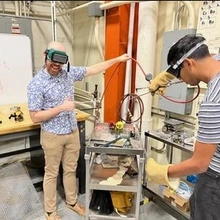
Trading lab coats for welding goggles, the research team set out to recreate planetary conditions in the lab. Here, Crossley and Anzures are seen working together to develop new experimental assembly designs and methodologies for melting experiments. Amentum/Kayla Iacovino
Planets in the early solar system began their lives by coalescing from gas, dust and ice. As they grew, heat produced from the decay of radioactive elements caused minerals to begin melting, providing a pathway for a planet to segregate into the familiar layered structure of core, mantle and crust. For decades, scientists believed that forming a core required large-scale melting of a planetary body, followed by heavy metallic elements sinking to the center. This study introduces a new scenario, by which cores could have begun forming earlier and without the need for the young planet to undergo melting as a whole.
The results, according to the research team, are especially relevant for planets forming farther from the sun. There, in the solar system's outer reaches, abundant volatiles like sulfur and oxygen behave like road salt on an icy street – lowering the melting point of metals by reacting with iron metal to form iron-sulfide. This destabilizes the metals and allows them to migrate and combine into a core. The problem? Until now, scientists didn't know if sulfide could travel through solid rock under realistic planet formation conditions.
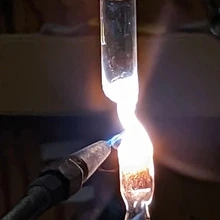
Sam Crossley welds shut the glass tube of the experimental assembly. To prevent reaction with the atmosphere and precisely control oxygen and sulfur content, experiments needed to be sealed in a closed system under vacuum. - Amentum/Brendan Anzures
"We could actually see in full 3D renderings how the sulfide melts were moving through the experimental sample, percolating in cracks between other minerals," Crossley said. "It confirmed our hypothesis – that in a planetary setting, these dense melts would migrate to the center of a body and form a core, even before the surrounding rock began to melt.”
Recreating planetary conditions in the lab required not only experimental precision but also close collaboration among early-career scientists across ARES to develop new ways of observing and analyzing the results. The team used chips of genuine meteorites as well as synthetic minerals doped with trace amounts of noble metals to observe how those elements behave during this melt percolation process.
As molten sulfide moved through solid rock at high temperatures in a lab experiment, Scott Eckley, an X-ray scientist at ARES, used X-ray computed tomography to produce high-resolution 3D renderings – revealing melt pockets and flow pathways within the samples in microscopic detail. These visualizations offered insight into the physical behavior of materials during early core formation without destroying the sample.
To understand the distribution of trace elements, study co-author Jake Setera developed a laser ablation technique to trace noble metals such as platinum, palladium and iridium, which are known to concentrate in iron metal found in planetary cores and meteorites. These elements tend to "prefer" metals and sulfides over silicate rock, making them ideal indicators of core formation processes.
"We searched for forensic evidence of sulfide percolation in meteorites," Crossley explained. "By partially melting synthetic sulfides doped with trace metals, we were able to reproduce the same anomalous chemistries we'd previously seen in oxidized meteorites. That was a strong indication that percolative sulfide core formation had actually occurred in the early solar system."
When paired with Setera's geochemical analysis, the geochemical data provided powerful, independent lines of evidence that molten sulfide had migrated and coalesced within a solid planetary interior – a process that, until now, had not been directly confirmed in a laboratory setting.
The study offers a new lens through which to interpret planetary geochemistry. Mars in particular, shows signs of early core formation – but the timeline has puzzled scientists for years. The new results suggest that Mars' core may have formed more efficiently, and therefore more rapidly and sooner, due to its sulfur-rich composition, potentially without needing to first undergo full-scale melting like Earth did.
The results also raise new questions about how scientists date core formation events using radiogenic isotopes, such as hafnium and tungsten. If sulfur and oxygen are more abundant during a planet's formation, certain elements may behave differently than expected – remaining in the mantle instead of the core and affecting the geochemical "clocks" used to estimate timelines of planet formation and evolution.
"This study advances our understanding of how planetary interiors can form under different chemical conditions – offering new possibilities for interpreting the evolution of rocky bodies like Mars," Crossley said.
As NASA prepares for future missions to the moon, Mars and beyond, understanding how planetary interiors form is more important than ever. Studies like this one help scientists interpret remote data from spacecraft, analyze returned samples and build better models of how our solar system came to be.
Crossley led the research during his time as a McKay Postdoctoral Fellow – a program that recognizes outstanding early-career scientists within five years of earning their doctorate. Jointly offered by NASA's ARES Division and the Lunar and Planetary Institute, the fellowship supports innovative research in astromaterials science.
UA News - Percolating Clues: A New Way to Build Planetary Cores

Winds, Jets, and Wigglings from Young Stars and Their Disks
New JWST observations provide a detailed look at the jets of four young stars, revealing shocks, mass loss, and wiggly behavior that hints at a hidden binary companion.Winds, Jets, and Wigglings from Young Stars and Their Disks

By Kerry Hensley, AAS - May 14, 2025
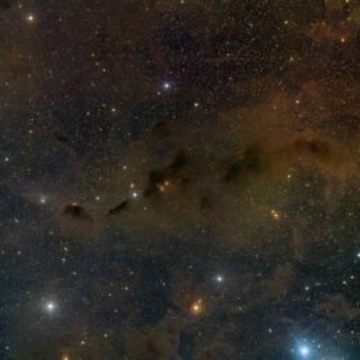
A portion of the Taurus star-forming region. [ESO/Digitized Sky Survey 2. Acknowledgement: Davide De Martin; CC BY 4.0]
From Cloud to Star to Planetary System
The transformation from a turbulent cloud of hydrogen gas to a star circled by planets is complicated. As stars coalesce from their natal clouds, they gather gas from their surroundings and flatten it into a dense, dusty disk. While feeding on the gas from this disk, young stars launch powerful, narrow jets and broad, slower-moving winds. As accretion slows, planets begin to form, getting their start from clumps of dust grains.
In a recent research article, JWST observations give insight into the details of this process, illuminating the winds and jets of the disks surrounding young stars.
JWST’s View
Naman Bajaj (Lunar and Planetary Laboratory, The University of Arizona) and collaborators investigated four protoplanetary disks with JWST’s Near Infrared Spectrograph (NIRSpec). The four disks — Tau 042021, HH 30, FS Tau B, and IRAS 04302 — reside in the Taurus star-forming region, which is 1–2 million years old and roughly 450 light-years away.
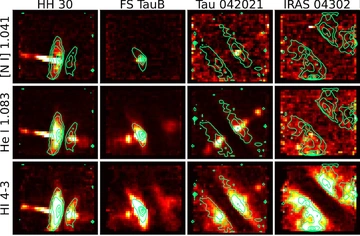
JWST images of the four disks as seen in a selection of emission lines. Green contour lines show the location of continuum emission. [Adapted from Bajaj et al. 2025]
Each of these disks displays narrow jets that emerge perpendicularly above and below the disk, nested within broad, cone-shaped winds. The disks were selected for their edge-on appearance, which highlights the jets and winds that emerge from the disk.
Bajaj’s team identified more than 40 emission lines for each disk, allowing them to determine the properties of the jets, such as the density and shock speed. One important aspect that can be gleaned from these observations is an estimate of the mass carried away by the jets. Using three independent methods, the team found that jet mass-loss rates for the four disks was on average a billionth of a solar mass per year.
The Wiggly Jet of Tau 042021
Though appearing to jut straight out from the disk, each of the jets studied showed signs of side-to-side wiggles. Tau 042021’s jets are especially interesting, displaying mirror-symmetric wiggling, in which the redshifted and

Observed locations of the center of the redshifted and blueshifted jets (circles) as well as a fit to a binary orbit model (green dashed line). [Bajaj et al. 2025]
blueshifted wiggles mirror one another. At present, the only explanation for these synchronized wiggles is a binary companion. By modeling the jet wiggles as emanating from a star in a binary system, the authors concluded that Tau 042021 likely contains a 0.33-solar-mass star and a 0.07-solar-mass star in a 2.5-year orbit with a separation of 1.35 au.
Bajaj and coauthors presented a rich dataset that illuminates the behavior of jets from young stars, and their work isn’t yet done; this is the second research article the team has produced from these data, and more are in the works.
Citation
“Class I/II Jets with JWST: Mass-Loss Rates, Asymmetries, and Binary-Induced Wigglings,” Naman S. Bajaj et al 2025 AJ 169 296. doi:10.3847/1538-3881/adc73c
AAS - Winds, Jets, and Wigglings from Young Stars and Their Disks

Combination of Cosmic Processes Shapes the Size and Location of Sub-Neptunes
A combination of cosmic processes shapes the formation of one of the most common types of planets outside of our solar system, a new study finds. The research team, which included University of Arizona planetary scientists, used data from NASA's Transiting Exoplanet Survey Satellite, or TESS, to study young sub-Neptunes - planets bigger than Earth but smaller than Neptune - that orbit close to their stars.Combination of Cosmic Processes Shapes the Size and Location of Sub-Neptunes

By Penn State Eberly College of Science Communications and Niranjana Rajalakshmi/University Communications - March 18, 2025
A combination of cosmic processes shapes the formation of one of the most common types of planets outside of our solar system, a new study finds.
The research team, which included University of Arizona planetary scientists, used data from NASA's Transiting Exoplanet Survey Satellite, or TESS, to study young sub-Neptunes – planets bigger than Earth but smaller than Neptune – that orbit close to their stars. The work provides insights into how these planets might migrate inward or lose their atmosphere during their early stages.
A paper describing the research was published Monday in the Astronomical Journal. The findings offer clues about the properties of sub-Neptunes and help address long-standing questions about their origins.
"The majority of the 5,500 or so exoplanets discovered to date have a very close orbit to their stars, closer than Mercury to our sun, which we call ‘close-in’ planets," said Rachel Fernandes, a U of A alumnus who led the research team and is now a President's Postdoctoral Fellow in the Department of Astronomy and Astrophysics at Penn State University. "Many of these are gaseous sub-Neptunes, a type of planet absent from our own solar system. While our gas giants like Jupiter and Saturn formed farther from the sun, it’s unclear how so many close-in sub-Neptunes managed to survive near their stars, where they are bombarded by intense stellar radiation."
The project began when Fernandes was a graduate student at the U of A Lunar and Planetary Laboratory.
"Our work provides one of the first glimpses into young planet populations, about which we haven't had a lot of insights so far," said study co-author Galen Bergsten, a graduate student at the U of A Lunar and Planetary Laboratory.
The research gives a peek into what was happening very early on for these planets, said Bergesten, who handled the statistics and modeling for the study.
To better understand how sub-Neptunes form and evolve, the researchers turned to planets around young stars, which only recently became observable thanks to TESS.
"Comparing the frequency of exoplanets of certain sizes around stars of different ages can tell us a lot about the processes that shape planet formation," Fernandes said. "If planets commonly form at specific sizes and locations, we should see a similar frequency of those sizes across different ages. If we don't, it suggests that certain processes are changing these planets over time."
Observing planets around young stars, however, has traditionally been difficult. Young stars emit bursts of intense radiation, rotate quickly and are highly active, creating high levels of "noise" that make it challenging to observe planets around them.
"These stellar tantrums cause a lot of noise in the data, so we spent the last six years developing a computational tool called Pterodactyls to see through that noise and actually detect young planets in TESS data," Fernandes said.
The research team used Pterodactyls to evaluate TESS data and identify planets with orbital periods of 12 days or less – for reference, much less than Mercury's 88-day orbit – with the goal of examining the planet sizes, as well as how the planets were shaped by the radiation from their host stars. Because the team's survey window was 27 days, the researchers were able to see two full orbits from potential planets. They focused on planets between a radius of 1.8 and 10 times the size of Earth, allowing the team to see if the frequency of sub-Neptunes is similar or different in young systems versus older systems previously observed with TESS and NASA's retired Kepler Space Telescope.
The researchers found that the frequency of close-in sub-Neptunes changes over time, with fewer sub-Neptunes around stars between 10 million and 100 million years of age compared to those between 100 million and 1 billion years of age. However, the frequency of close-in sub-Neptunes is much less in older, more stable systems.
"I found particularly striking that the occurrence rate wasn't uniformly high in the past. Instead, it started off lower, then increased, only to drop significantly when stars are billions of years in age – strongly suggesting that different physical processes shape planetary populations at different stages," said study co-author Ilaria Pascucci, a professor at the U of A Lunar and Planetary Laboratory.
It's possible that many sub-Neptunes originally formed farther away from their stars and slowly migrated inward over time, so we see more of them at this orbital period in the intermediate age. In later years, it's possible that planets are more commonly shrinking when radiation from the star essentially blows away its atmosphere, a process called atmospheric mass loss, that could explain the lower frequency of sub-Neptunes. But it's likely a combination of cosmic processes shaping these patterns over time rather than one dominant force, Fernandes said.
"Combining studies of individual planets with the population studies like we conducted here would give us a much better picture of planet formation around young stars," Fernandes said. "The more solar systems and planets we discover, the more we realize that our solar system isn't really the template; it’s an exception. Future missions might enable us to find smaller planets around young stars and give us a better picture of how planetary systems form and evolve with time, helping us better understand how our solar system, as we know it today, came to be."
Funding from NASA, Chile’s National Fund for Scientific and Technological Development, and the U.S. National Science Foundation supported this research. Additional support was provided by the Penn State Center for Exoplanets and Habitable Worlds and the Penn State Extraterrestrial Intelligence Center. Computations for this research were performed with Penn State University’s Institute for Computational and Data Sciences’ Roar supercomputer.
UA News - Combination of Cosmic Processes Shapes the Size and Location of Sub-Neptunes

James Webb Telescope Reveals Planet-Forming Disks Can Last Longer Than Previously Thought
Researchers at the University of Arizona have discovered that planet-forming disks of gas and dust around tiny stars live much longer than previously thought. The findings provide new insights into planet formation and the habitability of planets outside our solar system.James Webb Telescope Reveals Planet-Forming Disks Can Last Longer Than Previously Thought

By Penny Duran, NASA Space Grant Science Writing Intern, University Communications - February 26, 2025
If there were such a thing as a photo album of the universe, it might include snapshots of pancake-like disks of gas and dust, swirling around newly formed stars across the Milky Way. Known as planet-forming disks, they are believed to be a short-lived feature around most, if not all, young stars, providing the raw materials for planets to form.
Most of these planetary nurseries are short-lived, typically lasting only about 10 million years – a fleeting existence by cosmic standards. Now, in a surprising find, researchers at the University of Arizona have discovered that disks can grace their host stars much longer than previously thought, provided the stars are small – one-tenth of the sun's mass or less.
In a paper published in the Astrophysical Letters Journal, a research team led by Feng Long of the U of A Lunar and Planetary Laboratory, in the College of Science, reports a detailed observation of a protoplanetary disk at the ripe old age of 30 million years. Presenting the first detailed chemical analysis of a long-lived disk using NASA's James Webb Space Telescope, the paper provides new insights into planet formation and the habitability of planets outside our solar system.
"In a sense, protoplanetary disks provide us with baby pictures of planetary systems, including a glimpse of what our solar system may have looked like in its infancy," said Long, the paper's lead author and a Sagan Fellow with the Lunar and Planetary Laboratory.
As long as the star has a certain mass, high-energy radiation from the young star blows the gas and dust out of the disk, and it can no longer serve as raw material to build planets, Long explained.
The team observed a star with the official designation WISE J044634.16–262756.1B – more conveniently known as J0446B – located in the constellation Columba (Latin for "dove") about 267 light-years from Earth. The researchers found that its planet-forming disk has lasted about three times longer than expected.
"Although we know that most disks disperse within 10 million to 20 million years, we are finding that for specific types of stars, their disks can last much longer," Long said. "Because materials in the disk provide the raw materials for planets, the disk's lifespan determines how much time the system has to form planets."
Even though tiny stars retain their disks longer, their disk's chemical makeup does not change significantly. The similar chemical composition regardless of age indicates that the chemistry does not change drastically even as a disk reaches an advanced age. Such a long-lived, stable chemical environment could provide planets around low-mass stars with more time to form.
By analyzing the disk's gas content, the researchers ruled out the possibility that the disk around J0446B is a so-called debris disk, a longer-lasting type of disk that consists of second-generation material produced by collisions of asteroid-like bodies.
"We detected gases like hydrogen and neon, which tells us that there is still primordial gas left in the disk around J0446B," said Chengyan Xie, a doctoral student at LPL who also contributed to the study.
The confirmed existence of long-lived disks rich in gases has implications for life outside our solar system, according to the authors. Of particular interest to researchers is the TRAPPIST-1 system, located 40 light-years from Earth, consisting of a red dwarf star and seven planets similar in size to Earth. Three of those planets are located in the "habitable zone," where conditions allow for liquid water to exist and offer the potential for life to form, at least in principle.
Because stars with long-lived planetary disks fall into a similar mass category as the central star in the TRAPPIST-1 system, the existence of long-lived disks is especially interesting for the evolution of planetary systems, say Long and her co-authors.
"To make the specific arrangement of orbits we see with TRAPPIST-1, planets need to migrate inside the disk, a process that requires the presence of gas," said Ilaria Pascucci, a professor of planetary sciences at LPL who co-authored the study. "The long presence of gas we find in those disks might be the reason behind TRAPPIST-1's unique arrangement."
Long-lived disks have not been found for high-mass stars such as the sun, since stars in such systems evolve much more quickly and planets have less time to form. Although our solar system took a different evolutionary route, long-lived disks can tell researchers a lot about the universe, the authors noted, because low-mass stars are believed to vastly outnumber sun-like stars.
"Developing a better understanding of how low-mass star systems evolve and getting snapshots of long-lived disks might help pave the way to filling out the blanks in the photo album of the universe," Long said.
UA News - James Webb Telescope Reveals Planet-Forming Disks Can Last Longer Than Previously Thought

University of Arizona Professors Develop Astronomy Curriculum Materials to Aid Visually Impaired Students
Lunar and Planetary Laboratory's Dr. Steve Kortenkamp and with Dr. Sunggye Hong in the College of Education have made groundbreaking strides to develop astronomy curriculum materials to aid visually impaired students.University of Arizona Professors Develop Astronomy Curriculum Materials to Aid Visually Impaired Students

By Analeise Mayor, College of Science - January 27, 2025
University of Arizona faculty members, headed by professor Dr. Steve Kortenkamp in the Lunar and Planetary Laboratory and Dr. Sunggye Hong in the College of Education, have made groundbreaking strides to develop astronomy curriculum materials to aid visually impaired students.
Kortenkamp himself was originally a postdoc at the U of A, where he studied in the Lunar and Planetary Laboratory. His work has largely been in the realm of theoretical astronomy, or “computer simulations of gravitational interactions, asteroids, comets, and dust particles,” as Kortenkamp describes.
Over his career, Kortenkamp has excelled in both research and teaching, and he returned to the University of Arizona first as a part-time instructor, before joining the university full time in 2017.
According to Kortenkamp, he was confronted with the issues of inclusivity in STEM education early on in his teaching career.
“The first opportunity that I had to teach at the university in front of a class, one of my students was blind. And that, for me, was a big challenge.” Kortenkamp said. “There were very few resources available to sort of help in that situation.”
In order to make the course material more accessible for his student, Kortenkamp utilized audio aids and enlarged or simplified graphics with great success. Kortenkamp said the experience ultimately changed his outlook on teaching and his approach to inclusivity in the classroom.
“Each time I taught, I tried to develop some new things that I could use in that situation,” he said.
After joining the University full time, Kortenkamp crossed paths with Dr. Sunggye Hong, who shared his passion for making education accessible for all students. Hong runs the college’s program for the visually impaired and his past work has focused on braille reading, tactile communication, and STEM learning for students with visual impairments.
“I'm totally blind due to a congenital glaucoma, and as I was growing, science was a major that not many of my friends and colleagues with visual impairments could choose,” Hong said.
Hong's work has sought to address the lack of accessibility and barriers for students with disabilities in science, and create opportunities for visually impaired students to become engaged in science fields.
“I think it was 2016 where I received a Request For Proposal talking about STEM learning for students with disabilities, and I began putting the ideas together.” Hong said “That's sort of where the collaboration began.”
In 2019, with grant funding from the National Science Foundation, Kortenkamp and Hong designed a new learning curriculum, which would assist and inspire visually impaired students studying astronomy.
They brought together 33 participating students from middle and high schools across the country, all of whom had an interest in pursuing science education and STEM careers. The hope, Hong said, was to shape their experience with science and get them excited about a future in STEM fields.
According to Hong, there were two main components to the project. The first, of course, was science learning.
“It was kind of like an asynchronous online class,” Kortenkamp said. “We would send them packages in the mail, and then we would meet over zoom.”
To make the course material more accessible for the students, Hong and Kortenkamp compiled various types of tactile tools including braille, printed textile materials, and tactile graphics, as well as assistive technology equipment and audio software.
The materials also included 3D printed kits of spacecraft which had been modified or created to be easily assembled without sight.
“They could – by touching – feel a square peg and a square hole, and assemble them, and they would describe the differences that they're feeling. " Kortenkamp said. “We also had them create a little video for each segment of the curriculum where they had to teach someone else, using their models.”
In addition to the virtual curriculum, the students visited Tucson and the University of Arizona on two different trips to supplement their learning.
“We had different activities every day,” Kortenkamp said. “They were taking tours of different labs on campus and living on campus for a week.”
The second, and perhaps most important, component of the experience was mentorship. Outside of classroom learning, each of the students were also connected with two mentors, a U of A science student, and another mentor who was a professional working in a STEM field, who was also visually impaired.
“We wanted to help them understand that they could work in a field that maybe at first they didn't think they had a chance to.” Kortenkamp said. “So we paired them up with someone working in the field as an engineer, or as a scientist of some type. They would virtually shadow them to learn about what their daily life is like, and how their disability influences how they work in their job.”
According to Hong and Kortenkamp, the program had a profound impact on the students.
“The data clearly showed that the students were indeed much more closely engaged in science. The motivation was there,” Hong said. “We were able to hear from them using their own voices, and from their reactions, we could observe that they were very excited and motivated to participate in science.”
“It’s not a surprise to any of us that many of them are now at a university working their way through,” Kortenkamp echoed.
And it wasn’t just the students who benefited from the program.
“To some degree with our curriculum, we were able to educate scientists as well,” Hong said. “It's not just for visually impaired students to learn about science, it is also an opportunity for the science field to learn about the unique needs of students with visual impairments.”
Kortenkamp shared similar sentiments.
“The takeaway I have, as an astronomer, is that I would have never really thought about this kind of stuff if I hadn't encountered that first student in that first class that I was teaching,” Kortenkamp said. “It was a very eye opening experience for me, and it's interesting the way that these techniques can be used by anybody.”
Kortenkamp said the tactile models and teaching methods developed in the program can be applied in a traditional classroom environment as well, to aid all students, sighted or not. He has found that they encourage his students to engage with the course material in new ways.
“It does at least make everyone in the class aware of how it can be more inclusive,” Kortenkamp said. “I try to emphasize in class that these are also tools that can be used by students who are more tactile learners and visual learners. We could apply it not just to visual impairments, but to other kinds of learning difficulties.”
While Kortenkamp sees these successes as a step in the right direction, towards greater inclusivity in science, he said he wants to push the program even further.
“Going forward, I think it would be really nice to be able to take what we did and turn it into a University of Arizona class,” he said. “There are very few classes in the sciences that are geared towards visually impaired students, so I'd like to take what we have and modify the curriculum to make it fit into the system we have at the university. I would like to create a science class that is available for even non-science students, whether they are visually impaired or not.”
Though he said such a course might still be years in the making, Kortenkamp intends to continue using the methods and materials he developed, in his current classes, and his hope is to one day expand the work he’s done into a program that can sustain itself, “whether it's just in the state of Arizona or maybe even broader.”
College of Science News - University of Arizona Professors Develop Astronomy Curriculum Materials to Aid Visually Impaired Students