

With Webb Space Telescope, UArizona Astronomers Help Detect Carbon Dioxide in Exoplanet Atmosphere
After years of preparation and anticipation, exoplanet researchers are ecstatic about the first official scientific observation of an exoplanet by NASA's James Webb Space Telescope.
With Webb Space Telescope, UArizona Astronomers Help Detect Carbon Dioxide in Exoplanet Atmosphere

By Daniel Stolte, University Communications - August 25, 2022
Since NASA's James Webb Space Telescope began operations, breathtaking images offering never-before-seen views of the Milky Way have captured the imagination of people around the world. But for a team of astronomers at the University of Arizona, the most exciting finding so far is an unassuming diagram showing a squiggly line with a bump in it.
An international research team used Webb's Near-Infrared Spectrograph, or NIRSpec, to observe the exoplanet WASP-39 b. In the spectrum of the exoplanet's atmosphere, a small bump or "hill" in wavelengths between 4.1 and 4.6 microns presents the first-ever clear, detailed evidence of carbon dioxide in a planet outside the solar system.
"There are lots of things that absorb around that range," said Sarah Moran, a postdoctoral research associate in the UArizona Lunar and Planetary Laboratory and co-author of a forthcoming Nature paper detailing the discovery. "Based on observations with Hubble, we could only guess what the atmosphere of this planet is like, and we suspected it might carbon dioxide, but seeing this exact point in the JWST data, we know that it's CO2."
The discovery marks the first time carbon dioxide has been detected in the atmosphere of a planet outside the solar system, in this case in the atmosphere of WASP-39 b, a giant gas planet orbiting a sun-like star 700 light-years away. The discovery showcases the extraordinary capabilities of JWST and ushers in a new era of scanning the Milky Way for planets that may support life.
WASP-39 b is a hot gas giant with a mass roughly one-quarter that of Jupiter (about the same as Saturn) and a diameter 1.3 times greater than Jupiter. Unlike the cooler, more compact gas giants in our solar system, WASP-39 b orbits very close to its star – only about one-eighth the distance between the sun and Mercury – completing one circuit in just over four Earth days. The planet's discovery, reported in 2011, was made based on ground-based detections of the subtle, periodic dimming of light from its host star as the planet transits, or passes in front of the star.
Previous observations from other telescopes, including NASA's Hubble and Spitzer space telescopes, revealed the presence of water vapor, sodium and potassium in the planet's atmosphere. Webb's unmatched infrared sensitivity has now confirmed the presence of carbon dioxide as well.
Understanding the composition of a planet's atmosphere is important because it tells scientists something about the origin of a planet and how it evolved. Carbon dioxide molecules specifically contain information about the way a planet formed, for example how much gaseous material was used to form a gas giant planet.
"Previous observations with radio telescopes allowed us to see the individual ingredients that go into making planets, but now we can really start pulling apart what they look like after planet formation," said paper co-author Thomas Beatty, a former assistant research professor in UArizona's Steward Observatory who is now a faculty member at the University of Wisconsin.
"You could say we have seen the flour, the eggs and the butter sitting on the counter, but until the JWST became operational, we haven't been able to actually pick apart the cake and figure out how it's put together," Beatty said.
No observatory has ever measured such subtle differences in brightness of so many individual colors across the 3 to 5.5-micron range in an exoplanet transmission spectrum before. Access to this part of the spectrum is crucial for measuring abundances of gases like water and methane, as well as carbon dioxide, all of which are thought to exist in many different types of exoplanets.
Filtered starlight
Transiting planets like WASP-39 b, whose orbits we observe edge-on rather than from above, can provide researchers with ideal opportunities to probe planetary atmospheres. During a transit, some of the starlight is eclipsed by the planet completely – causing the overall dimming – and some is transmitted through the planet's atmosphere. Because different gases absorb different combinations of colors, researchers can analyze small differences in brightness of the transmitted light across a spectrum of wavelengths to determine exactly what an atmosphere is made of. With its combination of inflated atmosphere and frequent transits, WASP-39 b is an ideal target for this technique known as transmission spectroscopy . While JWST is not designed to spot life on other planets – if it exists – it is poised to identify potentially habitable planets, according to Beatty.
"There probably are a lot of places out there that are just lumps of rock with no atmosphere, so distinguishing between those and a world that does have an atmosphere is important at this stage," he said. "At this point, we have no idea we see all these planets that are roughly the same size of Earth, and for all we know, they could be worlds as hostile as Venus or as habitable as Earth."
Early release science
This NIRSpec observation of WASP-39 b is just one part of a larger investigation that includes observations of the planet using multiple Webb instruments, as well as observations of two other transiting planets. The investigation, which is part of the Early Release Science program, was designed to provide the exoplanet research community with robust Webb data as soon as possible.
"The goal is to analyze the Early Release Science observations quickly and develop open-source tools for the science community to use," explained Vivien Parmentier, a co-investigator at Oxford University. "This enables contributions from all over the world and ensures that the best possible science will come out of the coming decades of observations."
According to co-author Everett Schlawin, an assistant research professor at UArizona's Steward Observatory, many steps are necessary to tease out a result like the this from the raw data recorded by the space telescope. When starlight passes through a planet's atmosphere, it is spread out into its different colors, which the researchers have to convert into what is known as a light curve.
"There is a lot of noise in the data because you have all this starlight come at you, but you only want to analyze the tiny sliver of light that passed through the atmosphere," he said.
According to Moran, an important part of this work involves creating computer models that take into account various atmospheric compositions and conditions.
"To borrow the analogy of the cake, we know that you need eggs and butter and flour, but the tricky part is getting the balance of those things right," Moran said. "For example, we put this amount of hydrogen, this amount of CO2 or this amount of water our models. We then play with the balances of those ingredients and the temperature to see which 'recipe' best matches the observational data to understand what the planet is like."
Not surprisingly, it took the team a while to really be sure of the data, Schlawin said, but the end results surpassed expectations.
"When I showed the very first image to colleagues, they asked, 'Am I looking at your modeling data or the actual data from the telescope?' – that's how good these observations are," he said.
Beatty said the difference in the quality of the JWST data compared to what was previously available is like "jumping from an old-school TV to a 4K high-definition TV."
"Being able to see these things suddenly in this sharp detail is very exciting," he said. "I think our understanding of exoplanets is going to be completely different five years from now than what it is today."
UArizona exoplanet researchers are particularly excited about what the new space observatory will reveal about new categories of planets that have no counterpart in the solar system, like super Earths – worlds that rival gas giants in size but whose composition resembles that of terrestrial planets. The observations reported here are indicative of Webb's ability to detect and measure carbon dioxide in exoplanet atmospheres, whether they be thick, puffy atmospheres of giants like WASP-39b or tenuous gas envelopes of small, rocky planets.
"We really have no idea how many of these planets have atmospheres at all, which is definitely the first thing you would need to form life on the surface of the planet," said Megan Mansfield, a NASA Sagan Fellow at Steward Observatory who also is a co-author of the Nature paper. "We are going to be able to start taking these first steps to look for life on other planets."
The UArizona contributions to this effort included atmospheric chemistry studies by Mark Marley, head of the Lunar and Planetary Laboratory. The James Webb Space Telescope is the world's premier space science observatory. Webb will solve mysteries in our solar system, look beyond to distant worlds around other stars, and probe the mysterious structures and origins of our universe and our place in it. Webb is an international program led by NASA with the European Space Agency and the Canadian Space Agency.

More Than One Asteroid Could Have Spelled Doom for the Dinosaur
A newly discovered impact crater below the seafloor hints at the possibility that more than one asteroid hit Earth during the time when dinosaurs went extinct.
More Than One Asteroid Could Have Spelled Doom for the Dinosaur

By Daniel Stolte, University Communications, and Heriot-Watt University - August 17, 2022
Scientists have found evidence of an asteroid impact crater beneath the North Atlantic Ocean that could force researchers to rethink how the dinosaurs reached the end of their reign.
The team believes the crater was caused by an asteroid colliding with Earth around 66 million years ago – around the same time that the Chicxulub asteroid hit Earth off the coast of today's Yucatan, Mexico, and wiped out the dinosaurs.
Spanning more than 5 miles in diameter, the crater was discovered using seismic measurements, which allow scientists to probe what lies deep below Earth's surface.
Veronica Bray, a research scientist in the University of Arizona Lunar and Planetary Laboratory, who specializes in craters found throughout the solar system, is a co-author of a study in Science Advances detailing the discovery.
Named after a nearby seamount, the Nadir crater is buried up to 1,300 feet below the seabed about 250 miles off the coast of Guinea, West Africa. The team believes the asteroid that created the newly discovered Nadir crater could have formed by breakup of a parent asteroid or by a swarm of asteroids in that time period. If confirmed, the crater will be one of less than 20 confirmed marine impact craters found on Earth.
What impact would the asteroid have had?
Bray used computer simulations to determine what kind of collision took place and what the effects might have been. The simulations suggest the crater was caused by the collision of a 1,300 foot-wide asteroid in 1,600 to 2,600 feet of water.
"This would have generated a tsunami over 3,000 feet high, as well as an earthquake of more than magnitude 6.5," Bray said. "Although it is a lot smaller than the global cataclysm of the Chicxulub impact, Nadir will have contributed significantly to the local devastation. And if we have found one 'sibling' to Chicxulub, it opens the question: Are there others?”
The estimated size of the asteroid would put it roughly on par with asteroid Bennu, the target of the UArizona-led NASA asteroid sample return mission OSIRIS-REx. According to Bray's calculations, the energy released from the impact that caused the Nadir crater would have been around 1,000 times greater than the tsunami caused by the underwater eruption of the Hunga Tonga-Hunga Ha'apai volcano in the Polynesian country of Tonga on Jan. 15.
"These are preliminary simulations and need to be refined when we get more data," Bray said, "but they provide important new insights into the possible ocean depths in this area at the time of impact."
What does the crater look like?
Uisdean Nicholson, a geologist at Heriot-Watt University in Edinburgh, discovered the crater somewhat by accident, while examining seismic reflection data from the seabed during a research project dedicated to seafloor spreading, the geologic process that caused the African and American continents to drift apart, thereby opening the Atlantic Ocean.
"I've interpreted lots of seismic data in my time, but had never seen anything like this. Instead of the flat sedimentary sequences I was expecting on the plateau, I found an 8.5-kilometer depression under the seabed, with very unusual characteristics," Nicholson said. "It has particular features that point to a meteor impact crater. It has a raised rim and a very prominent central uplift, which is consistent for large impact craters.
"It also has what looks like ejecta outside the crater, with very chaotic sedimentary deposits extending for tens of kilometers outside of the crater," he added. "The characteristics are just not consistent with other crater-forming processes like salt withdrawal or the collapse of a volcano."
The asteroid crashed around same time as the dinosaur killer
"The Nadir Crater is an incredibly exciting discovery of a second impact close in time to the Cretaceous–Paleogene extinction," said study co-author Sean Gulick, an impact expert at the University of Texas at Austin. "While much smaller than the extinction causing Chicxulub impactor, its very existence requires us to investigate the possibility of an impact cluster in the latest Cretaceous."
While the seismic data indicate that the sediments impacted by the asteroid correspond with the Cretaceous-Paleogene boundary – a sedimentary layer demarcating the end of the Cretaceous period and last known occurrence of dinosaurs – there is some uncertainty about the precise time of impact, limited by the resolution of the data.
"Despite 4 billion years of impactors hitting Earth, only 200 have been discovered," Gulick said. "It is thus exciting news whenever a new potential impact is discovered, especially in the hard-to-explore marine environment."
Nicholson has applied for funding to drill into the seabed to confirm that it's an asteroid impact crater and test its precise age.

As Reflective Satellites Fill the Skies, UArizona Students Are Making Sure Astronomers Can Adapt
University of Arizona students have completed the first comprehensive brightness study to characterize mega-constellation satellites cluttering the skies.
As Reflective Satellites Fill the Skies, UArizona Students Are Making Sure Astronomers Can Adapt

By Mikayla Mace Kelley, University Communications - August 2, 2022
As satellites crawl across the sky, they reflect light from the sun back down to Earth, especially during the first few hours after sunset and the first few hours before sunrise. As more companies launch networks of satellites into low-Earth orbit, a clear view of the night sky is becoming rarer. Astronomers, in particular, are trying to find ways to adapt.
With that in mind, a team of University of Arizona students and faculty completed a comprehensive study to track and characterize the brightness of satellites, using a ground-based sensor they developed to measure satellites' brightness, speed and paths through the sky. Their work could be helpful for astronomers, who, if notified of incoming bright satellites, could close the shutters of their telescope-mounted cameras to prevent light trails from tainting their long-exposure astronomical images.
The research team was led by professor of planetary sciences Vishnu Reddy, who also co-leads – with study co-author and professor of systems and industrial engineering Roberto Furfaro – the university's Space Domain Awareness lab, which tracks and characterizes all kinds of objects orbiting Earth and the moon.
Grace Halferty, a senior graduating this summer with a bachelor's degree in aerospace and mechanical engineering, is the lead author of the study, which is published in Monthly Notices of the Royal Astronomical Society. The study details how the team created a satellite tracking device to measure the brightness and position of SpaceX Starlink satellites and compared those observations to government satellite tracking data from the Space Track Catalog database.
"Until now, most photometric – or brightness – observations that were available were done by naked eye," Halferty said. "This is one of the first comprehensive photometric studies out there to go through peer review. The satellites are challenging to track with traditional astronomical telescopes, because they are so bright and fast-moving, so we built what's basically a small sensor with a camera lens ourselves because there was nothing off the shelf available."
The team made 353 measurements of 61 satellites over two years and found that the position of Starlink satellites as recorded in the government's Space Track Catalog only differed by an average of 0.3 arc seconds from the UArizona calculations. An arc second on the sky is about the size of a dime held 2.5 miles away. The tiny difference is probably due to natural lag times in the government data, Reddy said. Because that data is based on estimated orbits calculated days earlier, rather than on real-time observations, positioning errors can build up.
"This suggests that there is hope that astronomers can use these data to close the shutter of their telescopes in time amid the growing chaos in the skies above," Reddy said.
A stellar traffic jam
Starlink is a large network of satellites, also called a mega constellation, operated by SpaceX with the goal of providing global internet coverage. SpaceX started launching Starlink satellites in 2019. Today, more than 2,700 Starlink satellites have launched – a fraction of the intended total of 42,000 satellites.
Other examples of satellite constellations include 31 GPS satellites and 75 iridium satellites for communication. Other entities have plans to launch more satellites into low and medium Earth orbit in the next few years. Amazon, for example, plans to launch 3,000 satellites, and the Chinese government plans to launch 13,000. These satellites will orbit no higher than 22,000 miles above Earth.
The problem with these satellites is that they require power harvested from solar panels, which can reflect sunlight at ground-based telescopes and, in turn, impact astronomical observations from telescopes around the world. About 30% of all telescope images will be impacted by at least one satellite trail once the Starlink constellation is complete, said research team member Tanner Campbell, a graduate research assistant in the Department of Aerospace and Mechanical Engineering.
"As other constellations are added, the problem will only get worse for ground-based astronomical surveys," he said.
These satellites are even more reflective right after launch, while they are still relatively low and tightly clustered before they spread throughout their orbit over time. They are often as bright as Saturn or Jupiter, two of the brightest objects in the night sky. As they maneuver into higher orbits, they become slightly fainter.
A moving target
SpaceX has deployed a few different methods to darken its Starlink satellites. For example, VisorSat satellites rely on a shade to block additional sunlight, making them 1.6 times fainter. DarkSat satellites, on the other hand, rely on an anti-reflective coating that makes them 4.8 times fainter. However, DarkSats got too hot, so SpaceX moved away from that specific method. Since August 2021, all Starlink satellites are VisorSats.
"While these modifications are steps in the right direction, they also don't dim the satellites enough for astronomical surveys," said research team member Adam Battle, a graduate student studying planetary science.
In July, SpaceX announced new strategies. One involves mirrors that reflect sunlight away from Earth and another involves using darker building materials. Reddy's team plans to study how effective these methods are at reducing sunlight reflection back to Earth.
While knowing exactly where satellites are is helpful to astronomers, the act of shutting the cameras adds overhead costs for telescope operations. Surveys become less efficient when astronomers have to close the shutter or throw away contaminated images. For example, a survey that would take five years to complete could take 10% to 20% more time if survey efficiency is down. Costs will continue to increase as more satellites are launched, Reddy said.
The team plans to build upon its success by studying the brightness of the latest generation of Starlink satellites in four different colored filters – the same ones used in astronomical surveys of the sky to tease out different information from stars, planets and more. To achieve this, the team has worked with Tucson-based small business Starizona to build a sensor that can take pictures of satellites in four colors simultaneously.
"Working with local small businesses is a win for us as it provides our students an opportunity to rapidly prototype and bring a new system online," Reddy said.


Webb Telescope's Stunning First Images Made Possible by UArizona Instruments and Expertise
The highly anticipated observations mark just the beginning of many years of new science and discovery, and University of Arizona experts are at the helm.
Webb Telescope's Stunning First Images Made Possible by UArizona Instruments and Expertise

By NASA and University Communications - July 12, 2022
After decades of development, a nail-biting launch and months of space travel and commissioning, NASA has released the first scientific images and spectroscopic data captured by the James Webb Space Telescope. The images hint at the beginning of years of space science, which will in part be made possible by the 21 University of Arizona researchers who have played a role in developing and managing the instruments onboard.
The release of Webb's first images and spectra kicks off the beginning of Webb's science operations, in which astronomers around the world will have their chance to observe anything from objects in our solar system to the early universe, using Webb's four instruments. These include the Near Infrared Camera, or NIRCam, which serves as the telescope's short wavelength imager and is led by principal investigator and UArizona Regents Professor of Astronomy Marcia Rieke. George Rieke, Marcia's husband and also a Regents Professor of Astronomy at UArizona's Steward Observatory, serves as science team lead for the Mid-Infrared Instrument, or MIRI, which will observe the universe at longer wavelengths.
NIRCam and MIRI played a role in creating several of the images released. Since these instruments and the others onboard operate to detect different wavelengths of light, the images can be stacked or compared to learn more about the composition or structure of their targets.
Webb's first observations tell the story of the hidden universe through every phase of cosmic history – from neighboring exoplanets to the most distant observable galaxies in the early universe, and everything in between.
"Today, we present humanity with a groundbreaking new view of the cosmos from the James Webb Space Telescope – a view the world has never seen before," said NASA Administrator Bill Nelson. "These images, including the deepest view of our universe that has ever been taken, show us how Webb will help to uncover the answers to questions we don't even yet know to ask; questions that will help us better understand our universe and humanity's place within it."
The release of the images and spectra reveal the range of capabilities of all four of Webb's state-of-the-art scientific instruments and confirm that future observations will revolutionize our understanding of the cosmos and our own origins.
"Each of Webb's four instruments have capabilities that are aimed at particular science investigations," Marcia Rieke said. "Our NIRCam, for example, was designed to survey large swaths of sky using different filters, while MIRI collects light at longer wavelengths than all other instruments onboard. The Canadian instrument, the Near-Infrared Imager and Slitless Spectrograph, or NIRISS, has special mode for detecting the composition of planets that orbit other stars, and the Near Infrared Spectrograph NIRSpec can take spectra of many objects at once."
The images are all aesthetically appealing, but they also have scientific utility, Marcia Rieke said. These and future images will be mined for answers to particular science questions.
"After years of development and months of commissioning, it's regular operations from here on out," she said.
Marcia Rieke said the questions she's most excited to investigate include how the first galaxies came together to create something like our own Milky Way and if we can find an exoplanet with an Earthlike atmosphere.
George Rieke said some of the objects he's most excited to study with the powerful MIRI instrument are quasars, which are supermassive black holes at the center of galaxies that create bright jets of light as they consume the surrounding gas.
"MIRI and all of Webb's other instruments are ushering humanity into new scientific territory and that's super exciting," he said.
Webb's first observations were selected by a group of representatives from NASA, the European Space Agency, Canadian Space Agency and the Space Telescope Science Institute, who are all partners on the project:
- Carina Nebula: Looking at this star-forming region and others like it, with Webb, scientists can see newly forming stars and study the gas and dust that made them.
- Southern Ring planetary nebula: From birth to magnificent death as a planetary nebula, Webb can explore the expelling shells of dust and gas of aging stars that may one day become a new star or planet.
- Stephan's Quintet galaxies: Stars derive from, and contribute to, gas and dust in mass quantities, swirling around galaxies. Webb can study nearby and dynamic interacting galaxies to see the gas and dust in action. Now, scientists can get a rare look, in unprecedented detail, at how interacting galaxies are triggering star formation in each other and how the gas in these galaxies is being disturbed.
- SMACS 0723 deep field view: To truly understand our beginnings, we must trace these galaxies back to the beginning. This deep field uses a lensing galaxy cluster to find some of the most distant galaxies ever detected. This image is only scratching the surface of Webb's capabilities in studying deep fields.
- WASP-96b exoplanet: Studying other planetary systems like this will help astronomers find out how typical, or atypical, our solar system is. Webb has detected water molecules on an exoplanet and will now set out to study hundreds of other systems to understand what other planetary atmospheres are made of.
"I'm very happy for all the young scientists who staked their early careers on Webb working smoothly and poured their hearts into getting every aspect tested and documented, and then turned it over to the astronomical community to let everyone help rewrite all the textbooks with new discoveries," George Rieke said.
The James Webb Space Telescope launched Dec. 25, 2021, on an Ariane 5 rocket from Europe's Spaceport in French Guiana. After completing the most complex and difficult deployment sequence in space, Webb underwent months of commissioning, in which its mirrors were painstakingly aligned, and its instruments were calibrated to its space environment and prepared for science.
NASA Headquarters oversees the mission for the agency's Science Mission Directorate. NASA's Goddard Space Flight Center in Greenbelt, Maryland, manages Webb for the agency and oversees work on the mission performed by the Space Telescope Science Institute, Northrop Grumman and other mission partners. In addition to Goddard, several NASA centers contributed to the project, including the agency's Johnson Space Center in Houston, Jet Propulsion Laboratory in Southern California, Marshall Space Flight Center in Huntsville, Alabama, Ames Research Center in California's Silicon Valley and others.

OSIRIS-REx Scientists: Taking Asteroid Sample Was Like Punching a Ball Pit
Before-and-after images and measurements revealed a treasure trove of data from the few seconds that it took for the OSIRIS-REx spacecraft to collect an asteroid sample, which is currently en route to Earth.
OSIRIS-REx Scientists: Taking Asteroid Sample Was Like Punching a Ball Pit

By Daniel Stolte/UANews and Lonnie Shekhtman/NASA - July 7, 2022
Asteroid Bennu, the target of NASA's OSIRIS-REx asteroid sample return mission, led by the University of Arizona, kept surprising the mission team while the spacecraft studied the asteroid from a distance. The biggest surprise, however, came when OSIRIS-REx swooped in to grab a sample of material from Bennu and encountered not a solid surface but one that gave way so easily the sampler arm sank 1 1/2 feet into it within seconds.
The OSIRIS-REx mission team has spent the time since the sample collection in 2020 processing data recorded by the spacecraft's instruments during and after the sampling event. Taking advantage of top-notch science instruments – some built at the University of Arizona – along with clever spacecraft maneuvering and detailed observations of individual rocks, the team uncovered a treasure trove of information about what Bennu and other asteroids similar to it are actually like.
Two papers in the journals Science and Science Advances detail the latest findings about Bennu's physical properties and provide a fascinating account of the events surrounding the sampling event. One paper was led by UArizona Regents Professor of Planetary Sciences Dante Lauretta, the mission's principal investigator, and the other was led by Kevin Walsh, a member of the OSIRIS-REx science team with Southwest Research Institute in Boulder, Colorado.
When the OSIRIS-REx spacecraft descended to the surface of Bennu on Oct. 20, 2020 – its sampling arm extended in anticipation of scooping up pristine material dating back to the formation of our solar system – mission scientists and engineers braced for an experience resembling a pogo stick bouncing off a gravel road. To everybody's surprise, that didn't happen. Instead, once the sampling head made contact with the surface, it dove right in with almost no resistance.
One of the most surprising takeaways is this: Had the spacecraft not fired its thrusters to back away immediately after grabbing dust and rock from the asteroid's surface, it would have sunk right into Bennu, and the asteroid might have swallowed it whole.
"It turns out that the particles making up Bennu's exterior are so loosely packed and lightly bound to each other that they act more like a fluid than a solid," Lauretta said.
In other words, if a person were to step onto Bennu, they would feel very little resistance, as if stepping into a pit of plastic balls that are popular play areas for kids.
The results add to the intrigue that's kept scientists on the edge of their seats throughout NASA's OSIRIS-REx sample-return mission, as Bennu has proved consistently unpredictable.
The asteroid presented its first surprise in December 2018 when NASA's spacecraft arrived to survey it. The OSIRIS-REx team found a surface littered with boulders instead of the smooth, sandy beach they expected based on observations from Earth- and space-based telescopes. Scientists also discovered that Bennu was spitting particles of rock into space.
"Our expectations about the asteroid's surface were completely wrong," Lauretta said. "There was no obvious place to collect a sample anywhere."
The latest hint that Bennu was not what it seemed came after the OSIRIS-REx spacecraft picked up a sample and beamed down stunning, close-up images of the asteroid's surface to Earth.
"What we saw was a huge wall of debris radiating out from the sample site," Lauretta said. "We were like, 'Holy cow!'"
Scientists were bewildered by the abundance of pebbles strewn about, given how gently the spacecraft tapped the surface. Even more bizarre was that the spacecraft left a large crater, 26 feet wide.
"Every time we tested the sample pickup procedure in the lab, we barely made a divot," Lauretta said. As a result of the surprises found in the images, Lauretta and his team decided to send the spacecraft back to take more photographs of Bennu's surface "to see how big of a mess we made."
The imagers of the OSIRIS-REx Camera Suite, or OCAMS, provided the researchers with high-resolution, fast-sequence snapshots of the sample site before, during and after the sample acquisition. Additionally, the spacecraft collected data with the Touch-and-Go Camera System, or TAGCAMS, which is part of its guidance, navigation and control system. Using image processing algorithms, the researchers were able to tease an amazing amount of information from the pictures taken by the spacecraft, allowing for realistic calculations of the amount of material that was kicked up by the spacecraft plunging into the surface and detailed clues about how dust, pebbles and even boulders move and behave in Bennu's microgravity environment.
Besides analyzing the volume of debris visible in before-and-after images of the sample site, dubbed "Nightingale," the mission team also looked at acceleration data collected during the spacecraft's touch-and-go sample collection maneuver. This data revealed that as OSIRIS-REx touched the asteroid it experienced the same amount of resistance – very little – that a person would feel while squeezing the plunger on a French press coffee carafe.
"By the time we fired our thrusters to leave the surface we were still plunging into the asteroid," said Ron Ballouz, a former LPL postdoctoral researcher at UArizona’s Lunar and Planetary Laboratory who is now based at the Johns Hopkins Applied Physics Laboratory in Laurel, Maryland.
Ballouz and the research team ran hundreds of computer simulations to deduce Bennu's density and cohesion based on spacecraft images and acceleration information. Engineers varied the surface cohesion properties in each simulation until they found the one that most closely matched their real-life data.
Spectral analysis of light reflected from the sample site before and after the sampling revealed that the process exposed and mobilized fine dust from a few inches below the surface, reminiscent of a condition on Earth known as desert pavement, which forms when fine dust is being blown and washed away by wind and rainfall, leaving behind a relatively stable surface of similar-sized pebbles and rocks.
"Our observations confirm previous results, which have found that the most freshly exposed surfaces are among the spectrally reddest and darkest," Lauretta said. "We attribute the spectral changes to the exposure of fresh, organic-rich material, which is exactly the type of material we were hoping to get in our sample, so we can analyze it once it returns to Earth."
Now, this precise information about Bennu’s surface can help scientists better interpret remote observations of other asteroids, which could be useful in designing future asteroid missions and for developing methods to protect Earth from asteroid collisions.
It's possible that asteroids like Bennu — barely held together by gravity or electrostatic force — could break apart in Earth's atmosphere and thus pose a different type of hazard than solid asteroids.
The University of Arizona leads the OSIRIS-REx science team and the mission's science observation planning and data processing. NASA's Goddard Space Flight Center in Greenbelt, Maryland, provides overall mission management, systems engineering, and the safety and mission assurance for OSIRIS-REx. Lockheed Martin Space in Littleton, Colorado, built the spacecraft and provides flight operations. Goddard and KinetX Aerospace are responsible for navigating the OSIRIS-REx spacecraft. OSIRIS-REx is the third mission in NASA's New Frontiers Program, managed by NASA's Marshall Space Flight Center in Huntsville, Alabama, for the agency's Science Mission Directorate Washington, D.C.
Dying stars could seed interstellar medium with carbon nanotubes
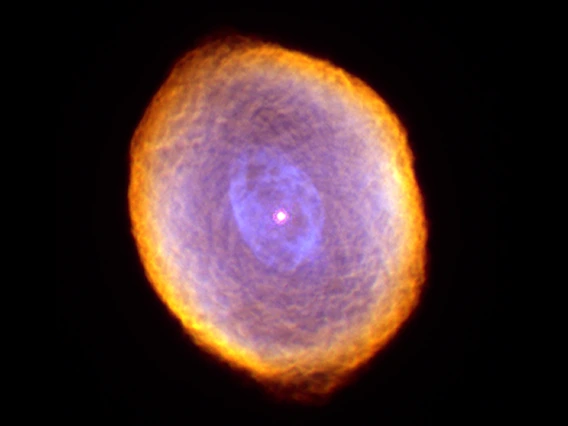
Evidence suggests that carbon nanotubes, tiny tubes consisting of pure carbon, could be forged in the envelopes of dust and gas surrounding dying stars. The findings propose a simple, yet elegant mechanism for the formation and survival of complex carbon molecules in space.
Dying stars could seed interstellar medium with carbon nanotubes

In the mid-1980s, the discovery of complex carbon molecules drifting through the interstellar medium garnered significant attention, with possibly the most famous examples being Buckminsterfullerene, or "buckyballs" – spheres consisting of 60 or 70 carbon atoms. However, scientists have struggled to understand how these molecules can form in space.
In a paper accepted for publication in the Journal of Physical Chemistry A, researchers from the University of Arizona suggest a surprisingly simple explanation. After exposing silicon carbide – a common ingredient of dust grains in planetary nebulae – to conditions similar to those found around dying stars, the researchers observed the spontaneous formation of carbon nanotubes, which are highly structured rod-like molecules consisting of multiple layers of carbon sheets. The findings were presented on June 16 at the 240th Meeting of the American Astronomical Society in Pasadena, California.
Led by UArizona researcher Jacob Bernal, the work builds on research published in 2019, when the group showed that they could create buckyballs using the same experimental setup. The work suggests that buckyballs and carbon nanotubes could form when the silicon carbide dust made by dying stars is hit by high temperatures, shock waves and high-energy particles, leaching silicon from the surface and leaving carbon behind.
The findings support the idea that dying stars may seed the interstellar medium with nanotubes and possibly other complex carbon molecules. The results have implications for astrobiology, as they provide a mechanism for concentrating carbon that could then be transported to planetary systems.
"We know from infrared observations that buckyballs populate the interstellar medium," said Bernal, a postdoctoral research associate in the UArizona Lunar and Planetary Laboratory. "The big problem has been explaining how these massive, complex carbon molecules could possibly form in an environment saturated with hydrogen, which is what you typically have around a dying star."
In this schematic illustration, experimental heating causes a grain of silicon carbide to shed silicon atoms (green). This leaves behind carbon atoms (black), which assemble into sheets of graphene and ultimately into rod-shaped carbon nanotubes and spherical buckyballs.Jacob Bernal/University of Arizona
The formation of carbon-rich molecules, let alone species containing purely carbon, in the presence of hydrogen is virtually impossible due to thermodynamic laws. The new study findings offer an alternative scenario: Instead of assembling individual carbon atoms, buckyballs and nanotubes could result from simply rearranging the structure of graphene – single-layered carbon sheets that are known to form on the surface of heated silicon carbide grains.
This is exactly what Bernal and his co-authors observed when they heated commercially available silicon carbide samples to temperatures occurring in dying or dead stars and imaged them. As the temperature approached 1,050 degrees Celsius, small hemispherical structures with the approximate size of about 1 nanometer were observed at the grain surface. Within minutes of continued heating, the spherical buds began to grow into rod-like structures, containing several graphene layers with curvature and dimensions indicating a tubular form. The resulting nanotubules ranged from about 3 to 4 nanometers in length and width, larger than buckyballs. The largest imaged specimens were comprised of more than four layers of graphitic carbon. During the heating experiment, the tubes were observed to wiggle before budding off the surface and getting sucked into the vacuum surrounding the sample.
"We were surprised we could make these extraordinary structures," Bernal said. "Chemically, our nanotubes are very simple, but they are extremely beautiful."
Named after their resemblance to architectural works by Richard Buckminster Fuller, fullerenes are the largest molecules currently known to occur in interstellar space, which for decades was believed to be devoid of any molecules containing more than a few atoms, 10 at most. It is now well established that the fullerenes C60 and C70, which contain 60 or 70 carbon atoms, respectively, are common ingredients of the interstellar medium.
One of the first of its kind in the world, the transmission electron microscope housed at the Kuiper Materials Imaging and Characterization Facility at UArizona is uniquely suited to simulate the planetary nebula environment. Its 200,000-volt electron beam can probe matter down to 78 picometers – the distance of two hydrogen atoms in a water molecule – making it possible to see individual atoms. The instrument operates in a vacuum closely resembling the pressure – or lack thereof – thought to exist in circumstellar environments.
While a spherical C60 molecule measures 0.7 nanometers in diameter, the nanotube structures formed in this experiment measured several times the size of C60, easily exceeding 1,000 carbon atoms. The study authors are confident their experiments accurately replicated the temperature and density conditions that would be expected in a planetary nebula, said co-author Lucy Ziurys, a UArizona Regents Professor of Astronomy, Chemistry and Biochemistry.
"We know the raw material is there, and we know the conditions are very close to what you'd see near the envelope of a dying star," she said. "There are shock waves that pass through the envelope, so the temperature and pressure conditions have been shown to exist in space. We also see buckyballs in these planetary nebulae – in other words, we see the beginning and the end products you would expect in our experiments."
These experimental simulations suggest that carbon nanotubes, along with the smaller fullerenes, are subsequently injected into the interstellar medium. Carbon nanotubes are known to have high stability against radiation, and fullerenes are able to survive for millions of years when adequately shielded from high-energy cosmic radiation. Carbon-rich meteorites, such as carbonaceous chondrites, could contain these structures as well, the researchers propose.
According to study co-author Tom Zega, a professor in the UArizona Lunar and Planetary Lab, the challenge is finding nanotubes in these meteorites, because of the very small grain sizes and because the meteorites are a complex mix of organic and inorganic materials, some with sizes similar to those of nanotubes.
"Nonetheless, our experiments suggest that such materials could have formed in interstellar space," Zega said. "If they survived the journey to our local part of the galaxy where our solar system formed some 4.5 billion years ago, then they could be preserved inside of the material that was left over."
Zega said a prime example of such leftover material is Bennu, a carbonaceous near-Earth asteroid from which NASA's UArizona-led OSIRIS-REx mission scooped up a sample in October 2020. Scientists are eagerly awaiting the arrival of that sample, scheduled for 2023.
"Asteroid Bennu could have preserved these materials, so it is possible we may find nanotubes in them," Zega said.
Funding for this work was provided by NSF Grant AST-2137919, NSF Grant AST-1907910, and NASA grants 80NSSC19K0509 and 80NSSC21K0593 ("Alien Earths"). Bernal was granted a Mathematical and Physical Sciences Ascend Fellowship by the National Science Foundation.

How to Spot Asteroids
“Stay up all night,” says Gregory Leonard, a research scientist at the University of Arizona’s Catalina Sky Survey, who uses a network of powerful telescopes to find and track what NASA calls near-Earth objects, including asteroids that come within 120 million miles of the sun. Go looking in a place without light pollution on a cloudless night with a steady atmosphere. Avoid a full moon.
How to Spot Asteroids

By Malia Wollan - March 15, 2022
“Stay up all night,” says Gregory Leonard, a research scientist at the University of Arizona’s Catalina Sky Survey, who uses a network of powerful telescopes to find and track what NASA calls near-Earth objects, including asteroids that come within 120 million miles of the sun. An amateur hunter can use the same strategies as a professional. Go looking in a place without light pollution on a cloudless night with a steady atmosphere (if you see stars sparkling, it’s a sign of atmospheric turbulence). Avoid a full moon. Leonard and his asteroid-hunter colleagues tend to be solitary types who don’t mind working solo night shifts and sleeping during the day.
Under the darkest skies, you might see Vesta, the largest asteroid, with your naked eye. Discovering others will require a telescope, preferably one with an aperture of at least eight inches and equipped with an astronomy-imaging camera. Take multiple photographs of a patch of sky over 60 minutes and then quickly flip through those images one after the other, looking for bits of light in motion. Stars will appear stationary, but asteroids, satellites, comets and other bits of space debris will seem to move. Try to photograph your asteroid over several nights to collect information on its orbital path.
If you think you’ve seen an asteroid, submit your data to the Minor Planet Center, funded by NASA and run by Harvard and the Smithsonian. The center has received some 340 million observations, including more than 28,500 near-Earth object discoveries, all available to the public.
On any given night, alone at a survey telescope in the Santa Catalina Mountains north of Tucson, Leonard says he feels “a little bit like a lighthouse keeper,” looking for potential danger out in the cosmic sea. Do not go hunting for chunks of rock hurtling through space unless you can do so without feeling overwhelmed by fear. If you’re going to worry, do it in a gentle way with a deep-time mind-set. “The probability of being affected by an impacting asteroid in a human lifetime is about as close to zero as one can get,” Leonard says. “That said, over geologic time, the probability is 100 percent that there’s an asteroid that’s got our number on it.”

Dr. Sarah Moran Named UArizona Sursum Fellow
Dr. Moran was selected for her proposal on Haze Evolution in sub-Neptune Exoplanets through UV Laboratory Experiments.
Dr. Sarah Moran Named UArizona Sursum Fellow


Dr. Sukrit Ranjan Joins LPL Faculty Starting Fall 2022
Sukrit's work is focused on the origin of life on Earth, the search for life on other worlds, and the atmospheres of rocky exoplanets. He applies photochemistry to questions related to the origin of life on Earth and the search for life on other worlds.Dr. Sukrit Ranjan Joins LPL Faculty Starting Fall 2022

Dr. Sukrit Ranjan will join LPL as an assistant professor. Sukrit completed his Ph.D. in Astronomy and Astrophysics at Harvard University, where he was the first student to earn a certificate in Origin of Life studies. Sukrit completed his undergraduate work at MIT, majoring in physics and minoring in astronomy and history. In addition to research, Dr. Ranjan values outreach and education.
Sukrit works to constrain the palette of environmental conditions from which life arose on Earth to constrain and guide experimental studies of the origin of life. To search for life elsewhere, he works to determine observational tests by which life on other worlds may be remotely discriminated. In collaboration with experimental colleagues, Sukrit seeks to obtain the critical measurements of fundamental photochemical parameters required to build robust models in support of both goals.