

By Joe Schools, Lunar and Planetary Laboratory - February 9, 2026
The biggest planet in our solar system is a little bit smaller and a little bit flatter than we thought. A new study involving LPL Professor Emeritus William Hubbard updates our understanding of the shape of Jupiter, which has implications for the structure of Jupiter’s atmosphere. This work is also important in a broader astronomy context, as Jupiter’s shape is commonly used as a reference point for describing or modeling various objects such as exoplanets.
Jupiter’s shape is known as an oblate spheroid, with a distinct bulge around the equator. The distance between Jupiter’s center and top of the atmosphere at the equator (the equatorial radius) is about 7% larger than the distance between its center and the top of the atmosphere at the poles (the polar radius). This equatorial bulge exists due to a combination of factors including Jupiter’s rapid 10-hour rotation rate, its complex internal structure, and wind effects in the atmosphere.
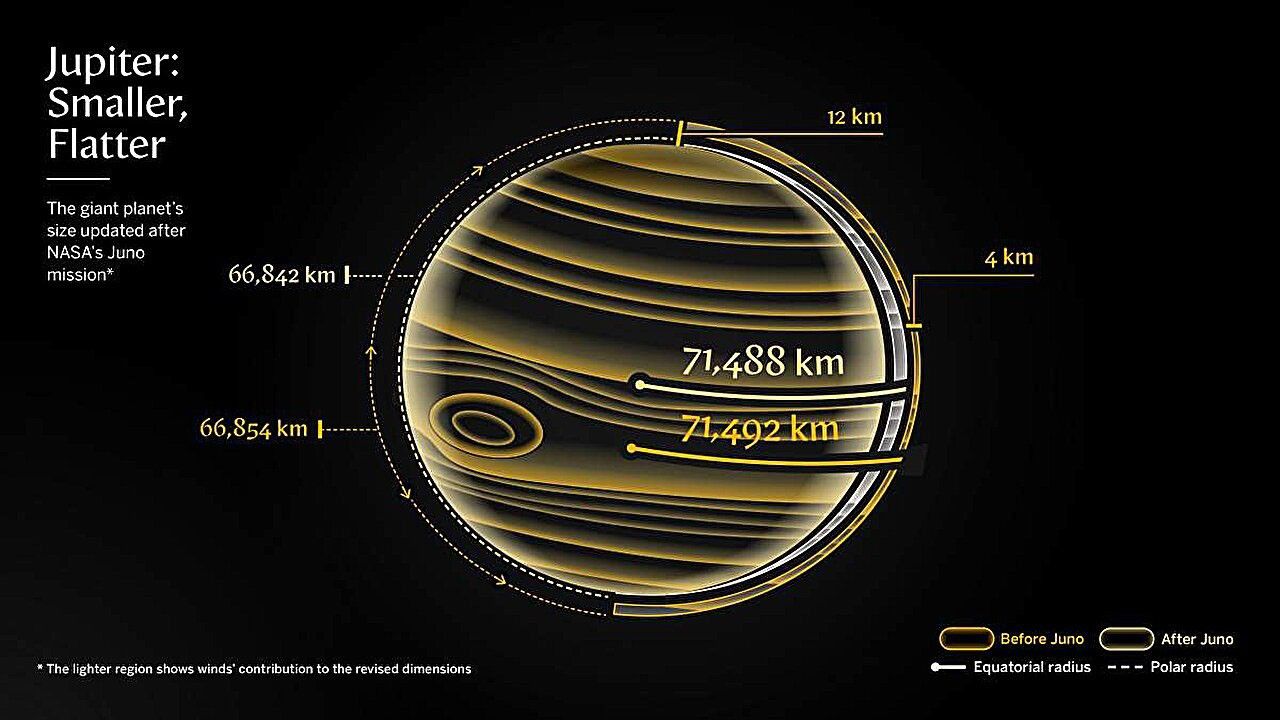
The current values for Jupiter’s radius and broader shape were calculated from Pioneer and Voyager radio occultations (changes in a radio wave as it passes through an atmosphere) in the 1970s. This work, published in Nature Astronomy, uses many high-precision radio occultation measurements from the Juno spacecraft, currently orbiting Jupiter, to make a much more precise determination of Jupiter’s shape. Jupiter’s polar radius and equatorial radius were found to be 12 km smaller and 4 km smaller, respectively, than previously thought, meaning that Jupiter itself is a little smaller than previously estimated, but its equatorial bulge is slightly more pronounced.

NASA/JPL-Caltech
The Pioneer and Voyager derived Jupiter shape did not account for the effect of wind induced variations. This new work accounts for the strong zonal winds that blow east-west around the equator, which raise regions of denser atmosphere and add to the equatorial bulge of Jupiter.
Professor Hubbard was involved in the original analysis of the first radio occultation data from Pioneers 10 and 11 (1973 and 1974 respectively). Now, more than 50 years later, he is a member of the team that plans the Juno radio occultations and analyzes the more precise and extensive data.
The Juno mission is managed by Southwest Research Institute with support from NASA’s Jet Propulsion Laboratory.