
Graduate Student News

Image
Madison Tuohy

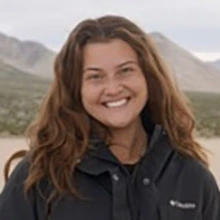
Madison is a fourth-year Ph.D. student in Geosciences, completing a graduate minor in Planetary Sciences. She is advised by Professor Christopher Hamilton. Madison is interested in the active eruptions in Fagradalsfjall, Iceland, and how these eruptions can be used for hazard mitigation and planetary analogs.

Madison was recently selected for the Philanthropic Educational Organization (PEO) Scholar Award. P.E.O. Scholars have demonstrated their ability to make significant contributions in their chosen field of study. Madison was selected as one of this years recipients out of nearly a thousand nominees throughout the US and Canada.


The Kuiper-Arizona Laboratory for Astromaterials Analysis awards the Hitachi Scholarship in Electron Microscopy annually to two graduate students generating cutting-edge research and publications in the area of electron microscopy. The scholarship was established by Hitachi High-Technologies as part of their partnership with the University of Arizona


Beau Prince
Beau Prince

LPL graduate student Beau Prince uses transmission electron microscopy to study nanoscale, fluid-filled inclusions in samples from asteroid Bennu and other materials from the outer solar system. These inclusions can provide insights into the nature of water-rock interactions on now-destroyed planets that existed early on in solar-system history."


Jeremy Philbrick
Jeremy Philbrick

Transmission electron microscopy helps Jeremy Philbrick, a graduate student in the Physics department, directly visualize crystal structures to help find the microscopic origins of material properties.

Image
Kayla Smith

Kayla Smith was awarded the Mensch Prize for her research on the temporal evolution of brown dwarf habitable zones. Alongside this technical work, she has co-authored a philosophical paper on epistemic pluralism and astrobiology and holds an Arizona Astrobiology Center seed grant to develop astrobiology curriculum for incarcerated youth. Her breadth of contribution across science, philosophy, and outreach exemplifies the spirit of the Mensch Prize. Kayla is a second-year Ph.D. student advised by Professor Mark Marley

The Mensch Prize in Astrobiology, hosted by the Arizona Astrobiology Center at the University of Arizona, is a scholarship recognizing undergraduate and graduate students whose research or creative projects advance our understanding of life in the universe. Two $1,000 prizes are awarded annually, one at each level, to students who demonstrate creativity, interdisciplinary thinking, and academic excellence across the broad landscape of astrobiology. Nominations are evaluated on the originality and academic merit of the work, its relevance to astrobiology, and its potential to push the boundaries of how we think about life in the cosmos.


Cole Meyer
Cole Meyer

Advisor: Walter Harris

Outreach

Built to Last: Scaling an Astrobiology Curriculum for Incarcerated Youth


Elana Alevy
Elana Alevy

Advisors: Samuel Crossley, Jessica Barnes

Multiphoton Microscopy for 3D Imaging and Analysis of Silica-Rich Minerals from the Moon, Meteorites and Terrestrial Granites


Cole Meyer

Cole Meyer is the recipient of the 2026 Leif Erland Andersson Award for Service and Outreach.

Cole Meyer is a second-year student working with Professor Walt Harris. He is busy in the research community as an active member of the Optical and Space Flight Instrumentation Development (OSFID) group and lead graduate student on the Spatial Heterodyne Interferometric Molecular Cloud Observer sounding rocket. He also spearheads several instrument development efforts in the OSFID group. Cole is also a National Science Foundation Research Fellow and Arizona/NASA Space Grant Fellow.

Cole has devoted significant time to improving access to STEM education and serving the broader community. He has advised research projects for four undergraduate students, three of which are Arizona NASA Space Grant students and one high school student through STAR Lab. He is also a graduate instructor for University of Arizona Sky School, contributing to a specialized astronomy curriculum for a school visit in April 2026.

Cole has lead K-12 curriculum development efforts aimed at improving access to high quality STEM education for underrepresented and underprivileged students. With seed grant money from Arizona Astrobiology Center, Cole is a co-investigator for the Other Worlds program, which develops and delivers new astrobiology curricula to high school students at the Pima County Juvenile Detention Center (JDC). With his collaborators, Cole expanded this program to 12 graduate developers and multiple community partners, including UA Sky School and Pima County JDC CAPE School. Plans for the program include developing lesson plans (“Detecting life from afar” and “Life on Earth & Beyond: Foldscope Exploration of Microscopic Life”) and comic books (Wow! I’m a Scientist! Astrobiology Comic Book). This curriculum is planned to be delivered in June 2026 to the JDC Cape School.


The LPL Andersson Award for Service and Outreach is awarded annually to a PTYS graduate student in recognition for attention to broader impacts and involvement in activities outside of academic responsibilities that benefit the department, university, and the larger community. The award is named for Dr. Leif Andersson, a scientist who worked at LPL in the 1970s. Support the Andersson Award with a gift.

Previous Leif Andersson Award Recipients

The Curson Education Plus Fund in Planetary Sciences and LPL was established by Shirley Curson, a generous donor and friend of LPL, for the purpose of supporting travel expenses outside the state of Arizona during summer break. The award is open to students in the Department of Planetary Sciences and Lunar and Planetary Laboratory who propose to fund study, museum visits, special exhibits, seminars, instruction, competitions, research and other endeavors that are beyond those provided by the normal campus environment and are not part of the student’s regular curriculum during the recipient’s school year.

To donate to the Curson Travel fund, visit the University of Arizona Foundation.


Michael Daniel
Michael Daniel

Advisor: Jack Holt
Juneau Icefield Research Program
Juneau, Alaska

Leading academic activities and mentoring undergraduate students as part of the JIRP teaching faculty


Cole Meyer
Cole Meyer

Advisor: Walter Harris
SPIE Astronomical Telescopes + Instrumentation 2026
Copenhagen, Denmark

Presenting research on astronomical instrumentation


Previous Curson Award Recipients

University of Arizona College of Science Galileo Circle Scholarship

Congratulations to LPL's 2026 Galileo Circle Scholarship recipients: Roberto Aguilar, Rahul Arora, Arin Avsar, Namya Baijal, Devin Hoover, Rowan Huang, Cole Meyer, Kayla Smith, and Anna Taylor.


Galileo Circle Scholarships are awarded to the University of Arizona's finest science students and represent the tremendous breadth of research interests in the University of Arizona College of Science. The scholarships are supported through the generous donations of Galileo Circle members. Galileo Circle Scholars receive $1,000 and the opportunity to introduce themselves and their research to the Galileo Circle patrons.


Roberto Aguilar

Roberto Aguilar
Advisor: Jack Holt

Advancing the state-of-the-art in drone-based ground-penetrating radar (DGPR) for Mars-analog environments and the development of novel 3D Martian radar volumes using orbital SHARAD data.


Rahul Arora

Rahul Arora
Advisor: Sukrit Ranjan

Focusing on understanding how planetary interiors shape atmospheric compositions over time and influence their detectability.


Arin Avsar

Arin Avsar
Advisor: Dániel Apai

Seeking to understand the history and detectability of massive planetesimal collisions in debris disks.


Namya Baijal

Namya Baijal
Advisor: Erik Asphaug

Actively contributing to the NASA Psyche Mission to better understand the interior composition and origin of the largest known metal-rich asteroid, (16) Psyche.


Devin Hoover

Devin Hoover
Advisor: Tommi Koskinen

Conducting a comprehensive investigation of the upper atmosphere of Titan, Saturn’s largest moon by combining the Ultraviolet Imaging Spectrograph instrument data to create a detailed view of Titan’s atmosphere.


Rowan Huang

Rowan Huang
Advisor: Virginia Gulick

Mapping the morphology of young Martian channels called gullies using high-resolution imagery and topographic data from the Mars Reconnaissance Orbiter to test a novel model for gully formation in which impact cratering releases volatiles from the subsurface, forming gullies even in extremely cold environments. 


Cole Meyer

Cole Meyer
Advisor: Walter Harris

Developing a new class of compact, high-resolution spectrometers suited for spaceflight.


Kayla Smith

Kayla Smith
Advisor: Mark Marley

Focusing on the atmospheric and thermal evolution of brown dwarfs and their implications for habitability and spectral signatures. 


Anna Taylor

Anna Taylor
Advisor: Tommi Koskinen

Researching atmospheric escape, the process by which planets lose mass to space over time, and how it shapes atmospheric composition, structure, and habitability.


View all PTYS Galileo Circle Scholarship Recipients

Lucas Smith

Lucas Smith won this year’s Graduate Teaching Assistant Excellence Award for his support of PTYS/ASTR 206: Exploring Our Solar System, with instructor Dr. Steve Kortenkamp, during the Fall 2025 semester.

Lucas connected undergraduate learning with authentic experiences outside of the classroom. While helping at the required telescope observing evenings, Lucas worked closely with many students. He spent time talking to them at the telescopes to discuss his research and the realities of scientific careers.

During his office hours, Lucas would occasionally invite students to visit the lab where he is working on his dissertation research. This was not part of any assigned class responsibility. The visits generated so much enthusiasm that Lucas then proposed and organized a larger optional OSIRIS-REx lab tour for the class.

The GTA Excellence award provides $1,000 in support of conference and research travel.


The Graduate Teaching Assistant Excellence Award is an LPL initiative which is intended to promote, recognize, and reward exemplary performance among graduate teaching assistants assigned to PTYS undergraduate courses. The award consists of funding intended to be used toward travel and expenses to professional meeting chosen by the recipient. All graduate teaching assistants assigned to PTYS courses are eligible, whether or not their home department is PTYS.

Dingshan Deng Kuiper

Dingshan Deng began his graduate career in the midst of the COVID-19 pandemic when travel restrictions delayed his arrival in the U.S. He attended his first semester remotely from China. When a class was scheduled for 9:00a.m. in Tucson, Dingshan was participating at midnight local time. Despite this, he earned top grades in all of his courses and will be graduating with a 4.0 GPA.

For his Ph.D. thesis, Dingshan undertook a challenging but important project: determining the mass of planet-forming disks which various groups have studied, often arriving at puzzling conclusions. Dingshan dived into understanding the reasons behind these conclusions and developed an independent code (DiskMINT) that uses a self-consistent disk structure and a reduced chemical network optimized for CO and its isotopologues, coupled with proper continuum and line radiative transfer. Aiming for transparency and to aid in reconciling discrepancies among various research groups, Dingshan made DiskMINT available to the wider community.

He demonstrated that reported disk depletions are not required to explain the data. Dingshan took the lead role in reducing and analyzing for 100 hours of disk observations, which was a complex and time intensive task. He quickly became the go-to person within the team, and thanks to his dedication and careful work, the collaboration substantially increased the number of CO isotopologue detections.

Building on the code he developed, Dingshan has run an extensive grid of more than 100 disk models (the DiskMINT-GARDEN), spanning key disk parameters that affect CO and its isotopologue emission. With more than one hundred disks that already have archival or approved deep CO observations, DiskMINT-GARDEN will enable to quantify what fraction of disks remain capable of forming giant planets as a function of time, and to characterize how the gas surface density evolves.

Dingshan’s academic and research achievements have been exceptional. He has solved a major problem in the field and provided the community with tools to robustly assess fundamental disk properties. Dingshan is also mentoring two undergraduate students. He plans to defend his Ph.D. this summer.


The Gerard P. Kuiper Memorial Award is presented to students who best exemplify, through the high quality of their research and the excellence of their scholastic achievements, the goals and standards established and maintained by Gerard P. Kuiper, founder of the Lunar and Planetary Laboratory and the Department of Planetary Sciences at the University of Arizona. To support students with the Kuiper Award, visit the University of Arizona Foundation.

Previous Kuiper Award Recipients