Pandora
About
What Is Pandora?
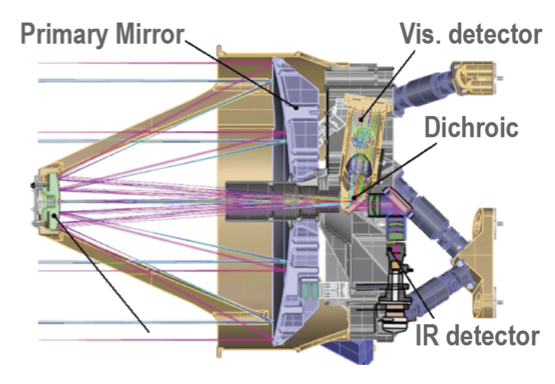
The Pandora SmallSat was selected as an inaugural NASA Astrophysics Pioneers mission in 2021, and it will launch in 2026 as a secondary payload in Sun-synchronous low-Earth orbit. It consists of a 0.45-meter telescope and instrumentation for simultaneous near-infrared spectroscopy and visible-light photometry. These wavelengths will provide constraints on the spot and faculae covering fractions of low-mass exoplanet host stars and the impact of these active regions on exoplanetary transmission spectra.
SmallSats are incredibly valuable for developing the next generation of space mission leaders. By design, Pandora has a diverse team, with over half of the mission leadership roles filled by early-career scientists and engineers.
Exoplanet Exploration
Pandora will improve our understanding of exoplanet atmospheres by disentangling exoplanet signals from their host stars. It will study host star variability with long-duration observations of 20 unique planets.
Supporting JWST
Visible wavelength observations are critical for quantifying stellar contamination in exoplanet observations. Pandora’s long-baseline observations in simultaneous visible and near-infrared wavelengths complement shorter-duration infrared observations with JWST.
Data For Everyone
A core philosophy of the Pandora team is to ensure that the data collected and tools developed for Pandora can be valuable to the broader science community. We will make data and tools publicly available.